
This is the back half of the third part of our series (I, II, IIIa, IIIb, IVa, IVb, IVc, IVd,IVe, V) discussing the patterns of life for the pre-modern peasants who made up the great majority of humans who lived in the past. Last week, we started looking at family formation through the lens of marriage, this week we’ll consider it through the lens of children. While contra the schoolyard rhyme, we’ve seen that love coming first wasn’t generally thought to be a requirement, “then comes marriage, then comes baby” mostly was.
Our model for childrearing comes here because it is going to build on the assumptions we’ve already laid out about the mortality structure (very high infant and child mortality, elevated maternal mortality) and marriage patterns. What we’re going to see is that for a population to remain stable or slowly growing required, under these circumstances, quite a lot of births, but at the same time not the maximum number of births. While we sometimes see elite populations drop birthrates below replacement, the pressures on the peasantry were different: having many children was a status-enhancing thing and children could provide valuable household labor. At the same time, because access to productive resources (especially land) was limited for such peasants, there was absolutely such as a thing as too many children. Consequently, peasant reproductive strategies are about staying within a range, but of course in the context of higher cost, higher risk or less reliable methods of birth control.
All that said, before we go any further, fair warning: this post is going to discuss how babies are made and also procedures used in history to prevent the making of babies (and do so quite frankly) and as a result may not be everyone’s idea of ‘appropriate for all ages.’ We’re also going to be talking about pregnancies, miscarriages, stillbirths and maternal mortality and I know that is a very emotional topic for a great many people. The analysis here is going to be, at times, quite emotionally ‘flat,’ but I hope no one takes that as indifference to the great joys and deep sorrows that come with the process of pregnancy, now and in the past.
Another obligatory note before we dive in: we’re going to be discussing pre-modern childbirth and fertility control here. I am, of course, not a medical doctor and while I have done my best to base the following off of sound medical (and historical) information, no one should be making health decisions on the basis of my blog posts and also do not get your medical practices from the pre-modern world, for reasons we have already amply discussed!
But first, if you like what you are reading, please share it and if you really like it, you can support this project on Patreon! While I do teach as the academic equivalent of a tenant farmer, tilling the Big Man’s classes, this project is my little plot of freeheld land which enables me to keep working as a writers and scholar. And if you want updates whenever a new post appears, you can click below for email updates or follow me on Twitter and Bluesky and (less frequently) Mastodon (@bretdevereaux@historians.social) for updates when posts go live and my general musings; I have largely shifted over to Bluesky (I maintain some de minimis presence on Twitter), given that it has become a much better place for historical discussion than Twitter.
Threading a Needle
We can start with modeling a slow-growing population to understand some of the concerns here. As we’ve seen already, there can be some significant variation in marriage patterns and (within bounds) mortality patterns which are going to impact the final numbers, so for the sake of consistency, we’re going to use the data we have for Roman Egypt – our best for antiquity – for mortality and nuptiality. That means a mortality pattern following a Model West L3 (child mortality around 55%, on the high end for the pre-modern) and an average female AAFM around 17 or 18. As we’re going to see, under these assumptions, the conundrum the peasant family finds themselves in is two-fold: on the one hand, they need to have a lot of pregnancies to achieve stable replacement or slow growth, but on the other hand, they still need to suppress normal ‘maximum’ fertility to avoid unsustainable household growth.
To explain what I mean, let’s consider what an approach seeking to maximize children might look like under the above conditions. Now we have a few more variables to introduce here. First, of course, pregnancies do not just happen on command and the chance of becoming pregnant declines as a woman ages: the chance for a couple trying for a baby to conceive is 85% per year for a mother under 30, 75% at 30, 66% at 35 and 44% by 40. Taking one set of per-month odds from the American Society of Reproductive Medicine, we can calculate a very simple average expected interval, which if I am doing my math correctly is an expected value calculation: from 17 (AAFM) to 25 we might assume a 25% chance per month (expected interval of four months), from 26 to 30 a 20% chance per month (expected interval of five months), from 31 to 35 a 15% per month chance (excepted interval of 6.66 months; we’ll round to seven) and from 36 on up a 5% chance (expected interval of 20 months), until menopause, which came earlier in antiquity than in modern western countries, generally between 40 and 45, rather than 45 and 55. That’s obviously a very simplified model of fertility, but it will serve to demonstrate some basic principles.
Next, we need to consider of course that a woman is not always able to conceive (even if she has no fertility problems) because of course already pregnant women cannot conceive. In addition, mothers who are breastfeeding have sharply reduced fertility (‘lactational amenorrhea‘ or ‘postpartum infertility’). That matters quite a lot for our peasants because they live in a world with no baby formula and thus no easy alternatives to breastfeeding, but are too poor to afford the wet nurses of the elites.1 There is a lot of variation, both individual and cultural, in how long this period lasts, but for simplicity’s sake, we can assume something like a year after successful live birth while breastfeeding continues.

Finally, we have to consider the miscarriage rate. Estimates for miscarriage rates I’ve found vary massively from 10% to as much as 33%; it seems like the more responsible estimates are in the 10-20% range. Given weaker nutrition, higher disease rates and so on, we’d expect the ancient miscarriage rate – which I don’t know that we can estimate with any precision – to be on the high end. Combined with the stillbirth rate, we might assume something like one in four (25%) of pregnancies end without a live birth.
If we were doing a full study, we’d take all of those variables (in rather more sophisticated form) and run a bunch of computer simulations to generate averages, but this is a blog post, so instead I am going to take a bit of a shortcut and just generate a single ‘model’ mother, who is maximizing the number of her children. We’ll assume every fourth pregnancy, beginning with the first, fails to result in a live birth (and thus no period of lactational amenorrhea). I want to stress, we’re not modeling here a ‘typical’ woman’s reproductive life-cycle, but instead probing what maximum fertility looks like; as we’ll see, this is not typical! What we get is a very rough model that looks like this:

There are some immediate necessary caveats: of course this is a highly simplified model, not a statistical average. It doesn’t account for low probability events like maternal mortality and obviously the regular spacing of pregnancies and miscarriages is also a simplification. I should also note that I’ve opted to assume a full nine month period for pregnancies here ending in miscarriage, but of course most miscarriages happen in the first trimester and fertility after miscarriage generally returns very quickly, so in most cases the interval here would be shorter. I suspect there are substantial refinements to be had in nearly all aspects of the model, but the point was to make a very rough estimate, which we may now do.
Our model Egyptian woman, married at 17, experiences nine live births and four (or three, depending on when menopause arrives) miscarriages. With nine live births and a 55% child mortality rate, 4.05 of those children survive to adulthood. That implies a net reproductive rate (NRR, the number of daughters who reach adulthood born to each woman who reaches adulthood) of two,2 which implies a population that would grow very rapidly, indeed far more rapidly that our evidence allows or than peasant economies could support. Instead, as Bruce Frier notes, the observed population trends we see in antiquity, combined with our estimates of child mortality, implies five to six live births per woman, not nine, to get an NRR just barely over 1 instead of 2.3
Now your average peasant couple isn’t directly considering the impact their child-bearing patterns will have on our archaeological evidence for population change, of course. They’re considering their desire to have another child, which in a society where children brought a lot of social status, was often going to be a decision about their ability to support another child. But the impact is the same: the peasant wife (and her husband) had to thread a fertility needle between high child mortality (requiring a high birth rate) and high natural fertility (which would push the birth rate even higher than that), aiming to land somewhere close to population replacement with a little bit of growth.
What the model above thus strongly implies is that the absence of runaway population growth we see in our evidence requires our peasant families to be engaging in some degree of ‘family planning.’ Which brings us to:

Birth Control Strategies
Now its important to clarify a misconception here at the beginning that ‘people in the past didn’t have birth control.’ What we mean is that they didn’t have highly effective (pharmaceutical) and very safe birth control. That, of course, matters a lot if someone wants to be sexually active and their acceptable number of pregnancies is zero: they want a birth control solution which is extremely effective and also very low risk. But for someone whose acceptable number of pregnancies is not zero (but also not ‘all of them’) suddenly a lot of lower effectiveness strategies become viable to space out rather than entirely eliminate pregnancies.
The most immediate such strategy is, of course, “delay marriage” by which we mean “delay the onset of becoming sexually active” in societies where sexual activity outside of marriage – for women, at least – was sharply condemned.4 This is very obviously part of what is happening with the late/late western European marriage pattern and on some level it seems like it can’t be an accident that pattern is emerging in a Christian cultural context where there is both some significant disapproval of other methods of birth or family-size control and probably lower rates of mortality (meaning the ‘target’ birth rate is coming down too).
Beyond this, at least in the Roman context, the job of fertility control, to the degree it was practiced, seems to have fallen on women.5 A variety of strategies were available. ‘Fertility awareness‘ strategies have regular use failure rates that are a lot too high for most modern folks to consider them a fully reliable strategy to achieve zero pregnancies, but as a strategy for spacing out and and thus limiting the total number of pregnancies, it could bring down the average significantly. The ancients seem aware of this strategy, (e.g. Augustine, On the Morals of the Manichaeans 18.65) but it isn’t clear that medical writers had the correct timings, though I rather suspect that knowledge among women on this point, passed down informally over generations, may have been better than what we see from the elite male authors of ancient medical treatises.
Beyond this, of course, methods of sex beyond vaginal intercourse could also be used to avoid or limit pregnancies. Sue Blundell6 notes that when Greek artwork depicts heterosexual sex, it is often oral or anal and even points to lines in Aristophanes (Wealth, 149-52) with prostitutes in Corinth showing their anuses to potential customers. Likewise, coitus interruptus (the ‘pull out’) method seems to have been understood (though Greek medical writers like Soranus suggest it is the woman who ought to back off, because, again, the responsibility for birth control was placed on women in Greek culture).7 Women might also employ pessaries of various herbs in an effort to disrupt the sperm or otherwise hinder fertility; some of the substances mentioned in antiquity seem like they would have at least some effect. Physical barriers may also have been used, but our evidence for things like condoms only becomes clear in the early modern period, though the basic notion that blocking or expelling semen would prevent pregnancy appears in antiquity.
In addition, a wide array of abortive practices, ranging in safety (though generally not very safe) and effectiveness were known since antiquity. For Greek and Roman antiquity, a lot of attention is given to the contraceptive usage of silphium (a now extinct plant with contraceptive and abortifacient properties), but other abortifacient plants like hellebore, birthwort or pennyroyal were available – the downside in basically all cases is that the plants are quite toxic so the risk is considerable. Likewise, from antiquity methods and instruments to perform something like a dilation and evacuation procedure existed, but the risks must have been substantial.

In addition, a wider spacing of pregnancies could also be achieved by prolonging breastfeeding and thus extending lactational amenorrhea. The medical risk of pregnancies in too rapid a sequence seems to have been understood in antiquity, so this sort of ‘spacing’ technique would have made sense. Soranus (Gyn. 2.47) recommends weaning only at eighteen to twenty four months, which also matches preserved wet nursing contracts from Egypt.8
Finally, many societies practiced infant exposure or other forms of infanticide. Both Greek and Roman sources report the practice for unwanted babies or those thought to be deformed and Roman law gave the pater familias the authority to order the death of his child. Infanticide in medieval Europe was strongly discouraged, although the harshest punishments for it emerge only in the 15th century. Alternately, infants might be left in a public place either to perish or to be fostered by another family; many pre-modern societies had customary locations for such infant abandonment. In the Greek and Roman world, such abandoned infants could also be enslaved. That said it is hard to know how common such practices were even in societies where they were known. As noted, infanticide and infant exposure were both entirely legal in the Roman world (albeit often disapproved of by our literary sources), but while the literary evidence suggests female newborns were more likely to be unwanted than male newborns, if there was any effect on the sex ratio (as seen today in countries where the practice of sex-selective abortion is common) we can’t see it in our admittedly limited evidence.9 Likewise, our literary sources often seem to suggest that disabled or deformed infants were invariably killed in Greece and Rome, but more recent scholarship, particularly by Debby Sneed, suggests this was not always the case and that disabled Greeks and Romans were more common than once thought.
That said, we also want to note the impact of both infanticide and also exposure-and-fostering has on a demographic model of population growth, which is that it doesn’t – of course this is quite apart from the emotional and moral considerations. Of course an infant which is exposed and either fostered or enslaved does not disappear from the demographic model, but rather simply grows up in another household. But also remember that when we model the populations of ancient or medieval societies until quite late, we do not have a record of the number of live births: we are back computing those figures from population snapshots created in our evidence. In those circumstances, infanticide is statistically indistinguishable from other forms of infant mortality – we have no way of separately quantifying the two – and so the rates of infanticide in these societies, whatever they may have been (they were certainly not zero) are already ‘baked in’ to our models.
Given all those methods in mind, we can go back to our model and nuance it a bit. Below I’ve charted out what the model looks like if breastfeeding is extended to 24 months and lactational infertility holds for all of those 24 months (it doesn’t always, but these are simplifying assumption). It brings down our expected live births down to seven (given how late the last one falls, we might say six-and-some-percent; remember menopause seems to occur earlier in societies with more limited medicine and nutrition).

But extending lactational infertility so long puts a lot of strain on one of our other key assumptions, which is that we’ve assumed full breastfeeding time for each child, but on our model life tables (again, Model West, L3), fully one third of children never reach their first birthday. The premature death of a child is, of course, going to end lactational infertility early. So here is a revised version of the model now assuming one out of every three live births results in a child that only lives six months – again, not a very rigorous model but a rough effort to get a sense of the impact this has (note that we’re still assuming child mortality around 50%, but only accounting for the c. 33% that perish within the first year).
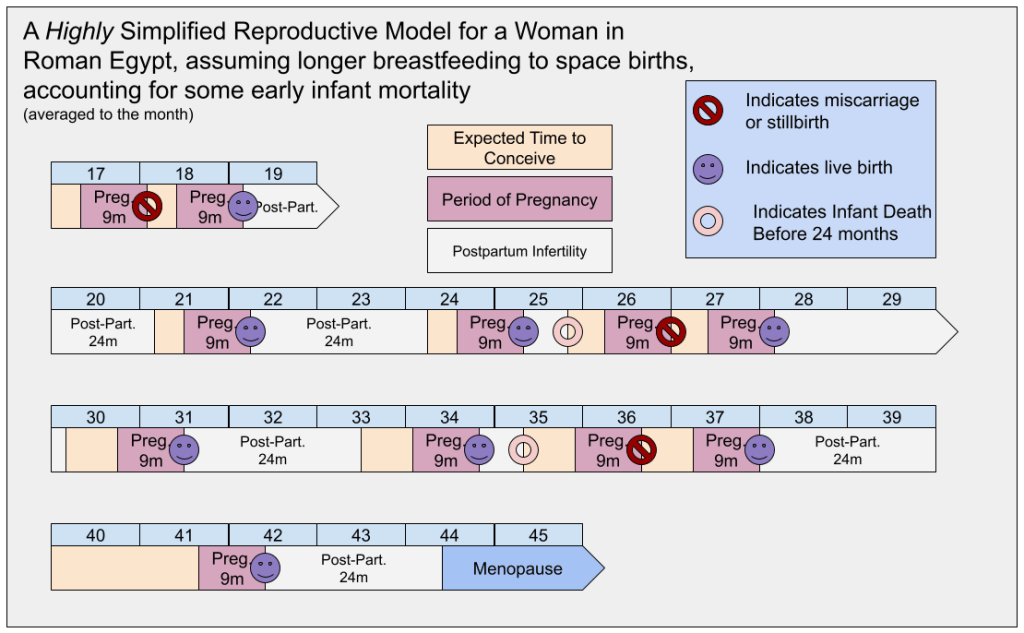
That moves the model back to eight live births over a lifetime, though once again given how late the last live birth falls, we probably ought to say seven-and-some-percentage. Finally, we ought to account for mortality. To do this very roughly, we can go back to our Model West L3 life table, which breaks mortality into five year brackets, check what percentage of our cohort of mothers dies in each bracket and assign that percentage the number of births they’d have by that age in our chart above and, assuming I’ve done my math right, we land at an average number of live births per woman of 6.684, which is still a bit high of our expected replacement-and-a-bit-more (which should be around 5.8 for a slowly growing population under these mortality conditions).10 So to have observed population patterns, we still need births spaced out a bit more than this.
I should also note that this model is another reason why I find ‘intermediate’ female AAFM models (so AAFM between 17 and 20 or so, ‘late teens’) at least plausible for ancient societies. Even moving the AAFM here from 17 to twenty doesn’t push our model below replacement – it effectively subtracts one live birth from every age bracket in the sample, which after all the mortality calculations gives us an average of 5.68 live births per woman or a gross reproductive rate of 2.84, very close to the GRR of 2.9 Bruce Frier supposes necessary for a population growing at 0.5% per year, roughly what we suppose to have been typical in antiquity.11 Consequently, a Roman female AAFM of 18 or 19 doesn’t strike me as inherently unreasonable (though clearly with our ancient mortality assumptions, one cannot push over 20 – mortality has to be lower to make the late/late marriage pattern viable).
The point of all of that modeling is that despite the high child mortality peasant families who want manageable levels of fertility (which would be slow population growth in the aggregate, but they’re not concerned about the aggregate) have to engage in a meaningful amount of fertility control (beyond any infanticide or exposure, which is, again, baked into our infant mortality estimates). The precise mix of methods and techniques is going to vary by culture and region and we are able to glimpse these only very imperfectly, but we can be sure some degree of fertility control was always going on because we don’t see the sort of runaway population expansion implied by a maximum fertility model. Instead, given the high mortality estimates we laid out in part II, we would expect around five or six live births per woman, rather than the c. nine implied by a maximum fertility model. If we were to tweak the variables of our mortality regime (generally downward), we would also be lowering the expected number of births, something that may in part explain the late/late early modern European marriage pattern.
Paternity
Cultural attitudes in pre-modern societies towards parenthood and children varied a fair bit, but I want to cover some recurrent features here.
The first pattern is typically (but not quite universally) a strong concern and substantial anxiety over paternity and indeed one might argue that when our (elite, male) literary sources repeatedly stress the purpose of marriage is the production of (legitimate) children, one might well argue the true purpose was to establish secure paternity for children. Of course, some anxiety about paternity is common even in modern societies: mothers can be quite sure about their maternity, but absent medical testing, a father might doubt.
But this question matters much more in a society where nearly all wealth comes in the form of scarce farmland that is inherited from one generation to another and overwhelmingly if not entirely owned by men – even in societies like Rome where women could hold and pass down property, most of the landed wealth passed down the male line. Social status in these societies is essentially predicated on land ownership, without that farm the social position of even the peasant functionally collapses and given the extremely low social mobility in these societies, it collapses with little if any chance to ever regain it. Consequently, as you might imagine, the men who dominate these patriarchal societies are extremely anxious that their holdings – their position in society, however meager, which grants them a more-or-less stable living – pass to their actual, biological descendants.
This is a substantial viewpoint shift, so I do want to stress it: we live in a society where wealth is produced in substantial quantity daily and new economic niches emerge in the tens and hundreds of thousands every month. But for peasant farmers, the amount of wealth and the number of economic niches was, if not fixed, growing only very slowly so the careful preservation and inheritance of the limited and basically fixed supply of economic and social niches which ensured respectability and survival was of far greater importance.
Placing those concerns in the context of a society which could not test for paternity, dominated by men for whom that anxiety was so central, and much of what follows makes sense. Most pre-modern societies had a double-standard on sexual activity: penalties for promiscuity for women who were married or marriageable (by ‘marriageable’ I mean a woman of the respectability, age and social standing that she might be married) – that is, women whose children might be in a position to inherit, whose paternity mattered – were very harsh. For women outside of that world (sex workers, for instance), penalties might be much less harsh, amounting to not much more than permanent exclusion from the world of marriageability from which they were already excluded. Meanwhile for men, promiscuity might in some contexts be disapproved of (lightly so in Rome, more seriously so in much of medieval Europe, but not much at all in ancient Greece; I can’t speak well to other regions and periods), but it was generally permitted so long as it did not implicate the chastity of married or marriageable women.
That final point is something often misunderstood about these societies, where students – and even, to my frustration, sometimes teachers and public communicators – might assume that, say, in a case of adultery (understood by many of these cultures to be illicit sex with a married woman; the married status of the male does not matter) that the woman was punished but the man was let off, which is very much not the case. In Athenian law, for instance, it was legal to extra-judicially murder a man engaged in adultery with your wife. Under the Lex julia de adulteriis coercendis (The Julian Law On the Suppression of Adultery), wives who committed adultery lost half their property and were banished but so were their partners in adultery (banished to different remote islands, under the law).
In short, the adultery double-standard in many of these societies is that adultery law was primarily concerned with the secure parentage of children in a marriage and so cared quite a lot less about a married man having sex outside of marriage so long as it was not with another married or marriageable woman. Instead, adultery was the crime of illicit sex with a married woman, not a married person. Some societies also had laws against illicit sexual acts outside of marriage – in Roman law this was stuprum – which often carried lesser penalties.
The intensity of that anxiety could also have impacts on women’s lives – controlled, as they were, by a male-dominated patriarchal social order – although this varies a fair bit by culture. In some places, ‘respectable’ elite women might be ‘cloistered’ – that is, made to live in relative seclusion – though this could hardly have been an option available to most peasants. Still, women’s social access to men and male spaces might be sharply restricted – we see plenty of such restrictions in Classical Athens, for instance. But it was not always the case and here Rome provides the counter-example: respectable women, even elite Roman women, moved through Roman society, frequented public places and the Roman banquet ritual (the cena) included women and children (in contrast to the all-male-save-for-entertainers Greek symposion). Nevertheless, while the Romans probably represent one of, if not the most gender-liberal ancient society, the concern placed on female chastity was substantial and respectable women were expected to veil themselves in public as a sign of their modesty.
Motherhood and Childhood
As with paternity, of course there is more variation in rituals and habits around motherhood and childhood than we can cover here, but I want to point out some common elements.
To begin with, I think it is worth simply pointing out some of the obvious logistics of motherhood here. If the average woman has roughly six live births over her lifetime in order for a population to replace itself, that means – as you can see above – that a woman surviving to menopause needs a bit more than seven (to make up for early mortality in other mothers), which, accounting for miscarriages might mean something like 9 or 10 pregnancies over a lifetime.
Assuming a typical mother surviving to menopause has 9 pregnancies, under the assumptions of our model above, that out of the c. 25 (~300 months) years of her reproductive adult life, she would spend 81 months (27%) pregnant and another c. 121 months (40%) nursing. Now I want to be very clear: that doesn’t mean she was not working in those months, because as we’ll see, she absolutely was working on a wide range of essential tasks. But the demands on our peasant mother’s time are considerable.

In functionally all pre-modern agrarian cultures, the demands of childrearing fell almost entirely on women: some of this was, of course, patriarchal gender roles, but quite a bit of this was the unavoidable impact of the nature of a society with high child mortality (so mothers would need to bear and nurse a larger number of children in order to ensure a given number survived to adulthood) combined with the absence of modern technologies like baby formula that let fathers perform some kinds of childrearing labor they would otherwise be incapable of. At the same time, it is not hard to see how the culture of gender-inequality is going to be shaped by these norms: so long as the baby is nursing (either because it must or because nursing is being extended to suppress unwanted fertility) its mother needs to be in physical proximity more or less continuously – in a society where ‘so long as the baby is nursing’ might be almost half of a woman’s reproductive life, that becomes a pretty major life-shaping concern.
Children, of course, do not stop needing parenting merely because they’re no longer nursing, but childhood in these societies was quite a bit shorter. Remember that these are societies which understand individuals primarily through their social roles, not as individuals per se and children were no exception. Thus, rather than a broad education preparing children for a wide range of possible life paths, children in peasant households were expected to slot into the same social and labor roles as their parents and began doing so pretty much as soon as they were physically able. Consequently, children in these households learned their tasks and roles by watching their parents and other family members perform them. Their labor was also important: these households could not afford to maintain children in idleness (or in pure focus on an education). We’ll talk about the typical gendering of labor roles in the household in the next part of this series, but those gender-divisions were introduced functionally immediately in childhood: girls began spinning thread at very young ages (essentially as soon as they could hold and manipulate the distaff), while boys assisted in farming labor just as young.

For women in these societies, childbearing and motherhood were crucial components to their own social status. Ancient literature overflows with references to the importance of motherhood, from women’s boasts about the number of their children (e.g. Plut. Mor. 241D), to legal privileges, the ius liberorum, accorded to women with many children in the Roman Empire, to the repeated attestation of the number of children a woman bore on her tombstone in Roman inscriptions and so on. The unpleasant flipside of this was often the diminishment or even legal discrimination against women who were childless. Some societies offered alternative paths, particular in the form of positions of religious celibacy (the Vestals, Christian nuns, and so on), but these were often both few and generally unavailable to the vast majority of peasant women.
Instead, in a society where individuals were strongly expected to conform to their social role and rewarded with status in their community only to the degree that they did so (within a hierarchy of roles), to be the mother of many children was the highest status to which many peasant women could aspire.12 And of course, on top of this, most (though not all) humans genuinely want to have children and are genuinely delighted by their arrival. In those contexts, it is not surprising that despite the perils of childbirth and the difficulties of motherhood, the attitude we generally find in our sources from these societies (admittedly often mediated by male authors) towards childbirth is one of positive anticipation and excitement.
Naturally there’s a lot more to say on childhood and motherhood (and fatherhood) here that is culture-specific and we may return to these concepts in the Roman context (where I am most familiar) at a future point. But for the next part of this series, having covered birth and death, we will at last turn to work and look at how the peasant household we have so carefully constructed sustains itself.
- As an aside, when you see high elites (queens, etc) bearing absolutely prodigious numbers of children, part of the reason for this is that they are employing wet nurses rather than breastfeeding themselves, resulting in a much shorter period of postpartum infertility, essentially ‘fooling’ their body into acting like the baby was stillborn and thus returning to fertility faster. This option is largely not available to our peasants and so we need not treat it in depth here.
- 2.025, in fact
- Frier, op. cit., 797-8.
- We’ll come back in a moment to why these societies tend to have very different attitudes towards male and female promiscuity, keeping in mind that understanding a thing is not the same as approving of it.
- Noted by Blundell, Women in Ancient Greece (1995), 108. Note also R. Flemming, “Fertility Control in ancient Rome” Women’s History Review 30.6 (2021). Hardly shocking, given their patriarchal nature. Again, describing is not approving.
- Women in Ancient Greece (1995), 107-8
- On Soranus, see A.B. Freidin, Birthing Romans (2024), 126-30.
- Frier, op. cit., 803.
- As noted by Frier, op. cit., 804.
- That rough 5.8 is the number of total live births for a gross reproductive rate (GRR) of 2.9, which I am getting from Frier, op. cit., 797.
- Frier, op. cit., 797
- Again, just to reiterating, describing is not an endorsement.


.png)
Maybe this is outside the scope of this blog series, but something I have wondered off and on here is how a pre-modern couple living with say, a 2 year old, a 5 year old and an 8 year old, with a small domicile, one bed, maybe two rooms, finds the time, space, or privacy to have sex and therefore additional children.
I believe the answer to “how do they find privacy” is “they don’t”.
You got it.
From what I understand, the idea of “sex is deeply private” wasn’t a cultural thing nearly as much in places where you had a domicile like that. Humans are gonna have sex, and if it’s not possible to do so without other people knowing about it, other people are gonna know about it.
My understanding is that (as far as one can generalise across the entire species) humans generally prefer to have sex in private, but if that’s not possible for whatever reason, it’s the privacy that gets sacrificed, rather than the sex.
The concept of privacy itself was of course rather different at various times, and note the observation early in this series that people tended to think much more in terms of households as a unit, and rather less in terms of individuals, so that’s going to make a difference too.
They don’t. The assumption seems to be that they’d have sex (possibly trying to do so quietly) with children in the same room, because y’know… Otherwise you can’t. Privacy might be desired, but it was not neccessary.
Even today there are billions of people who share a small living space with family members and spend their days in constant close proximity to others. Darkness is all the privacy you get, and it’s enough. Funny noises in the night are part of the normal background.
Privacy obviously varied by culture and weather, but people often wonder/joke if preindustrial folks had sex outside if indoors had all those people around, and some of them DID.
You can get privacy in places OTHER than the house if you’re not too picky (or squeamish like a lot of modern folks), hence the common rural trope even today about having sex in a hayloft/barn or a field. The barns would still have livestock, and you would likely have to be careful about but animals definitely wouldn’t care about someone getting nookie as long as you keep a safe distance. Hell, I imagine the hayloft became a typical “farm sex spot” BECAUSE it’s secured, the animals’ feed times are well-known, and you aren’t likely to get trampled or interrupted for long stretches of the day.
Folk songs often talk about lovers meeting out in nature, described in pastoral terms as “untouched wilderness,” and implied if not stated to be a good walk away from home. It is not hard to assume that sex is one of the top reasons for why two young people would need to physically hike out of their village/town for a few hours.
There’s a lovely German poem called “Under der linden,” where a woman meets up with her lover, and she is VERY frank that they had sex. https://en.wikipedia.org/wiki/Under_der_linden
“If any knew
He lay with me
(May God forbid!), for shame I’d die.
What did he do?
May none but he
Ever be sure of that — and I,
And one extremely tiny bird,
Tándaradéi,
Who will, I think, not say a word.”
wait. Those are how Henry and Theresa did it in Kingdom Come.
I’m reminded of “velvet green” by Jethro Tull
Walking on Velvet Green
Scotch pine growing
Isn’t it rare to be taking the air?
Sinning
Walking on Velvet Green
Walking on Velvet Green
Distant cows lowing
Never a care
With your legs in the air
Loving
Walking on Velvet Green
You’ve left out the point that the house will probably contain several other adults as well.
The Decameron has a story (I think actually more than one?) that’s a sex comedy where the wife accidentally has sex with a guest, thinking it’s her husband, because they’re all sleeping in the same bed – I think notions of “how much privacy is enough to have sex” varies enough that life finds a way.
It’s been some time since I was a teenager, but I remeber quite distinctly that most of the people in my social circles were able to perform unnoticed in a shared tent, or hostel room.
It was a skill people developed fast. Getting hit with something throwable and hearing comments like “I don’t care what you do, but let me sleep”, kill the mood pretty quickly.
Before electrification, adults would tend to wake in the middle of the night, *do various things you can do in the dark,* and then go back to sleep. After infancy, the propensity to wake in the night increases steadily with age, so children could be expected to sleep through these adventures (or pretend that they had slept through).
Having raised two kids, I can say that you’d be amazed at how well small children sleep. I was once able to carry my sleeping toddler off a streetcar, hold her in one arm while unfolding a stroller with my free hand, all in the median strip of a busy avenue in mid-afternoon, without waking her. Compared to that, a few noises under a blanket across the room are nothing.
I have a suspicion that there is a strong evolutionary advantage to sound sleeping children, such that wakeful kids had fewer siblings and so over time their lineages were out-competed by their oblivious peers.
We have one account in Poland about this: a peasant wife was annoyed by her husband’s advances and wasn’t in mood for sex. So she reached for one of her children and put it on the bed between her and the husband.
We can thus infer it was common for people to have sex while there were kids in the same bed. It would be hard to avoid something like that in any case because most peasant huts consisted of a single room.
It is probably “test for paternity” not “text for paternity”.
Other than that, have you accounted for temporary famine/cold winters/physical hardships/illness on one or both parents in your model? Would that change the model in any way?
Though there’s got to be a good joke in that typo…
Another typo: “under these circumstances, quite a births,” “quite a lot of births” I assume.
On the subject of extrajudicial murder by a husband of a man having sex with his wife, it’s not just the ancient world. In France in the 19th and most of the 20th century (the law was only repealed in 1975!), a man who discovered his wife having sex with a man in his house could murder them and would not be convicted. A woman in a similar situation, however, had no such protection.
In fact, this legal point is briefly reflected in one of the first detective stories as we know them today, 1867’s The Mystery of Orcival (Le Crime d’Orcival) from Émile Gaboriau’s Monsieur Lecoq series (for one, believed to be a major inspiration on Conan Doyle’s Sherlock Holmes, which followed 20 years later) was technically about the murder of Countess of Tremorel and the disappearance of the Count, for which their servant had been blamed.
However, it eventually flashes years back (I think via the discovery of a set of letters/diaries). It turns out the current Count was a down-on-his-luck minor noble given shelter at the estate by the previous one, who was the Countess’ first husband. The latter being older as well as seemingly more staid and boring meant that an affair soon began. When the first husband finds out, he considers his options – and the first thing he thinks of is murdering them both, noting to himself that “the law would probably be sympathetic”. But, he’s reluctant and also considers other options such a duel or a divorce – and he happens to do all of that outside under the drenching rain, predictably developing pneumonia. One he would have had recovered from – but at point, the wife decides to use that illness as the perfect cover for gradually poisoning him.
Moreover, he realizes that…and decides to let it happen, instead having his revenge by confronting the two on his deathbed and exposing the lover as a weak, pathetic and indecisive man who had already began a different affair with a teenage commoner in town – so, she is both struck by the contrast in their strength of character and has to live with the knowledge she destroyed it all herself and now it’s too late to go back. In fact, he completes his revenge by making the two of them join hands and promise to marry each other in front of the witnesses right before he expires, to commit them to a union he knew they’ll both despise. (And I believe he also designs a failsafe by entrusting those writings to an old friend whose identity they do not know, with the order to unseal them if they refuse to marry.) Things go on like that up until the commoner gets pregnant, driving the new Count to commit that murder and frame the servant while the two escape.
The ending also ties back into this blog series’ point about AAFM. Once the detective and everyone else involved in the investigation (most notably, the town’s judge) discover this scheme, they effectively set up a confrontation between the count and his lover where she encourages them to commit suicide together (the detectives literally banging at the door of their hideout by then), and as he keeps hesitating, she just shoots him herself. They burst in and stop her before she’s about to turn the gun on herself…and then, the solution offered (and accepted) is that she marries the judge (who had earlier confessed to the detective to being “into her” for years), with the child getting attributed to him.
What makes this dénouement particularly…“remarkable” is that the judge was described as being quite old for the period (from memory, something around 50), implying an age gap of ~30 years. This was considered a good ending in a mid-19th century novel! On the flip side, it also appears that unlike his other stories, this one had never received an adaptation more modern than a 1914 silent film – presumably reflecting more recent generations’ discomfort with that conclusion.
https://en.wikipedia.org/wiki/%C3%89mile_Gaboriau
Famine, cold winters, etc cause the mortality rates as covered in the previous post. In a population study over any large geographical area and/or long time span they’re going to average out across the population and every family will be more or less equally effected. Yes dying does drastically alter the odds of a woman becoming pregnant, but the model diagrams are captioned “A Highly Simplified Reproductive Model”.
Yes should be “equally affected” not effected before the pedants swarm.
The answer for “adjusting for seasonal mortality’ is “it’s baked into the assumptions of a Model West L3 mortality structure.”
As for the typo, I’ll fix it.
But i did not mean “one or both parent dies” but “one or more parents become incapable of generating offsprings for some time during their fertile years”
I have already commented under Part II that at least according to a post on Tales of Times Forgotten (a source which was recommended on here during the most recent Gap Week), both of the highlighted claims are in significant doubt – the contemporary literary sources seem to overwhelmingly focus on silphium’s culinary properties, and there’s also limited evidence for its outright extinction. In fact, last year, a Greek newspaper outright ran a story headlined “Miracle Plant Used in Ancient Greece Rediscovered After 2,000 Years” – based on the research previously featured in the National Geographic.
https://www.amhenews.gr/miracle-plant-used-in-ancient-greece-rediscovered-after-2000-years/
“we’ve seen that love coming first wasn’t generally thought to be a requirement”
But surely sitting in a tree was always understood as essential.
How could peasant families maintain high fertility levels when golden carriages were so expensive?
They’d look sweet upon the seat of a saddle built for two.
Looking forward to OGP’s 3-5 part series of posts on how this effects steppe reproduction…
Not sure Egyptologists would agree that “the Romans probably represent the most gender-liberal ancient society” and steppes archaeologists might have questions too.
Empires certainly encourage women to have lots of children, like the Achaemenid baby bonus and Augustus’ marriage program. James C. Scott noted some reasons why this might be. I’m thinking if evidence from lower social scales in the ancient societies I know best match some of the general statements in this post.
I thought of Egypt when reading that as well.
And where can one read more about Achaemenid baby bonuses?
There is some information on the bonuses which Achaemenids paid to female workers who had babies in Maria Brosius’ book on Women in Ancient Persia and Pierre Brian’s History of the Persian Empire (not the newest resources, but should be accessible). The Greeks mention cash bonuses as well to specifically Persians who had children, but the documents from Persepolis are payments in kind to lowly workers. I should pitch something on this to a magazine!
Greek and Latin literature definitely have a lot of references to “produce legitimate children” as the purpose of marriage but its harder to say how many ordinary rural people wanted.
Thank you!
There is also a broad pattern by which the local big men (and kings who are Biggest Men) giving things to people is one of the recurring ways in which they establish themselves. For the big man, it’s the way he shows himself as the kind of righteous fellow who deserves all of his privileges, his authority, and his ability to live ten times better than you or anyone like you, subsisting entirely off his share of your muscle-straining, exhausting labor and that of a great many other peasants.
Giving new mothers a gift when their baby is born is a natural option to fit into this pattern, and it may perhaps be understood more as an extension of the general trend of pre-modern elites engaging in routine, structured, traditionalized charity as a tool of legitimacy-building, rather than as a pro-natal policy. There is some measure of overlap, but on the other hand, I’m fairly sure the king doesn’t seriously believe that any peasant woman out there is getting pregnant specifically because of the gifts expected.
That’s a really interesting point about empires, as opposed to smaller scale societies. What are the reasons that James C. Scott points to?
> In those contexts, it is not surprising that despite the perils of childbirth and the difficulties of motherhood, the attitude we generally find in our sources from these societies (admittedly often mediated by male authors) towards childbirth is one of positive anticipation and excitement.
That reminds me about https://blog.rootsofprogress.org/russian-peasant-life
And I am curious what about disparity here. Is it presenting the same in a different context?
Is that source uniquely bad/manipulated?
Is Eastern Europe much worse that typical and what you discuss here?
Is it more of uniquely Russian things?
Or is early XXth century worse than you describe?
All of above?
Something else?
It’s Russians, what can you expect?
I am very tempted to go with that, but I prefer to not run very wildly with a confirmation bias.
I believe that here we might be dealing with two issues at once:
i) Our host admits to choosing a “quite emotionally ‘flat,’” approach for this subject at the start of the post – which also appears to mean that quite a number of grislier details are skimmed over. This is presumably done to avoid a “sensationalistic” tone, but the effect at times verges on “sugarcoating”. In particular, what jumped out at me is that the following sentence
since it appears to greatly soften both the first aspect, and the second, one described under the link. Consider the Wikipedia article segment on even the Medieval times (under Part I and II of this series, this comment section had already discussed the widespread Greco-Roman practice of abandoning infants at manure heaps (to the horror of occupied Egyptians), which is mentioned in the same wiki article):
https://en.wikipedia.org/wiki/Infanticide#Middle_Ages
ii) Your link seems like an example of what our host had disparagingly described in some of the “meta-Collections” about the historical discipline. That is, an amateur (the linked blogger appears to lack formal historical training, instead describing himself as “a former software engineer and startup founder”, as well as being associated with LessWrong – a place whose “alumni” have a notorious reputation for overestimating their own intelligence and underestimating the need for domain expertise) engaging with primary historical sources without possessing either the knowledge of the historical background or the training in historical method necessary to properly contextualize it. I.e. according to the “Bread” series on here, the peasants’ lack of desire to work harder than subsistence to produce surplus appears to have been largely universal, with “Big Men” and the cities being the ones forcing them to work hard enough to extract surplus. Then, he may not only be not aware of the facts from the Wikipedia article quoted above, but is apparently shocked (“(A penance!)”) to read that “For overlying a child, the priest imposes a penance”..
This means that he is unaware that this was the standard approach for all of Europe through the entire Medieval period. In fact, if you follow the “harshest punishments” link in the blog, you’ll see that the main reason why Europe had changed its approach at the boundary of “Renaissance/Enlightenment” periods to, in the words of the link, “ever more cruel forms of execution” (as well as the practice “to torture any woman who had concealed pregnancy and birth and claimed the infant was stillborn” and/or “the death penalty for concealing pregnancy and birth when a dead infant was found”) was because “The Council of Florence decreed in 1439 that the souls of children who died without having been baptized descend to hell. “ Since that declaration was obviously irrelevant to Orthodox Christianity in Russia, there was also no reason for the ancient practice to change.
Additionally, even in Imperial Russia, and even in rural localities, the people at the turn of the 20th century, would have “believed in their own religion” a lot less strongly than they would have had during the actual Medieval period. Thus, it is also quite likely that a) penance would have been a somewhat stronger deterrent back then as opposed to when the source was written; b) there would have been less of a stigma to acknowledging both such events and the lack of enthusiasm for children to an outsider in the 20th century than during the Medieval times.
Finally, there’s c) – the overwhelming impression from our host’s Sparta series and “A Trip Through” series is that effectively none of the ancient sources (even the few written by (invariably elite) women) would have even dreamed of deigning to interview a peasant woman, or bother to record their lullabies and the like, meaning that they cannot be compared like-for-like with what Semyonova Tian-Shanskaia had done. The latter observes that rural men are often oblivious to infanticide in their families – which echoes the blog post’s “Beyond this, at least in the Roman context, the job of fertility control, to the degree it was practiced, seems to have fallen on women.” To me, it seems like it’s hardly a leap to suggest that
is strongly coloured by the same selective obliviousness, which we do not get from Semyonova Tian-Shanskaia’s work.
Have you looked at the sources of that Wikipedia section you’re quoting? They’re ranging from nothing to awful to questionable. Why did you upgrade them to “facts from the Wikipedia article”?
Knowing how comment sections work, I’m sure that there are going to be people who would “Like” the above without checking for themselves. Thus, for the sake of posterity, these are the sources in question:
[14] A 24-page paper published in the American Historical Review: an academic journal dating back to 1895, which apparently accepts ~10% of submissions.
[55]+ [56]: Early 1970s papers published in History of Childhood Quarterly. Now, I’ll admit that the journal itself has a strange history, having rebranded in 1976 to The Journal of Psychohistory and existing to this day as “one of very few journals not published by a large publishing house or by a University Press”. However, the authors of both of those papers are incredibly renowned: that is, one of them, William L. Langer, had chaired Harvard’s History Department, was the President of the entire American Historical Association for a year and he was one of the initial leaders of OSS (the forerunner to CIA), receiving a Medal for Merit from Truman in 1946. The other historian, Richard Trexler, literally got the following lines in his obituary.
https://www.thereporteronline.com/2007/03/28/richard-c-trexler/
[57] 1944 work published by the Oxford University Press. Would be nice to have a more recent reference, but, you know, Oxford is still Oxford.
[58] 1958 book on Late Ancient and Medieval Population. The author doesn’t appear to be especially well-known, but the book still got published by the University of Pennsylvania Press and was featured in Transactions of the American Philosophical Society (merely “the oldest scholarly publication in the country”, published since 1771.)
[59] Volume 54 of Brill’s Studies on Art, Art History, and Intellectual History, published in 2021. I suppose you don’t know what De Gruyter Brill encyclopedias are – but let’s just say that back in 2023, Our Gracious Host had described contributing a single chapter to Brill’s Companion to Diet and Logistics in Greek and Roman Warfare as a notable achievement of his, and proudly displayed its physical copy (“the whole volume is excellent”) in a last year’s Fireside.
“Nothing to awful to questionable”, indeed.
I mean, the blog you linked to points out that Semyonova was writing a polemic. Most of the example quoted in the post seem plausible, but they’re going to be cherry picked and possibly exaggerated.
I’m suspicious about the observations on cruel lullabies and indifference to the death of children in particular. Those can easily be interpreted as black humour (hardly unknown among parents even today) and stoicism around death (“at least they’re not in pain”). Similarly, while I don’t agree with corporal punishment, it was ubiquitous even relatively recently and plenty of parents who love(d) their children use(d) it.
Which isn’t to say that Semyonova’s overall point was wrong, and that the life of a Russian peasant wasn’t miserable and often violent. But people in a miserable and violent culture can still be eager for and love their children.
@Mateusz,
I mean, I’m not denying that Russia seems to have some unusual cultural pathologies that the rest of Eastern Europe doesn’t, and that might even help explain some features of its history (both premodern, 20th c, and current). America has its share of cultural pathologies too. And some of Ms. Semyonova’s observations may even be correct. (I’m sure periodic famines, like the one that had happened ten years earlier, didn’t help either).
That said, even the blog post you links to includes the caveats that 1) she didn’t actually interact deeply with the peasants she writes about in the ways that a responsible modern anthropologist would, 2) she had a very clear and distinct ideological agenda (progressive, economically and culturally liberal, ‘westernizing’, etc.), and 3) lots of other observers of the Russian peasantry around the same time came to extremely different, though maybe overly idealistic, conclusions.
I would take *her* writings specifically with some big grains of salt.
We gotta ask ourselves: if everything is negative and everything is horrible and they do everything wrongly, how did these people not promptly die out? It’s the same as battles in antiquity between armies hundreds of thousands strong, gotta be some truth and a lot of exaggeration/cherry-picking. Unfortunately it gives the work little value as we can’t use it to tell how much is exaggeration.
Certainly there are pretty big differences on purely demographic grounds considering 19th century Russia saw colonization of the steppe by farming populations and the attending growth of population in the order of around 5 times?
When our host went into details in previous posts regarding his core Roman era in Italy and the Mediterranean region generally there was discussion of population growth in the order of 25% over a longer timespan, far from triple digits:
https://acoup.blog/2022/02/11/collections-rome-decline-and-fall-part-iii-things/
Huh. The reason I thought of that post were the figures quoted by Bret regarding the Roman provinces, they do range in the two digits but the 25% figure is not there. IIRC it was for late republican Italy but it looks like it was brought up somewhere else.
The effectiveness of breastfeeding as contraceptive is a bit overestimated here. Its only semi-reliable while the child is exclusively breastfeed. For modern populations with very high fertility it is extremely common to get pregnant while still breastfeeding, certainly unlikely to get 2 years, so common to be continuously pregnant, nursing, or often both, for many years. This of course means that other means of fertility control had to be quite common.
We have a pretty good idea what ‘natural’ fertility looks like from populations like early 1900s Hutterites, more conservative Amish and Hasidics, etc. Just over 50% of married women in the 16-25 age range can expect to have a baby in a given year. With a marriage age of 22, you can expect a completed fertility of about 10 on average. This varies wildly though based on average marriage age and rate of non-marriage.
So a population with an average female marriage age of 17-18 where 95% marry would have a natural TFR of ~12 (earlier than that is ~irrelevant fertility is low and dangerous for first few years after menarche). A population with average age of 22 and 90% marry would be TFR of ~9. A population with an average marriage age of 25 and 80% marry (much of early modern NW Europe is like this) would only be a TFR of ~6. Now stillbirth rates were much higher (more impactful on total fertility than miscarriages) and menopause earlier, so this is a bit high probably.
So the US (TFR ~7) and England (TFR ~5.5) in 1800 were not that far below natural fertility for married women with most of the difference between them being due to Americans marrying younger and at higher rates. By contrast France (TFR ~3.5) by the French Revolution was like 60% of natural fertility and most premodern populations would have been a decent bit below natural fertility.
So arguably our impression of historical fertility is kind of skewed by the dominate culture being one that had relatively low limits on marital fertility (though not none, e.g. stopping conjugal relations after a bunch of kids was not uncommon). Then made worse by us assuming that elite marriage patterns reflected general society. There is almost no society ever where most people married in their late teens and had however many kids God gave them.
Interestingly during the demographic transition fertility often *increases* for a bit, eg England increased from ~4 to ~6 from 1700 to 1830. While simultaneously death rate is plunging. So societies go from slightly above replacement fertility to often 2X or more replacement fertility…
In addition to the hormonal reasons a breastfeeding mother is less likely to get pregnant, there are a few circumstantial reasons. Depending on how the birth went, the mother might be left with injuries that made intercourse unappealing for weeks or months, for example. How much a husband would care is an open question, but one assumes the median man would care at least a little bit.
And then, as any modern parent could tell you, there is the problem that very young children have an extremely annoying habit of screaming a lot whenever they are awake, which is by no means confined to daylight hours. This is usually considered a turn-off, and even a quiet baby might deter any loud activities for fear of waking it up.
I think this implies a cyclical approach to sex and fertility control. A couple could probably try to “schedule” a pregnancy – during which they could have as much sex as they wanted – for a period where both of them were at home and free time was relatively abundant. If the mother gave birth just before a season or time period where the father was likely to be busy or frequently absent, the risk of becoming pregnant sooner than desired ought to be mitigated.
I also wonder if the apparent double standard about male and female infidelity has something to do with this. I can’t imagine many pre-modern women were enthused by the idea of their husbands sleeping around, but a woman desperately trying to give her body a rest after her sixth or seventh pregnancy might conceivably have seen it as the lesser evil.
I think “early 1900s” invalidates those populations for comparison. There really is a step change involved.
Even if those populations didn’t have access to the drugs available in the cities, there’s still the knowledge of the importance of hygiene, and more importantly, just how to do it. You don’t get people throwing their garbage in the street.
Those populations are also much better fed. They’re all New World, with much larger and better plots of land, growing food with different tools and using different methods than someone in the 1200s.
This means that the mortality patterns are different.
I mean our host doesn’t use TFR, but NRR, which looks like it’s TFR/2 (barring societies where female infanticide is much more common?). Counting that, your number actually match the host. Also 1900s is much much after early modern, which our host noted already adopts late/late pattern because of reduced infant mortality. I could imagine a society which for some reason have early/early pattern in 1900s would absolutely explode in population. These articles actually shed light on some myths that we believe because our window on peasant societies is wrongly colored by who’s currently living, even though they’re so far away from how actual ancient societies worked.
“I could imagine a society which for some reason have early/early pattern in 1900s would absolutely explode in population.”
And now I’m going to commit the same mistake and suggest that if you want to see what happens with early/early with a twentieth century death rate you have only to look at what has happened to the population in Africa. Assuming you can believe the census figures there, which is another problem.
Though as of now, even a country like Niger (which used to be considered one of the most ‘backward’ in the world in terms of fertility rates) has now started the fertility transition. It didn’t start until 2012 (!) but since then fertility has dropped from 7.5 to 6.1.
I suppose that further reinforces the point made in this week’s post, which is that, given the inferred mortality and population growth, the fertility must have been significantly lower than the biologically possible maximum, and, therefore, there must have been social/cultural factors suppressing fertility.
The total fertility rate of 3.5 in France in 1800 does stand out, though. Is there research on how French social/cultural norms differed to produce that result? It would have been a pre-contraceptives, mostly pre-industrial, Christian-European society like the United States or England in the same era.
There’s some arguments as to why, and it’s a bit of a longstanding question. The usual explanation is just that France was ahead of the curve for thed emographic transition, but why that is has, AFAIK never been confidently settled. I’ve seen argument for everything from just “the french were more comfortable with non-procreative sexual activities”, effects of the french revolution, etc. But we honestly just don’t know. “Why is France so weird demographically?” is just one of those perennial questions.
Basically, at the time everyone else is going through the demographic transition, French mortality is decreasing…. but so is Natality.
I’ve always found the promiscuity-double-standard thing weird but the cultural split into “two kinds of women” does make it make sense a bit more (and sadly explains a lot of enduring stereotypes and expectations placed on women…)
Still, I have to ask where the risk of fathering bastards falls in this? Especially before your own marriage – a bride who isn’t a virgin is relatively “safe” in terms of introducing illegitimate children with a claim to inheritance into the marriage, as long as none of her dalliances happened within the past 3 months or so (the window between conception and visible pregnancy). But a *groom* who’s been slinging his schlong around might have unwittingly fathered bastards years ago – who knows how many women might show up, baby on arm, and claim inheritance/support for their child… and if the guy has a reputation as a playboy that might be credible. So why make so much more of a deal of “the bride must be a virgin” than “the groom must be a virgin”?
Or did the status of “unmarriagable woman” automatically imply that none of her claims of paternity would be taken seriously, thus making it “safe” to sleep with such a woman outside of marriage?
One thing to remember is that generally, though not universally, bastards did not have rights to inherit. They and their mother tended to be kind of screwed if the father was not warmhearted enough to recognize and support them (or lacked the means). Of course the female norms meant in practice as Bret mentioned last post, the options were likely to be pretty limited even for guys if you belonged to the 80% of society that was rural peasants.
In terms of the virginity thing, the risk your bride is pregnant exists, but is smaller than the risk she cheats *during* the marriage. So its basically prediction: if she didn’t sleep around with people she wasn’t married to before she married you, presumably she won’t after. A norm of A. extramarital sex before marriage but B. not after suffers the problem of it being hard to tell which people will actually do B. Of course the ideal was never achieved, premarital sex and adultery were never *that* uncommon.
At least in medieval and early modern Europe sex before marriage wasn’t that uncommon, a lot of pregnant brides. Getting *pregnant* out of marriage doesn’t tend to be that much of a scandal, tut-tuting but that’s it, giving *birth* outside of marriage destroys you. This of course means women can suffer horribly if they misjudge the strength of their partner’s love or sense of honor…
I assume as a result there probably was quite a bit of sexual behavior short of what might get you pregnant in premodern societies where women were not so cloistered they had very little contact with unrelated males. But people don’t tend to talk about that much *today* much less in traditional societies.
“his of course means women can suffer horribly if they misjudge the strength of their partner’s love or sense of honor…”
And sue, as I understand the legal systems of not-so-early modern Europe. Of course, proving the existence of a verbal promise made in private would not be easy…
Sex obtained through a false promise of marriage seems to be a criminal offence in some countries today, as a matter of fact, though I’m not sure to what extent these laws are still enforced.
Sex where consent is obtained through a sustained and intentional deception is generally considered nonconsensual sex; there are plenty of jurisdictions where the legal standard for rape is not just simple nonconsent, but no one anywhere who is engaged in an effort to con someone into a sex act should be confident that they aren’t a rapist.
the basic premise (“had a dalliance with a man who promised to marry her and went back on his word, threatening to ruin her”) is a common dilemma for women and fiction, at least, from the days of Shakespeare and Cervantes until, idk, the 19th century
Don’t get me started on clandestine marriage and pre contracts!
Yep, getting pregnant before marriage was usually seen more or less as a signal to *get married*. Since most of the time the parties in question were already betrothed (which was, at least in scandinavia, often the more important legally binding contract) that could be arranged…. Usually.
The same seems to have been true in England; records from the late 1500s to the Industrial Revolution suggest that between 20% and 30% of first children born within marriage had been conceived before the marriage. https://www.campop.geog.cam.ac.uk/blog/2024/10/03/sex-before-marriage/
“who knows how many women might show up, baby on arm, and claim inheritance/support for their child”
And be laughed at for not recognizing that “child support” was not going to be invented for another five hundred years?
I’ll defer to our host’s greater expertise in these matters, but I’m pretty sure the *legal* responsibility of the fathers of illegitimate children in most of these societies was somewhere between limited and nonexistent – particularly if they were themselves married and with legitimate children of their own when the issue came up. And inheritance was right out.
Any social obligations were I think of the form “it would be nice, and maybe good for your reputation, if…”, not “you’ll be driven from polite society unless…”
And again, elite vs peasant. An elite playboy, who can afford to pay for someone else’s modestly secure life out of petty cash, may not be hard to convince on that front. A peasant who as a young man was able to sweet-talk some stupidly promiscuous farmer’s daughter into a roll in the hay, and is now busy trying to provide for his legitimate family, is probably going to get away with “sucks to be you, and you can’t prove it was me anyhow”.
Yes/No/Sorta? There often was some degree of responsibility required… But since paternity was basically impossible to ascertain it was all but impossible to prove. So the cases where that *isn’t* the case is usually where the father admits their paternity.
Until her three brothers show up.
I suspect there is some privilege in being born to a family with three healthy adult sons.
Since support of unwed mothers and their children tended to devolve on the public funds pressure for fathers to provide could be quite strong.
Part of how this got dealt with was, well, abortion and infanticide. For example, one of the markers of a Roman brothel is that somewhere nearby or on the premises there’s going to be a pit with a bunch of baby skeletons.
on ‘unmarriagable women’, prostitution is not as lasting a stigma as many suppose. I’ve had occasion to look at the careers of Filipina bargirls – most end up married and (as far as migrants go) the marriages are as lasting as most. Defoe’s Moll Flanders goes from prostitute to married, widowed, prostitute again … Victorian social investigators found again that it was a recourse in desperate times but often a temporary one. These are, of course, women in the anonymity of urban areas, but marrying off one’s mistress to one of the tenants is a staple of pre-industrial fiction.
True. A gentleman was expected to provide a marriage, and a dowry to sweeten the deal for his ex-mistress.
A woman who lost her chastity usual could and did marry eventually was generally several cuts below what she may have had if she’d met expectations
Because a man cheating on his wife produces children who are clearly illegitimate because she did not give birth to them, but the wife cheating on him produces children with uncertain paternity. Ergo, the man sleeping around is no threat whatsoever to the inheritance of his legitimate children because any resulting bastards get no claim on his inheritance anyway, whereas the reverse is not true. Thus, the rumor that the queen of Castile was having an affair in the late 1400s was sufficient to cause (or at least give a pretext to) a civil war placing Isabella the Catholic on the throne because that meant the royal heir may not have been legitimate, but Isabella’s grandson Charles having a ton of pre/extra-marital sex was not a problem for the succession of his legitimate son Philip because the illegitimacy of any children born thereof was self-evident.
As for child support we can look at Charles again, who made provisions for his illegitimate children (Margaret was made duchess of Parma, the boy who would become Don John provided for in Charles’ will) but this was because he wanted to, not because they could claim part of his inheritance.*
*I omit for this purpose the houses of Trastamara and Aviz seizing the Castilian and Portuguese thrones, and of Don Antonio’s claim to Portugal in 1580, but civil war and/or the legitimate line dying out is hardly ordinary succession.
Not a post on leisure? How much leisure time they had, what did they dedicate It to?
This is going to come up a bit when we talk about work, because I do want to talk about festivals and such.
So if inheritance was the concern driving sexual mores and law, presumably homosexual sex involving a married person would be legally distinct from adultery in most cases? To what extent was it stigmatized in practice for a married parent (ie clearly bought into their socially construed duty of reproduction) to also engage in some amount of homosexual conduct? Presumably the extent varied in time and place.
Inheritance definitely was not a sole concern driving sexual mores and law, though obviously it was one of major drivers.
Religion and other traditions, various health issues were also of very major importance.
(and I probably missed something major as I am not an expert on this topic)
> varied in time and place.
of definitely, compare ancient Greeks, Medieval Europe with Christianity and modern Europe for massive difference in what was considered as acceptable. Massive cultural differences, last one also has massive gap in medicine from first two that has own effects.
My understanding is that generally female homosexual behavior was largely ignored. Male homosexual behavior varied widely between societies in terms of how they handled it though in non-Abrahamic contexts, often relatively tolerated as long as the right people were engaging in the ‘male’ and ‘female’ roles.
Of course regardless you would be expected to marry and have kids, my understanding is generally premodern societies viewed homosexuality as more of an action as opposed to an identity in the way we do today.
In the case of Rome, my understanding is that male homosexuality was more-or-less accepted, but it was hugely disreputable to be the bottom to someone of equal or lower social standing, and the rumor that Caesar had been the bottom to a foreign king was the one rumor about his sexuality that he really wanted to silence.
It depends a lot on time and place, christian europe largely tended to persecute homosexuality… But often as part of a pattern of persecuting non-procreative sex *in general*. (Homosexuality, along with beastiality, being seen as a particularly perverse forms of non-procreative sex since there’s not even the possibility of procreation)
The Old Testament contains a theme that the Chosen People specifically are required to prioritize their population growth via procreation even when it makes them individually uncomfortable or unhappy. Christianity doesn’t get widespread authoritative theology talking about that until the Reformation, which brought up a bunch of other Old Testament stuff too. That coincides with the initial (failed) Roman Catholic abortion ban, but it wasn’t until the post-industrialization birthrate crash in Europe that the Western Christianities went to their current rabid pro-natal positions.
Procreative, anti-homosexual cultural mores tend to arise regardless of religious background when a population is under multigenerational pressure of being extirpated by outside forces, but as far as we know that’s more a matter of elite prejudice than universal tendencies.
Eh, there’s absolutely a medieval notion of procreation being the purpose of sex. (though rather than being pro-natal, it tended to be pro-*celibacy*, as the generally more desireable option) there’s a distinction there compared to the modern evangelical obsession.
As I understand it and if I remember correctly: (it was a couple of decades ago but looking at my old notes I believe my source is Bruce Smith’s Homosexual Desire in Shakespeare’s England) homosexual sex was not normally prosecuted in medieval England unless it was rape or there was some political motivation. Which is not to say that medieval attitudes were in any way ok or liberal by modern standards. The main point Smith makes is that premodern attitudes to desire between men were a lot more complicated than the late nineteenth century division of people into homosexual and heterosexual allows, and there was little attempt to unify religious attitudes, legal attitudes, and social attitudes.
On the adultery prospective, an interesting though of course elite example is Llywelyn the Great and his with Joan (bastard daughter of King John). Llywelyn caught her in bed with William de Braose, a nobleman under polite imprisonment. He had the guy hanged. This was widely approved of and did not even interrupt the planned betrothal of his daughter and Llywelyn’s son. Joan was put under house arrest for a year and then forgiven, which was somewhat more controversial…
Also interesting on a past cultures thing, is the movie Fiddler on the Roof. I love how it addresses some of the traditional norms around marriage and love at a time they are starting to fall apart, in this case set among Russian Jews around 1900. Tevye and his wife realize that maybe they love each other after 20 years of marriage, though even then it is basically “well we’ve lived a life and raised a family together, so we must love each other!” Wealthy 60-year-old Lazar Wolf wants to marry 19-year-old Tzeitel and he and Tevye (at first) think it is a great idea without consulting Tzeitel’s opinion. But he’s not really portrayed as a villain, he’s lonely and I’m sure would have treated her decently by his sensibilities (so of course including an expectation of sex Tzeitel was very uninterested in having with him).
Well, technically, Fiddler on the Roof started out as a Broadway musical, 7 years before the film was made. (And the short story it’s based on dates to 1894.)
Interestingly, a similar situation (quite possibly inspired by the aforementioned work) occurs in Girl from the North Country, another, (very recent) stage musical that is set during The Great Depression and structured around Bob Dylan’s songs devoted to that period. The focal location is a hotel that’s badly struggling since obviously, few people have money to travel. One of the owner’s desperate attempts to right the situation is to try marrying his adoptive daughter (that is, one abandoned on their doorstep as a baby long ago) off to an aging cobbler. (Since she is black, matches with wealthier men are apparently out of the question.) As with Fiddler‘s Lazar, the cobbler is portrayed semi-sympathetically, at one point getting to deliver a long and heartfelt monologue about the ravages of aging, complaining it’s not his fault it’s getting harder and harder to get out of bed every morning. The disparity though, is still large enough that the owner’s wife quite graphically remarks that if it goes ahead, the poor girl would lie in bed next to feet “as cold as tombstones”.
The theme of “traditional norms starting to fall apart” is also reflected in the less-traditional structure of the owner’s household. His wife has aged worse than he did, and is already suffering from hallucinations. Effectively the only thing stopping him from divorcing in favour of a slightly younger widow (who is one of their only regular customers) is because he is still too attached to let her go into the rudimentary old age care system of the period, so he keeps seeing the widow with the wife’s grudging acceptance. (Widow’s inheritance is also the only thing resembling a permanent solution to the hole the hotel is now in…but of course, it is tied up in a court battle with the departed’s other family members.) There are several other recurring plotlines (including a very painful look at intellectual disability at that time), and in all, it’s a remarkable work – which is apparently due to become a film of its own soon.
https://en.wikipedia.org/wiki/Girl_from_the_North_Country_(musical)#Reception
As with Fiddler‘s Lazar, the cobbler is portrayed semi-sympathetically, at one point getting to deliver a long and heartfelt monologue about the ravages of aging, complaining it’s not his fault it’s getting harder and harder to get out of bed every morning. The disparity though, is still large enough that the owner’s wife quite graphically remarks that if it goes ahead, the poor girl would lie in bed next to feet “as cold as tombstones”.
For another example of how marriages with this kind of large age difference are considered in “semi-modern” or “modernizing” societies, this has become one of the classic real-life examples of a “tragic love story” in modernizing South Asia. It’s been adapted into books and movies numerous times since the events took place (1947-1957), on both sides of the border and in foreign countries. The interesting thing, from an American point of view, is that while the marriage is considered scandalous and controversial, it’s not because of the age difference (55 and 18, or thereabouts), but because of the religious difference. She was Muslim and he was Sikh, so, explicitly forbidden by both religions.
https://en.wikipedia.org/wiki/Boota_Singh
Thank you for mentioning this; I wasn’t aware of it, and it is indeed a tragic story.
Coincidentally, I actually saw earlier in the year how the subject of “age gap”* is treated in the region’s popular culture more recently. On a whim, I watched Sankranthiki Vasthunam – not realizing it is one of those key-holiday-centered comedies every major country seems to make (think all the Hallmark Christmas films, or perhaps Russia’s multi-part Yelki (Literally “Firs”, though “Christmas trees” is the intended meaning), and which are rarely renowned for their quality. The above is no exception, with heavily hit-or-miss humour and basically not even trying to make its action scenes look remotely believable or dynamic. (Plus, those people who often seem to accuse contemporary U.S. media of “copaganda” might well suffer an aneurysm from how that film handles the subject.)
Nevertheless, it was also refreshing, in a sense, to see it intentionally avert the surprisingly common idea in fiction that you can have people in a relationship become separated for one reason or the other for years, and then their lives all but stay on pause and the relationship can resume almost as if nothing happened once they reconnect. There, the young female police officer (who has the same name, Meenakshi, as the actress playing her) expects this would happen once she is forced to seek out her former superior who retired in the countryside, who even vowed he would not move on…but in practice, he married a villager his own age mere months after (forced) retirement, and they already have multiple young children.
The song below is his attempt to explain that past relationship to his wife – and the interlude that’s not a song is a flashback to when he tells Meenakshi he’s uncomfortable with their age gap – and she counters that equal-aged relationships are unstable while her own parents (or grandparents?) are happy with the same kind of an gap – that it makes “the wife respect husband’s age”, etc., etc. (I can no longer recall the full conversation without subtitles.) The narrative itself does not exactly seem to agree (he still left her in the first place but stays with his wife, after all), but it was quite something to even hear that kind of argumentation laid out by a generally positive character in the first place.
https://www.youtube.com/watch?v=E_GSGIVbmKM
*Said literally in English, rather than being translated. One thing which keeps surprising me about the contemporary Indian cinema is how in all the present-day films, the (educated) characters keep switching to English whenever they want to emphasize a point, which sometimes seemingly happens in every other sentence – regardless of which language group the film is originally from. I have seen it in the Telugu film above (anybody else can ascertain it from the conversation segment in the clip), in Hindi films, Malayalam films, Tamil films, etc.
The only exceptions are in the historical cinema, like Malayalam The Goat Life** or the Punjabi Guru Nanak Jahaz*** – or when a character’s “backwardness” is the point the narrative wants to underline. (i.e. in the film above, the wife’s inability to understand more complex English words when the others casually drop them around her is a running gag.) The only other time I have seen something like that was in Nepalese films (which share a lot of the cultural space, after all) – none of the recent Continental European films or the Chinese, Korean, Thai, etc. films I can recall seemed to have experienced the same temptation.
**About a pair of Keralan migrant workers in 1990s Saudi Arabia, who get separated from their employer’s group and end up effectively kidnapped at the airport by a sheep rancher in a remote area who takes advantage of them knowing nothing of the language or their situation. Not a lot of surprises in that story, but it does have a harrowing depiction of the language gap – when the protagonist cannot even properly converse with another Indian worker who had been in the same situation for a lot longer, since he’s a Hindi speaker, and they at best only manage to make a couple of words match.
*** The case of a large group of Sikhs who attempted to enter Canada on a Japanese steamer, asserting it was their right as citizens of the Empire and (in many cases) as veterans of conflicts like the Anglo-Boer War (this was just months before the outbreak of The Great War.) Nearly all were turned back after a prolonged stand-off in the harbour (including intimidation tactics like a cruiser lining up with the steamer, seemingly ready to fire at it point-blank) – and when the colonial police attempted to arrest and interrogate the leaders at their arrival, they ended up firing into the crowd and killing an estimated 26 people.
It’s also a bit of a hard film to rate, since it’s a remarkable story, with some standout moments (i.e. the arguments within the existing Sikh diaspora in Canada), but the director’s style often ends up making completely real events (i.e. the Canadian police storming the steamer and beating the passengers, but leaving after they fight back, including by tossing hot coals, or the reprisal assassination of the double-dealing Canadian immigration official after the diaspora learned of the police killings at home) look so stylized as to stretch all credibility, which detracts quite a lot from it.
Prof Devereaux: we need to make a very important point: we are talking about peasants. Remember peasants? This is a post about peasants
I suspect that having to deal, every semester, with an eternally rotating cast of college freshmen and sophomores who keep popping up with the same eternally renewed misconceptions that he has to deal with each semester has trained Dr. Devereaux to repeat himself on points like this a lot, because his classroom audiences may lose track of things like this if they are not uttered frequently.
It is also a good insurance policy against being quoted out of context.
There’s a Swedish poem called “lullaby for my son Carl”, where the Swedish poet Carl Michael Bellman talks to his little son. The theme is that life is a vale of tears and that there’s little we can do about it. Carl Michael Bellman had just lost two kids to a cholera epidemic. This was considered entirely appropriate material for a child’s lullaby in the 18th century – if you sang it to your kids today people would wonder what’s wrong with you.
All this discussion of fertility leaves me to wonder: what did cultural attitudes towards infertile women look like historically? There are some conditions which lead to total infertility which are visible from adolescence (for instance, some conditions mean that a woman will never have a menarche, thus obviously marking her out as infertile). Were ancient and medieval people able to identify such conditions, or was “you have a husband but no kids” the only way of identifying infertile women that was considered accurate?
Also, you can 100% still see the distinction between marriageable and unmarriageable women in modern social discourse. From a feminist perspective, such “unmarriageable women” (sex workers, lesbians, transgender women) are often considered degendered or third-sexed, being below even other women in terms of social status. As, indeed, we can see here: they’re not considered women for the purposes of adultery laws!
I can’t comment on this in great detail, but my sense is that any sort of inability to conceive was 1) typically blamed on the woman, even if the condition was had by the man and 2) seen as a sign of divine disfavor.
A reminder that these are often not very accepting societies – they can be very cruel and capricious. People idolize the ‘village’ sometimes, but there’s a reason the moment human beings can get away from this model of life, they do so, in massive numbers.
By “getting away”, do you mean individuals moving to the big city if they can get a job there? Was that a huge aspiration in pre-modern times? Or do you mean societies at large abandoning that model once they reach second or first world status?
Moving to the big city generally wasn’t an escape.
You’re in a village.
You’re a farmer. If you’re the oldest son, you will inherit the land.
If you’re a younger son, you won’t. As long as you’re not married, you’re basically working for your father and older brother for room and board.
There might be one tradesman in the village, say a blacksmith, but he has at least one son and the son is apprenticing to him. He has no room for more apprentices. Among other reasons he doesn’t want future competition for his son.
Going into the church generally means a large contribution, more than most can afford. In return the church more or less takes care of you.
Going into the navy requires walking to town first, since they don’t go into the countryside looking for people.
Going into the army again generally requires walking to the nearest place where there is one.
Going to town (at least before the switch to factories) means apprenticing to someone in town so you have some skill you can use. But those guys also have their sons as apprentices and don’t want more competition. Read up on guilds sometime for more on this.
Walking elsewhere, possibly for multiple days, means you’re very hungry when you get there. Since otherwise you’re taking food, and these people often don’t have it.
And most people quickly get used to a lot of things as being just the way things are.
Rome had the client system, where poor men would swear to a patron and get food and board in return. But that requires a level of organization that was often lacking. And the patrons had more people willing to swear than they could support, so they would generally choose people with e.g. skill at arms (or at least the ability to get their own).
Note that “first world/second world/third world” terminology is post-WW2 terminology. First World is the West i.e. US-aligned, Second World is the East i.e. USSR-aligned, and Third World is “the rest”, or those countries who wanted to be neutral, generally to extract support from the US or USSR. It didn’t have much to do with relative wealth, and is anachronistic here.
@MarkMagagna,
To be fair I think the three worlds terminology is *partly* about relative wealth as well, not just political alignment. As I’ve always understood and used the term, Second World referred to the industrialized or industrializing communist states, in Europe, and didn’t include even firmly communist countries in Africa or Southeast Asia. (Maybe middle income countries like Cuba might be a marginal case). And likewise, even firmly US-aligned, but poor and developing, states like Pakistan or some of the right wing Latin American states would not be considered First World (though again, maybe Chile and Argentina might be marginal cases because they were already quite industrialized).
Except that there are a lot of mobile professions (riverman, bargemen, packman, drover), there are positions in elite households (groom, stablehand etc), that from c1000 to 1300 or so a lot of land was being reclaimed from forest or marsh, and open to migrants on reasonable terms, there were agents looking to lure peasants to frontier regions (Poland, Hungary, Ireland), towns need unskilled labour, elites recruited for war throughout their domains. In short, medieval Europe was not static, nor confining. The village surplus of young men and women was continually bled off in many different directions.
@Hector, certainly people in everyday speech used First World etc in that way, and that is how ‘Third World’ came to mean the developing world. Most speakers didn’t even know what ‘Second World’ meant, and in the Cold War many rejected the idea that Communist nations were in any way ‘developed’ as traitorous/unpatriotic.
Prescriptively that was always a misuse.
Societies. (Before the 19th century or so, cities were not demographically self-supporting. They had worse hygiene and more expensive food than villages (since the food additionally had to be transported to the cities) thus high enough child mortality that they would have shrunk if not for a constant stream of young adults moving in from the countryside.)
In this case, since we are talking about a worldview, the difference between “can” and “do” is a bit murky. Anyway, the idea of this model of life is that it is “choiceless”, people are born into social roles. “The ideal Roman family was, in effect, one Appius Claudius after the next, each one quite a lot like his father, on and on forever.” Likewise, the successive members of one patrilineage own, work, and live on their patrimonium (see part 1), generation after generation living in the same house, eating at the same hearth, venerating the same lares and penates, as well as the same di manes, the long-since-dead members of their patrilineage (except for adding one member per generation), whose grave(s) are somewhere extremely close to the village (the exact position depends on the culture, some make it part of the individual house). And the Romans are relatively individualistic for an ancient society!
The reason people idolize this mode — the selling point, so to speak — is because if you don’t choose your social role, there can be no anxiety that you made the wrong choice. (This includes that you don’t have to expend effort even on unavoidable life decisions, because someone/-thing else puts in the work: e.g. your parents, or your village’s gossipy women, or your polis’ elected matchmaker-official, will assign you a spouse; other societies practice e.g. unilateral cross-cousin marriage, where “your MBD/FZS” or “your FZD/MBS” probably defines a pool of somewhere between 0-2 people.)
By contrast, the modern idea, eventually winning due to economic changes enabling it, is that …people are individuals, who choose where to live and what job to do. It doesn’t look like much to us because we take it for granted, but it would have been mindblowing to someone living in a house built by his great-great-grandfather (who is buried in the floor of said house), sleeping under a blanket sewn by his grandmother. The idea’s selling point with mass appeal is that you get to be …other than dirt poor. And that you don’t have to marry a person you don’t like. However, the idea dates back farther among nerds; this is the “each man his own confessor (you should keep a diary!)” and the “social contract” (even the question of what social roles there are is no longer a thing that just exists, because it has been that way since time immemorial; now it is a thing that is negotiated).
I’m thinking that the “modern ideal” is what our host meant, but I hope he will clarify. As someone who grew up in a conservative religious environment (and has remained in the religion of his parents), I feel like I got the best of “the village” as defined by my church and family, while leaving the icky medival aspects behind. And I’ve seen it argued that the pendulum has swung too far in the other direction; that by completely abandoning the village model altogether it’s left us more vulnurable to cultural aimlessness and state dependency.
I wonder how much of the change to “going off to the city instead of staying on the farm” was actually voluntary.
Certainly in England a lot of the people ended up getting kicked out during the enclosures. The owner of the land (the local lord or squire) only needed a couple of tenant farmers (today I guess they’d be called contractors) and his workers, so all the others went off to the city or off to the colonies.
But the model of living where your ancestors did is stable only when there’s a good chance that the population stays more or less steady. The pressure comes on when the death rate goes down. Suddenly there’s a lot more people and no jobs for them. Yes there’s more food, but a lot of that food is being sold elsewhere and those extra people have no right to it.
England isn’t unique, it just happened there first. It’s never really been the model in the US, since this is where a bunch of those extra people ended up. We have however seen that model happen in Europe, China, etc. The death rate comes down, then there’s lots of people moving to urban areas because the rural areas cannot accommodate them.
In China we also saw what happens when the state decides to push lots of people back to the rural areas regardless: lots of starvation.
Certainly in England a lot of the people ended up getting kicked out during the enclosures. The owner of the land (the local lord or squire) only needed a couple of tenant farmers (today I guess they’d be called contractors) and his workers, so all the others went off to the city or off to the colonies
This is certainly true, but I’d also say that even in a society with a fair economic system, where there were no rapacious landlords around, there would still be pressure for peasants to move to the cities. Partly because of improved agriculture technology, which increased agricultural production faster than consumption and drove prices down, and partly because the transition to low fertility took a while to hit rural areas (and in some parts of the world, still hasn’t been completed), so rural populations were growing.
Societies in the 20th c which got rid of their landlord class still saw trends towards urbanization, after all.
How do you guys format your comments? I see people using italics and embedding hyperlinks, but I have no idea how to do those with WordPress comments.
w/ reg. Gamereg’s comment:
“[…] I’ve seen it argued that by completely abandoning the village model altogether it’s left us more vulnurable [sic] to cultural aimlessness and state dependency.”
Cultural aimlessness and state dependency, as opposed to what? As a person who very much did *not* keep the cultural practices of the community in which I was born, I struggle to understand what exactly is supposed to be unappealing about cultural aimlessness and state dependency. “Cultural aimlessness” means freedom from my old-fashioned relatives’ ideal of what a young man is *supposed* to act like, and “state dependency” means not having to extend a humiliated hand to said relatives for help when I’m going through hard times.
Church and family may be a comfort, but they can also be suffocating collars. They may be the best aspects of a closely-knit community to you, but to those with less conforming beliefs, they may be the worst. Being socially and culturally dependent on such natural communities is very much a part of the icky medieval nonsense that the social mobility powered by our modern industrial economies is liberating us from.
@Russ I get the impression that the ‘new model of community’ works for you, and that’s fine, but I wouldn’t go so far as to say that it’s universally better for everyone. Broadly it works for me as well, but I can definitely see its downsides both for myself and other people.
For instance, I’d question why you feel that asking for help from your relatives constitutes ‘a humiliation’. I appreciate it might if your relatives are extremely condescending about your choices and actions, but I think a lot of people have internalised that to an unhelpful degree even when there are support networks around them that would be happy to help (I know I don’t ask for help anywhere near as much as I should do). That’s held up against evidence that there seems to be a significant positive effect for people’s wellbeing and sense of self-worth that comes from helping other people.
That’s sort of connected to a growing sense of commodification of interpersonal connection. There’s a twitter interaction that’s been floating around for a while about someone complaining about their friend ‘unloading their trauma to them when they should get a therapist’ and someone replying to that saying something like ‘good god they’ve paywalled human interaction now’. Now, I’ve definitely been in the position where I’ve thought ‘god this is too much for me to handle, this person needs professional help’ but then I’ve also been in about a dozen situations where friends of mine have mentioned something they went through a while ago and thinking ‘why the hell didn’t they talk to me about it’. Though I’ve been guilty of the same thing: not relying on people when I should have done. Now notice that is happening with a boatload of other stuff as well. Need a shelf putting up? Get a man in to do it. Need your sink plumbing? Get a man in. Shed? Pay someone. Moving house? Pay someone. Childcare? Pay a babysitter. Group meal? Go to a restaurant. Listen to some music? Go to a gig. Short term financial squeeze? Borrow some money from lenders who charge interest. Want a date? Pay for a dating app, or sell your data for access to it. Not all of that is bad, of course, but it’s not a binary option. It’s possible that it’s too commodified, which has all sorts of knock-on issues (not least that people without money are excluded from these).
There’s also a general sense that it’s fuelling some of the general apathy people seem to be feeling for the plight of others around them. So many people seem to be selfishly sitting there thinking ‘well I’ve got mine, I don’t care about anyone else’, which drives all sorts of suffering. A little more connection between people seems to help allay some of that (though not wholly, there was a lot of it in the pre-modern world too). This isolation and individualism makes building solidarity more difficult, which leaves individuals at far greater risk of exploitation from the powerful.
I don’t think anyone’s particularly advocating for ‘let’s do HOAs but for every other aspect of our life everywhere’. That sounds like what’s waiting for me in hell. Though it does feel like there should be some way to get a middle-ground between ‘you’re bound into these social obligations from birth even if they’re toxic’ and ‘everyone should live in a little isolated family unit and every interaction with other people should be commodified’.
@Russ:
1) Standard HTML. Replace the parentheses with < and it's (em) italic (/em), (strong) bold, (a href=”URL”) link, (del)
strikethrough, and so on.2) On the one hand, there is a certain “conservation of coercion”, because every society needs mechanisms to deal with actions that gum up its business processes. Murder, theft, breach of contract, avoidance of taxation (including draft dodging). The spice must flow, there is “only” a dazzling variety of mechanisms, from nesting patronage hierarchies, through the medieval frankpledge system (the tithing/vill of, in theory, 1-2000 people is collectively fined if “their” criminal doesn’t show up to court), to modern police. In this sense, the state and its legible police replace the arbitrary and capricious will of the paterfamilias; a clear improvement.
On the other hand, the degree to which functional culture is expressed in public is highly variable. (Inasmuch as modern, cosmopolitan regions have little of this. No sumptuary laws — our dress codes are only enforced by HR, not the government. No social-status-expressing structure of etiquette that takes ages to learn well. Few holidays with public decorations (Halloween) or parading (Pride), none with neighborhood feasts, and no “sporadic” parading (Roman triumph, American ticker-tape parade within living memory). And most certainly no connection between them, by which I mean your boss doesn’t rebuke you for your house having insufficient Halloween decorations.) But expression of functional culture does serve a number of, well, functions. Some of these are important on the level of the polity; e.g. a modernized equivalent of “performing kingship” creates legitimacy and social cohesion (it puts in the work to create/maintain some imagined community). Others are sort of important because many people strongly desire to feel as if their membership in whatever group is unquestionable, and either they will be deeply unhappy without that or they will try to find some replacement even at the cost of knocking over other things in the process.
These are not always distinct. For example, traditionally attractive buildings (or even nontraditionally attractive ones, such as the Sidney Opera House) simultaneously reinforce the social structures affiliated with them, work to fill the need, and moreover are just nice amenities for the area.
@Ynneadwraith:
It’s always funny how apparently a lot of people become quite emotionally invested in their car, something which is a mass-produced commodity. But that comes from prolonged use (and the person caring about automobiles as a form of self-expression). It seems to me that this sense of “commodification” comes from the-spice-must-flow eroding away sources of friction, and making some interactions transactional where previously they were embedded in longer-term favor-exchange relationships.
@Basil As an avowed classic car nut myself…that’s me! I do wonder if it’s a little odd sometimes…but then I remember that children will readily pair-bond with ‘pet rocks’ and that expanding our ‘theoretical kinship group’ is one of our major evolutionary advantages (on two counts mainly: domestication of animals and expanding societal complexity beyond Dunbar’s Number). Not that I necessarily think of my cars as ‘kin’, that is a bit weird, but I’m convinced that the varying degrees of attachment to non-human things in our environment hijacks that same set of neural circuitry.
It was fun when Bret dipped into that world with the Mad Max post as I could actually use some of my specialist expertise. It gave me an interesting view from the other side of the fence, watching someone who is very good at research but is tackling a conversation that they’re not necessarily steeped in the subject matter of. He did well, by all accounts, but it’s made me wonder how we come across in the comments section…
I don’t particularly think people are unhappy in general with the commodification of things. It’s useful in a lot of ways (not least for those people who struggle with social interaction). There’s just specific areas that it feels like an over-reach, or a loss, or less effective, or just generally unwanted. I’m sure where that line is drawn will differ between people.
For me, my main complaint is more structural. The modern structure of life seems like it’s not conducive to these sorts of networks forming organically (which they seem to do without much provocation if people are given the capacity to create them). I don’t particularly want to enforce community upon people who don’t want it, but I think a lot of people who would enjoy it are prevented from creating or joining their own through the pressures and social mores of modern life (especially WEIRD life, to which I would probably add ‘white’ in an American context).
I’m wondering if you could expand a bit on what you mean here:
> we can calculate a very simple average expected interval, which if I am doing my math correctly is an expected value calculation: from 17 (AAFM) to 25 we might assume a 25% chance per month (expected interval of four months), from 26 to 30 a 20% chance per month (expected interval of five months) …
(I’ll assume the data from the “Odds of Getting Pregnant By Age Chart” is correct–that’s the only place I see monthly odds in the RMA page, but it only goes down to age 25 and the underlying data aren’t in the source it cites.)
However, it sounds like you’re saying that with a 25% chance per month, you can expect to be pregnant after 4 months. But even at 25% chance per month, the chance of a pregnancy after 4 months would still only be about 68%; I don’t see 95% chance of pregnancy until 10-11 months.
Here I’m taking the 25% chance of being pregnant to mean 75% chance of *not* getting pregnant in a particular month, then taking 0.75 to the power of (number of months) to find the chance of being not-pregnant after that many months of trying.
Since (chance of pregnancy + chance of no pregnancy) = 1 [you either did or did not get pregnant], we can find the chance of pregnancy after X months as
1 – (monthly_chance ^ n_months)
Could you say a bit more about how you’re defining “expected value calculation?” Just “odds are better than not”?
Prof Devereaux wrote:
I want to stress, we’re not modeling here a ‘typical’ woman’s reproductive life-cycle, but instead probing what maximum fertility looks like…
and
… obviously the regular spacing of pregnancies and miscarriages is also a simplification.
So the point of the question was to clarify that model. After all, if all we wanted was a just-plausible upper bound on maximum fertility, we could’ve just said “eh she rolls a nat 20 every time” and assumed next pregnancy immediately follows our fixed exclusion window. But the proposed model is more realistic than that.
And when we’re talking about a “total career” of 300 months, the difference between a model that says “certain to get pregant after 4 months” and one that says “certain to get pregnant after 10 months” is *quite a lot*–probably enough to at least weaken some of the subsequent claims about interventional fertility restriction.
That’s why I’d like to better understand what our host meant in this section.
By “maximum fertility” here is not meant the maximum number of children a given woman can plausibly have, but rather the *typical* number of children that a woman *trying* to have as many children as possible will have.
“Maximum” here is referring to maximum effort, not maximum success.
Looks like just a standard expected value calculation — average number of months to pregnancy, weighted by the probability distribution. Basically the infinite sum of kp(1-p)^(k-1) over k=1, 2, …, where p is the (assumed constant) probability of getting pregnant each month.
(Which resolves to simply 1/p.)
Oh, I see what you mean. We’re taking the expected value of a random variable X which takes on the value of the number of months elapsed between pregnancies.
Thank you for clarifying.
Technically, the calculation would be exactly appropriate for the situation if in the second (and successive) months you had a 25% chance to get pregnant whether or not you already got pregnant in a previous month.
I think an anthropologist (either a biological or a cultural anthropologist, for different reasons) might gently push back at a lot of the generalizations in this post. Anthropologists tend to be extremely aware of the extent to which different premodern societies were, well, sharply different from each other in terms of sexual morality, including permutations that don’t fit at all into our liberal vs. conservative spectrum. Some of these permutations have been brought up in this comment section in the past, in fact.
That said, as long as you limit it to Greece, Rome, and Christian Europe, I guess it’s a good overview.
It tends to be not so much just Greece, Rome and Christian europe but well… *peasants*. While there are specific differences they largely hold true for China (though not entirely, China is big!) and at least most of India (with similar caveats there)
There is a point that while these kinds of peasants are probably a huge chunk of everyone who has ever lived they are not neccessarily representative for the number of *societies* that has ever existed: They’re just relatively big societies. (I think it’s notable that when you see different models they are often people living in modes different from these peasants: Mountain peoples in particular)
@Arilou,
That is a great point, although I’d qualify it a bit. I think someone either in this thread or the other one made the point that it seems to be especially *empires*, or the cultures ruled by the great empires, that emphasize patriarchal norms designed to increase fertility, and while I’m not a historian (nor an anthropologist for that matter) that does seem kind of intuitively correct to me. Like you say, a lot of the premodern societies with more…permissive sexual norms, did exist in ‘marginal’ areas ecologically (Pacific islands, Southern African semidesert environments, Himalayan or New Guinean mountain enviornments). And even one of the examples I can think of which wasn’t ecologically marginal (the Nayars of extreme southwest India) was still geographically marginal, i.e. pretty far away from the “core” civilizational zone of the Indo-Gangetic plain.
Nayar sexual morality is interesting partly because you can see how they solved the ‘paternity problem’ with a very different equilibrium. Paternity in the direct sense didn’t matter because inheritance went through the mother’s line and a man’s biological children weren’t going to inherit anyway: instead, men were responsible for providing paternal care and presumably personal property to inherit, to their sister’s children rather than their own . In a promiscuous environment, while you can’t be certain that your sexual partner’s children are your kin, you can be certain that you’re sister’s children are your kin. It’s also interesting that these people weren’t ‘liberal’ by modern American standards: while women were free to have multiple sexual partners without social or moral stigma, sleeping with soemone outside your caste community was considered a horrible moral transgression and was punishable by enslavement.
I think I mentioned before that one of my relatives is a zoologist, who did fieldwork in the Himalayan mountain environments in the extreme northeast of India- one of those special zones where even Indian citizens can’t legally travel to, or move to, without special permission. This is culturally and ecologically kind of at the borders between South, Southeast and Central Asia and really has very little in common with the rest of India- certainly it was never a part of any of the great imperial states of East or South Asia, and never really picked up the religions associated with them (today they’re roughly evenly split between Hindu, Christian, and Animist, with a smaller Buddhist minority). Liek a lot of people doing fieldwork in environments like that, he had to get to know the local people and their chieftains a little bit, picked up a bit of the language, was invited to ceremonies etc.. One thing he noted (not from personally experience, i’ll note, he’s pretty sexually conservative himself) was how much more sexually liberal they seemed, and how much higher status women had, than in similar contexts in the “core” civilizational zone of North India. Obviously none of these cultures today is “premodern”, they’re all “semimodern”, i.e. stuck somewhere in the transition to modernity, and they nowadays have access to manufactured goods, contraception, radio, and so forth. But, he said it was striking to see the difference between a semimodern mountain culture that had never been shaped by one of the “big religions” like Christianity or Hinduism, versus a plains culture that had been shaped by patriarchal (Hindu or Islamic) gender norms for millennia.
Permissive sexual mores are a popular fantasy and fallacy. There are always rules. Sometimes very different from what we call normal, but no culture is a hedonistic free for all.
There are always rules. Sometimes very different from what we call normal, but no culture is a hedonistic free for all.
Good thing I didn’t say that any culture was a free for all or had no rules, then. I agree that there are always rules, which is why I noted that “different premodern societies were, well, sharply different from each other in terms of sexual morality, including permutations that don’t fit at all into our liberal vs. conservative spectrum.” When I talked about the Nayars specifically, I mentioned how they were quite permissive in some ways (they don’t seem to have cared that much about marital fidelity, and women could take multiple partners), but extremely restrictive in others (specifically, sleeping with someone outside your caste community was considered to be a horrible moral transgression).
When my relative mentioned that the mountain peoples of extreme northeastern India had a more liberal sexual morality than the people of the plains, he didn’t mean that they had no rules either. In fact, according to anthropological studies they have quite strict rules about who you’re allowed to marry- marriages have to be within specific clans/lineages, etc..
Contemporary American society has its norms and rules about sex and relationships as well, although with a few exceptions these are usually enforced by social opprobrium rather than by legal sanctions or material sanctions- you will not get jailed or fired for violating the norms, but you will be shunned by a lot of people.
That said, while all societies have some kinds of rules, I think we can still say that some have more repressive and restrictive rules than others- permissive vs. restrictive exist on a spectrum.
Yeah, I’m curious about how this compares to, say, ancient China. I’ve read from modern Chinese bloggers that attitudes towards adultery are much more lax there than in the US, and I wonder how far back that extends.
I would be careful about generalising about ancient China from modern China, considering the immense cultural and political shifts of the past century. That being said, considering the immense social stigma placed on widows who remarry during the late Song and Ming dynasties, I can’t imagine they were particularly lax about adultery either.
That’s elite morality, though. If you’re talking about peasant mores, China is probably one of the modern countries where general cultural values are most reflective of their earlier peasant values, because of the shifts you mention: those shifts were not about creating universal cultural values from first principles (although some people directing the upheaval sometimes claimed that they were), those shifts were about removing (violently, often) the influence of elite values from the formation of universal values.
The thing is, at no point in the process by which China went from empire to civil war to Maoism to post-Dengist de facto capitalism was there ever any authentic effort to normalize “peasant mores” or “peasant values.” At no point did the peasants really get a vote, at no point were the people actually in charge themselves typical peasants, as opposed to being members of various urbanized and in many cases partially Westernized elites. Mao grew up in the countryside, but he was the son of a prominent landowner who could afford to get his boy an education; this is just one example.
So we cannot assume that the social mores which exist in China c. 2025 AD are in any way representative of what the social mores of the Chinese peasantry were in 1925 AD, let alone 925 AD, somehow “free” of elite influence.
Not at all. I’m not an expert but Confucian ethics were very anti-adultery, for women of course. There was some nuance, a recognition of circumstances justifying a stretching of rules but the matter was not taken likely.
As far as ancient China goes, this only really applies if you treat concubinage as a form of adultery. While such conduct might appear comparable to many of us nowadays, it was in fact tightly regulated for the exact purpose described in the blog post – that of ensuring clear paternity and, consequently, inheritance.
The above is quoted from a source linked in the following Yale article, which describes contemporary (as of 2018) views on the morality of adultery worldwide – and it suggests that “attitudes towards adultery are much more lax there than in the US” may only be true in a rather limited sense. That is, 10% fewer Chinese might describe adultery as “morally unacceptable” when compared to the Americans – but just how significant is the difference between 74% and 84%?* Though, in theory, it is possible that a quarter vs. a sixth of the population having lax attitudes might create a strongly permissive impression within a certain social circle while still not being representative of the wider population. (The article itself has Bo Xilai as one of its illustrations, whose womanizing didn’t exactly seem to endear society towards him.) And of course, it is certainly possible things have substantially changed in the more permissive direction in the 12 years since that 2013 survey – but so far, we do not seem to have anything more than anecdotal evidence.
https://archive-yaleglobal.yale.edu/content/world-agrees-adultery-while-prevalent-wrong
*Islamic countries surveyed topped the list with >90% disapproval; in line with stereotypes, France was the only country surveyed with less than majority disapproval at 47%. Germany, Italy, Spain, India and South Africa were the next lowest, with their disapproval levels in the low 60%s range – still markedly lower than China, let alone the U.S. Interestingly, China’s level was slightly below the UK and Canada and slightly above Mexico and Israel.
As for myself, the only recent anecdotal evidence I can offer is from some recent hit Chinese films – and though it varies on a case-by-case basis, it seems to lean in a disapproving direction. In alphabetical order:
* Dead to Rights: brand-new drama about the photo studio which was forced to serve Japanese wartime photographers during the Nanjing Massacre, and which was the reason those photos escaped wartime censorship and rippled across the world, eventually serving as the evidence in war crime trials. Very strong film, which could well be compared to Schindler’s List. A major supporting character there is fluent in Japanese and therefore collaborates as a translator; he’s also married with children, yet has an actress as a mistress – and because the Japanese soldiers control all exits and only let out those with passes, he is forced to present her to them as the wife of the main character (a postman who luckily manages to pass himself off as photo studio employee) in the hope they’ll reward him and “his wife” with passes they would never give to anybody’s mistress.
In that film, she is portrayed very sympathetically: though the first we see of her is drawing a Rising Sun on armband to signal loyalty (and reciting praise of “Sino-Japanese friendship” in Japanese) and she comes off almost snobbish to the main character, we quickly learn she’s hidden away a policeman who fought on the city’s walls (when the Japanese executed anybody they found with telltale marks on their shoulders and palms from carrying/firing a rifle) and over time, she and her lover only diverge further in their views on the desirability/justifiability of collaboration. By the end, (spoilers), she ends up as the only surviving major character: the one who smuggles out the negatives of the atrocities (alongside the baby of the photo studio’s founder), and gets to take a photo of the postwar execution of Iwane Matsui (the General in charge of the occupying forces) in the epilogue.
* A Gilded Game: this spring’s financial drama from the remarkably prolific Herman Yau, who averages more than one film per year, and often makes them into hits regardless. (Last year, his Hong Kong-set remake of 1990s Samuel L. Jackson/Kevin Spacey’s police drama The Negotiator was one of the comparatively few PRC films prominent enough to get an overseas screening: a year before, the same was achieved by his heavily fictionalized take on the early 1990s joint Russian-Chinese operation to take down a Chinese diaspora crime ring operating in Russia right after USSR’s collapse, Moscow Mission.) It’s not his finest work (his action-director instincts really don’t serve him well when they compel him to keep switching camera angles every few seconds even during mere boardroom scenes), but it does feature a genuinely honest depiction of “meme stock” manias, of the kind that seems badly absent in Western films, which instead tend to glamorize the few lucky gamblers with myth-building like Dumb Money. (Myth-building that is blind to how much most people lose attempting to gamble on stocks that are volatile for good reason; sometimes everything for stocks of the companies which bankrupt, most dramatically with BBBY, which cost over $1 billion to people who could ill-afford it – and anecdotally seemed to mint a number of fresh #45-47 voters in the process.)
https://www.investors.com/etfs-and-funds/sectors/sp500-bed-bath-beyond-bust-brings-meme-investors-loss-billion/
It also notable for playing around with romance tropes, since it’s the protagonist’s mentor at a financial consulting agency who gets a normal-ish romantic plotline (reconnecting with an old flame, when that relationship turned cold due to her father’s suicide over a failed investment), and the protagonist starts off already in a happy relationship – which then gets tested, both by the stresses of high-powered corporate life, and by its temptations. He eventually succumbs and sleeps with his boss – who later sends the evidence to his girlfriend, to ensure he would be out of office and unable to interfere when she executes her masterstroke of insider trading against his family friend’s company. Ultimately, almost everyone gets some measure of jail time for insider trading (though the protagonists markedly less than the antagonists), and the main character’s girlfriend seems to walk out on him for good.
* Hit & Fun: a martial arts comedy whose inciting incident is infidelity: the main character is an ad agency executive and has a dominating role in her relationship with a struggling painter (who is already intending to break up, to be fair: in fact, he’s been telling her as such, but fails to convincingly insist whenever she asks if he’s sure of it). Once she discovers a letter from his lover, she shows up at that address, ready to fight…but it turns out the latter is a Muay Thai champion who basically blocks all her feeble blows without breaking a sweat. Undeterred, the protagonist challenges her to a proper match in several months, vowing to train up by then. One obviously cannot cram years of training into a few months, but the journey soon becomes more important than the destination anyway. The film actually treats both women very positively – but it is resolute that the society at large is very much in the protagonist’s corner: when the video of their row leaks, the online condemnation forces the champion to quit her position at a dojo (?) to avoid dragging it down with her.
* The Movie Emperor: when the main character (Andy Lau effectively playing himself) is assumed to have committed infidelity after he is reported to have left a wedding ring behind at a home of his much younger co-star, it’s definitely treated as a notable PR problem for him – however, it’s an atypical example with additional valence, since the situation obviously echoes #MeToo concerns for many netizens. (Plus, it very quickly stops being his most important PR problem – seriously, that film gets wild!)
Now, in fairness, three out of four of these films are from Hong Kong, and could thus be said to be more representative of that region’s values rather than of the country at large, but it didn’t really come across that way to me at the time.
Is concubinage relevant to pre-modern Chinese peasantry? Elsewhere it’s generally limited to elites who can afford it, and my (not very informed) assumption about the writings of Confucius is that he was also writing to elites about elites, and as our host explicitly notes, we don’t assume that the elite norms are informative about how the majority of society functions with respect to marriage.
I was a bit surprised to see a link for Richard Carrier’s blog; though there doesn’t seem to be anything wrong with that specific post
The more I read about ancient people’s lives (especially marginalized groups, non-elites, women, slaves, and so on), the harder it is for me to believe in any sort of benevolent creator like they used to. Maybe an indifferent or facetious demiurge if you will
Well, there’s a reason that so many ancient myths consider humans to have been created to serve the God’s. Or, like you say, as the corrupt creations of the demiurge.
At the risk of meandering off into a religious discussion, I might point out that pre-Judeo-Christian cultures did not believe their creators to be “benevolent”, or at least all-knowing and playing 1000 steps ahead for the greater good of mankind. Their gods could be just as fallable and self-serving as mortals. And while Judeo-Christianity didn’t immediately throw mankind into all the philosophies about human rights and altruism that we take for granted today, it laid the foundation for such discussions to germinate and evolve.
Well…Our Gracious Host prefers to treat the decidedly pre-Christian Cicero rather than the vague “Judeo-Christianity” as foundational for such concepts. From “A Trip Through Cicero”, published on here in December 2019:
I’ll also add that the entire premise whereas “Judeo-Christianity”* had “laid the foundation” for the concept of altruism is going to be deeply confusing to anyone with a working knowledge of Confucianism, for starters.
https://philosophy.lander.edu/oriental/main.html
*Itself an ahistorical neologism stemming from post-1945 Western political need to manufacture unity where none was previously perceived: i.e. Disraeli’s foreign policy was notoriously scrutinized for signs of pro-Ottoman sentiment, on the assumption that the Jews would “naturally” gravitate towards Muslims rather than the Christians who subjected them to countless ghettos and pogroms in contemporary times. Our host does not appear to have ever used the term himself, for good reason.
I would also say that it is typical for people to believe that the divinities they believe in are benevolent. Trickster gods are exceptions, not rules, and usually part of a patheon where you have unambigiously good gods. And on the other hand, even our Abrhamic, monoteistic Creator is unscrutinizable. His goodness is a principle but because it manifests in unfathomable ways, He is not really that easy to understand. He sends accidents, pestilence, famine and war, not only good harvests and happiness – everything for our best. (In fact, dualist and polytheistic have it easier, because they can attribute bad things to a Set- or an Ahriman-equivalent.)
(In fact, dualist and polytheistic have it easier, because they can attribute bad things to a Set- or an Ahriman-equivalent.)
Yes, this is one of the two big reasons I’m somewhere between dualism and polytheism, these days. The other big reason is that the varieties of religious experience throughout the world and through history persuade me that these people can’t all be talking about the same god, and it makes more sense to me to think that there are multiple divine beings out there than that just one of them is true and the rest are all lying or deluded.
“I would also say that it is typical for people to believe that the divinities they believe in are benevolent.”
I’m not sure that’s an accurate characterisation. At most there may be a handful of deities/spirits/etc. who may be characterised as ‘wholly good’. The overwhelming majority seem to have operated on a decidedly quid pro quo basis where their good graces were afforded through meeting some ritual/cultural expectation (and whose ire could be raised through inattentiveness, not even through directly malicious actions on the part of the human). I should note that the god of the Old Testament falls decidedly in this category as well.
I’ll also add that the entire premise whereas “Judeo-Christianity”* had “laid the foundation” for the concept of altruism is going to be deeply confusing to anyone with a working knowledge of Confucianism, for starters.
Yes, the idea that altruism of all things, needed Moses, Confucius, Cicero, Jesus or any other thinker to invent it seems…..so bizarre to me. Altruism is innate (or to be more exact, the tendencies towards altruism, cooperation, etc.) are innate parts of our minds, or souls if you prefer that formulation, and almost certainly pre-date the human species (although since we can’t talk to higher animals or get inside their minds, we are never going to know, in this life, *exactly* how much true altruism, as opposed to kin selection, reciprocal cooperation, possibly group selection, or simply misdirected psychological patterns play a role in explaining their behaviour). So are the opposite tendencies, as well- humans also have immense capacity for selfishness, evil, etc., and which ones emerge on top is going to depend onthe individual and the situation. But, neither Christianity nor Judaism ‘invented’ any of this stuff, and I don’t think the most serious Christian thinkers would ever say it did- certainly St. Paul didn’t think so.
This is an excellent opportunity to “read intellectual history backwards”: what was believed before these philosophers had these ideas about natural law? The idea that humans have faculties of perception which can discern what is good; and that people, no matter how powerful (yes, even the gods) can fall short of of it?
I’ve seen an excellent case that, for the most part, the emotional logic corresponding to hierarchical domination/submission (a.k.a. abuse) was, um, dominant. Quite simply, people with higher status — parents, later the big men and officials — tell children and young adults what conduct is expected of the children. Expected by their superiors rather than their own conscience. What is expected is, first of all, to show deference, because this in turn pretty much entails the “doing whatever they tell you to do” part. Deviation from this (notably including insufficient display of submission) is punished with physical violence. This hierarchy is then simply projected beyond humanity: the king is subordinate to the god(s).
What is badly missing is, well, any impartial criterion of goodness. In this frame, “being moral” and “doing the good thing” is nothing more than “respecting your superiors” and being obedient. For example, if the king passes a law that declares murder to be a crime, then if you commit murder, the problem is that you insulted the king by breaking his law. If somehow you should manage to find a way to dissipate his righteous anger at being disrespected (I mean, other than execution), then you’re alright again. It is also possible for others to intercede on your behalf (more or less offering themselves as targets for the retribution to be displaced onto), and if their groveling pleases the king, you’re fine (well, you owe these people a big one).
Another corollary is how in the Old Testament, God repeatedly calls His people “stiff-necked” when He is annoyed with them. Refusing to bow the head is the valence into which their various hijinks against His order are collapsed. Also, when
the peopleAaron makes an idol, getting God riled up and ready to kill everyone, Moses calms him down by saying “what will the neighbors say” (Exodus 32:12).Well, I have decided to consult another work I have brought up on here a few times – the late Ted Kaczynski’s* review of anthropologists’ studies of hunter-gatherer tribes, intended to debunk the myths of anarchoprimitivists, whose hero-worship of his actions had deeply annoyed him.
Until now, I have quoted the excerpts on the “abundance” (or rather the absolute lack thereof) of such preagricultural life – though some here have objected that the lives of the remaining modern tribes on marginal lands would not be representative of how the initial pre-agricultural people occupying what is now prime crop/pasture land would have lived. When it comes to these societies’ customs and morality, though (probably as good an example of “pre-philosopher” worldviews as any we could realistically get) such factors are probably not (as) relevant.
https://theanarchistlibrary.org/library/ted-kaczynski-the-truth-about-primitive-life-a-critique-of-anarchoprimitivism
Having said that, he does note the following a little later on.
There’ll also a long section on the myth of preagricultural gender equality which involves a sizeable recount of gendered violence in the aforementioned societies, but this comment is already long as is.
*better known for other works
Good points about Cicero and Confucius, thought I’d think that by abcd’s standards, since they still lived in classist, sexist, and warlike societies by modern standards, they weren’t that benevolent either.
I did not have the classism and sexism in mind when I wrote this (although they were obviously bad as well), I am simply still reeling from the fact that half the children died from disease and malnutrition and that in turn shaped the material conditions (and agency) of premodern households for the worse.
When people think of the theodicy, they usually have in mind great catastrophes like epidemics or earthquakes or what not. It’s hard to conceive that from our modern eyes, human life was just one long evolution-crafted calamity. Nasty, brutish, poor and short.
An understandable perspective. I think I would find the nastier parts of mortality all the harder to endure if I didn’t believe in an afterlife. The belief that there is something better to aspire to, even after death, may helped keep pre-modern people going as well.
I’ll just note that there’s no Judeo-Christianity. There’s ancient Judaism and there’s Christianity which emerges from it as an already distinct thing, but then they diverge from each other quite sharply. The term itself is modern.
I also understand ancient Israelites as not really considering their God to be omni-benevolent, but rather benevolent to those who follow him – an idea naturally acceptable to them and also to the Canaanites and surrounding people. For the record, this is perfectly reconcilable from a Christian point of view as a human limitation that God had to overcome himself instead of “benevolently” mind-controlling everyone.
Thank you for saying this. Judaism and Christianity are quite distinct; in Judaism, God learns something from each interaction with people and mostly succeeds at continually moderating his behavior, while in Christianity the events happen in a different order (Job, for instance, is much earlier) and all the whiplash variance in God’s behavior is then recontextualized in the New Testament as the capricious mandate of an omnipotent sovereign. The idea that the two faiths are a unified identity is an extremely new revision of an idea that has always been a part of Islam but was largely confined to Muslim theology for most of history; extremely literate individual Christians have always tended to develop Judeophile beliefs, but the idea of Judaism as a denomination-equivalent begins with some American Baptists in the 1970s.
There’s a reason Early Christianity before its adoption by the Roman state was a religion of women, slaves, and the poor. It offered a balm by saying that the individual was afforded dignity before God and could recieve a just reward in the afterlife. Most other ancient religions couldn’t even offer that – the afterlife was almost always some sort of drab, dreary underworld, at best a continuation of this life.
The Egyptian afterlife was a continuation of this one, with fields and beer and onions. “When I am called to work in the fields then you, my ritual doll, will rise and work for me” (while I stay here and drink beer).
Except that for the Ancient Egyptians, entrance into the afterlife was a class privilege. Without the right funerary preparations and the right spells (which cost a shitload of money), not a chance.
This is spelled out explicitly in “Conversation between a Man and his Ba”, where a depressed man is considering suicide to live the easy life in the netherworld, and one of the very first arguments his Ba (soul, sort of) brings forth to talk him out of it is that he’s not a noble and thus won’t have eternal life in the netherworld.
John Romer has a book (Ancient Lives) on a village of fairly humble craftspersons in ancient Egypt. They built little mortuary chapels, had picnics in the cemetery and wrote letters to dead grandmum. Mummification was very cheap – here are loads of very ordinary graves.
I’m willing to bet money this village of humble craftspersons is Deir el-Medina, which while a window into the lives of more ordinary Ancient Egyptians, also very unusual and thus any conclusions from it have to be couched in a lot of caveats.
The village was after all made up of solely craftspeople working in the nearby tombs and basically state-funded, which is not a usual state for a village: Most villages were mostly farmers and had to pay the State, instead of getting paid by it.
And especially funerary practises are one of the aspects where we should be very careful to generalise. Because this is a village that has an unnatural high concentration not just of literate craftsmen, but specifically tomb-makers. All the specialists required to provide one of their dead relatives with a nice funeral were gathered already and could offer their services for cheap because of the state funding.
It is Deir el-Medina. The village was unusually literate, but recall that temples and temple foundations were a huge part of ancient Egyptian life – a lot of peasants worked on or for temple estates (and Deir el-Medina had a close connection with the temple across the river). Any museum has a lot of cheap mummies and very cheap mummy offerings (a few bits of cat wrapped in bandages with a scribble). A lot of burials are just a shroud and deposit in dry sand.
To the extent that gods might be considered benevolent, I think there are three major things at work.
People in most cases deeming existence to be preferable to non-existence, regardless of all other details.
A tendency to attribute what is good in their lives (and it is uncommon for there to be nothing good in a life) to the beneficence of the divine, and seeing what is harsh as somewhere between just punishment, an entitlement of greater power, or something with a wholly prosaic origin.
And a frame of reference that doesn’t really see the current state of things as less than it could be or ought to be. Like, I think the ancient peasant doesn’t typically look at the labour to provide food as unjust because why couldn’t the gods give them a world of ease. They won’t have any basis for thinking that the world could be anything other than a form where food only exists if the work is put in.
quite a births → quite a lot of births (?)
Very interested to read the next part!
” For women outside of that world (sex workers, for instance), penalties might be much less harsh, amounting to not much more than permanent exclusion from the world of marriageability from which they were already excluded. ”
Yes, well, prostituted women were basically in the worst imagineable situation already, and men wanted them to be there, so how could they have punished them?
(Not that the men in later societies didn’t find a multitude of ways to make their lives even worse while still keeping them around. But execution was obviously off the table.)
I am rather surprised at your use of the word “sex worker”, which implies that being raped for a living is “work”. I would have assumed that you are keenly aware that in the times your blog is about, people rarely got to choose what they did for a living, and that this, obviously, included prostituted women.
I give you a pass on not emphasizing the fact that the sex expected of her in a marriage that a woman did not choose is also rape (even if she gives superficial assent because she needs children for economic reasons), but idealizing premodern prostitution (which was recognized as horrible fate even then, by women, that i is a step too far.
Nowadays, some people might be able to imagine that many women voluntarily choose to have sex with any man who asks in exchange for money (despite a quick survey among one’s aquaintances would, in almost all cases, give the result that women are generally appalled by the very idea of themselves doing this), but in times and places when women had next to no freedom, and poverty was common, et cetera, et cetera … it should be quite obvious that the women forced into prostitution did not choose this, and that it therefore was rape.
I’m not surprised to see someone making this argument, but I’m sure you are aware that it is a marginal and contested argument, not an obvious truth that our host should be expected to reflect.
There is a sense in which anything other than the most freely desired-and-chosen sex is analogous to rape, as anything other than the most freely desired-and-chosen work is analogous to slavery. But these are not the central examples, and leaning on them does a great disservice to rape victims, and to enslaved persons.
The key thing about these crimes is that they extinguish the choices (the consent) of one party (the victim). In other circumstances of sex or of work everybody is making a choice, choices constrained as all choices always are by availability, social pressure, ethics and economics.
I believe it’s worth noting that Dr. Eleanor Janega (who had actually been on the same stage as our host during PDXCON 2022: you can see photos/references to that in three Firesides on here, and her work is also mentioned in two more Firesides) appears to have a rather different interpretation of the subject matter.
https://going-medieval.com/2018/04/18/on-sex-work-and-the-concept-of-rescue/
Yeah, prostitution was often a thing women did for a time than moved on. Even the Victorians were not as Victorian as we imagine, much less non-Victorians. But also Dr. Janga’s piece is basically a pro-sex work propaganda piece (to be fair she is pretty explicit about that). Sure the upper end of prostitution could have a certain ‘glamor’ and prosperity (still true of course!). But there absolutely was a lot of desperation and brutal exploitation going on. Women fleeing brothels and being forced back to them was a thing and presumably extremely traumatic…
Women doing prostitution for a time was common and probably comprised most prostitutes and a lot of them did eventually marry. Even the Victorians were not as Victorian as we think, much less anyone else.
But also Dr. Janega is writing essentially a pro-sex work propaganda piece (and to be fair is pretty explicit about that!). High-end prostitution can have a certain ‘glamor’ and wealth (still true), but she’s doing the equivalent of looking at elites and considering them the entirety of society. But there absolutely was a lot of desperation and coercion going on. Women sometimes escaped brothels and were forced back into them, which I suspect was exactly as traumatic as one would think!
Like you can argue what is the best way to handle it as a legal matter, but even legalized sex work has always had a tendency toward exploitation which a lot of people will find viscerally traumatic to a depth they would not in other high-abuse-potential careers. Most (though not all) people don’t view it as just another job. And women, at least in the US, are significantly less likely to support legalizing it than men.
“And women, at least in the US, are significantly less likely to support legalizing it than men.”
this is correct, but why does this make their perspective, you know, correct?
I do think there’s a point that while sex work often involved plenty of coercion *so did all other aspects of womens (and to only a slightly lesser extent mens) lives*. There’s really no contradiction here in sex-work being an escape for someone women into something that could be classified as independence, while being a living hell for others. The same was true for marriage., but that does not imply there were not loving marriages either.
Being a medieval sex worker sucked. Being a medieval *anything* sucked. Did being a medieval sex worker suck more than any other option? Well…. That probably depends on particulars.
While she makes good points about “rescuers” not being that helpful, and women back then having less options, women having more economic options today (at least in 1st and 2nd World countries), would arguably make it even more taboo. There’s also the spread of STDs, broken families when a spouse strays for easy sex, all issues that don’t come up in othe professions.
I wish I could remember the title, but I recall reading a bit from a book by a human rights activist about how her organization USED to support legal sex work, but changed their stance when they observed that even in places where it was legal, the abuse didn’t let up.
@Hastings,
I didn’t initially want to weigh in on the convo, since although I have strong feelings regarding sex work, I’m willing to concede that sex work in different historical eras, and for that matter in different cultures, may be very different and as someone who’s neither an anthropologist nor a historian, I don’t want to extrapolate too much.
That said, other commenters seem to have waded in regardless of all that, so I’ll just say that since I think Eleanor Janega is dead right about sex work today (at least in developed countries where it’s legal), and since I agree with her broader normative perspectives on probably more than half of issues, including this one, and since she’s an expert on medieval Central Europe, I’m going to trust that she’s correct about what sex work was like in medieval Central Europe as well. In particular, I have just about as much antipathy towards the ‘rescue industry’ and ‘swerfs’ as she does.
I really don’t think she is generalizing the experience of ‘elites’ here. (I don’t think high class courtesans are “elite” in the same sense that feudal lords, capitalists, financiers etc. are, but let’s leave that aside). In modern developed countries where sex work is legal (that is to say, countries like England, Switzerland, Australia etc., not America), the median sex worker is *not* a high class courtesan, but she’s also not a trafficked sex slave for whom each day is miserable. Her experience is somewhere in between, she probably has other jobs and is not a sex worker full time, she probably sees sex work as having pros and cons, like many other things one could do, and, as hard as this might be for some people to believe, in many cases she actually takes pride in what she does and considers it a social service.
Rather than “having a tendency towards exploitation”, I would rather say that sex work has “potential for exploitation”. Which, sure, there are lots of marriages which involve abuse as well. Is that a good reason for banning or stigmatizing the institution of marriage?
Most (though not all) people don’t view it as just another job
It doesn’t have to be “just another job” for it to be a completely legitimate thing for people to pursue. Being a soldier isn’t like “any other job” either. Neither is being a farmer or a commercial fisherman. Or an academic, for that matter. These are all legitimate avenues to pursue, however.
Her writing is so aggressively millennial.
It feels like a Tumblr blog.
To be snarky: our gracious host has argued on multiple occasions that one of the central benefits of a humanities education is learning the skill of writing well. The skill of shaving off shout-outs and other little “hairs” (or at the very least, moving them to footnotes) and laying out the primary stream of argument as a continuous path, rather than jumping around.
I recall the first time I mentioned her blog on here (having followed one of the Fireside links earlier), I preceded it with Warning: the writing style there can be charitably described as “informal” and less charitably as “Twitter brainrot”. At that time, I have just experienced the below (and it really is an experience in every sense of the word).
https://going-medieval.com/2018/06/05/considering-bad-motherfuckers-hildegard-of-bingen-and-janelle-monae/
Having said that…she had already finished two history books, both of which average ~4.5 stars on Amazon. Moreover, with ~250 and ~180 user reviews, they are significantly more popular with the buying audience than all but a few of the books which have been recommended in all the Firesides to date. (I.e. for comparison, the supposedly legendary Soldiers and Ghosts is at “only” 98 Amazon reviews.) Of course, it’s not a completely fair comparison, since it’s often been The Pedant’s intention to specifically highlight lesser-known works he finds interesting. Nevertheless, the snark about her “skill of writing well” might be subjectively pleasing, but objectively, it does not appear to be warranted.
P.S. I must say, it would be ironic if this comment goes into spam filter purely because of the URL.
I do wonder how Dr. Devreaux and Dr. Janega interact in person, since their ideological perspectives are so…..different.
…Different indeed!
https://going-medieval.com/2021/08/26/on-the-power-of-pushing-back-against-the-marginalisation-of-sex-workers/
Moreover, I am absolutely not going to tell you that “work” is good either. It is bad but we have to do it in order to survive in our garbage society.
Regardless of your opinion of work, that last phrase tells me that Janega is utterly disconnected from reality. What, does she think that the food she eats would magically spring out of the ground and make its way to the grocery store of its own volition if society were structured more to her liking?
I think (someone like Hector, who has apparently been following her for a lot longer, would be able to address this with more confidence) that she’s referring to paid work specifically – being the kind of a doctrinaire Marxist who is in favour of some form of cashless society.
That goal was actually the ultimate lodestar of more people than one would think – i.e. for all the attempts to paint Stalin as a creature of pure power who “clearly” couldn’t have believed in his own
religionideology, the closest thing to his deputy, Molotov, very much said otherwise. During one of his late-in-life recollections*, he claimed there was a time Stalin walked up to a window, pointed to a river and said (paraphrasing): “Do you see the water there? Is it not free? We must ultimately make it so that bread flows just as freely as the water in that river.” (Water in a regulated society is not truly free either, of course – and while “water markets” might make people uncomfortable, unregulated water consumption has such extreme downsides once there are enough users that any form of demand management is generally preferable.)https://en.wikipedia.org/wiki/Molotov_Remembers:_Inside_Kremlin_Politics
*He made it to 96, dying the same year as the Chernobyl disaster – while a fellow member of the Stalin’s inner circle, Kaganovich (who eventually happened to be the only Jew there, and the only one present during the signing of the Molotov-Ribbentrop Pact**), made it to 97 and died exactly 5 months before the USSR dissolved. The linked book is based on the 140 conversations he’s had with a biographer (and, for the lack of a better word, a fan) over the last decade or so of his life. In those, he remained generally unrepentant about his role in the purges, describing them as “necessary” and acknowledging how he personally “corrected” a number of people’s sentences from a 10-year incarceration to a firing squad. If anyone today still has the notion that responsibility for massive bloodshed must somehow limit one’s lifespan, cases like those of Molotov and Kissinger ought to thoroughly disabuse one of that notion.
**At the same time as Stalin had offered an ironically worded toast to Hitler – “I know how much the German people love their Fuehrer, and would like to drink to his health” – he also made Ribbentrop offer a toast to Kaganovich. This was after Stalin specifically made Molotov a People’s Commissar of Foreign Affairs because he knew Ribbentrop wouldn’t personally deal with his Jewish predecessor Litvinov, while Molotov’s wife (then the People’s Commissar for Fisheries) would be easier for him to overlook. (Ironically, she herself eventually got arrested due to the perception of being inordinately pro-Israel at her meeting with then-Ambassador Golda Meir, and might have been executed had Stalin lived even slightly longer.)
@YARD,
I mean, I’m certainly not *that* well acquainted with Eleanor Janega or her thoughts. I’ve listened to some of her podcasts, some of which I loved, some were so/so, some I found plenty to disagree with, and some I had to turn off midway through because they were going to drive me up the wall. I think you’re more or less right that she is a very ‘orthodox’ type of Marxist, that holds (I think she mentions this in one of her podcast episodes) to a sharp distinction between the lower stage of communism and the higher stage, and thinks that in the higher stage things like money, exchange, state coercion, etc. would disappear. (I’m neither very clear on what that’s supposed to look like, nor very interested, so maybe you can fill me in).
That’s one of the three things that “work is bad” could mean, I guess- the others are that work is bad so we should get slaves, serfs, proletarians, foreigners or whoever else to do it for us, or that some day goods will be abundant enough that work as we know it will be minimized. I think all three, including the “higher stage of communism” thing, are fairly preposterous, and I disapprove strongly, but at least the first one is less morally objectionable to me than the other two, so I’m going to charitably assume that Janega meant the first one.
Saying “work is bad” without qualification seems…..exceptionally strange for a self-described Marxist, of all people? If communism and socialism mean anything, surely they’re supposed to be largely about the idea that work is good, that work is part of what makes us human and expresses our nature, and the problem with society isn’t the requirement that we work, it’s the existence of whole classes of people- slaveowners, feudal lords, capitalist business owners, financiers, etc.- who *don’t* make their living through labour in the ordinary sense.
I’m sure she would quote chapter and verse of Marx at me to demonstrate that she’s right, but as far as I’m concerned, Marx died in 1883, and most Marxists, including the ones who, you know, actually ended up running countries, evolved significantly in their thought in the 140 years since then, including on that issue. As far as I’m concerned, we aren’t ever going to get beyond the lower stage, or maybe if we’re lucky Stage 1.5. Even if *some* things can be freely distributed according to need, and even if we reach a point where there are no more capitalists and never will be again, there will always be a need for exchange, for cost accounting, and for state coercion. For the reasons you cite about water, among others.
The problem, from my point of view, isn’t that people are required to pay for their usage of water (or land, or capital goods, or money), it’s that A) some people have massively more ability to afford these things than others, and B) some people are deriving a private income from their ownership of these things.
It’s standard economics to assume that work is a disutility. If it were not, we would not have to be paid to do it.
I don’t think that follows at all?
The marginal amount of money I get paid to work is zero after all- I get a salary so it doesn’t matter if I work 40 hours a week or 80. I don’t work 80, but I work closer to 80 than 40, that’s because I value my work in its own right.
Tom Sawyer: Work consists of whatever a body is obliged to do, and Play consists of whatever a body is not obliged to do.
Many of us like our work, but we are still obliged to do it.
I think what Bret said (chastity standards mostly apply to aristocrats and other landed folks) does not differ very much from what Eleanor Janega said in her legendary piece ‘on body count’
https://going-medieval.com/2024/08/21/on-body-count/
She is also liberal with the term ‘sex worker’ and I don’t think you could accuse her of being ignorant or dismissive of the plight of commoner women at the time. Is it solely the use of the term itself you object to?
It’s basically a complicated issue because…. Well, no one had *much’ choice about anything. And ironically in some cases sex work could actually be one of those choices you could make (since at least sometimes meant a degree of independence, even if the price was social ostracism)
One thing that should be noted is that at least in christian europe sex work was often kinda lumped together with other forms of infidelity (“whore” means “adulteress”) the actual exchange of cash or goods for sex wasn’t *uninteresting* but a large part of the stigma was simply sex taking place outside of marriage *at all*. (to the point where it’s often hard to tell if what is going on is actually prostitution or “just” women having sex outside of marriage)
Of course it gets even more complicated because the line isn’t all that clear at all cases either: A man buying a woman an expensive gift in order to woo her, is that prostitution or not? Would probably depends a lot on what the local magistrate feels about it.
I feel as though you’re taking a 2025, progressive, western view of what constitutes “rape” and then back-applying it to contexts that were potentially none of those things, and then complaining that the author doesn’t explicitly join you in moral outrage.
Even if we leave the past in the past, and exclusively look at the world we live in today, there are plenty of men *and* women in the UK, US, and EU with very different opinions to you on sex work. And that’s taking a very western-centric view that ignores the majority of the world’s population and their laws and attitudes. Neither Brett nor anyone else is required to share yours, and waving condemnation around at “men” isn’t amazingly useful for the purpose of the article. Heck, there are two separate footnotes saying “Understanding does not equal approval”.
One of the central repeated points in this series is that *everyone* had fewer choices, and therefore life sucked, by our standards, for *everyone* except the richest of the rich. By the moral and ethical standards of today it sucked for peasant mothers, peasant women, peasant girls, peasant boys and most peasant men. But the point of the series is not to be a soapbox pushing a political stance or to condemn people and societies long-dead. It’s to have an understanding of population patterns and demographics.
Any intelligent person reading this can hopefully distinguish between an absence of repeatedly written moral outrage, and idealization/approval. Certainly I don’t come away from reading this with the opinion that Brett somehow is all-in on a pro-rape or even pro-prostitution stance, any more than he advocates a pro-infanticide or pro-patriarchal position. All of those things happened. End of story. How strongly you personally feel about it is your business.
@abcd
“I don’t think you could accuse her of being ignorant or dismissive of the plight of commoner women at the time.”
You don’t think so? Interesting.
I read her piece on “sex work”, and she seems to be twisting herself into a pretzel in order to argue that prostitution is great fun, and the worst thing that could happen to women in prostitution is someone trying to rescue them.
She even argues that prostitutes were better off back then, when they were made to wear specific clothing so that everyone would know at all times that they were prostitutes, and banned from interacting with non-prostituted women, than they are nowadays when they’re free to go wherever they want, and are able to not mention their past in prostitution in job applications.
Because, oh shock and horror, nowadays there’s those evil feminists who want to rescue them, and nothing worse could happen to a woman than someone trying to improve her living conditions.
She clearly has an agenda, and I cannot quite believe that she has any empathy for, e.g. maidservants who were raped by their employers – after all, in her eyes it’s just “sex work”, no more traumatic than a waitress being asked to also wash some dishes. Just work.
I don’t have the time to read any other blog articles of hers right now, but I rather doubt there’ll be a sudden reveal of deep empathy for women who, you know, didn’t want to be “sex workers” – after all, to her they must seem as entitled as peasant woman not wanting to do their farm work. It is, after all, just “work”, to her.
@Sethis: My view is “western” and “progressive” … and the term “sex worker” isn’t?
That’s rich.
“Sex worker” is a term that implies that prostitution is work, when in reality it is rape. (According to my modern definition, and while women in ancient times might not have called it that, they were traumatized just the same – no woman aspired to be a prostitute.)
I don’t see where she is saying or even implying that being a middle age prostitute was great fun. She is doing what all online historians are doing, aka correcting misconceptions, except that she’s using a faux millenial style to make all of the boring historical details fun and reach a broader audience (your mileage may vary. Bret seems to have embraced a full-on pedant style with no less impressive audience reaching results).
You presumably object to the term “work” because it appears to give the activity a veneer of normality (“oh, it’s just a job”). I don’t think that’s what anyone here is trying to do, in this case “work” simply means doing something for money. People also apply it to many other activities with an unsavory context. Using that word does not automatically make the activity respectable in the eyes of the person using it.
If you suspect bad faith or callous dismissive behavior, you should have more to go on that the mere use of a word. If you think Janega specifically has an ‘agenda’ (whatever it is), maybe you should write her your concerns, she is after all active and able to speak on her own.
The definition of rape hasn’t really changed, though. Initially it is a theft-of-services charge, where the defendant is accused of having stolen sexual access from the person to whom that access belongs (initially, father, husband, or slave owner, and occasionally deity or some sort of generalized clan/family grouping).
Today, rape is still understood as a violation of someone’s right to preserve exclusive sexual access, the only difference is that we now tend to think that the person who engaged in sex they did not consent to is the victim because we tend to think that they own themselves. It is still essentially theft-of-services, and it is still the case that defenses against rape charges primarily involve either denying the incident entirely (Clodius’s claim that he wasn’t even in Rome or Kavanaugh’s claim it was all made up to defame him) or center on assertions that the sex in question was not valuable enough to count.
“whom that access belongs (initially, father, husband, or slave owner, and occasionally deity or some sort of generalized clan/family grouping).”
First of all: “father”? Fathers had sexual access to their children too?
Secondly: do you have any source for this? I believe most pre-modern societies did make difference between “rape” and “adultery” – implying that they were not the same crime of “stolen sexual access”. And I also believe such societies did regard the raped victims as victims who had their rights violated instead of just “stolen goods”.
It “belonged” to fathers in the sense that they were the rightful owners of the value of that sexual access, and could sell it (or not) in marriage, and in case of that “theft of services” of an unmarried woman the father was the one who deserved compensation, e.g. in the Bible Deuteronomy 22:28-29.
One obvious thing that isn’t mentioned, but that we know people actually did to space out their fertility is…. Not have sex. Or at least maybe wait a bit between pregnancies. People taking “time off” from sex, or just stopping having sex as they got older was absolutely a thing. How common? Hard to say.
And Cephalus said “Let me tell you about old age, Socrates. When we old men gather, when we old birds of wrinkly feather talk and squawk together, most of us just grumble and feel sorry for ourselves, longing for the joys of youth and yesteryear, thinking back on how fun it was to spend every night drinking, partying, whoring and whatnot. The poor men are in anguish, thinking that they’ve lost what really matters, that they really lived back then and that now they might as well be dead. Some of them whine about how their families and friends don’t treat the elderly the way they should, and they go on bending heaven’s ear with the ways in which old age is the root of all their misery. But it seems to me that their blame is misplaced, Socrates. For if old age really were responsible, my experience of aging would be the same as theirs, and so would that of all other men who’ve gotten to be this old. But as things stand, I’ve run into others who feel very differently. Take the poet Sophocles, for example. Just a while ago I was with him when somebody asked: “How’s your sex-life, Sophocles? Can you still get it on with a woman?” And he said “Oh be quiet, man. Honestly, I’m pretty happy to have left all that behind. It’s like I’ve finally made a getaway from some insane, sadistic taskmaster”
-Plato, the Republic (translation from A.Z. Foreman)
Meta-comment. Bret, how would you feel about “collecting the collections” into a epub (or some other document)? I find your “series” of posts are interesting enough that I’d like to have them saved and read them as a book, rather than as part of my “browsing” activities.
(If access to something like this were a Patreon benefit, I’d gladly subscribe, btw.)
“… which is that we’ve assumed full breastfeeding time for each child, but on our model life tables (again, Model West, L3), fully one third of children never reach their first birthday. The premature death of a child is, of course, going to end lactational infertility early”
A thing to do here might be “nurse your friend’s kid”, particularly if someone in your village is having trouble breastfeeding.
I’m probably using a modern lens on a premodern concept but
“Consequently, as you might imagine, the men who dominate these patriarchal societies are extremely anxious that their holdings – their position in society, however meager, which grants them a more-or-less stable living – pass to their actual, biological descendants.”
doesn’t follow at all for me.
Keeping the land in the family, of course, but why care if the heir is biologically theirs or not as long as they are competent. From what I read here about adultery penalties, another man cannot simply roll up and say: “this is actually my kid so that’s my land now”.
I would wonder if it might be a matter of certain observed foundational worldviews that are invested in a matter of legacy and certain ideas about how things one possesses might intersect with one another. Like “I possess this land, and thus the status and security that comes with it”, and “I possess this child, and thus their obedience and how they will carry on my name after I am gone (and possibly perform the rituals to honour and preserve me after death”, and that the one should go with the other.
Still, I’ll admit that I wonder if it’s extrapolating from marriage as the foundation of verified paternity along a slightly truncated angle. When thinking through the implications, my mind goes to an idea that paternity that is deemed reliable is wanted for a matter of removing ambiguity over who inherits.
Or it might just be one of those things where all you can really conclude is that there isn’t really a rational reason to privilege biological children over any others, or to feel disconnected from children whom you have raised to find that they have other paternity. It’s just one of those things that vaguely feels like it makes sense (and perhaps could be one of the very very few things that an evolutionary psychology might have application to), and just proceed from there.
This bit is especially strange coming from our host who is a specialist of the Romans who were famous for legal adoption of unrelated adults. Are we missing something?
Not quite unrelated. Octavian was Caesar’s grand-nephew, to pick the most famous example. If you don’t have surviving male heirs, it makes sense to go for the closest thing.
Still, it’s known among the elite we have literary evidence for. Whether typical a land-owning peasant, citizen 3rd class that can afford grandpa’s sword and armour, would even bother with that formality (never mind adopt a random child) rather than simply agreeing with his closest relatives on how his land will be distributed after he’s too old to work it, is something I find questionable. Formalities are a dispute prevention mechanism so less to dispute over means less formality.
Christopher Dyer summarizes contracts from later medieval England when an old peasant agreed to let someone else use their land in exchange for a cottage, food, fuel, and clothing because elder neglect happened. The recipient of land was usually a blood relative or an in-law. By the time of the Gracchi sources tell us that many Romans squatted on public land and considered it their own land, so some probably thought of grandpa’s olive grove as their land even if he was still alive.
Romans also had the custom that freedpersons became part of their former master’s familia, so there were many ways for a Roman to have heirs and supporters in old age other than biological children.
To be fair, there’s a big space for psychological distance between “I am comfortable with adopting a specific young man whom I know and may be distantly related to, and calling that man my son” and “I genuinely don’t care whether my notionally biological son and heir was actually fathered by me, or by some rando I don’t even know who was boinking with my wife.”
We may imagine that if Dave declares Elmer to be his heir on the belief that Eddie is his son, but in reality Fred is Elmer’s father, that in some sense Dave has been ‘robbed’ through deception; an important fact about Elmer that influenced Dave’s decision is not true. Dave has a strong incentive to make sure that Elmer is really his son.
You are not familiar with some men’s pathological need to father as many children as possible?
I recommend that you read a bit about Elon Musk. It’s a well-known phenomenon, and it is getting out of hand now that, instead of having to acquire several wives, a man can just pay for “surrogacy” and buy babies conceived with his sperm by the dozen.
It isn’t rational, and it doesn’t logically follow, I agree, but it is definitely a thing.
Considering that men basically invented patriarchy in order to ensure they would have biological descendants, it is clearly a strong driving force. (For some, getting to rape women may have been the main incentive, but they wouldn’t have to get so upset about adultery if it wasn’t also about spreading their genes.)
I believe patriarchy and family were created as human society adapted to agricultural production, not because some underdog incels in the matriarchal society launched a patriarchal revolution to get themselves some kids.
There are women who have a possibly pathological desire to have lots of children too. Octomom comes to mind.
Your understanding of how patriarchy came to be is not held, as far as I’m aware, by any serious modern historian.
“Alternately, infants might be left in a public place either to perish or to be fostered by another family; many pre-modern societies had customary locations for such infant abandonment. In the Greek and Roman world, such abandoned infants could also be enslaved.”
Not only do contemporary societies have “baby boxes” (and an organized foster care system for them to feed into), as late as the early 20th century the US had orphan trains.
———————————————-
“[…] the observed population trends we see in antiquity, combined with our estimates of child mortality, implies five to six live births per woman, not nine, to get an NRR just barely over 1 instead of 2. […] What the model above thus strongly implies is that the absence of runaway population growth we see in our evidence requires our peasant families to be engaging in some degree of ‘family planning.’”
“what is happening with the late/late western European marriage pattern […] lower rates of mortality (meaning the ‘target’ birth rate is coming down too)”
“have to engage in a meaningful amount of fertility control (beyond any infanticide or exposure, which is, again, baked into our infant mortality estimates). The precise mix […] we are able to glimpse these only very imperfectly, but we can be sure some degree of fertility control was always going on because we don’t see the sort of runaway population expansion implied by a maximum fertility model”
This last one finally hops off the fence of maybe talking purely inferentially about a mathematical constraint without any pretense of following causality, but appearing as though it were talking about causality, and as such is technically true but misleading — this one actually says a but-for test that is false (in the sense that counterfactuals can be false).
Specifically, NRR is just about the most exogeneous variable here. If peasants didn’t deliberately do any fertility control, if they tried to follow the maximum fertility model, no population explosion would have happened anyway. The “soft” variables, the ones to yield under pressure, would have been child mortality, and the ones buried in the model of fertility (from “hard” starvational amenorrhea through decreased monthly chances to increased miscarriages, and of course elevated chances of early maternal death). Thus the quoted sentence’s but-for should not be against NRR; it should be against the other parameters on the same side of the equation. (This is a particularly odd mistake given that in the section about paternity anxiety it is correctly pointed out that “for peasant farmers, the amount of wealth and the number of economic niches was, if not fixed, growing only very slowly“, explicitly contrasting it with the situation of late-early-modern peasants. Drop a shipload of Chilean nitre and guano on their doorstep, or drop the peasants into various new worlds, and off to the stork derby they go.)
We merely infer that the peasants tried — successfully — to avoid this nastiness, hence “surely they must have been doing family planning instead”. Yes, there exists a technology-dependent floor below which peasants couldn’t push child mortality, but above that, birth rates are controlling mortality! What is going on with the late/late western European pattern is that because they cranked the birth rate down (until the agri. rev), child mortality followed it down.
I don’t think it’s actually that simple. I don’t think that “just having fewer kids” causes such a reliably decline in child mortality. For that to be the case, you’d need a fairly rapid linear increase in child mortality as a direct function of birth rates, and I don’t think that actually shows up in the demographics of premodern societies. That is to say, if a society’s birth rate increases by 0.1 children per woman, I don’t think the infant mortality rate, specifically automatically rises to compensate, which seems to be what you are saying.
“for peasant farmers, the amount of wealth and the number of economic niches was, if not fixed, growing only very slowly“, explicitly contrasting it with the situation of late-early-modern peasants. Drop a shipload of Chilean nitre and guano on their doorstep, or drop the peasants into various new worlds, and off to the stork derby they go.)”
And the Ancient Mediterranean/Near Eastern world was full of various new worlds, too!
Greek colonies from 8th to 3rd century BC. Roman colonies from 4th century BC to at least some AD. From Egypt, the irrigation works at Fayum.
How did the peasants handle the stork derbies? And how did they handle the start and finish lines of stork derbies?
Plus remember that there would have been a lot of peasants who individually got an opportunity to support as many children as his wife could bear because of individual upward mobility while the village on average was stationary. Like inheriting the lands of a family member who had the misfortune to die childless. How tightly did individually slightly wealthier peasants ensure they had more children?
I mentioned this on BlueSky as well, but on the topic of extended breastfeeding, the Instruction of Ani (or Any), which has surviving manuscripts from the XXI or XXII Dynasty and was probably composed in the XVIII Dynasty, recommends breastfeeding a child for three years. That may not have survived the intervening centuries to Roman Egypt, but it provides at least some suggestion that it could be very extended by modern standards.
The idea of later marriage as natural contraception reminded me of a discussion of the same topic in the book Christendom Destroyed by Mark Greengrass (though discussed there in the ‘more focussed’ context of Europe from 1500-1650). In it, the author says on p. 52: “Late marriages were a form of natural contraception. The age of marriage followed the inverse of real wages; as the latter fell, the former rose.”
Meaning (generalising greatly): if times were good and there was a lot of money to be made, young folks could get their dowries in order earlier and get married earlier too, leading to a longer possible married lifetime to have children in. If times were bad and there was less money to be made, it would also take longer for these young folks to get their dowries saved up and so they could only get married later.
Is this dynamic recognisable in other times and places? It seemed in the blog post that the early vs late marriage ages were more culturally and less ‘economically’ bound. Is the dynamism in AAFM described above an anomaly compared to the rest of history, or is it simply impossible to tell from the evidence for other times and places than early modern Europe?
Re fertility rates, is the model assuming bottomless food? It takes a lot of extra calories to make a baby, and more after that to produce milk. Even if the peasant women aren’t actually starving, do they always have enough extra to successfully bring a baby to term and then breastfeed it? At the very least that would seem to push down the likelihood of getting pregnant again while breastfeeding. And of course poor nutrition would push back the age of puberty.
I think this is baked into the still birth and child mortality statistic.
“Of course, some anxiety about paternity is common even in modern societies: mothers can be quite sure about their maternity, but absent medical testing, a father might doubt.”
Well, they can be quite sure in the British sense (fairly) but not in the American sense (completely). “Babies swapped deliberately or accidentally at birth” is a popular trope in stories and a not-unknown occurrence in reality, and the related myth of changelings may point to a fair amount of maternal anxiety on the issue.
One of my strangest language-learning experiences was a listening comprehension exercise in Russian class. You know the sort of thing: you listen to a recording of a speech or a conversation and have to answer various questions about it. “What is Sergei trying to buy in the shop”, “where does Irina say her house is”, etc.
Except this one was called “Mix-Up In The Maternity Hospital” and was premised on the apparent policy of Soviet maternity units of taking newborns away from their mothers for tests and only returning them much later, mostly but not always to the correct mother. You had to listen to various women’s voices describing their babies in Russian, and then another voice saying “well, the baby I’ve got here looks like this” and then the mother’s voice saying something appropriate, generally either “khorosho” or “bozhe moi!”
It is possible that this experience left me with a slightly distorted view about how common this sort of thing was in the USSR.
Reading харашо transliterated as khorosho makes my skin crawl.
Why did you add an h! There is no k sound! At all! There isn’t even that much air!
The seemingly random addition of inappropriate k’s is an element of Anglo phonetics that has never made sense to me.
*Add a k, sorry
What’s interesting to me is that I got my Russian transcription corrected by someone who claims to speak Russian and is actually called “Sergei” and somehow can’t spell the extremely common Russian word “Хорошо”.
Haha, that’s genuinely funny! Dyslexia and fast typing on my phone strikes again.
Just liked I mistyped k for an h, I seemed to have twice hit о instead of а
“The seemingly random addition of inappropriate k’s is an element of Anglo phonetics that has never made sense to me.”
On this: the k’s are not inappropriate. The sound represented in Cyrillic by “X” is represented in English by either “ch” (as in loch) or “kh” (as in “Ladakh”). For unfamiliar words loaned from other languages, English tends to use “kh” because “ch” is also used in English for a different sound, as in choice, cheese, each, and so a non-Russian speaker seeing the unfamiliar word “chorosho” would not be sure how to pronounce it.
(*I meant to type “twice hit a instead of o”. I flip vowels in my head frequently)
I suspect that an English speaker seeing kh will try and pronounce the ‘k’, no? There is no ‘k’ sound proceeding the x in xорошо, and phonetically it is much closer to the Latin’s unadorned ‘h’. Even typing ‘hh’ would be better.
According to both my own personal pronunciation and some Youtube videos I just watched, both loch and Ladakh are both pronounced with a much more audible ‘k’.
You don’t need to take my word for it! Listen:
https://www.youtube.com/watch?v=z7vFrRNBh3k
I put in multiple Youtube links, but only one seems to have been properly embedded. I wonder why.
Even aside from dark-comedic incidents involving Russian maternity wards, it should be pointed out that in the typical peasant village with a total population of less than 500 people, women are not giving birth in maternity wards. They are giving birth in their own homes, assisted mostly by close relatives and possibly an experienced community midwife. Despite the very high fertility required to sustain the community, the total number of children being born per year is probably no more than a few dozen at most, which means that any given woman who gives birth is very likely to be the only woman giving birth that week, and almost certainly the only one giving birth that day. Babies are seldom going to be separated from their mothers for any great length of time, due to the necessity of breast-feeding, and when they are thus seperated they will usually be under the supervision of some close relative (e.g. an aunt, grandmother, or older sister).
In such an environment it is far less likely for babies to accidentally be switched between mothers.
A couple of decades ago, I read an analysis of pre-modern “Africa”, which I think mostly meant west Africa. It claimed that the “hoe agriculture” system there required lots of manual labor, so the scarce input was actually labor and not land. But they didn’t use draft animals, so the labor required endurance but not top-end strength. The result was that men desired as many wives and children as they could obtain, because both wives and children were profitable, and the wives were a means for reproducing. The result (it claimed) was that that men were much less worried about paternity than in the land-scarce zone of Europe/Mediterranean/India/China, and indeed were quite willing to acquire wives that already had children.
One possible factor our good host does not talk about enough is that taking care and raising children is economically costly and strenuous, and thus having a partner tied to the mother raises both the mother’s and the child’s odds or survival.
Hence, it is not just men’s worries about their own bloodline that led to greater efforts to contain women’s sexual proclivities, but also an acknowledgement that a baby, at the wrong time and in the wrong place, can lower her and her entire family’s odds of survival. In plough based societies this factor becomes even more stark, as make peasants are on average more agriculturally productive -and to a degree necessary- than female peasants.
Regarding fertility awareness as a method of adjusting fertility:
It should be noted that the Catholic Church also *currently* considers this the only acceptable means of adjusting fertility, and has a general principle that a “fully reliable strategy to achieve zero pregnancies” is both religiously unacceptable and has negative social consequences.