Last week, we started our nitpicking of Gladiator II (2024) by looking at the problems with the films chronology and its portrayal of the Roman army of the early third century, both in its equipment and in its battle tactics. This week, we’re going to move forward to the main action of the film, set in Rome and look at how the film portrays the city of Rome itself, the role of gladiators in the Colosseum and finally its depiction of the Severan dynasty (and how the film’s mangling of the Severans fundamentally undermines its own themes).
As a reminder from last time, while we are engaging in a bit of fun historical critique, I did not go into Gladiator II expecting a rigorously historically accurate film; I have seen a Ridley Scott film before. But Ridley Scott’s films frequently have interesting historical themes – Kingdom of Heaven (the director’s cut) is really interesting in this regard, for instance. Alas, in this case, that did not happen: Scott mangles not only the historical details of this period, but also the historical themes of that period and (much like the disappointment that was Napoleon) one can hardly say he did so in pursuit of a good or artistically interesting film.
And, as always, this project relies on word of mouth to gain new readers, so if you like what you are reading here, please feel free to share it! If you really like it, you can support this project on Patreon; amici of the blog at Patreon get monthly updates on my research progress (or lack thereof), while patrons at the Matres et Patres Conscripti level also get to vote on future topics. If you want updates whenever a new post appears, you can click below for email updates, or you can follow me on Bluesky (@bretdevereaux.bsky.social) or Twitter (@BretDevereaux) or (less frequently) Mastodon (@bretdevereaux@historians.social) for updates as to new posts as well as my occasional ancient history, foreign policy or military history musings; I am probably more active these days on Bluesky than Twitter.
Third Century Rome
After the initial battle is over and our hero Lucius/Hanno (henceforth ‘Lucius’) is captured and his wife is, as has apparently become obligatory in these films, promptly shoved into a refrigerator, we set off to Rome. And I have to admit, I found the travel montage a bit baffling. First, a point is made of showing the regular Romans being hostile to the war prisoners being brought to Rome as slaves, presumably intended as a commentary on contemporary immigration debates1 which is both odd for Rome in this context, because while there was certainly snobbish bigotry against non-Romans at Rome, these men are being brought to Rome as war captives, which is a thing the Romans generally thought was good, as it demonstrated Roman power and success. But more broadly looking back, it feels a bit odd in the context of the rest of the film’s messaging, which drops the faint utopian republicanism of the first film for a far more authoritarian framing – we’ll come back to this when we get to the Severans – that is usually itself pretty hostile to immigrants and immigration. This is a film, it turns out, that loves strongmen (both literally and figuratively).
But also the landscape we see was, to me at least, pretty odd – and here you must pardon me that I am forced to rely on my memory and notes on the scene, so may get some details a little wrong (but hopefully not very wrong). We move from the port of Ostia (which is fairly grand), down a series of relatively basic dirt roads, through some small villages that are mostly dusty and dingy and quite dry (these scenes were shot, as I understand it, on Malta, which is rather drier than Latium where Rome is), until we reach Rome. We see Rome a few times from the film and the framing is often of Rome viewed from a road as buildings framed by two large hills with the Colosseum looming up in the center of those hills.
And there are a few problems with that presentation. This trip would have actually followed the Via Ostiensis, the road between Ostia (Rome’s primary port) and the city of Rome itself. The road itself is just short of 20 miles long, so this isn’t exactly a long journey – even on foot it’d be a day or two. That means we start in Ostia, which is no small port: late second or early third century Ostia probably had a population approaching 100,000. This is already by ancient standards a very big city and it’s just the port. Then we’re moving up the aforementioned via Ostiensis; this is no dirt road, but a well-paved Roman road and one of the most important transit routes in Italy. Indeed, it was so well paved that you can walk the Roman road today.

The Romans had a term for this region outside of the formal boundaries of Roman: they called it the suburbium (from whence we get our modern term ‘suburbs) and while it would have been somewhat rural, it would hardly have been undeveloped countryside. After all, as we’ve discussed, land this close to the city center was really valuable; the suburbium is where the rich had their large pleasure villas, but it also would have been a region of very intensive agriculture and especially horticulture and thus, by rural standards, quite densely peopled, albeit nowhere near as built up as the urban core. Land right up against the via Ostiensis, one of the busiest and most important roads in all of Italy, would have been very valuable and thus quite developed.
And then we reach Rome itself. And I rather expected, given how far special effects and CGI was and that we’re about to see Rome in the early third century, one of the grandest, largest and wealthiest cities anywhere at any time in antiquity, that the movie would show off its grandeur. Alas no. As noted, we get quite a few shots of the city from the outside, with the Colosseum dominating the skyline, but there are all sorts of problems with this. By the third century (indeed, by the first century) Rome had spilled out well beyond its tradition walls (the Servian Walls). Indeed, Rome had expanded so much that in 271 the emperor Aurelian is going to give Rome a new set of walls covering a much larger area because the built up area of the city was so large.

If you haven’t been to Rome, here’s a Google street view of the sight from the Porta San Paolo (the site of the Porta Ostiensis, the gate in Aurelian’s 271 wall which faced Ostia), about where travelers coming into early Third Century Rome are likely to hit the built up part of the city. I’ve taken the screenshot facing North-North East towards the Colosseum and you can see the Porta San Paolo itself on the left:

Can you see the Colosseum? Of course you can’t, it’s a mile away behind three hills in a depression between the Caelian, Paletine and Esquiline hills. As an aside, one of the motifs Scott returns to several times in the film is the idea of the Colosseum as ‘Rome’s greatest temple,’ which I thought was a bit ironic, because moving up the Via Ostiensis to the Colosseum, you would have had to move past ancient Rome’s other, much larger sporting venue, the Circus Maximums, where Rome’s other more popular ‘sporting’ event, chariot races, happened. But we’ll come back to that in a moment.
As an aside, I think that’s part of the underlying fundamental problem with this film: it needs Rome to be about gladiators and thus for the Colosseum to be the symbol of Rome and the utmost expression of the Roman state and culture. It needs that not because that was true about Rome (it wasn’t, really; the Romans loved gladiatorial games, don’t get me wrong, but they loved a lot of other things too) but because this film exists to invent a lucrative franchise called Gladiator, rather than merely a singular one-off movie. And turning Gladiator (2000) into a franchise requires making gladiators the center of the Roman world (which they weren’t). But we’ll come back to that.
But the result of these visual choices is that the movie really undersells the visual splendor of Rome, its main subject. The city has to be small in order for it to dominated by the bulk of the Colosseum (rather than the Colosseum mostly sinking into the background of a city that is so much bigger than it is). Rome in the early third century probably had a population a bit under a million; Rome in the first century had reached about a million, but the Antonine Plague (165-180) had probably brought the population of the city down a bit. Nevertheless, Rome under Caracalla was hardly a decaying city either: Caracalla himself would build a massive complex of baths that would be the largest in the city until topped by Diocletian. The famous Gismodi model of Rome (though modeling the Rome of c. 300 rather than c. 200) gives a sense of how the Colosseum actually fit into the urban landscape of Rome.

The Colosseum – known at the time as the Flavian Amphitheater (Amphitheatrum Flavium) – is obviously prominent, but not even really primus inter pares among the other major state buildings. Above it and to the left, that massive compound up on the hill (the Esquiline, in the event) are the Baths of Titus (built in the 70s and renovated by Hadrian (r. 117-138)). In front of the Colosseum to the right, the cluster of buildings on that hill are the great houses on the Palatine, including, at this point, a couple of imperial palaces; just out of view beyond this is the Circus Maximus, even larger in footprint than the Colosseum. On the bottom left, also higher up than the Colosseum, are the temples of the Capitoline Hill, the largest of which is, of course, the Temple of Jupiter Optimus Maximus. And at very bottom left, up against the Tiber River, is the Theater of Marcellus (built 13 BC), itself about half the size of the Colosseum.
So Gladiator II‘s Rome is missing both the size of the city (making it seem quite a bit smaller than it was), but also isn’t playing the Colosseum into its relative proportion with the rest of the city.
Finally, Gladiator II‘s Rome is drab. When the the first film came out in 2000, it was pretty normal to still show Roman buildings and statues as lots of white marble and limestone, unpainted, although scholars had, by that point, known for some time that it wasn’t so. But since then, we’ve had a number of depictions of Rome in the popular culture, perhaps most notably HBO’s Rome, which have been willing to show Rome with the painted buildings and statues it would have had. It is ironic, given that Gladiator II, like its predecessor, is thematically interested in decadence and decline, that it doesn’t indulge in the full opulence of the Roman cityscape.
Overall, Gladiator II‘s Rome ends up, to me at least, feeling small, a bit dingy and a bit shabby, dominated by the Colosseum, its one interesting building. That is a really interesting thematic expression of the narrative bankruptcy of this film series, unable to look beyond the feats of the first film in the Colosseum to tell new or more interesting stories in the setting. But it is a poor representation of early third century Rome, which was a city still very much operating at its architectural height, crowded with hundreds of thousands of residents and preposterous amounts of wealth. We don’t get that sense from Gladiator II and I find that, in an age of ubiquitous CGI, baffling.
Gladiators in Gladiator
Once in Rome, we move into the main action of the film. To briefly summarize, celebratory gladiatorial games are put on to commemorate Acacius’ successful siege of ‘Numidia,’ after which, he is supposed to go to war with ‘India and Persia.’2 So while Lucius fights as a gladiator in those games, two plots begin unrolling in parallel: Acacius and Lucilla plot with senators to overthrow Geta and Caracalla, while Macrinus plots to take the throne himself. Naturally all of this revolves around a sequence of set-piece action scenes in the arena itself.
Now I want to keep this section short, as I am not a scholar of gladiators and the arena – a topic that very much has its own specialists. If you are curious to read the reactions of such a specialist, Alexandra Sills does specialize in gladiators and arenas and had a range of thoughts over on her blog you can read. Still, since we’re nitpicking this film, there are a few fairly basic ‘gladiator facts’ that it is getting quite wrong that are worth nothing.
(For those looking for a sort of general, evidence-oriented primer on this sort of thing, A. Futrell, The Roman Games: Historical Sources in Translation (2006) is both a source-book and basic primer.)
There were three kinds of attractions held in Roman amphitheaters (of which the Colosseum, properly known as the Flavian Amphitheater, was one) and Gladiator II tends – either out of ignorance or for the sake of spectacle – to blur these together. But in practice, while all three events might happen over the course of a single set of ‘games’ (ludi, a term we’ll return to in a moment), they were distinct and involved distinct people. The three things were (in escalating order of prestige and excitement): executions, hunts (venationes) and gladiatorial fights.
Gladiator II lumps these together (as did the first film): our titular gladiators sometimes fight animals (often under-armed and always untrained for the task), sometimes engage in large group melees with high casualties, occasionally play a role in what are effectively theatrical executions and only rarely do the thing actual gladiators did which were small scale or one-on-one fights. These different events would have been done by different people.
Venationes, beast hunts, were performed by hunters (venatores)3 who were specialists in the slaying of wild animals. While venatores were in real peril, these are for the most part trained professional specialists with appropriate equipment being paid and brought in to slay animals where the appeal was in the exotic, foreign nature of the animal and the skill of the venatores in bringing it down. I don’t doubt people came to watch for the same reason some folks watch NASCAR and other races – to see a crash – but my sense is that venationes was more like Deadliest Catch than the slaughter we see in the film. These seem generally to have been the first events.
Then there were executions of varying degrees of theatricality. A lot of what people – including, clearly Ridley Scott – think about when they think ‘gladiator’ are actually these events. Condemned criminals might be forced to face wild animals unarmed or even bound, or else to engage untrained in mass melees where the high casualties were, in effect, the form of execution. For instance, the famous saying morituri te salutant (‘those about to die, salute you’) was uttered (but once; this was not a common thing) at a naumachia – a staged naval battle – put on by the emperor Claudius on Lake Fucinus. The men who were morituri were condemned prisoners who uttered the cry in the hopes of a last minute pardon (which they did not get).4 But by and large the executions, however theatrical, were the least interesting part of the event; they generally happened at midday (the ludi meridiani) and Seneca notes the arena might well be practically empty of spectators, presumably as everyone went to grab lunch during the interlude (Sen. Epist. 7.3-5).
Instead, the big show everyone was waiting for were the gladiators. Gladiators were almost always enslaved, but in contrast to the condemned above, they were highly trained slaves who thus carried considerable value. The fellow putting on the spectacle – called a munerator or editor (as gladiatorial spectacles were known as munera) – essentially rented trained gladiators from the owners of gladiatorial schools (called ludi; that word can mean both ‘game’ and ‘school’) to put on their spectacle, paying a rental fee to the gladiator’s owner. Gladiators were trained by specialist trainers (who were not the owners) called lanistae and operated in troops or teams which were rented as groups. However, gladiators functioned on a you break it, you buy it system: if a gladiator died, the munerator had to repay the owner a substantial fee, probably reflective of the ‘market value’ of the enslaved fighter.
A gladiator in a fight could, by a gesture (raising a finger) admit defeat, at which point the choice about his survival fell to the munerator or editor. The crowd would try to influence this decision: fan favorites or gladiators who fought well, they might call to spare and vice versa. However, the final decision fell with the munerator/editor who was financially on the hook for dead gladiators. So on the one hand, the entire point of holding gladiatorial spectacles was to gain the favor of the crowds, but on the other hand losing gladiators was expensive; consequently it seems fairly clear that at least by the imperial period if not earlier, the grant of a reprieve to a proper gladiator was typical and we see gladiators with multiple draws and defeats suggesting as much.
That isn’t to say gladiators never died in the arena, for they surely did. Another thing that Scott gets routinely wrong in Gladiator II (and the first film) is the equipment of gladiators. Gladiators were not general-purpose warriors, but highly specialized performers, typically fighting in one of several well-defined, visibly distinct stylized combat roles. So for instance the retiarius (‘net-man’) was lightly armored, fast and fought with a net and a long trident (evoking a fisherman), typically against a secutor (‘follower, chaser’), a heavily armored fighter with a large shield, helmet and arm protections, but with only a sword. So the retiarius is less heavily armored, but faster with a longer reach weapon, while the secutor had the clear advantage in a close-in fight. Gladiators would train on a specific type and often be paired against opposing types. So the secutor and retiarius were a matched pair, but equally murmillones (heavily armored sword-and-shield fighters) were often employed against either the thraex or hoplomachus type.

One thing about nearly all gladiator equipment, however is that the chest is unarmored. Heavier gladiators generally had shields, heavy, well-enclosed helmets and metal arm-guards (called manica); sometimes they also had greaves, but the chest was left unarmored. That, of course, was part of the spectacle: baring the chest in combat was extremely foolish but the entire point of the fight was peril and a weapon-strike to the chest could easily be lethal, though of course the gladiators knew that and likely fought in ways to limit the danger to their unarmored chest. Scott, by contrast, almost never puts his gladiators in these specialized equipment sets and frequently has them wearing only chest armor, since the audience needs to see their faces, I suppose.
Finally, Gladiator II makes a theme out of the centrality of the Colosseum and its gladiatorial spectacles to Roman culture, with Macrinus at one point commenting that the Colosseum was ‘Rome’s greatest temple.’ And as a thematic element to the film, there’s something in the notion that the real Roman religion was violence, a message which might resonate if Ridley Scott didn’t adore soldiers and gladiators quite so much. As we’ll see in a moment, its hard to argue that the problem with Rome is violence when your solution is, “power should be put in the hands of military men of violence.”
But it is also the case that the public fascination with gladiators is a bit out of proportion to their role in Roman society. Both Gladiator films, understandably, represent gladiators as the entertainment in Rome, but gladiatorial spectacles weren’t even the most popular entertainment for most of Roman history, much less the only one. Characters use ‘games’ to clearly mean just gladiatorial games in the Colosseum in the film, but ludi (‘games’) could stand for quite a few different public festivals: ludi scaenici were theater performances and then, of course, there are the ludi circenses.
It is something of an irony that the Roman satirist Juvenal’s line about panem et circenses (‘bread and circuses,’ Juv. 10.81) has become synonymous in popular culture with specifically gladiatorial entertainments,5 because circenses (‘of the circus‘) weren’t gladiatorial games – they were races (horse or chariot races) held in the circus (‘circle’). In Rome, that was the Circus Maximus, though races were so popular there was more than one race track in Rome – the smaller, less cool ones were the Circus Flaminius at the edge of the Campus Martius, the Circus of Nero and/or Caligula on the west bank of the Tiber (to the early second century), the Circus Varianus built under the Severans and the later Circus of Maxentius built in the early fourth century.

But the Circus Maximus was the big deal (the name literally means ‘the biggest circus’) and it was primarily for chariot racing. As a sport, chariot racing was generally more popular than gladiatorial games and you can tell: the Circus Maximus was substantially larger and also much older than the Colosseum. Whereas the Colosseum is built under the Flavian emperors (in the 70s AD) the Circus Maximus was supposedly built – according to Livy (1.35.8) – by the fifth king of Rome, Lucius Tarquinius Priscus (r. 616-578 BC), a figure so deep in Roman history it is not entirely clear if he was a real person. The site of the Circus Maximus was upgraded over time, with wooden stands replaced by stone and masonry. Whereas the Colosseum is 189m by 156m, the Circus Maximus is substantially bigger: 621m by 118m. It also housed more spectators, roughly 150,000, anywhere from two to three times as many as the Colosseum.6 It was central enough that when Domitian (r. 81-96) built a new imperial palace on the Palatine, he also renovated the Circus Maximus and seems to have connected the two.7
But of course a film named Gladiator II needs Rome to revolve around gladiators! That made some sense for the first film, as its villain was Commodus, an emperor famously obsessed with gladiators, but in turning a standalone movie into a franchise, suddenly all of Rome must revolve around the Colosseum, to the point that Macrinus can call it ‘Rome’s greatest temple.’ But in practice, the Colosseum, far from being the core of Roman identity was, at best, its second most popular sporting venue. But while Ridley Scott could have made an actually interesting film about the Severans – it could have even referenced the fictional characters of the original Gladiator – such a film could hardly have been Gladiator II. So instead, we get Gladiator II, because the rule of the day is that movies must come with an escalating series of numbers on them.
All of that said, we’re getting close to the film’s core themes and for that we need to discuss…
The Severans
Gladiator II is explicitly set during the joint reign of Geta and Caracalla, two emperors of the Severan dynasty, but the film’s depictions of the two emperors is unrecognizable, both literally and figuratively. Now the first Gladiator film, set during the reign of Commodus, the last of the Nervan-Antonine emperors, also played fast and loose with its source material, but there was some thematic grounding in the actual figure of Commodus. Commodus was, famously, a bad emperor who developed an obsession with gladiators and the arena and even fought as both a gladiator and a venator.8 So having a story about Commodus and gladiators makes sense and the thematic juxtaposition between a real warrior (Maximus) and a fake warrior (Commodus) is thematically powerful. And finally, while it is, as we’ll see, far too early for much Rome decline, the idea of Commodus as a lesser emperor to his father, Marcus Aurelius, holds up: Commodus shunned the difficult and uncomfortable life Marcus Aurelius had lived – mostly out on campaign on the frontiers – for a more comfortable, public life in Rome.
So while the events of the first Gladiator are very much made up, you can kind of see where the film is at least channeling the vague, broad outlines of Commodus’ reputation and the themes of the end of the Nervan-Antonine dynasty.
By contrast, Gladiator II so utterly misses the nature of the Severans, in so many ways, as to be profoundly baffling. The villains on screen have no thematic or factual relationship with their real world counterparts beyond their names and the names (but nothing else) of their murderers. More to the point, the thematic connections are opposed: the actual Severans would be a shattering rebuttal of the film’s themes. Let’s start with some real historical background.
Following the death of Commodus in 192 (assassinated by his wrestling partner, Narcissus, in turn supported in that by key members of his own administration), a power struggle broke out in Rome in what we call the Year of the Five Emperors (193). Two senators in Rome (Pertinax and Didius Julianus) tried to seize the throne and three field commanders (Pescennius Niger, Clodius Albinus and Septimius Severus) – legati Augusti pro praetore – also moved to seize power. Septimius Severus ends up the victor taking power in Rome by the end of 193 and successfully crushing the other to claimants by 197 and starting the Severan dynasty.
Now, Septimius Severus has two sons, Geta and Caracalla, by his wife Julia Domna (who will be important here). But I want to give a sense of the kind of ruler Septimius was, which we can do just with a brief timeline of his rule: he marches on Rome in 193, fights Pescinnius Niger in Anatolia in 194, spent 195 in Northern Mesopotamia mopping up, then spent 196 and 197 clearing out Pescinnius Niger, transiting through Rome relatively briefly. He then returns to Rome in 197, but leaves before the year is out to campaign against the Parthians, leaving most of the day-to-day of his administration to his wife Julia Domna (once she outmaneuvers and removes his praetorian prefect). Septimius is campaigning – well inland – on Rome’s North African frontier against the Garamantes in 202 and 203. In 208 he heads north to Britain and is campaigning there straight through to 211 when he dies.
What I want to note is that whereas many earlier emperors in the principate ruled from Rome and dispatched generals to handle their wars, Septimius Severus apparently greatly preferred to lead his armies in person on the frontiers and did so, to the annoyance of the Senate. That wasn’t quite new in terms of rulership – the Nervan-Antonines swing between more civilian-oriented and military-oriented emperors – but we generally view Septimius as a prelude to the ‘soldier’ or ‘barracks’ emperors of the mid- and late-third century, when the emperor was a soldier first and an emperor second.
Caracalla was, by all indications, a chip off the old block. Geta presumably was too, but here we run into the first problem in the way the film represents the Severans: while the film presents the ‘twin’ emperors (they were brothers, but not twins; Caracalla was a year older) as ruling together for quite some time, their actual joint rule lasted less than a year. Septimius died on campaign in Britain in February 211 with both Geta and Caracalla with him. The two sons feuded on their way back to Rome, while their mother, Julia Domna, tried to reconcile them. Finally, in December, Caracalla had Geta murdered in their mother’s arms. So we don’t know very much about how Geta would have ruled, because Caracalla murdered him very quickly (he also then murdered all of Geta’s supporters).
So given that background, how does the film opt to portray Caracalla? Well, both of the emperors were cast as pale white young men with red hair; makeup is used to give their faces a sickly sort of color, with deep bags under their eyes. They’re presented in the film as chaotic, with Caracalla in particular being an effectively insane syphilitic (treating his pet monkey as a senator),9 and also queer-coded, shown with a decadent entourage of both men and women, wearing lots of jewelry (something only women and villains do in this film) and generally being fairly ‘camp.’ Indeed, Scott leans really hard on the bad-old-trope of using queer-coding to signal villains or ‘decadence’ in this film: not just the emperors, but also Macrinus (explicitly bisexual in the film) and the effeminate Senator Thraex – in contrast to the heroes Acacius and Lucius who are both explicitly straight and married to women. Indeed, even Lucius’ closest ally in the gladiator school, the former gladiator Ravi, stops to make sure we’re aware that he’s married to a woman.
I don’t want to dwell on this point too much because we want to be focused on the history, but it is in fact worth noting this is a film in which all of the villains are queer-coded or gender-non-comforming, whereas all of the heroes are very straight and in explicitly straight marriages. To be clear, not some, not most; all. I have no idea if Ridley Scott intended to make a bigoted anti-LGBTQ film, but he did.
Instead, I want to focus on how absurdly off-base this characterization of Caracalla is. We can start with his appearance, because that’s relatively easy. Caracalla’s father was Septimius Severus, a man of North African extraction who claimed both Libyan and Punic ancestors. Caracalla’s mother, Julia Domna, was a Syrian woman, from an Arab family born in what today would be Homs, Syria (then Emesa). All of which is to say, Caracalla was not a pale redhead, but rather a man – by 211 he is 23 years old – of mixed Arab, North African and Levantine ancestry. We actually have a color portrait of the Severan family on the famed Severan Tondo, though because the Roman habit in portraiture was to represent women and children as having very pale skin, it can be a bit misleading. Nevertheless, not a red lock of hair in sight.

Moreover, in the film, both Geta and Caracalla are the sort of emperors who send their generals – the fictional Marcus Acacius played by Pedro Pascal – to fight their ways, while they remain at Rome in luxury, far form any sort of violence. Indeed, this is an essential thematic contrast in the film: Rome’s failure and decadence are represented by the queer-coded, effiminate ‘soft’ men of the city and politics – Geta, Caracalla, Macrinus, Senator Thraex – while its vitality is represented by the hard men of violence – Acacius and Lucius.
As we’ll get to in a moment, the message of this film is direct and unsubtle, that for Rome to be saved, it must be delivered into the hands of muscular, burly violent men and out of the hands of men like Caracalla.
Except the real Caracalla was exactly the sort of Roman that Ridley Scott pines for and he was a terrible emperor as a result. Caracalla – the real Caracalla – leaves Rome in 213, never to return. Instead, he campaigns in Raetia on the Danube in 213 and 214, before heading East to prepare a war against the Parthians who controlled Iran and most of Mesopotamia. He launched that war in 216, but was assassinated before its conclusion in 217 by Macrinus. The real Macrinus, by the by, was not the freedman-turned-businessman-turned-schemer of the film, but a Roman elite (an eques) from a distinguished family and a career civil servant and legal expert.
The real Caracalla cared little for either the pomp of Rome – which he left quickly and never returned – or the great luxuries of wealth or the task of administration. The last of these was, in his reign, largely turned over to his mother, Julia Domna. Indeed, the Severan Dynasty was famous for the tremendous power wielded by key women in it: Julia Domna, her sister Julia Maesa and Maesa’s two daughters, Julia Soaemias and Julia Mamaea. From about 205, one of these women was basically running the administration of the empire almost continuously until the end of the dynasty in 235. Julia Domna headed up affairs for her husband Septimius and her son Caracalla – she seems to have managed to get over Geta’s death tolerably well, these women are pretty hard-edged, as we’ll see – to 217 when he was murdered; she commited suicide upon hearing about it. But her sister, Julia Maesa was able to out maneuver Macrinus and have him killed and put her grandson Elagabalus (r. 218-222) on the throne. When it became clear that Elagabalus’ idiosyncrasies (for another time!) were imperiling the dynasty, Julia Maesa had both Elagabalus and his mother (her own daughter!) killed and replaced with her other daughter, Julia Mamaea and her son, Severus Alexander (r. 222-235). Julia Mamaea, effectively ran a good portion of Severus Alexander’s administration. These women wielded tremendous power in this family and so of course are entirely absent from this film.
Which is wild to me, because the intrigues those women got up to would have been way more interesting than anything else in the movie, but then I guess we wouldn’t have space for our story about how what Rome really needed was a bunch of big, burly soldier men.
But also Caracalla was a big, burly soldier man! He grew up in the military camps of his father, who was a Roman general before he was emperor and clearly preferred that environment to the comforts of Rome or any other large city. One anecdote we have about him, from Herodian, was that Caracalla preferred soldier’s bread, hand-ground and baked in campfires (Hdn. 4.7.4-6; note also Dio. 78.3) – the modern equivalent of a man who, taken to the finest restaurants in Paris, would prefer to order the Chili and Macaroni MRE rations. He was also, to judge by his imperial sculpture, not a slight man; rather he’s shown with a scowling expression, a thick muscular neck, a soldier’s haircut and a generally threatening demeanor.

Far from being decadent, Caracalla was active, energetic and physical. Herodian has him as eager to engage in physical labor when with the soldiers, frugal in what he ate and scorning luxuries (Hdn. 4.7.4-6). He even preferred, supposedly, to march on foot rather than use a chariot and was evidently quite physically strong (Hdn. 4.7.6-7). He liked to wear military dress, including a cavalry cloak – called a Caracalla – after which he took his nickname (Hdn. 4.7.3; Dio 78.4).
Caracalla was also very violent. Dio – admittedly a hostile source, to say the least – reports that after Caracalla had his own brother murdered in their mother’s arms, he followed up by murdering some twenty thousand of Geta’s supporters (Dio 78.4-6). Like most would-be ‘great’ Roman generals, he tried to pattern himself off of Alexander (Dio 78.7-9; Hdn. 4.8). At Alexandria, reportedly when he was lightly mocked by the citizens there, he responded by having his army sack the city and butcher much of the populace in reply (Dio 78.22-23; Hdn. 4.9.4-8). And he sure liked some war, moving from one campaign to the next, paying his soldiers lavishly while at the same time clearly troubling the treasury: we can see the purity of the denarius decline over his reign and he introduced a new silver coin, the antoninianus a double-denarius that contained only about 1.5x the silver; debasement is a pretty clear sign of financial trouble. Meanwhile, as noted, Caracalla largely ignored the day-to-day administration of the empire, leaving the task to his mother, Julia Domna.
Far from being a luxuriant, decadent, effeminate and insane figure – as Scott has him – the real Caracalla was perfectly sane. Paranoid, vengeful and violent, but absolutely in touch with reality. He is exactly the sort of man of violence these films glorify.
And as a result he was a bad emperor! Caracalla’s lavish payments to the soldiers (he raised their pay substantially) and frequent campaigns (also expensive) drained the Roman treasury, while his reign reinforced the damaging precedent that the emperor was, for the most part, simply a soldier and a general. The problem with that is that if the emperor is just a general, then any general could be emperor and starting in 235, a non-trivial portion of Roman generals would try it, causing the Crisis of the Third Century. Which isn’t to say everything Caracalla did was bad: he ordered major public works in Rome, notably a large new set of baths, the famed Baths of Caracalla, and he also issued the Constitutio Antoniniana, a decree extending Roman citizenship to all free persons in the Empire.
But overall, Caracalla was a violent and ineffective emperor, a model for the ‘Barracks’ or ‘Soldier’ Emperors of the Crisis of the Third Century whose interminable civil wars will badly weaken the empire. All of which is a touch ironic because…
Caracalla is the Emperor Ridley Scott Thinks Would Save Rome
And this is, I think, the greatest weakness of this film and the one I am probably going to spend the next decade attempting to ‘unteach’ to my students.
Because the film presents a very clear and entirely wrong understanding of the problem eating away at the Roman Empire. In the film, the problem in Rome is all of the decadent queer-coded characters, immersed in their luxury or fecklessly performing their politics. At the film’s opening, we’re informed that Rome’s endless conquests and expansion are ruining the empire and we quickly see that the general doing the fighting, manly-man Marcus Acacius, wants it to stop, but it is the decadent Geta and Caracalla who demand – from their luxury in Rome – that it continue. Meanwhile the extravagantly dressed, robed-and-jewelry wearing bisexual Macrinus schemes to become emperor and is openly contemptuous of Marcus Aurelius (treated reverently by the film’s ‘good guys’), understandably bitter at having been enslaved by Marcus. Macrinus’ schemes can succeed – and the effort by Lucilla (who should, at this point, have been dead for at least thirty years), Acacius and the one good Senator Gracchus to save Rome and maybe ‘restore the republic’ (a silly notion in 211AD) fails – due to the corruption of the effeminate, make-up and jewelry wearing Senator Thraex.
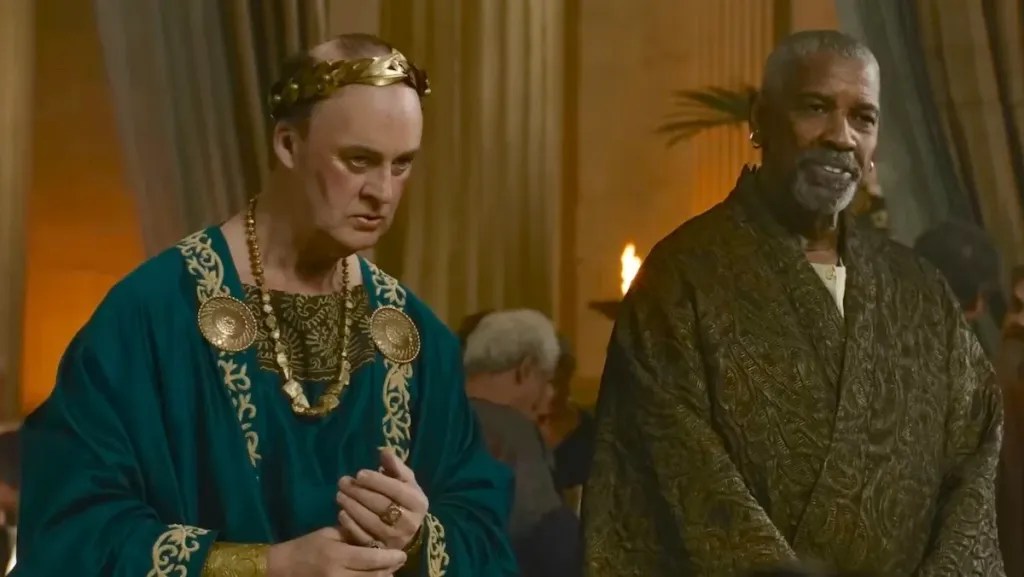
The sartorial contrast is actually very marked. Bad guys (Caracalla, Geta, Macrinus, Thraex) wear gold jewelry and frequently dress in long tunics or flowing robes (so, gender-non-conforming attire) and are either camp or openly LGBTQ while good guys (Acacius, Lucius, Ravi, Gracchus) do not wear jewelry and dress either in simple tunics or else in armor and explicitly note their heterosexual marriages. It is once again a visual motif delivered with such consistency that it rises to be part of the film’s themes.
But also it’s just part of the text of the film. Acacius, the battle-hardened general who is aiming to save Rome declares early on to a crowd that “I am not an orator or a politician; I am a soldier” – he is betrayed to his doom by the aforementioned weak, effeminate and decadence Thraex. His speech is echoed by Lucius later, who rallies his gladiators to their insurrection by telling them, “I am not a general, but we are all soldiers.” And at the end of the film, when he’s triumphed over all of the villains, Lucius – standing between two Roman armies with not a civilian in sight – gives his big speech on how to save Rome, declaring the need to “give Rome back to them” and pointing at the assembled soldiers. Lucius, our hero revealed to be Maximus’ long lost son, at the film’s end, contemplating what sort of Rome he wants to have – now that he appears to have made himself emperor – closes the film with the final line, “Speak to me, father.”
In short, in Ridley Scott’s take, what Rome needs in order to survive is for power to be violently removed from the decadent, queer-coded men who have it and delivered to the burly, masculine, straight-coded men of violence who do all of their killing up close, man to man. Women, in this world, of course cannot and do not wield power: they exist to die at appropriate moments to motive the burly men of violence, just as Maximus’ wife is killed in the first film and both Lucius’ wife and mother take arrows to the chest in this film at appropriately motivational moments. Doubtless there are already folks lining up to say, “but that’s how it was in Rome!” who need to scroll up a few paragraphs to note that that was very much not how it was under the Severans, where tremendous power was wielded by the women of the imperial family. Of course all of those actual Severan women are not in this film.
Naturally, this is somewhat troubling framing for the contemporary moment, given that, “what we need are very straight, burly men of violence” is not just quasi-fascist framing, but in fact Ur-Fascist framing. I can’t imagine Ridley Scott intended to make a fascist movie, just as I don’t imagine he intended to make a bigoted, anti-gay movie, but he did both. That sort of thing can happen when you are careless with your themes and characterization.
But as a take on Roman history the film is also nonsense of the sort I will be unteaching for years not because it gets this helmet or that toga wrong, but because it reinforces a popular notion about the ‘decline and fall of Rome’ that is not remotely tenable with the evidence as we have it.
For one, the film’s juxtaposition between the burly men of violence like Acacius and the weak, decadent senators is silly on its face. Indeed, Scott relies in both Gladiator films on a contrast between the career military men (Maximus, Acacius) and the political, senatorial elite. In Rome, these were the same men. To be a legatus Augusti pro praetore and to have a provincial command and a large army, one had to be a senator who had at least reached the praetorship. Not every senator was a general but every Roman general was a senator. Acacius’ claim in Gladiator II to not be “an orator or a politician” but merely a soldier and a general is a nonsense claim: at Rome, one could not be a general without being an orator and a politician.
And while the film errs in suggesting that Roman collapse is just around the corner in 211 – when in fact we are close to the height of the empire and serious fragmentation is two centuries away – the Crisis of the Third Century (235-284) is coming. But the Crisis of the Third Century isn’t caused by a shortage of burly men in armor doing violence, but a surplus of them. It is a consequence of one Roman general on the frontier after another realizing they can march on Rome to make themselves emperor – and then the winners immediately march on the Sassanids (who have, by that point, replaced the Parthians) to attempt (and fail) at glorious wars of conquest rather than staying at the political center to stabilize Rome. One of the great weaknesses of the political order that emerges out of that crisis is that no emperor could trust anyone else with the field army anymore, so emperors remain front-line field commanders, a perilous and destabilizing way to run a large empire.
In short, Scott says, “if only the Romans trusted a good, violent general like Maximus or Lucius or Acacius with power, everything would be well” and as a historian I cannot help but scream they tried that! They tried that and it nearly destroyed the empire! It was arguably the most foolish thing they ever did. The consequences of that style of rule were a state overburdened by military expenses, fragmented by repeated instability and civil war, with an economy slowly crumbling under the weight of endless armies.
Not only did the Romans try “what if we let big burly generals run the show?” Caracalla himself is that figure. Accepting the ‘lore’ of the Gladiator films, Septimius Severus – a frontier general who seized power after the death of Commodus – basically is ‘what would happen if Maximus became emperor’ and the answer was that, in the long run, it turns out poorly! The real Caracalla, the soldier-son of a frontier-general-turned-emperor effectively is what the film presents Lucius (revealed to be the son of Maximus, because of course he is) to be. And Caracalla’s reign was a failure.
None of this distortion of history is, of course, in support of artistic merit, because there frankly isn’t much here. The actors give the best performances they can, but this is – along with Napoleon – probably Ridley Scott’s worst film. As a piece of entertainment, wholly divorced from the actual past, Gladiator II falls into the trap of worshiping the first film (literally there is an altar to Maximus in the movie), trying to replay and one-up its high notes; vapid but entertaining catch-phrases in the first film are treated as invocations in the second, inscribed above altars and whispered by characters in reverent tones. The reuse of the original musical motifs at moments of high emotion is interminable. The whole thing is terminally ill with sequelitis and indeed a third film is apparently already on the way, because every pop culture product these days needs to be an extended universe franchise endlessly rehashing the same tired stories.
And I assume that’s why no effort at all was made to actually capture anything about the Severan period or Caracalla. After all, a story about an emperor who effectively answers the question of “what if Maximus had lived and become emperor in the first film?” with “he would have made a bad emperor because being a good warrior doesn’t make you a good ruler” would, on the one hand, be a really interesting story but on the other hand wouldn’t give everyone an opportunity to cash in on the nostalgia-dollars.10
Instead, to get those nostalgia-dollars, we need to reenact all of the things people think they know but get wrong about Rome: we need some queer-coded decadence, some ‘insane’ emperors,11 some gladiators, and a vague notion that Rome ‘fell’ due to something called ‘decadence’ a few centuries earlier than it actually did fragment in the West.
In order to tell that very marketable story, one that could serve as the foundation for a franchise, because everything today must be a franchise, the film had to not merely mistake history, but twist it back on itself, turning a brute, tyrannical emperor into a sickly, insane weakling and blue-blooded career bureaucrat into a self-made freed slave12 so that Ridley Scott could have the themes he wanted, the themes someone thought the ‘franchise’ needed to keep printing money, rather than the themes the history of the period actually offered.
The irony is that unlike the Gladiator II we got, a film that embraced more of the actual history of the period might have been more interesting. Presenting Caracalla as, effectively, a dark mirror of Maximus would have been interesting! Bringing in the historical Severan women – as opposed to pulling Lucilla back into the story to tap into some cheap nostalgia – would have been interesting! Questioning the efficacy of yet more violence in a Rome already soaked through with violence (and with the explosion of violence in the Crisis coming around the corner) would have been interesting!
Instead, what we got was a retread of the original film, faded with time. Much like Napoleon, it is astounding how able Ridley Scott has become to take a deeply interesting period of history and make a deeply uninteresting movie out of it.
I was not entertained.
- Not necessarily in the USA, to be clear; Ridley Scott is English though I understand he splits his time between the UK, USA and France. But immigration is a hot topic in all three countries.
- Persia in this period is ruled by the Parthians. The Indian subcontinent was fragmented in this period.
- They might also be called bestiarii, but this term also applied to those exposed to animals for executions.
- The episode is reported in Suet. Claudius 21.6.
- Note, for instance, this as a motif in the popular Hunger Games novels and movies, with the dystopian setting of the story even being named ‘Panem’ in case one missed the reference. The titular hunger games are thus the circenses and are gladiatorial combats.
- Note that other events, especially venationes, also took place at the Circus Maximus.
- Royal architecture in Constantinople, where the Great Palace was also connected to the chariot racing venue there (the Hippodrome), would later mirror this element.
- Which was scandalous, I should note: gladiators could be super-popular rock-stars, but they were fundamentally low-class slaves. Even gladiator trainers, the lanistae, were infamis (of ill-repute, a class of occupations that faced legal limits on their civic participation due to their low reputation)
- Several references are made to a sickness essentially eating away Caracalla’s sanity, though syphilis in particular doesn’t seem to have existed in Afro-Eurasia prior to the Columbian exchange of the 15th century.
- I suppose they might go this way with Lucius in the third film, if it gets made, but then I don’t see why I was made to sit through this film to get there.
- Of all of Rome’s emperors, only one – Caligula – could be fairly tagged as mad. Several others – Nero, Commodus – were probably narcissistic sociopaths and others – Tiberius, Caracalla – were dangerously paranoid, but perfectly sane. Ironically, given the public reputation for Rome having ‘mad emperors’ to the point that people search lamely for excuses (lead pipes!) to explain their ‘madness,’ on the balance the Roman Empire generally had better than average rulers. Roman emperors tended to be capable precisely because assassination and usurpation were so common: bad emperors didn’t tend to last long and incompetent men didn’t tend to become emperor. What Rome tended to get instead were intelligent, competent, capable rulers, who might also be brutish, tyrannical, violent or paranoid (but as often were not).
- As an aside, it is pretty awkward that this part – the freed slave who holds a grudge against his former enslaver so deep that he plans to effectively destroy the entire society in revenge – is the one given to an African-American actor.

?uselang=de#/media/File:Plastico_E.U.R._rom_marts_2003.jpg)
If I recall correctly, a *lot* of Roman emperors die from assassination or coups/coming up on the losing end of a civil war. Is it really paranoia if you have so many people out to kill you?
Told In Stone (on whose channel Bret has appeared as a guest) covers the statistics of Roman emperor’s death here: youtube.com/watch?v=41zuH-CWYwo. It’s easy to conclude that, if anything, they weren’t paranoid *enough*. Although the number of assassinations prompted by fear of a pre-emptive purge suggests the whole thing is a vicious cycle.
At least in large businesses, that vicious cycle would be deemed to fall into the category of “corporate culture”. (See discussions of how e.g. Boeing’s degraded.) And while luxury and promiscuity are the highly visible part in depictions and discussions of “decadence”, I understand the endemic-chronic-backstabbing-disorder part to be central to the concept. Both literally (assassinations) and figuratively. (I suppose it doesn’t help that most “proponents”, so to speak, of “decadence theory” are very much connecting the two parts — I understand they see both backstabbing and promiscuity as immoral in comparable ways.)
I expect a lot of people nowadays would put that figurative part in terms of the prisoners’ dilemma. I think the closely related “stag hunt” game is more relevant. There both symmetrical actions (C-C and D-D) are stable. For a player to choose to cooperate — out of pure self-interest! — nothing more is needed than expecting (above a threshold that is a simple formula of the payoffs) that the other player will cooperate. Thus it is entirely possible to have two otherwise identical pools of exactly the same agents (algorithms) where in one pool, they almost always cooperate, while in the other pool they almost always defect, simply because those in the first pool (correctly!) expect the others to mostly cooperate, while those in the second pool (correctly!) expect the others to mostly defect. All this applying to the single-shot game — while theoreticians have to twist themselves into pretzels to get algorithms to cooperate on the single-shot PD.
Paranoia doesn’t actually make you any good at rational threat assessment and mitigation, and is really more often a liability towards those things. It also makes you susceptible to people who validate your delusions and offer you a sense of security. So yes, it’s still paranoia even if there might be people out to get you; this can be indicated by how so many paranoid authoritarians still end up murdered, often by people in their inner circles.
On the point of gladiators being infamis, how well would the analogy with modern day porn stars be? The most successful are famous, rich, are (sexually) desired, have fans, but it would be beyond scandalous for a head of state to become one. You could even draw a parallel between blood-lust and sexual lust. Obviously no analogy is perfect, but to what extent are the social views of the two professions 2000 years apart similar?
My thought was like really trashy reality TV stars, but I suspect there isn’t a perfect parallel
I feel like that’s a bit different? Trashy reality stars are a love-to-hate-them kind of mentality, and are essentially real-life soap opera characters. People turn there noses up at them, but they’re seen as *culturally* inferior not lesser as humans.
You’re of course right that there isn’t a perfect analogy, if only because Romans had explicit laws that restricted the privileges of the infami, and there’s no such thing in western modernity.
Yes, but trashy reality TV stars can become President these days, so…
Porn stars are essentially prostitutes … which existed in Rome, too, and a head of state becoming one – servicing men while other people were watching – would have been a lot more scandalous, I wager, than playing gladiator.
The closest modern equivalent would probably be professional wrestling – fighting that is intended to be entertaining above all else, and seems, at least to me, to be a rather working class thing. (Having big muscles was regarded a working class thing until quite recently, so …)
There’s also “strongmen”; men who lift heavy objects of all kinds for the entertainment of crowds. A profession that originates in circuses (the modern kind, not the ancient Roman one) and would typically have been performed by people who lived hand-to-mouth. Not slaves, but definitely a kind of outcasts. Some decades ago, a politician engaging in such things would likely have caused at least a small scandal.
“a head of state becoming one – servicing men while other people were watching – would have been a lot more scandalous, I wager, than playing gladiator.”
Indeed, that’s one of the accusations leveled against Elagabalus by hostile chroniclers!
I certainly think there’s a more general comparison between gladiators and prostitutes in the Roman world to be made, as a gender separation of vice as entertainment (there were male prostitutes and female gladiators, but in the minority). I’m sure someone could squeeze out a Master’s thesis out of it (if they haven’t already). I said porn stars however because they have an audience beyond the person they’re performing with, like gladiators but unlike prostitutes, which allows a qualitatively greater fame. Unless the Romans had public sex shows which I wouldn’t put past them, but I’ve never heard of (orgy parties being different).
I don’t think the strongman / wrestling analogy is as apt however. Being infamis was different to being working class, and substantially below it in the pecking order, barely above slavery. Say a footballer becoming prime minister might be a culture shock to the establishment, but few would see it as an abherant attack on the moral fabric of society. A pornstar becoming so, however, would be for many. And that’s why I think it’s closer to the stigma that Romans associated with gladiators.
Yeah. And thinking about America’s own history, we have at least one prominent celebrity who started out as a bodybuilder, became an actor known more for his big muscles than for his acting talent, and managed to parlay that fame into governorship of a major US state. And Arnold Schwarzenegger can’t become president, but it’s because he’s an immigrant, not because he’s got a reputation for “infamous” professions.
I think that porn stars are the best analogy. Even there, there’s no legal obstacle to a porn star doing any thing any other American citizen can do, but there’s a very, very solid barrier of cultural custom. Importantly, especially with American politics so polarized between the ahems and the ahems, it’s a bipartisan custom that shows little sign of changing in the foreseeable future.
Until fairly recently, actors, musicians and other performers were considered socially declassé. My girlfriend’s mother was offered a screen test by Cecil B. Demille, but her family didn’t approve. It’s like this elsewhere. In Japan, people in the “water trade” were considered down a few rungs socially, but not as far down as slaughter house workers. In many traditional societies, these social distinctions are formalized. Louis XIV set up 20 or so social classes, each with their rights and privileges.
The trouble with wrestling as an analogy is that there is a very close link between a certain successful modern American politician and professional wrestling – https://www.youtube.com/watch?v=jkghtyxZ6rc
While this connection may be looked down on by many parts of society, it has done, at the very least, no harm in this case and arguably it has done him a lot of good – https://www.theguardian.com/commentisfree/2024/dec/14/donald-trump-us-politics-world-wrestling-entertainment
I wonder but don’t know whether similar distinctions applied in Rome – for a populist, being infamis might be a problem with the senatorial class (and of course, there are the legal restrictions), but less so or not at all among the plebs.
Though the plebs are much more powerful and important in the USA than they were in Rome.
That seems like a relatively apt comparison to me (as does reality TV star as another commenter mentions). Gladiators, prostitutes, and actors are considered to have had a relatively similar role as groups that were dishonourable due to performing for the common people, but that could become famous and sometimes rich doing so.
Besides Commodus and Nero, Suetonius also mentions senators partaking in gladiatorial games and acting during Julius Caesar’s reign, and Tacitus includes an odd incident with a Roman lady voluntarily adding herself to a list of sex workers.
More than one lady, actually, by accounts. The problem with being a respectable woman was that you fell under Augustus’s morality laws
I can completely see a (former) sex worker becoming head of state of a modern country, actually. Maybe not in the US, in the near future, but certainly in Europe, Australia/New Zealand, maybe even Latin America. Possibly even at the state level in some of the more Democratic states of the US. We live in a post sexual revolution / post Pill age, traditional Abrahamic sexual morality has *much* less hold on people than it had in the past, to a degree I think a lot of people still haven’t internalized. Especially since someone like that could take the “become consort of a politician, then inherit his position and/or voting base after he dies, or is term-limited out, or whatever” route to power.
For that matter, there are parts of the world where the cinema was considered until recently to be at least faintly disreputable, and yet people never had a problem with voting for actors and actresses to lead them. The kind of character traits you look for in a political leader aren’t necessarily what you would look for in, like, a bishop.
Far cry from head of state, but as far as Australia goes, a former sex worker in Fiona Patten at least made it to state parliament and leader of a minor party in the mid-2010s.
Ilona Staller was a former porn star who was elected to the Italian Parliament in 1987.
I also recall some porn star who was a rising figure in some far right party in Germany, until footage of her having sex with a black man resurfaced.
Evita Peron was a tango dancer (something close to professional mistress) and made head of state. On wrestling – Jesse Ventura and, earlier, didn’t Abe Lincoln do a bit of wrestling?
Evita Peron was a tango dancer (something close to professional mistress) and made head of state.
Eva Peron was extremely influential, but I don’t think she was ever formally made head of state. You might be thinking of Peron’s third wife, Isabel, who was also a nightclub dancer and who inherited the presidency after he died in 1974. Nominally, anyway, she seems to have been largely a figurehead for her inner circle. She’s still alive, interestingly enough.
Hector – you are right – I was thinking of Isobel
@PeterT:
One of the most bizarre stories about the Perons is where Juan, during his Spanish exile, managed to retrieve Eva’s embalmed corpse (it was in a tomb in Italy, for some reason), and got his “court magician” to perform a kind of necromantic ritual where Isabel lay on top of the coffin and they tried to transfer Eva’s soul (she’d been dead for many years at this point) into Isabel’s body. (The magician was a core member of their inner circle, and later ended up as Minister of Social Welfare and leader of a right wing militia). So, it’s easy to conflate the two women: Peron seems to have actively *tried* to literally blur the distinction between them.
I was actually thinking about that minor party! They were called, of all things, the Australian Sex Party.
I’m not sure we need to bring prostitution into the discussion when professional wrestling is right there, and is really a very close analogue to gladiatorial combat in terms of both structure (fights mostly staged for entertainment rather than realism with larger-than-life figures in it) and reputation (regarded as not worth any elite attention despite being a massive business).
Honestly I’d lean more towards actual combat sports than wrestling, especially with the fact that he also fought as a venator. The Emperor hoping into the arena with a lion or gladiator seems to me to map more closely to a President entering the boxing ring or the Hexagon than a wrestling ring. Extreme violence, somewhat controlled but an ever present threat of death nonetheless.
Barrack Obama in the Hexagon with Connor McGregor, JFK boxing Muhammed Ali.
People would lose their minds.
One-on-one basketball was President Obama’s fitness routine, and by necessity that generally involved playing against people who worked under him. Reportedly one of his body man’s duties was quietly warning people ahead of time that they shouldn’t let the President win.
TBH I don’t think professional wrestling is comparable to Roman gladiators when talking about social cachet. Yes, there are surface similarities and some segments of today’s society turn their noses up at it, but you can’t tell me that people like e.g. Hulk Hogan or Dwayne Johnson are even remotely approaching the infames of Rome. If John Cena became governor of California I’m sure there would be plenty of jokes about it on SNL but that would be it, in ancient Rome it was fundamentally inconceivable that a real, enslaved gladiator (And not just a member of the senatorial class who liked fighting in the arena) would ever have the slightest hint of political power.
> fights Pescinnius Niger in Anatolia in 194, spent 195 in Northern Mesopotamia mopping up, then spent 196 and 197 clearing out Pescinnius Niger
I assume one of these is supposed to be Clodius Albinus?
This reminds me of the Star Wars series Book of Boba Fett – the scenario is that Boba Fett installs himself as crime lord of a city, extracts tribute and brings in an open gang war, which is fine as a storytelling decision in and of itself, but the story then treats him as if he was the legitimate ruler of the city. There’s no hint that perhaps there should be democratic elections.
Democracy is a very minority system in history (or fantasy. Too many people seem to admire the decadent aristocrats in Game of Thrones, for example).
Well yes, but Boba Fett is only the crime lord of the city. The ruler of the criminal underworld of the city, you can justify, but for Boba Fett to be the legitimate city government would require actually overthrowing the old city government.
I’m not entirely sure if Mos Eisley had an old city government–I’m pretty sure it was being run by Jabba the Hutt until the opening of Return of the Jedi happened, and then there was a power vacuum that no one managed to fill.
There is a mayor in the BOBF. He’s pretty corrupt but presumably there was a legitimate process by which he got appointed.
I think the underlying ‘trick’ is that it’s often very easy to get a reader/viewer audience to accept that the main character of the story is or ought to be “in charge.” The idea of being “in charge” of an organization is such a common vicarious fantasy, and so simple for our monkey/caveman level social instincts to accept, that almost any conceivable explanation for how the protagonist comes to be “in charge” will be accepted almost on instinct.
Peasant boy is revealed to be secret royal heir and catapulted into power with no inconvenient opposition from existing power-holders within the realm? Bam, most of the readers will accept that the peasant boy is in some cosmic sense “supposed” to be the king.
Hardworking and capable official revolts against unjust behavior of hereditary monarchy? Bam, most of the readers will accept that the official has more right to be the king than the king or his children do! And never mind that this idea is mutually exclusive with the justifications that would put the peasant boy on the throne.
A crime boss having more right to rule the city than the nominal mayor does? Second verse, same as the first. Besides, it’s a Star Wars story and there is very little open practice of democracy in Star Wars except as something to pay lip service to or as deep backstory. The governor was probably an appointee of an appointee of Palpatine anyway.
I think the greater problem with Boba Fett was that they were afraid to make him do crime lord stuff. The position necessarily requires some amount of threats, bribery, violence, etc., but Disney is too “for kids” to actually have their protagonist/hero be that kind of gangster. As a result, the show is just boring until it becomes The Mandalorian Season 2.5.
It’s like that meme from that kids’ cartoon “A good pirate doesn’t steal from other people.” They want to use the cool factor of a crime lord, without the moral hazard of crime actually happening.
Is that “the pirates who don’t do anything?”
Fredric : You make it a point of never attacking a weaker party than yourselves, and when you attack a stronger one you invariably get thrashed!
[Pirates approach him with great indignation]
Pirate King : [Holding up finger] There’s some truth in that.
– “The Pirates Of Penzance”
That’s Veggie Tales, so a different franchise. (And more honest about what it takes.)
The thing is that they probably could have done a show about Boba Fett learning that there’s more to leadership than brute force. “The man who learns better” is a classic for a reason.
Very much this. There were some very funny takes asking “so what does a ‘Daimyo’ do exactly?” when BoBF was running, and this was the issue LFL found themselves in. The question of how you make money doing organized crime in Star Wars has well-established answers: you get involved in either the slave or spice trade.
I don’t blame LFL for not wanting to make their main character run a slaving operation or a drug cartel, but it does create this awkward situation where he’s allegedly an aspiring kingpin but they can’t show him acting like one.
Crime lords in Star Wars are basically monarchs who also do crime. That’s the role Boba Fett is stepping into.
It’s unsurprising that Fett isn’t a fan of democracy. Democracy, to him, is the corrupt Republic that fell when he was a child, and the New Republic dedicated to being the same thing. Also, the New Republic is an enemy of Fett because he’s a criminal. And democracy isn’t something any of Fett’s subjects expect. They expect their ruler to be a crime boss, because their rulers have always been crime bosses, either ruling independently or as part of the Empire.
When I sally forth to seek my prey
I help myself in a royal way;
I sink a few more ships, it’s true,
Than a well-bred monarch ought to do!
But many a king on a first-class throne,
If he wants to call his crown his own,
Must manage somehow to get through
More dirty work than ever I do.
There’s a problem with the phrase “crime lord”.
If you’re the monarch (I assume absolute instead of constitutional), can you actually do crime? In other words, you say what’s illegal, so I guess you do something and then declare it to be illegal? Why?
“Crime lord” assumes a larger governing authority that declares these acts as such. In the Star Wars universe, I assume this is the Old or New Republic doing it. There’s a certain incoherence in “This planet or system is independent, but we declare the ruler to be a criminal”.
I think part of it is Republic snobbery, calling rulers they don’t like crime lords. But most of it is that these rulers run organizations that do crime inside the Republic and Empire (e.g., Jabba hiring Han Solo as a smuggler).
I think Mos Eisley Spaceport is kind of like one of the towns in Sid Meier’s Pirates game that is actually run by pirates – it’s just a refueling point and trading hub for illegal activity that Jabba is more or less in charge of.
It does raise the question, though, of why the Empire doesn’t just wipe it out. In a society with a strong rule of law, the government can suspect that Mos Eisley is rife with crime and smuggling but not have the evidence in place to prosecute. The Empire doesn’t really have anything stopping it from just turning Mos Eisley into an expanse of molten glass, due process or no. Probably there’s some benefit to the Empire in keeping an eye on the black market there, skimming money, etc.
Also, it’s a big galaxy. You can wipe out one, but how many are there?
It might just be that Mos Eisley isn’t a serious threat to core Imperial interests so they don’t bother. They temporarily siezed control with little difficulty when they had cause to.
In the original movies, Jabba the Hutt looks like he’s just a local mob boss. But in the Phantom Menace, his ceremonial position at the pod race shows that he’s a political figure. Also, when Watto tries to cheat Qui-Gon, Qui-Gon threatens to take their dispute to the Hutts, indicating that the Hutts are the court system.
If you get into the comic books, Jabba gets even bigger. He’s the leader of the Hutts, and they control multiple planets and important trade routes. The Emperor sends Darth Vader himself to “negotiate” a trade deal with Jabba. (The deal is that Jabba sells the Empire whatever the Empire wants to buy, at whatever price the Empire chooses to pay, or else Vader personally murders Jabba. But that fact that it’s Vader himself making this threat instead of imperial officer #65345 means that Jabba is important.)
Not necessarily, there’s a few ways you can be a “Crime lord” while receiving no challenge from external political forces. The most common of which are:
1. There’s some nominal legal government structure in place, but it’s so hollowed out by corruption the de facto ruler of the city/country/planet is someone who has no official power on paper, but nonetheless controls the territory and runs local government like a puppet due to being the leader of the most influential criminal gang.
or
2. The official government is some form of monarchy/autocracy/oligarchy, and the person holding the title is also a habitual criminal, and routinely engages in crime at extremely high orders of magnitude. However this is overlooked in their relations with other powers due to political expediency – witness Bashar Al-Assad as the most recent pertinent example, who oversaw state-run illegal drug farms exporting to the entire region and barrel-bombed his own civilians with chemical weapons – but nonetheless was treated as a legitimate ruler by many other countries. Sure, there were some sanctions, but there was certainly no enforced regime change, and no refusal outright by the global community to engage with him. You can point to plenty of other similar examples in other parts of the world and historical record.
When it comes to Star Wars and the Hutts in particular, the Hutts have been the legitimate rulers of Nal Hutta, Nar Shaddaa, and various other planets for centuries. Everyone knows they’re proverbial for being crime lords, but by greasing the right palms and staying just on the right side of expedient, the galactic government of the day holds their nose and does business with them. Further, the Republics (just like the UN) are/were very good at saying “Everyone should respect human rights” while allowing the Galactic equivalent of China to join, and quietly run their own internal affairs without interference.
When it comes to Monarchies, it often comes down to ‘do as I say, not as I do’. Even if the monarch is doing a crime, they don’t necessarily want to make it legal, because then everyone can do it. And that may well have a corrosive effect on their country (to say nothing of permitting competition in whatever criminal field they’re engaged in). And even if they hold themselves personally to a different standard of law through divine right etc. it’s generally understood that there are limits to such things, if you don’t want people to start thinking of guillotines with fondness.
Damn. What an epic, hilarious takedown
Part 1: “they got 200 BC and 200 AD confused LOL”
Part 2: “Intentionally or not, this film delivers a thesis statement of fascism and engages in some of the most heinous filmic tropes of the era in the service of turning a flawed but well-regarded original into cynical sequel bait.”
The sad thing is, they actually did have a historical consultant that did know about the invasion of Numidia being 300 years before the film is set, as I have seen an article quoting them. Seemingly it’s a case of not caring.
The “a general, not a politician” (auto)hagiography is silly in general, tbh – even outside of societies where those are explicitly the same job, you don’t get to be a general if you can’t handle at least *some* politicking.
Not to mention the “orator and a politician” comment, when good speechmaking is pretty darn important part of command at the time. Or that choosing and managing subordinates is a big part of getting battle plans to perform successfully.
After the “how to command an ancient army” series of posts on this blog, plus similar descriptions elsewhere, it does sound like “managing and inspiring an army to carry out seemingly simple battle plans” is a better description than “comes up with genius battle plans” of what is going on, and the skills involved are quite similar to competing in civilian politics.
To be fair, it’s pretty common for orators to say they’re not orators.
Apart from things like anti-intellectualism, it is perhaps to be expected that people aren’t predisposed to respect a person whose main skill is persuasion itself. If I’ve spent my whole life practicing the art of convincing you of anything you have to say, you may understandably be reluctant to assume that I have your best interests at heart, and you may understandably suspect that I am “all talk” in some sense.
Thus, if you want to give a good speech that will actually motivate people, you can do a lot worse than to try to convince your audience that you’re not there just to give them a good speech.
“Tenth Legion, I am but a simple country lawyer…..”
It’s designed to appeal to a modern American audience, which has been propagandized (not least by things like this movie) into believing that “politician” is the lowest form of life, that nothing but immorality and corruption can be expected from any “politician,” and that anyone involved in “politics” is out to hurt you for your own advantage, as distinct from people in commerce and the military who are fine upstanding citizens.
Ironically, this belief seems if anything to make it much easier for deeply corrupt politicians to uphold their career. Because someone who believes the idea in the above paragraph will have almost no incentive to remove a corrupt politician from office, since the alternative is to replace them with another corrupt politician. When their man’s corruption is revealed and evidence brought to light, they are now mentally equipped to simply shrug and ignore it.
This is what royally pisses me off about the whole ‘all politicians are corrupt/the same’ argument. All it does is excuse people who’s behaviour is corrupt, and dissuade people who could do better from doing better. It’s utterly self-defeating, as well as being patently incorrect.
It’s interesting that you say that, since America seems to me to be unusually prissy about good-government stuff, and unusually intolerant of corruption. Although in the era of Trump, that might be changing.
I had to take a closer look, and while the graph below is not a definitive answer, it does appear to broadly side with your claim.
https://ourworldindata.org/grapher/share-of-people-paying-bribes-vs-corruption-perception
General Ulysses S. Grant did become general without politicking. He got there by winning battles when everybody else in the Union lost battles.
Later, as POTUS, he did show himself rather inferior at politicking.
However, before that, after Lincoln’s assassination, to keep Johnson from destroying the entire point of the damned war in the first place, he either politicked successfully, or he managed by treating the situation as a general with a battlefield. Or both.
And ya, he’s probably an exception that proves the rule.
No, Grant did do some politicking–specifically, he ingratiated himself with a congressman named Elihu Washburne, who served as his political patron through the early part of the war.
Now, the reason he kept that patronage was, as you say, because he won battles and campaigns, but in order to get that *necessary* patronage there were politics involved.
You’re right, a(n incidentally) melanated warlord shouting and raging as he fails to impose order on the capital like he could on the frontier, as all the other warlords sharpen their knives in the background and the women of the family do everything up to and including the murder of their own children to keep riding the tiger that is world empire would have been MUCH more interesting and cut across interminable culture-war stuff much more compellingly. I’ll stick to Shakespeare and I, Claudius!
“Both Gladiator films, understandably, represent gladiators as the entertainment in Rome…”
I take issue with this. The first Gladiator film focused on gladiators, sure, but it never seemed to state or imply that gladiators were THE entertainment in Rome. At least, no more so than “The Queen’s gambit” shows chess as THE entertainment of the Western world, or “Talladega Nights” shows NASCAR as THE entertainment of the USA. Gladiatorial fights were the focus of the movie, but the movie never presented them as somehow uniquely significant. The first movie even had senators discussing the games, one of them attacking them as vulgar (pulling from some Stoic literature). The fights were important entertainment, but they were just that, entertainment.
The first film needed a setting, and the gladiatorial games were as good as any other. Once that was chosen, obviously the rest needed to be ignored, by virtue of the fact that the hero and villain spent most of their time in the arena. It’s a necessary effect of the limited focus available to a film. And you’re right that Rome was obsessed with chariot races, but WE are obsessed with gladiators, so choosing an emperor that played into both the “Decline and Fall” motif and allowed the focus to be on what the audience would consider significant was a smart choice, at least form a marketing standpoint.
Please note that I’m certainly not defending the historical accuracy of the film. It occasionally gets something right, mostly by accident. I’m just saying that this particular statement is not, in my opinion, a valid criticism.
To add: It makes sense that modern people would notice gladiators more, because they are the stranger entertainment. Even if they sound mostly like a boxing/MMA/etc. match, they still have that “some people will be deliberately killed for entertainment” thing going on. Which is pretty disturbing and different. While Chariot races, theater, even beast hunts somewhat are similar to things modern people do.
(Kind of like how Aztecs are the “cut out hearts for the gods” civilization in pop culture, less so the “large building projects” or “floating farms” or “standard tribute empire” or other things they did.)
Counter-point: In the original Gladiator, Senator Gracchus explicitly says: “The beating heart of Rome is not the marble of the Senate. It is the sand of the Coliseum.” Gracchus is telling us, the audience, that Commodus has his finger on the pulse of the Romans in this scene. There are no scenes in the first that I can recall where an authority challenges this view. After Maximus’ reveal, Lucilla states “Today I saw a slave become more powerful than the emperor of Rome,” apparently a disgraced former general becoming the fan favorite is enough to knock an autocrat’s powerbase off kilter. Both of these are provided without pushback; opponents of Lucilla and Gracchus do not say: “yeah, they are wrong in their assumptions about gladiators”; they react and move as if both the above statements are fact. I think it is safe to say that Ridley Scott is representing gladitorial combat as THE entertainment in Rome.
I forgot the first line.
I don’t think the second line is quite as significant as you do, in terms of this argument. It’s more a commentary on Maximus’ ability to defy the Emperor without the Emperor having a realistic option to respond. That doesn’t require gladiatorial combat; it could be a race, or an oration, or a dinner party and the effect would have been the same. Popular will was not an insignificant power in Rome (though my understanding is that the power of the mob wasn’t as strong under the Antoninus emperors as later ones, where Commodus could well have been murdered at that point). It was usually the army that murdered their emperors and replaced them, but as I recall the general population occasionally got into the act.
To put it more clearly (woke up too early and didn’t get coffee until just now): The issue here is that the slave embarrassed the Emperor in a way that exposed Commodus’ cowardice without an avenue for him to respond. That this happened in the arena is a matter of setting; it could have (occasionally did, in Roman history) occurred in a number of settings, but since this movie is about gladiators it has to occur there.
The first line is more damning to my argument. Part of me wants to say that it’s a comment that could be made about a number of entertainments (dinner parties were just as important), but there’s nothing to say that. And that omission is telling. The two senators could have said something along the lines of “X days of races, Y of gladiatorial combat, feasts–you’ve seen the beasts he’s brought in for the meals!” I’ve read (translations of) Roman letters that they could have easily pulled from here. (As an aside, the YouTube channel “Tasting History” is well worth watching for anyone who’s interested in the food aspects of the ancient world. He’s done a few on Roman feasts and these comments on the expense and important of such meals has come up several times.) Or he could have said “The beating heart of Rome is the sands of the Circus and the Colosseum.” Or discuss Maximus’ war record and play that up, playing to the Roman value of martial virtue. Or…well, there are a thousand ways to demonstrate that there were other things important to Rome. The fact that they didn’t means that Ridley Scott did intend the line to be taken as you argue it should be.
This comment is mostly so you know I did read and process your response.
Yeah, my second point was weak, it would have been better to have left it out. You rightly point out it could have been about any situation where Commodus could not respond without looking weak (maybe Maximus humiliated Commodus in a public game of Magic: the Gathering). First quote was the crux of my argument, but I also needed coffee and sleep and thought I should have two points. I also spelled Colosseum wrong. Have a good one!
“By imperial decree, my addition of a +1 counter to my creature applies before, not after, your -3/-3 stat reduction. Therefore, it survives, and I win next turn.”
-Casts instant creature destruction spell immediately after, goes on to win game anyway.
Some nitpicks for you:
beyond its tradition walls → beyond its traditional walls
Circus Maximums → Circus Maximus
in order for it to dominated → in order for it to be dominated
When the the first film → When the first film
that are worth nothing → that are worth noting
its hard to argue → it’s hard to argue
far form any sort of violence → far from any sort of violence
to motive the burly men → to motivate the burly men
“Meanwhile, as noted, Caracalla largely ignored the day-to-day administration of the empire, leaving the task to his mother, Julia Domna.”
If our source(s) had not been hostile, would they have written “delegated”?
“to save Rome and maybe ‘restore the republic’ (a silly notion in 211AD)”
Unintentional brilliance? Silly to a modern audience’s decoding of the word — “most students decide that ‘the Republic’ is a system of voting and office holding” — but entirely plausible for other concepts of how to understand a term as nonspecific as “public thing”. According to which understanding(s), “the republic” was still around (if in a sorry state, needing some restoration) at the time. (Compare, perhaps, the ambiguity of the currently not used English word “commonwealth”.)
Arguing classification sometimes feels like arguing air, but: is there a desire/school/movement to label the Crisis of the Third Century as the fall of the Roman empire, with correspondingly labeling post-Diocletian as a distinct empire (or perhaps two empires, as the case may be)?
I would caution against labelling the Crisis of the Third Century as the Fall of the Roman Empire because the Roman Empire in general (as in, considering the West and the East) doesn’t die until the Fall of Constantinople in 1453 AD.
Now, the field of Late Antiquity has made the distinction between the two phases of the Roman Empire: the pre-Crisis Principate, which is the one that most people are familiar with; and the post-Crisis Dominate, which is the less known period but is also highly important because it is going to influence the way the germanic successors are going to rule their kingdoms all the way to the Middle Ages (and arguably, up until the Early Modern Period).
I’m not sure there’s much difference between talking about “the end of the Principate and beginning of the Dominate,” and talking about “the end of the Roman Empire Mk I and beginning of the Roman Empire Mk II.”
To some extent, whether we model the Roman Republic, the Roman Principate, the the Roman Dominate, and the Byzantine Empire as being one country with 4+ successive systems of government and a single move of the capital, or as four distinct countries that had a lot of cultural and institutional continuity but operated along quite different lines after successive rounds of shattering and re-formation, feels like just one of those “lumper versus splitter” debates.
More than four; not viewing the events of the Fourth Crusade as the end of the Roman Empire is also just a choice, and for that matter the transition from Palaiologos rule in Constantinople to Osmanli rule there was less transformative than what Constantine the Great did after his civil war victory.
Obviously false, since the Empire didn’t fall until 1922. (1453 just meant it changed language and religion, but that happened before after all…)
It’s sad but not surprising to see directors like Ridley Scott falling by the at this point cliché dichotomy of the “moral straight-coded soldier” and the “decadent effeminate politician” because that’s the sort of thing that happens when someone refuses to read what history actually says, though one might wonder if there’s also a bias of the director at play.
What’s depressingly ironic is that Ridley Scott at least (seemingly) understood this lesson before, because Kingdom of Heaven, with all its inaccuracies, made the point that giving power to “burly men of violence” whose only redeeming quality is excelling at violence is a self-destructive endeavour that only ends up in misery for everyone. Salah ad-Din even notes bitterly in the extended edition how he can’t run his kingdom at peace because his vassals also push him for war after the standoff at Kerak.
Despite the hammering given in part 1, I was still prepared to watch the film. I could stomach some horrible dating of events and poor naming choices, in order to enjoy a couple of hours of swords and sandals.
But after reading this, no. Not at all. I’ll happily never watch it. The world did not need yet another movie where all the women are ‘fridged’ and all the ‘gays’ and ‘politicians’ are evil and all the ‘manly military men’ are the epitome of moral virtue. To have such a famous and enduring film as Gladiator spawn an offspring that undershoots even the lowest social-justice or representation bar in 2024 is depressing. The news that there’s already a 3 on the way (likely following exactly the same pattern) is even worse.
I dunno that I’d claim the first bite at the apple was ‘famous’ or ‘enduring’. it was some fun garbage, and I’m disappointed that this one is not-fun garbage.
I was on the fence, as I’m burned out on sequels and extended universes that tell the same story over and over again. I want something new. The moral repugnance puts the nail in the coffin. I recently saw a woman in tears because her child was denied medical care due to being non-binary; we do not need more hatred towards non-heterosexual-white-males.
Dr Devereaux is being, IMHO, somewhat generous.
What I find the movie’s greatest failure is not its (barking mad) history, or even it’s odious political themes, but the simple fact that it’s such a dramatic failure. Dull.
Especially telling is how the performances of so many great actors are so wooden. Denzel Washington should absolutely steal this movie, but (despite some claims to the contrary I’ve seen in revies)… he just doesn’t. His performance in this one is nowhere near, say, Alan Rickman’s in the original Die Hard. Just sayin’
Sounds like we could get a franchise of:
-Good emperor Alexander killed by Thrax the giant, who rules for a bit, then gets tricked into the arena and killed by the main character in a David and Goliath “normal sized guy vs. huge guy” fight.
-Valerian captured by Persians, An unknown man who happens to be his son gets stuck in the arena, finds out Valerian was betrayed by some enemies, who he fights and beats and it restores Rome somehow.
-Aurelian falls on hard times and is sent to the Arena, where he is at first is dejected, but eventually finds the courage to earn his freedoms, inspire the people, and bring the empire back together.
-Constantine gets captured and sent to fight in the arena, where he makes some friends and convert him to Christianity, before he organizes a rebellion that overthrows the previous rulers at the Milvian arena, and goes on the stop the games forever in the name of Christianity. Including lots of shots of Lions killing converts, and maybe an Androcles type thing, because there’s a religious audience that goes for that sort of thing.
-Prequel Nero’s decadence leads him to denigrate gladiators to boost his preferred entertainment of plays and music and similar. Scene of him sadistically watching the city burn. Angered gladiator meets him in some games that place gladiators and theater actors in the same event, where Nero egotistically tries to compete in fighting games and gets killed.
-Prequel where the Meridius family is fighting against a Roman invasion of Spain. Augustus’s general Scipio* is fighting hard against Viriathus, the good guy coded Spanish leader. But then main character Meridius ancestor is captured, and at the same time Viriathus is betrayed and killed. Cue several scenes of the next Spanish leaders being decadent and incompetent, while Meridius ancestor fights in the arena and gathers news about Spain, eventually arranging an escape. He then fights for a bit, but is disgusted with the current ineffective Spanish leadership. Climax has him come to respect Rome and what it stands for, and arrange a favorable peace treaty where the worn down Spanish agree to join with Rome, but have earned some honor and respect or similar and thus get a favorable deal from the Romans, setting up the later movies.
I’m sure we’re all looking forward to it.
*Yes, I’m aware of what I’m doing with the history here.
‘Looking forward to something’ is such a strong phrase…
“The famous Gismodi model of Rome” – looking this up (wow!) it appears this should read Gismondi, with an N.
I would love it for you to do a post on Elagablus! So much stuff that’s come out about that emperor and I’m very unsure of how much to trust any of it.
Elagabalus must have flagrantly violated what Romans thought proper in some way. Maybe the problem was just acting like a Syrian priest of the sun god despite being emperor, maybe Elagabalus was actually trans, maybe we can add a second person among as a mad emperor besides Caligula. But it seems clear to me that it was a case of “more eccentric than the Romans could stomach”.
Even if we completely accept the stories about Elagabalus, which i’m happy to do, I don’t see anything there that says “mad”. Highly religious, sure, transgender, sure, an impulsive teenager, sure, but none of that has anything to do with “mad”. (Americans might be puzzled by how you could be both transgender and highly religious, but some religious worldviews don’t think about sex and gender in the way that Abrahamic religions do).
Although I suspect that throughout much of history someone who was definitely a man and kept insisting that he was a woman might be widely regarded as not being right in the head.
Especially since, on the face of it, anyone claiming that Elgabalus was a woman would be claiming that Elgabalus was not eligible to be an Emperor.
Strange argument for Emperor Elgabalus to make.
Although I suspect that throughout much of history someone who was definitely a man and kept insisting that he was a woman might be widely regarded as not being right in the head
Depends on the culture- there have been plenty of cultures historically that recognize a kind of liminal space for the (small minority of) people who don’t fit clearly into the male or female categories.
My one reservation about this is that Dr. Devereaux is usually extremely careful, by pop-history commentator standards, to tell us when we have biased sources and when we cannot easily or definitively tell which of multiple theories is true. Where scholars find ground to disagree intelligently, my impression is that he will try to present the controversy even if he is clear in his own mind on which side of the debate he’s on.
Elagabalus is a case where we have almost no unbiased evidence and where it is likely that we will literally never know which of multiple conflicting theories is true. I would be surprised if Dr. Devereaux himself has a firm opinion on the subject to begin with. So it would be almost a pure case of “teaching the controversy,” rather than the usual essay focused on a specific thesis the author feels is well grounded in fact.
If that’s what the post is, I’ll be more than happy with it. Even if there are very few hard facts about Emperor Elagabalus to relate and so much of what pop culture knows about this figure was written afterwards to smear their reign, I think it could be an interesting window into discussing what sort actions and activities the Roman Empire (famous for overindulgence) would find beyond the pale. As well, it could be an opportunity to talk about this practice of smearing a person’s reputation from beyond the grave.
It’s sad because the film almost, -almost- came close to saying something significant when Denzel pointed out now noble philospher king Marcus Aurelius owned slaves as much as any other spoiled, hedonistic elite of Rome, slaves claimed by his own imperial conquests that we literally saw in the first movie. But of course the other American pop culture obsession quite literally going back to the Founding Fathers is that only a reluctant leader can be trusted with political power, because surely Cinnnatus’s story wasn’t overly mythologized over the course of cenuturies, and therefore anyone who seeks power and change must be evil.
Like at least the trieme d-day and the rhino rider were dumb fun, as opposed to Brave Honorable Masculine Man versus Craven, Hedonist F** actually being the main plot of a blockbuster movie in the year of our lord 2024.
Wait what?
I’m not American so I may have simply missed this, but I think I would have noticed a stupidity held at the level of obsession. Instead I always understood the thesis to be that:
1) “Wanting power for its own sake” is bad. Partly because it will be wasted — someone whose goal is to maintain power will tend to neither look for, nor act upon, opportunities to use it for “good” ends. Partly because it will be used for ill.
2) Some people change over time after they get power, some we had appraised incorrectly, some lied. Either way, we have to check (repeatedly) whether people who received power for “good reasons” are actually using it well or badly.
3) Change in most directions is bad, but there are some directions in which it is good. Which directions those are is nonobvious and subject to disagreement (but investigation and discussion let us make headway). Obviously we want power to be exercised in good directions. (The reason more directions are bad than good is the same reason having to move to an identical apartment a few blocks away is a pain in the back: the costs of disruption and readaptation are always present.)
Which is to say, the thesis is roughly equivalent to those regarding fire, aviation, edged tools, etc. We (don’t) name cities after Daedalus even though he, as a result of his wisdom and self-discipline, only took the aviation-related risks he needed to. Unlike Icarus, who went joyriding and died as a result. And also unlike the people whose goal in flying wasn’t a soft arrival onto a runway but a hard arrival into a skyscraper.
I work in American elections, often on behalf of candidates and always as someone who engages with the voting public. The American electorate believes, in defiance of all reason or evidence, that their favored policy goals must exclusively be enacted by politicians who personally oppose those policies. Americans who deeply want extensive government funding of heath care will prefer Republican Party representation, and equally many sincere proponents of concentration camps for recent immigrants are only comfortable asking for that if Democratic Party politicians will be the ones empowered to build them. For persons not familiar with American politics, Democrats view their Party as the party that helps people who need to be helped, Republicans view their Party as the party that hurts people who need to be hurt, and thus these are currently the two issues most identified in the public mind with the Parties (and yet many voters choose as I described above). It is even frequently the case that a person proudly supporting the Executive candidate for one Party will then subsequently declare that they must therefore support a Legislature of the other Party; voting only one Party demonstrates an inability to make your own decisions, of course.
The second-largest city named after George Washington is Cincinnati, Ohio. It is a core value of American political culture that government can only be done well if it is done reluctantly, and the American electorate as an aggregate is very successful at maximizing the reluctance of its elected officials to do what it wants.
and equally many sincere proponents of concentration camps for recent immigrants are only comfortable asking for that if Democratic Party politicians will be the ones empowered to build them.
I don’t think this is self evidently stupid. There are lots of reasons that someone might decide that, on the whole, their dislike of the Republican Party outweighs their dislike of immigration, even if in a perfect world they’d have both Democratic Party rule and concentration camps for migrants.
To be pedantic, Cincinnati was named for a Revolutionary War veterans’ organization, the Society of the Cincinnati; that’s why its name is plural.
The claim that the Society was named after the Roman Cincinnatus is a bit misleading, as that choice was made because of the popular notion that there was an American Cincinnatus, a man for whom the Society was organized and upon whom the initial leadership of the Society was foisted. Similarly the city name would never have stuck without the Washington connection; many places in the Old Northwest Territory went through several names as the incoming population worked out how to attract further settlement.
But it seems that Ridley Scott, for one, does believe that ‘a good man doesn’t want power’
But it seems that Ridley Scott, for one, does believe that “only a reluctant leader can be trusted with political power”, judging by the fictional lead character he created for Kingdom of Heaven and named ‘Balian of Ibelin’. (So evidently does Orlando Bloom, who in one of the DVD extras said of the character ‘He’s a reluctant hero, which of course is the best kind of hero’, evidently expecting general agreement to this assertion as a matter of course, although Western peoples from any age in the last few millennia would be seriously startled by it.)
And Peter Jackson and his co-writer radically altered the character of Aragorn in LotR from Tolkien’s conception – the heir to a great dynasty wholly embracing his destiny, who does not doubt his duty and competence to restore his ancestors’ rule – to one who has spent most of his adult life trying to dodge his destiny and fearing his weakness. Either they personally believed their rewritten character to be better than the one Tolkien had written, or they judged that he would be more acceptable to modern audiences.
Well, I haven’t seen the DVD commentary, so I can’t be sure how it was meant, but “the best kind of hero” can mean several different things. It could mean that those types of heroes tend to make for the best/most interesting stories. Or it could mean that they are morally the best type of hero, the kind that our society needs most, etc. The former position is certainly debateable, but it doesn’t necessarily imply the latter.
Also, I recall in our host’s recent post “Afterlife of the Roman Republic”, part of the ceremony of Augustus’ settlement was for him to “return” power to the Senate, only for them to ask him to keep certain “reponsibilities”, with a few he would deliberately reject to show that he wasn’t a tyrant.
So, to the extent that you’re right, I don’t think this perspective is a purely modern or American one.
I think part of the reason they changed Aragorn’s character was because they wanted to give him an on-screen character arc–in the books, he’s done almost all of his character growth off-page, as it were. This is fine for books, and I like book!Aragorn better than movie!Aragorn as a character, but for a movie it doesn’t work quite as well.
I remember hearing or reading somewhere that this changes under the Severans, with Centurions starting to be promoted to higher ranks that previously had been limited to senators and equestrians. Which does directly feed into the Crisis of the Third century, with more and more emperors having a purely military career. Which does support the argument of this post that the Severan’s overly military focus lead to many problems down the line.
More generally, there is something here, in connection with the post about how the Principate works, that causes some rather ambivalent feelings with me: It seems that Rome was most stable and prosperous when the military, political, economic, and intellectual elite were all the same people, the non-elite didn’t hold political power (but could petition), and there was one person – the emperor – who had the last word and the power over life and death, with the possibility of assassination as the veto for senators against the emperor. That seems cash out as an argument for authoritarianism (of a non-fascist variety). And if we add the very successful Middle Republic, the people do have political power, but it is still characterized by a unified elite that non-elite people defer.
I think this assessment, while not comforting, is broadly correct. For most of recorded history hereditary monarchy seems to “outcompete” other forms of government. There are exceptions like the Roman Republic, but they trend towards monarchy over time. And conversely, when a monarchy declined in power relative to other domestic actors, the results were generally … unhappy; our host has written about the problems elective monarchy brought the Poland-Lithuanian Commonwealth before.
The good news is that things appear to have changed in 18th and 19th century.
Hereditary monarchy doesn’t outcompete other regimes through any virtues but simply because it’s self-replicating in its very nature. And yet it stills fails at even that, much of recorded history consists of devastating and often internecine wars of succession.
My pet theory is actually that stable succession is what made hereditary monarchy successful.
Pre-modern republics had very high levels of internecine political violence; the late Roman Republic is the most famous example, but you see similar phenomenons at work in the Greek (Alcibiades career is instructive) and medieval Italian city-states. Non-hereditary monarchies were even worse; the Mamluk Sultanate and the Roman Empire’s crisis of the third century are salient demonstration of how that could end up.
It’s only comparatively recently that society figured out how to consistently manage peaceful, regular transfers of power in large states (USA was probably the first in my opinion, although there’s an argument for Switzerland).
Hereditary monarchies aren’t especially politically stable and transfers of power are only sometimes nonviolent within them. What are the actual percentage rates, across large regions and non-cherrypicked periods of history, of peaceful transfers of power in hereditary versus non-hereditary systems?
I think this is more or less right, yea. It’s interesting, on that note, that even in modern, non-monarchical states, issues of succession often end up settling on a child, relative or spouse of the former leader: it almost seems to be an equilibrium that societies and governments slide into by default when there’s no other clear mechanism of succession. Family dynasties, after all, remain quite common today, from the Assad family in Syria to the Nehru family in India (America thus far seems to have not gone into the dynastic thing as much, but maybe we’ll see the Trump family break that pattern).
It’s also worth noting of course that free elections are only one method of non-hereditary succession: another one is for the ruling party to select a successor, where there’s ideological continuity rather than the genetic continuity you would get in a hereditary monarchy.
Self-replicating is a virtue. Succession crises are PAINFUL.
Hereditary monarchy isn’t common because it’s effective, it’s common because it’s ineffective. States with bad institutions can sustain hereditary monarchy, it’s the low energy equilibrium of states. When states get effective institution, hereditary monarchy gets outcompeted extremely quickly.
I used to assume the same, but looking at the evidence it doesn’t seem to become true until quite late. Prior to that the largest, most sophisticated states are hereditary monarchies, while republics and oligarchies were marginal players (i.e. the Achaemenid Empire and the Greek and Phoenician city states).
Putting it in the terms you used, I don’t think that state institutions were sufficiently developed until the late 18th century (and even then, some trial and error was required). Afterwards I agree completely; hereditary monarchy has proven vastly inferior as a system of government.
I think we need to be a bit careful about our definition of “hereditary.”
When you say “hereditary monarch,” do you actually mean “real power flows directly from one holder to the next via a clear line of succession that is convincingly followed even when inconvenient to the surviving real power-holders in the realm at the time of succession?”
Or do you mean “nominal power consistently remains in the hands of members of a single extended family, but in practice can be shuffled from nearly any member of this family to nearly any other depending on who wins the political power struggle and who is most willing to act as a figurehead for strong backers outside the family?”
Or do you mean “you don’t actually have to be related to or an inheritor of power to rule in this society, but it kind of helps as long as you don’t have anything else big working against you!”
Because a lot of powerful states fall into the second and third categories, but it’s questionable whether they are “real” hereditary monarchies in the sense that your explanation suggests.
Ideally, the system of the Republic would force the elites with power to demonstrate competence in something before they gained real power. But we see what the demos will do.
Historically, the demos doesn’t do too badly at this, but we really, really notice it when a trickster or incompetent takes power with popular support.
It is tricky to judge, societies are complicated beasts and lots of patterns are “happens more often then not” and “lots of other factors contribute to an outcome”/”lots of factors combine in weird ways”, which makes trends hard to judge. It seems, for example, when people measure societies in current times that democracies usually have faster economic growth, but there are plenty of counterexamples if someone wants to argue the opposite, and some arguments for why authoritarian governments do better in certain situations.
In the current day, less abusive, authoritarian, generally,. in most cases, seem to produce better outcomes, though as always this is a general trend. Lots of people certainly want to believe the opposite. Ancient societies might be different enough in various ways to change the trends (Like war being much more rewarding relative to other activities in ancient times then current day) An “authoritarian” king is also a lot less authoritarian in practice, since there much more limit on what governments can actually do.
That said, I have heard elsewhere (Though don’t remember where) that the Pax Romana period had somewhat good social mobility for an ancient society overall, which was reduced in the later empire, even if emperors themselves come from more variety of backgrounds after Severus. It seems, at a glance, that the Middle Republic and Pax Romana government both have relatively stable institutions that people respect, with somewhat more social mobility and balance of power then similar governments (which might be a reason the institutions are respected, giving a bit more sense of participation/trust then other ancient governments). Later empire/byzantine empire acts much more like a standard monarchy and isn’t as prosperous, Late Republic and 3rd century have military getting powerful enough compared to civilian institutions that ambitious commanders start civil wars and cause instability.
A previous blog post argued something like “Hereditary Monarchy is the default state, but other governments often perform better” and this seems to make sense. Also there’s the problem of city state governments not scaling well. The more open ancient Mediterranean city states, at least the most famous ones, seem to punch above their weight. (Athens produces lots of culture and a big navy for awhile, Rome and Carthage are powerful at war, Carthage seems powerful at trade). In the 1700s, England with its strong parliament starts off industrialization. But these are just a small number of examples, so it seems a big database of different governments and what they produce in various areas would be useful for these sorts of measurements. There’s also the problem of city state governments not scaling, so kingdoms might be the only thing tat works well in this period for for ling lots of territory. And as some comments in the imperator series pointed out, in a province your experience of the Republic is someone else collecting taxes and telling you what to do, not really different, or worse, then the empire.
So it seems like less authoritarian governments in ancient times, when conditions allow, often do run a place more effectively. But the conditions have to be exactly right (high trust, small size, culture allows it, etc.), and if these are broken monarchy takes over pretty quickly. And strong/absolute monarchies have lots of other institutional factors influencing how they operate, so once with strong bureaucracies, good succession systems, etc. can also do quite well for themselves.
I’d say that the Republic worked fine as long as it was small enough for a significant fraction of the Army to vote in Rome. But as Rome’s power and recruiting grounds expanded, there was less and less reason for the Army’s soldiers to prefer being ordered around by the Roman people, rather than by some general. Why should some provincial recruit care whether Rome was ruled by the people or an Emperor?
Hard to believe they actually made a film about the Severans less accurate than *Unbiased History*. And in that series, Caracalla is depicted as loving Geta so much that after Praetorians brutally stab him to death for no reason, he defaces all paintings and sculptures of him that made him look bad. It would be interesting for you to analyze, I think.
Does that mean I am not the only one who went back to re-watch Unbiased History’s episode on the Severans after reading this blog post?
But I am not really surprised. The core joke of Unbiased History works by being very accurate to the history/narrative of the sources – which the viewer is expected to have some familiarity with – so that it is obvious where he twists or exaggerates the facts in a way favorable to the person he depicts as the chad-meme.
I bet if all the viewers of Gladiator II watched Unbiased History instead, Bret would need to do much less re-programming in the coming years.
Persia in this period is ruled by the Parthians. The Indian subcontinent was fragmented in this period.
The Indian subcontinent has always been fragmented, up until the colonial era. The modern existence of only 3-5 political units (depending on how you count) is the exception not the rule, and is a completely artificial creation of the British- disunity in the Roman era is not something unusual to be noted. “India” is no more a natural country than “Europe” would be.
Well noted!
There’s nitpicks to be had about the “always” (Asoka for example comes to mind), but fully agreed on it not being naturally a country (or nation).
This is Eurocentric nonsense. Do you think the Mughals knew what they were conquering? Do you think Timurh understood what he wanted to conquer? Could the example of Asoka have defined India in the imagination of the people who lived there, as well as those who conquered it? Hinduism, Buddhism, and Jainism are highly syncretized so the flow of kingdoms and religions can be fluid and hard to parse but that does not imply that Indian history cannot be parsed. Sometimes it is not even difficult to do – see the Ajanta caves and how each religion is given its own place of prominence, reflecting an understanding of internal cultural diversity.
The best comparison I can think of is Scotland, where clans and religions and regions vie for influence. But surely you wouldn’t argue that Scotland isn’t a country? Or that Scotland is not a natural nation?
What’s so weird about this discussion (other than the fact that it is happening between people who are ignorant about the topic but that’s par for the course among casuals) is that you privilege the British colonizers over all the other colonizers who came to India! I mention the Mughals above – if your belief is that the colonizer defines his spoils, then give credit where credit is due. That so much of Indian culture, across all regions, still reflects and often celebrates Mughal influence….surely that implies that India was at least unified under a conquerer before the British arrived. I mean, if the colonizer is your preference. I’ve worked with inscriptions that suggest the people who lived there before outside colonization also had an understanding of their “national” borders but ymmv i guess.
India nationalist shows up I see.
India has a lot of common culture and influences, but has also rarely been controlled by one big entity. So it is similar to Europe or the steppes or any other number of similar regions.
What a predictable, stupid response. I work closely with archaeologists, anthropologists, and indologists, none of whom are Indian nationalists. And I find it an incredible annoyance of my own field that people say ignorant (and frankly, offensive) things like this and then default to the most facile namecalling possible. The assertion that India did not have familiar borders prior to the British is a very stupid thing to say and no credible scholar with even a passing familiarity of Chinese, Indian, Mongol, Greek, Iranian, Lankan, Indonesian, Malaysian, Laotian, Tibetan, or British (among others) history believes it. If you think I’m an Indian nationalist, ask a British nationalist in the 1920s. Mortimer Wheeler did not believe this, for crying out loud.
Also, it’s a tangential point, but my comment was largely focused on the Mughal colonization of India. If anything, I’m like a Gurkani imperialist. (I’m neither but for accuracy’s sake.)
I’m going to leave this conversation here because I’m not sure you’re open to listening but I’d like to gently suggest that one does not need to be a nationalist – or even Indian – to care that Indian history is done accuracy and respectfully.
@DillonSaxe,
Careful, the term “nationalist” gets complicated very quickly. South Asia is a very nationalistic part of the world in general, but there are lots of competing nationalisms: there is the civic/composite “nationalism” centered around contemporary political states, there is the religious/cultural form of nationalism, and then there are nationalisms centered around particular ethnolinguistic nationalities, all three of which are severely antagonistic to each other.
I would say that I’m very much a nationalist, for example, but my national feeling is ethnic rather than civic or religious: it’s not centered around the post-1947 Indian state, or around a particular religion, but around my ethnic identity. (Ethnolinguistic but also ethnoracial, since language often strongly correlates with ancestry). When I’m asked “what are you”, that’s how I respond- either by saying “South Asian” or by stating my actual ethno-national identity, not by saying “Indian”. Largely because I think religion is much too personal, subjective, and amorphous a concept to base a state or a nation around.
I think Yalipi has a point here.
First, whatever you say about Aurangzeb as a Mughal emperor, he did unite the overwhelming majority of what we would now call “India” under the Mughal banner, generations before European colonialists made any really significant inroads into the subcontinent. Which, frankly, they were able to do in the first place because of the decay of the Mughal Empire after Aurangzeb’s death in 1707. So the proposition that Europeans in general or the British colonial rule in particular “made” the idea of India as a singular nation ignores the Mughal legacy which predates the arrival of Europeans as a major force.
Second, the idea Yalipi is responding against (“Of course India wasn’t united in Roman times, this is unremarkable”) seems a bit odd when compared to the way we discuss European history. When we talk about, say, medieval Germany or ancient Greece, it is routine that we establish for the record that yes, these were not the comparatively unified political entities we think of today. Greece was a mass of city-states during the classical era; Germany was a mass of feudal micro-states (some city-states, some not). But the idea of “Greece” or “Germany” were not truly anachronistic during those periods,
Likewise, it would be an absurd waste of time to bicker over whether Greece or Germany is a “natural country” or not. At some times in their history they have been largely disunited. More recently, they have been united, either by outside forces or by internal forces or sometimes first by one and then the other. So why are we questioning whether India is a “natural country?” What purpose does this serve? What insight is gained?
I think Yalipi has a point here.
Sorry, no, he doesn’t have a point. You seem like a pretty thoughtful commenter in general, so I’m surprised that you’re impressed by his comment.
Aurangzeb succeeded in conquering most (not all) of the Indian subcontinent, but 1) his conquests didn’t really much outlast him, and 2) he’s one of the most despised figures in history to a lot of South Asians today, which is one reason *why* his conquests fell apart shortly after his death. Saying that Aurangzeb shows that India is really a natural nation is like saying that, I dunno, Genghis Khan or Napoleon’s careers mean that Chinese and Uzbeks, or Poles and Spanish, are parts of the same nation too.
So why are we questioning whether India is a “natural country?” What purpose does this serve? What insight is gained?
I’m not sure what this question even means? People debate all the time about what “German” really means- just today I was in an acrimonious debate on Facebook with some Germans about whether Austro-Bavarian is a dialect or a language (it’s clearly a language). I can’t speak for anyone else, but for me, at least, my purpose in denying that India is a natural country is to make clear where my loyalties and personal identification lie. I don’t think India is a natural country, and I think that one of the *many* things wrong with British colonialism (in South Asia, Africa, the Americas and elsewhere) was that it short circuited the organic process of nation-building that European peoples went through. My national feeling is directed towards my ethnic group, not towards the modern Indian state or the Hindu religion, I hope that someday we can have a nation-state of our own just like Poles, Czechs and other peoples of Europe do, and my goal in arguing with people like Yalipi is to do what I can to corrode the idea that there’s anything natural, normal, healthy or wholesome about the borders of India that the British created.
Your point about Greeks and Germans is really pretty preposterous. Greeks all, you know, speak the same language. Germans don’t, but at least they share a written linguistic standard (and have been intermarrying and intermixing for centuries, which the peoples of South Asia have of course not). Does my family speak the same language as a Punjabi? Do we even speak a language *from the same language family*? Do we share a common ancestry in the sense that a DNA test would find it hard to distinguish us? Do we share a common history prior to about the mid 19th c? Do we share, really, *any* of the general markers of nationhood, besides the common experience of British colonialism?
Germany was not “a mass of feudal micro-states” during the Middle Ages, it was a regional term used to describe the core territory of a political entity (the Holy Roman Empire) and its primary constituent parts (the others being Italy, Bohemia and Burgundy/Lorraine).
The microstate mass only came about when the 30 Years War broke the Emperor’s central power and granted each constituent parts a notion of sovereignty.
Well, that depends a large part on what precise decade you’re talking about. HRE succession was fractious enough that Emperors regularly came to novel political arrangements to become emperor, which often meant a frankly ludicrous amount of autonomy for several constituent states. When state power is that diffuse and that compromised calling it a singular entity is inaccurate.
Let me be the first to argue that Scotland is not a natural nation!
Neither is India, the United States, Germany, or any other nation.
National Identitism is a mentis creatio, a social construct, and like all social constructs is not natural in any sense of the word.
I hate it when people argue otherwise. They are wrong. Full stop, and objectively so. I’ll admit that part of the reason I dislike this is because I myself am an anationalist (I neither have nor want a national identity). I wear my bias openly.
Like Hector, I believe that India would be as disunited as Europe is today were it not for outside intervention. Like you, I believe that intervention pre-dates the British.
Agreed. I go a little further in my view of questioning the ‘inherent rightness’ of the nation-state as a form of governance.
The principle of one people, self-governing and coterminous with their state is an appealing ideal, especially compared to the dominant paradigm beforehand: that of an enfranchised elite ruling over a broadly disenfranchised multi-ethnic population (i.e. empires). My issues are what happens when you apply that ideal to the messy real world.
Firstly, it fuels an exclusionary nationalist sentiment that only people who are ‘your people’ should be in your country. You see the upshots of this not just with anti-immigration, but in the waves of phenomenal violence that have flared up as multi-national polities rearranged into national ones (breakup of Yugoslavia and Indian partition being two big examples). Corollary to this is what happens when you view people outside of your country as ‘your people’ even when they don’t (see Ukraine, Taiwan etc.).
Secondly, it biases success in international politics significantly towards large/prosperous ethnicities as multi-national confederated polities are less likely to be formed in the first place or survive through nationalist independence movements (as everyone is supposed to be fully independent by the dominant paradigm of the times).
Personally, my preferred ideal is a balanced multi-national state where each nation achieves self-governance within a wider framework of collaborative rule. Then again, I’m British, and that’s sort of what we have so I may be biased. Though you can make a strong argument for how balanced our current iteration is, I see this as an issue of implementation rather than an issue of principle.
The principle of one people, self-governing and coterminous with their state is an appealing ideal,
It’s certainly very strongly appealing to me (I’m strongly critical of mass migration, so your point there doesn’t give me pause, and I think that formation of Pakistan was ultimately for the best as well).
I’d argue with you on one point though: the 1947 partition wasn’t the formation of national states out of a multinational ones, because both India and Pakistan are multinational countries today. India more so than Pakistan , but really I’d say both are multinational states to some degree. Bangladesh is a nation state, but neither of the other two really are (and I think only some extremely polemical religious nationalists on either side would disagree).
I’m of course sympathetic / supportive of the formation of Pakistan (not because of any fondness for Islam, but because I think Jinnah’s Lahore Resolution is maybe the clearest and purest expression of nationalism that I’ve ever seen), but I think it didn’t go far enough- the subcontinent is made up of many ethnonational groups, not just two, and I’d much have preferred to see an alternate world in which ethnolinguistic nation states were able to organically form out of the South Asian context, just as they did in Europe. Europe, after all, has Poland for the Poles, Slovakia for Slovaks, Hungary for Hungarians, etc.: why do we have to get forced into 3-5 superstates instead, just because of the way the British organized things?
The conception of ‘multinational state with regional autonomy within a framework of collaborative rule’ is, I think, exactly what the center of the Indian political establishment is trying to achieve, and what they hold as their self conception- i disagree with it, but I don’t think it’s fair to say that that concept is alien to Indian politics.
To be clear: I am fairly certain you know that nations are social constructs that not a one of them is natural. I did not mean to speak down to you, or to condescend. I am easily triggered by the assertion that nations and national identities are inevitable and natural, and it sometimes results in my posting in haste.
Indian identity is about as naturally coherent as European identity. There have been empires that comprise some or most of Europe (Rome most notably, but also Charlemagne, the Eastern Romans, the Hapsburg monarchy, Napoleon, Nazi Germany, the Soviets, and NATO all deserve mention here in some capacity) but it’s never really been united under a single rule and it’s never really had a monolithic cultural identity that would imply it “naturally” forms a single empire.
The real effect here is actually best understood as one of geographic domain-Empires spread until they outrun their logistic or administration base. In most of ancient history administration was relatively simple whereas logistics was incredibly hard, so effectively empires spread along rivers, inland seas, and arable land. From hence a regions boundaries lead to some shared culture and history, but the forcing factor is geography.
Europe’s geographic boundaries strongly incentivize empires based either in Atlantic ocean or Mediterranean Sea logistics until the late 1700s. Very rarely do they manage to both control Northern and Southern Europe at the same time, or more properly the Atlantic and Mediterranean, because the logistical demands are simply different. You also have some empires that tend to form across the river networks from the western steppe to Poland, similarly removed from the rest of Europe. This means there are in practice three different European pan-nationalistic traditions, not one.
India meanwhile is smaller and has higher population density and a dense river network, but some pretty inhospitable highlands. This meant somewhat easier logistics, but also a lot of places for pretenders and rivals and local rulers to hide out, so you see empires that rise out of some defensible valley to spread across the river system until they suffer some administrative collapse. Then a new empire rises out of another highland region to spread across the river system…you get the picture.
This tends to create a few large empires in regions spreading from the Central Highland or Ghat ranges into the the Deccan plateau or Ganges region, but they almost never meaningfully control *both*. The exceptions tended to occur at the start of the modern period, at which point advances in logistics, technology, and administrative techniques mattered just like they did in Europe.
Hence Indian nationalism is similar to pan-Europe nationalism. There’s not *nothing* there, but there are limits. This isn’t a justification for some exceptionalism to English colonial rule (which actually followed that administrative rule from earlier until very late, and collapsed rapidly after) or a reason why India can’t be united, as modern logistics are different and unity is generally a *good* thing. But it’s a negation of the idea that India is some natural cultural entity-it’s a geographic boundary that has some cultural themes.
In practice the only modern significance is that the people arguing about a single natural Indian culture that needs to be preserved are screeching idiots. As they are everywhere.
Scotland? Scotland? Are you ****ing serious?
I don’t know whether that comparison is more comical or more infuriating. Do you have any idea of how much the peoples of the Indian subcontinent differ from each other? Ethnoracially, linguistically, historically, religiously, or really by any other measure you pick?
Linguistically, the subcontinent has speakers of four entirely different language *families* (not subfamilies, families). Five, if you count the Andaman Islanders. Beyond the major Indo-Aryan and Dravidian groups, there are peoples in the east and northeast that speak languages broadly related to Tibetan and Burman (on the one hand) and to Vietnamese and Cambodian (on the other). Ethnoracially, the peopling of the Indian subcontinent happened in four quite distinct waves, producing a range of ethnic groups with quite different genetic makeup: it’s analogous to Europe in this sense, with the salient differences that 1) the original, native inhabitants retained a much bigger genetic imprint on modern day South Asians than the original European hunter gatherers did on most Europeans today, outside of Scandinavia and the Baltic, and that 2) because of extreme endogamy, South Asian populations have remained a somewhat greater degree of genetic separation than European populations have. The Irula, for example, have essentially zero Indo-European ancestry: they’re a picture of what a pure population would have looked like before the IE invasion. Historically, as noted, the subcontinent has never been united, until the British. Your bringing up the “Mughals” here sort of underscores my point. As you ought to know, 1) Mughal rule never extended to all of the subcontinent, in particular Kerala and the southern reaces of TN, 2) it was a fairly decentralized type of sovereignty in any case, certainly nothing like the kind of unitary state the British built, 3) it fell apart pretty quickly, and 4) the Mughals are *extremely* controversial, in general (although they were certainly better than some of their predecessors like, say, Mahmoud Ghaznavi). If you think all South Asians ‘celebrate’ the Mughal era, you haven’t talked to enough people.
My own perspective here, since you ask, is that I’m broadly in the Dravidian nationalist camp: I don’t celebrate the British, but I also don’t think they were uniquely bad: the Brits were just the ‘third colonization’ after the Turko-Persian Islamic conquests and the Indo-Aryan conquests.
Your point about the “Vedic literature” is also very weak, since none of that has anything to do with whether the subcontinent is naturally a nation, or a country, or not. Do you think all Christian peoples naturally form a country? And for that matter, Hinduism is *much* more amorphous and diverse a religion than Christianity is: Hindus don’t even agree on how many gods there are. Hindus may all consider the Vedas to be inspired, in some sense, but the Vedic gods don’t even overlap that much with the gods that feature in the everyday religious experience of Hindus today, and in the south, popular piety owes as much to pre-Hindu folk religion as it does to the Vedas. All of which is only semi-relevant anyway: the deeper point is that sharing a religion in common, *especially* one as flexible as Hinduism, doesn’t make a subcontinent full of ethnically, racially, historically, culturally and linguistically different people somehow a natural country, much less a *nation*.
If you study South Asian history, like you claim, surely you know all this already?
That is not at all true. For example, historians have found the usage and pronounciation of the Vedic texts, as part of religious training, remained identical across the greater subcontinent, regardless of the local language, in the same form as it would have been recited thousands of years ago. You can take or leave the specific dates but referring to India as a creation of the British is just nonsensical.
“The Vedic texts were orally composed and transmitted, without the use of script, in an unbroken line of transmission from teacher to student that was formalized early on. This ensured an impeccable textual transmission superior to the classical texts of other cultures; it is, in fact, something like a *tape-recording of ca. 1500–500 BCE. Not just the actual words, but even the long-lost musical (tonal) accent (as in old Greek or in Japanese) has been preserved up to the present.” Vedas and Upanishads,” ch. 3 of *The Blackwell Companion to Hinduism,* ed. Gavin Flood, 2003, pp. 68-9.
More generally, you can see Frits Staahl’s books *Agni: The Vedic Ritual of the Fire Altar* and *Discovering the Vedas*.
You can also look to this quote from Alain Daniélou, which endorses the idea of a cultural entity of India, if not the very broadest claims of Staahl: “In all regions of India, whatever may be the differences of race, culture or language, the Vedic chant remains identical and unchanged, even though the profane music may be very different. The Vedic chant is, however, complex and relatively varied.” i.e., the text was known across all regions of India though the prononciations might differ.
Daniélou was a musician who made recordings; Staahl was a linguist. Lest I be accused of some kind of Hindu bias, I’m not alleging that Hinduism united all of India at all times but that certain cultural signifiers existed which would have delineated India’s borders for the Indians of the time. You’ll notice, for example, that ancient texts make reference to Yavanas – the Indo-Greeks – and understand that they are not Greeks. You’ll also notice that Chinese Buddhist writers also know when they enter India – see faxian, who notes that unlike in the Land of Han (as he refers to his homeland of China), the Indian subcontinent has “venomous dragons” (differing from other parts of his narrative, where he can clearly identify a specific kingdom rather than region). The Mahabharata makes reference to kings from nearly every part of the subcontinent, and indeed, it was lessons learned from that epic (written in the North) that were later put into practice by the Chola kings wrt their dynastic succession rules. Monks writing at Buddhist monasteries in Sri Lanka are aware of their northern counterparts in the Himalayas. Jain kings can be found in South India around 500 CE, one Jain branch of the Kadambas ruling parts of Tamilnadu before the Cholas defeat them.
It’s the height of Eurocentrism to make sweeping declarations about the world without ever examining your own prejudices- namely, that the whole world starts and begins in some European capital (you can choose which one) and your perspective is dispositive. You might claim that the Indian subcontinent was not “real” until the British created it because it didn’t matter to your European capital and its limited worldview until then. But it was a very real place that played a real role in its own sphere of the world and also knew where its own borders were. You can see the idea of a *geography unified by culture* take hold as early as the empire of Chandragupta, who may have been inspired by Alexander himself.
The Golden Road: How Ancient India Transformed the World
by William Dalrymple.
https://www.lrb.co.uk/the-paper/v46/n17/ferdinand-mount/one-way-traffic?
The Golden Road: How Ancient India Transformed the World
by William Dalrymple.
https://www.lrb.co.uk/the-paper/v46/n17/ferdinand-mount/one-way-traffic?
… It’s a valuable achievement to shunt off the Silk Road into a permanent siding, but Dalrymple’s book has deeper and even more provoking resonances, which indirectly challenge the way history is usually written. First of all, this long sweep of time – the book begins in the fifth century bc and ends in the thirteenth century ad – is mostly a saga without soldiers. Post-colonial Indian historians have pointed out that there is no evidence to show any large-scale Indian military activity in South-East Asia before the Chola raids of the 11th century. Indian influence was spread by merchants and sea captains, but also by monks. The Buddhist monasteries of Northern India and Afghanistan became rich centres of economic activity, as medieval monasteries were to become in Europe, lending at interest and sending out missionaries far and wide. The Buddhist message was taken northwards by adventurous monks and eventually reached China and captivated the mercurial former concubine, the Empress Wu, who proclaimed Buddhism the state religion. Religious conversion and economic expansion went hand in hand. Greater Angkor is reckoned to have had a population of a million or so at a time when London had only 20,000 inhabitants. Chiefs and kings took the names of Hindu gods. The Brahmins brought with them not only their faiths and their epics but also the previously unknown art of writing. Sanskrit inscriptions, like Roman coins, turn up at the furthest flingings of Indian influence. Yet everything was subtly changed by the prevailing local cultures. When Rabindranath Tagore visited South-East Asia in 1927, he wrote: ‘Everywhere I could see India, yet I could not recognise it.’
In these enterprises, trade did not follow the flag, because there was usually no flag to follow. These were not colonies of conquest, or servile satrapies. They were zones of peaceful influence, expanded by merchants and monks and not by force of arms. Strabo records, with some contempt, that the merchants who had travelled from Rome to Egypt and on through India as far as the Ganges, were ‘merely private citizens’ and of no use in describing the places they had seen.
Dalrymple calls all this the ‘Indosphere’, attributing the coinage to Simon Sebag Montefiore (elsewhere it is attributed to Professor James Matisoff, a celebrated coiner of neologisms). But however we wish to describe it, the phenomenon is achieved, if not quite without firing a shot, at least without the deployment of huge armies or indeed of organised nation states. Only briefly under the Emperor Ashoka was India a united state, apart from the far south. And even Ashoka’s legacy was more one of spreading the ideas of Buddhism than of perpetuating the idea of nationhood. All the same, a sense of India seems to have been always in the air. Strabo reported that Alexander the Great had talked to holy men in India who conceived of their homeland as stretching ‘from the mouth of the Indus in the West to the mouth of the Ganges in the East, from the mouth of the Ganges to the tip of southern India and from there, again, to the mouth of the Indus’. …
“Indosphere” is fine (and as noted, it includes a lot of Southeast Asia as well as the Indian subcontinent), but a civilizational zone of influence isn’t the same thing as a nation. No one would argue, for example, that the various nations of Europe are all really one, even though they share many common cultural influences.
I mean, by that logic, the Roman Empire was just a civilizational zone of influence. Has Spain ever existed? Egypt? “Indosphere” is nonsense because it’s not the term used then or the term we generally use today. No one here is trying to 1:1 correlate the Roman idea of India with modern India other than you.
@yalipi Roman Empire sure wasn’t one nation. It was one nation ruling over smaller ones(, more isolated tribes/tribal groupings etc), as is usual for empires. Direct political power makes it not just a zone of influence. There was ancient Egypt, there wasn’t ancient (or medieval) Spain. We talk about nations as states nowadays because it’s common to have nation-states.
Hold on there, that depends a lot of who your talking about and when. Rome eventually granted citizenship to most residents in the empire and had multiple heads of state and political or cultural notables filter in from the peripheral territories. A lot of the reason we divide hegemonies into different states under an imperial core is that not everyone had the same rights, but for a lot of Roman history they did. For other periods they didn’t, but the unifying periods left a mark.
One of the main reasons there wasn’t an ancient spain is that Rome, by creating a province, made one. Nations are cultural constructs but they can be constructed; drawing arbitrary lines on a map isn’t typically a good decision, but often culture follows administration. A cultural identity can be seeded by the act of a state defining people. Not necessarily in a way the state wanted, some of the less offensive British Raj origin narratives for India are based around how Indians were united by hatred of the Raj which made them a nation, but it happens.
(I do not subscribe to those beliefs, as the British were late arrivals to a long history, but you can construct similar in narratives with the various earlier empires.)
My point is that political, administrative, and cultural boundaries can follow each other, and to emphasize that nations aren’t some primordial, discovered thing, nor some new invention, but rather something constructed over time.
Roman Empire sure wasn’t one nation. It was one nation ruling over smaller ones(, more isolated tribes/tribal groupings etc), as is usual for empires. Direct political power makes it not just a zone of influence. There was ancient Egypt, there wasn’t ancient (or medieval) Spain
+1000.
I mean, by that logic, the Roman Empire was just a civilizational zone of influence. Has Spain ever existed? Egypt?
It was a zone of influence, sure. That term works. It was also a state, since it had a unified political authority. It certainly wasn’t a nation. And since I believe in the normative ideal of the nation state, I don’t think that the teritories of the Roman empire *ought* to be a state, then or now. Again, are you seriously comparing a subcontinent with the kind of ethnic and linguistic diversity of South Asia, to Egypt? Or even to Spain?
There are people who do try and argue that European countries should all conglomerate into one super state (or maybe just southern and western countries, the ones that were part of the Roman Empire historically), and they do point to things like the Roman Empire, and to Charlemagne, and Napoleon, and Christianity. There are cosmopolitan progressives who dislike nations in general and want the world’s countries to unite into big multinational super-states, and then there are the white-nationalist types who think that all ‘white’ people form a nation and are happy to ignore differences between them. None of that- especially not Christianity, and especially not in light of the fact we live in a post-Christianized era- is at all convincing to me, either in the European context or the South Asian one. We are different peoples with actually not that much in common- nominally sharing a religion, and having been forced into (usually short lived) political unity by some conquerors in the past, and into a somewhat longer lived political unity by the British, doesn’t change that. r
I haven’t read it (though I have read his book on the Kohinoor Diamond, which I liked) but I agree with the greater point that India seems to have been a place spread largely more by interest in its various religions and philosophies. There are even Jewish communities who claim they fled to India after the destruction of the Second Temple, and churches in Malabar are extant to this day. Even if the lands were largely defined by “outsiders” (vis-a-vis the empires that existed in today’s Iran) v. “insiders” (however that was defined). In fact, in my opinion, the greatest threat the current Indian government poses to Indian culture is its desire to promote a single orthodox stream of thought in a land that always proved so adept at syncretization. Promotion of an India that was always [THIS ONE THING, EXCLUSIVELY] is the worst weapon that India currently wields against itself, and I find it horrible to see Western historians wield that same weapon. As you said, a sense of India was already in the air, and we should say “there always was an India” and follow that with some version of “it had many components, all important and vital.” But I feel like a lot of people enjoy doing a kind of preemptive antifascism against India by denying its very existence or by foisting all its problems onto the British, who encouraged (to govern with sensitivity, if you’re that kind) and even exploited (to extract resources more efficiently, if you’re the other sort) regional and religious differences.
I’m not even Indian, as I’ve said to others multiple times throughout this discussion. But as part of my scholarship I was involved in a project that was wrestling with the origins of Kali and the story of Medusa and the Gorgons, given their similar iconography. So I became really interested in the border regions of India, i.e. the Indo-Greeks, the Tocharians, the Chinese Buddhists. So this conversation was like a flea what got me where it itches most lol
I think we’re all broadly in agreement here about what we’re trying to express, and you’re mostly preaching to the choir.
The thing both Hector and I wanted to express is “One should be careful to try and differentiate between the current state of India, and the geographic subdivision that is the Indian Subcontinent”, precisely because the state of India is currently in the process of being defined as a specific, exclusionary nation state by an authoritarian leader, and that treating it as unitary in history is doing disservice to all the peoples, cultures, religions and polities that have existed on the Indian Subcontinent.
I think you’re also correct in noting that a Roman talking about “Conquering India” isn’t as such a nit to pick, since they knew about it (both politically and geographically) second-hand and thus were unaware of both the political complexity and the geographic size (Just like “Africa”, their conception of India was likely as a strip of coast, not a whole landmass).
@Yalapi, I think you are misunderstanding. No-one is saying that India the geographic area doesn’t exist, or that there isn’t a great deal of economic / cultural / linguistic continuity across that geographic area. The original post notes that the movie Gladiator II has a Roman Emperor want to declare war on “Persia and India” which isn’t how Rome worked. Rome declared war on states, not geography, and at the time Persia is one state but not India.
Religious continuity without political unity also existed in Europe, where it was common to speak of “Christendom” in the middle ages with everyone knowing full well that there were a multitude of kings, emperors, city-states. Similarly the “Dar al-Islam” comprises a great many states that have rarely been unified.
In the 20th/21st centuries “India” has two meanings, geographical area or nation-state. Nearly all the posts on this historical blog, and hence the commentators, are using the geographic meaning because that’s appropriate for the context.
Gaul was never one state, but the Romans seem not to have had trouble with the concept of “Caesar was campaigning in Gaul.” Yes, you could subdivide his actions into a succession of separate campaigns against various peoples or nationalities (the Helvetii, the Suebi, and so on), but the Romans did certainly understand the idea of going to war in a region that was not politically united.
Now, the exact dialogue of the movie (“emperor plans to declare war on India”) can easily be seen as an anachronism and criticized as such, but very similar dialogue would avoid the problem, such as “emperor plans to launch a campaign into India.”
My comment was really directed towards the fact that the host seemed to find it *unusual* or abnormal that South Asia wasn’t politically unified, and I was simply pointing out that it’s neither abnormal nor unusual, and there’s no reason to expect that the subcontinent should be.
Caesar was campaigning against particular tribes or tribal coalitions in Gaul, often allied with other tribes. At the end, he was up against a whole great coalition led by the famous Vercingetorix. Despite that, Gaul wasn’t a polity, so it’d be accurate to say he was campaigning in Gaul or against Gauls (plural as many different tribes that Romans tl;dr’d with one name even though they were aware they’re different tribes), but not against Gaul. The phrase “bellum Gallicum” doesn’t force one translation.
To your last paragraph, though I appreciate your condescending tone , I know how I’m using it. For example, here is the section from Peutinger’s map that refers to the place you are talking about: https://www.cambridge.org/us/talbert/talbertdatabase/TPPlace3258.html
Hint: it’s the red letters running diagonally across this portion of the map. It’s geographic (bc it’s a map) but it’s also a map of the Roman roads and trade routes that lead to India.
Julia Domna, the very same lady who merits mention in this blog post, commissioned a volume from Philostratus called the Life of Apollonius of Tyana. She did this because her son Caracalla was devoted to Apollonius of Cappadocia (per Cassius Dio but it’s part of insulting Caracalla because he likes jugglers so much). Philostrtaus devoted 2.5 books of his 8-book volume to Apollonius in India. No comment on how accurate he is but Romans – in fact, the very characters in this dumb movie – know where it is, what it is, and who lives there. And they refer to it as India. Not because they are ignorant or don’t know any better but because they know quite a lot about the kingdoms there!
Look, I can’t believe I have to explain this on a blog so focused on Roman history, but trade routes between India and Rome were extensive. Roman emperors received embassies from places as extensive as Muziris (modern Kerala), the Cheras (modern Tamilnadu), the Barygaza (Bharuch, modern Gujarat), and Puru (modern Pakistan). The Periplus refers to Barbarikon (modern Pakistan) and Taprobane. (modern Sri Lanka). I am well aware that those are two different countries than today’s India, though I appreciate your concern that I can’t tell modern and ancient apart. (Perhaps you ought to have consulted on this movie.) Pliny refers to Muziris, where Rome obtains pearls and pepper, as the primum emporium Indiae. The Romans referred to all these places collectively as India, which we know from sources as early as Pliny. Caracalla would have known what India was – indeed, we KNOW he did, given his mother commissioned a book for him that had India in it. Just look at the map again. Why would they not refer to it as India? Or consider it one region, which Alexander once conquered, and now sticks around as a white whale?
I don’t know what to tell you if it isn’t exciting to read about the idea of Roman traders spending the monsoon season in India and Pliny complaining about how much everyone is spending on pearls from India.
I don’t know why I bothered writing all this since it’s clear that I’d have better luck reaching a sock monkey than some of you, but this is just one of those weird misconceptions about my own work that drives me insane. I have limited space but I’ve tried to emphasize the centrality of Buddhists and Jains, as well as Mughal emperors in creating the idea of India, and I’ve provided Greek, Roman, and Chinese sources to show that outsiders did refer to the area as India and not just because of geography. At this point if you don’t think the Romans considered India a geographic region, as well as some common polity comprised of peoples of disparate kingdoms and beliefs and habits, I don’t know what to tell you.
You know, I’m not Indian and I don’t care how you feel about modern India – in fact, I suspect I share the same opinion as most of you. But if you decide to make sweeping declarations about India, you aren’t entitled to ignorant presentism.
Fair point, but there is really no such thing as a ‘natural country’ (Rome and the Carolingians united much of Europe, and the EU is making an effort in the same direction). States/nations are made, not just there.
So thank the Brits for creating the Indian nation, I guess.
why would I thank them?
To the “being a good warrior doesn’t make you a good ruler” point: this is what’s great about Robert Baratheon in ASoIaF. He’s the heroic leader and great fighter who won the big war and then it wasn’t happily ever after because ruling is a different job.
(I think the GoT show ends up throwing this message away down the line and equating combat skills with both goodness and authority — we’re told the Tyrells just “weren’t fighters” in some fundamental sense so of course they can’t be taken seriously as possible rulers of a kingdom, etc — but the books stay pretty consistent. We even have the heroic strongman Barristan Selmy pulling a coup in Meereen and doing an absolutely terrible job once he’s in power.)
In the books and, so far as I can tell, in the show too, Loras Tyrell’s skill as a knight kind of makes a joke out of the idea that the Tyrells “aren’t fighters.” It’s just that Loras winds up maneuvered into political irrelevance except as a knight to be moved around on someone else’s chessboard.
the Tyrells, like most of the westerosi nobility, still belong to a warrior class.
Yeah, I find fantasy/medieval fiction in general has a bad habit of casting certain families/groups as “soft” and thus not good fighters, even if their position in society would absolutely require them to be warriors. (I think the old blog post on Assassin’s Creed Valhalla touches on that, with how that game portrays the Saxon warrior aristocracy as “soft”).
if ridley wanted to do a “decadence and soft men are bad for the empire” trope movie. why didnt he just use the reign of Elagabalus? that would have fit his theme perfectly. how much of what we are told of Elagabalus is true may be suspect, but what is written of him wouldve fit the the theme.
If we assume, as you have, that the sources indicating Elagabalus was transgender are just like… lying in an oddly specific way, what remains is an extremely minor figure. A teenager was propped up on the throne for a couple years and then murdered, hardly a good villain. The mere fact that Elagabalus is even viewed as a plausible villain and not a scapegoat is a rather sad reflection of how easily people throw sexual minorities under the bus.
Given the changes to other history and characters in both movies, adjusting Elegabalus somewhat will still sticking to the spirit of how he is described would fit right in.
Yes it would be virulently bigoted against queer people which you apparently would be in favor of judging by the way you insist on using male pronouns for someone who very plausibly might have been transgender.
I use “he” out of convention, and because we don’t know if the person in question actually was. (Its a theory, but lots of plausible theories about what was actually going on.)
The actual movie could certainly be problematic, but the thread is implied to be theorizing about how to make a better movie. In that case, you could make a movie about the person who killed a person with too many rose petals at a dinner, some generic decadent court stuff, or similar as the villain.
Dillon, the neutral singular or neutral uncounted “they” has always been a feature of colloquial English, for any instance in which clarifying the identity of the referenced person would create more friction than it would avoid.
You doubtless feel you’re just being a grammatical pedant, but you are making a choice to assert a specific piece of information. You could as helpfully assert that Schrödinger’s cat is dead and has always only been dead, except in that case your statement would not be read in parallel with statements by other people (who you do not align with) who are sincerely devoted to the extermination of cats…
In the Gladiator Extended Universe, Elagabalus gets Caracalla’s plot.
This piece highlights a fundamental opposition of viewpoints I’ve identified in conversations about the value of fidelity to reality in fiction – it became clear that the disagreement fundamentally was that the anti- grouping saw realism/accuracy/background research purely as a restraint that would prevent writers from telling good story from pure imagination, while those in favor saw it as an enabler and creator of possibilities compelling narratives.
The problem arises when the writers who want to tell imaginative stories wind up, instead, unimaginatively and unreflectively copy-pasting ideas and tropes from other works of fiction, ideas that persist in giving us dangerously wrong ideas about the past that lead us into dangerously wrong ideas about the present.
The idea that the Roman Empire fell because of “decadent, effeminate, unwarlike” aristocrats who didn’t understand the “pure, valiant, strong, warlike” ways of ‘sterner, cleaner’ men and peoples is something that creators of fiction keep passing around to each other, but it’s very much inconsistent with the real story of what happened to the Roman Empire. And yet the fact that the fiction-makers keep passing it around has consequences, because people in our society try to use the fall of Rome to “authorize” their own ideas about what they need to do to our own society in the present day in order to prevent it from “falling” because of similar “decadence.”
I think you’re right in your assessment that there appears to be two broad camps when it comes to utilisation of historical realism as inspiration or a constraint.
However, even putting aside Simon’s comment below about inaccuracy having Consequences, there’s a simpler rebuttal that also works for Gladiator 2.
If you want to give us a good story from pure imagination….actually give us one.
Instead, what we get is a lukewarm rehash of a film that’s already 24 years old. It does nothing new or imaginative with the plot. It does nothing new or imaginative with the characterisation. It does nothing new or imaginative with the themes. It’s the same, tired, unimaginative story that’s been around for well over 2000 years (considering the Romans themselves were fond of this sort of story too).
I suspect that the people who see historical material as a restraint are fundamentally less able to give us a good story from imagination, because imagination is fed by the information you provide it. Discounting a whole swathe of information simply starves it of inspiration, which makes for a fundamentally less imaginative creative process.
But then again, I very much fall into the ‘historical realism is an inspiration’ camp in my own creative works, so take my words with the appropriate grain of salt.
I think Commodus gets an unfairly bad rap. He lasted 12 years as solo emperor, he couldn’t have been that incompetent. Weirdly he gets blamed for the chaotic “year of five emperors” after he was killed: if anything that shows he was more competent than his first four successors.
Commodus ended Marcus Aurelius’ pointless border wars, with no adverse consequences resulting. He didn’t face internal rebellions: Marcus Aurelius had to repeatedly put down revolts and rivals with military force. Probably his archer and gladiator stuff helped Commodus with that. As when a US president throws a first pitch at a baseball game, Commodus was showing that he was in tune with the common people. Plus also sending the useful message: “I’m a tough guy, don’t rebel against me”.
Commodus wasn’t perfect of course, as his assassination demonstrates. Commodus’ big failure was that he bad relations with Senate: that is, he failed to pander enough to the super-rich.
So it’s obvious why Roman historians of Senatorial rank would hate Commodus: a peace-loving man of the people who opposed the Roman aristocracy. I’m not sure why modern people are so against him though.
> So it’s obvious why Roman historians of Senatorial rank would hate Commodus: a peace-loving man of the people who opposed the Roman aristocracy. I’m not sure why modern people are so against him though.
Modern people are against him because we’re reading what the senators wrote about him. Ordinary people didn’t write history.
True! But there’s also Mary Beard’s line from “Emperor of Rome”:
“The impression we are meant to take away is that emperors were assassinated because they are monsters. It is equally likely that they were made into monsters because they were assassinated”.
Generally being peacefully succeeded gets you the Good Emperor tag, as your successor wants to elevate your reputation to legitimize himself. E.g. Hadrian was about as psychotic as they come, but still gets regarded as a Good Emperor.
When Commodus peacefully succeeded his father, he dutifully made sure his father had monuments and a great reputation, despite Marcus Aurelius’ various flaws.
But after Commodus’ death, he had to be made out to be a sufficiently bad monster to justify plunging the Empire into chaos.
Some thought-provoking points, but a lot of this is clearly wrong. For starters, Commodus never had “four successors” – I think even this post already notes that “The Year of Five Emperors” counted the two other generals who tried the same thing as Severus, but never reached Rome in the first place. As for “why modern people are against him” – it only takes a cursory reading of Wikipedia, of all things, to find out the generally accepted immediate reason for his assassination was LITERALLY writing up an execution order for his mistress, which very few are likely to defend regardless of time period. To boot, the disagreement appeared directly related to his conduct in these very gladiatorial games. Wikipedia also cites contemporary sources for the idea personal participation in gladiatorial games was NOT popular at the time and seen as a folly and an indulgence.
Moreover, his rule is considered to have significantly weakened the public finances, and in fact, it’s not under any real dispute that his initial successor, Pertinax, was laser-focused on bringing the fiscal situation under control – in no small part because he was murdered by the Praetorian Guard for attempting to curtail their unsustainable privileges. It is thus quite logical to argue that because his profligacy limited Pertinax’s options in attempting to restore the public purse and spoiled the Praetorian Guard in the first place, he therefore also shoulders some of the responsibility for his assassination, and thus for the subsequent crisis.
> These women wielded tremendous power in this family and so of course are entirely absent from this film.
> Which is wild to me, because the intrigues those women got up to would have been way more interesting than anything else in the movie
I think the LGBT villains are a moviemaking trick to depict “women in power” without scapegoating half the population. Do you really want to see a movie where the empire is failing because women are running things while the strongman is away on campaign? It’s a pretty tall task to make a movie with that theme in our zeitgeist.
When someone wants to do the decadent effeminate society trope, they do it by putting down effeminate men. Because depicting the council room as the roost of cackling hens would be even more offensive.
Fuck that. I like seeing me as a villain, if you do it in a way that isn’t all tired tropes.
Sure, nobody would mind getting cast as the Joker. But most villains are cardboard cutouts and not that compelling. Not every movie is a Joker movie.
In this specific movie, they wanted to focus on the virtuous glorious gladiators living in a failing republic. The villains are avatars of the weakness, corruption and outright sabotage that is bringing down the republic. The only question is – should personify the weakness, corruption and sabotage using Julia Domna and some other women from the period? Maybe it would be more historical to depict her as pulling all the strings, but oh boy imagine the commentary then
If you made a completely different movie, a political thriller about hard decisions, or a Joker-style revenge plot, you could do it. But in THIS movie, where the focus is on the gladiators, of course they didn’t pick a woman for the cardboat cutout villain. Brett would be even more outraged then.
The trouble is, in that case, that the narrative of “virtuous manly arrow-straight gladiators setting right the dangerous decadent downfall of a collapsing society with their virtuous manly capacity for violence” is false when we apply it to the Roman Empire (in any era but certainly in the era of the Severan dynasty).
The real problem here isn’t that the writer of the movie “had to” make the villains effeminate men so he could tell a story of manly gladiators putting a decadent Rome right, because the alternative would be to have women in charge and have the gladiators sorting them out.
The real problem here is that the writer of the movie decided to radically misrepresent the underlying problem that Rome had (“decadence, too much femininity”) and represent as a solution to the problem something that in real life actually caused Rome’s problems (appointing “bluff, virile, warlike” men to rule the Empire with a sword in their hand).
Nothing forced him to make that particular movie at all, so it doesn’t make sense to argue that he “needed” effeminate queer-coded male villains in order to make it.
Slight disagreement–I would argue that the reason that the “bluff, virile, warlike” men of the era were problematic for Rome was because they, too, were decadent–it’s just that for them, that decadence manifested itself in the desire to increase their status through martial power without regard to the price the Empire would pay for it, rather than indulging in hedonism.
Why would having a woman be the villain be scapegoating half the population? Does having a men be the villain scapegoat the other half? Thinking that any women on screen must somehow be representative of all women is how we get dull, Mary Sue characters. Cersei worked and was very popular as a love-to-hate-her villain.
Not doing something because you’re afraid that someone might take the stupidest possible political interpretation of it is the death of art.
I agree, but in this thread I am humoring the idea that casting LGBT people as villains is bad scapegoating.
There you go, trying to be reasonable. . . .
To answer your bad faith question accurately:
“Why would having a woman be the villain be scapegoating half the population?”
That wasn’t what they said. They said it was the way to refuse the extremely sexist “women in power” cliches. There are a set of well worn sexist tropes to depict women as deceptive and manipulative which we can see even in Roman historical writing. This bigotry also can be applied to gay men very effectively which doesn’t reduce the bigotry but creates a false veneer of respect for women.
“Does having a men be the villain scapegoat the other half?”
No, because these tropes haven’t been blanket applied to men for over two thousand years.
“is how we get dull, Mary Sue characters”
No, having stories writen by men who fail to see women as full humans no different from men is how you get dull, Mary Sue characters. And the venn diagram for such men and men who repeat sexist cliches about female villains is pretty much a circle.
Hear hear. People tend to forget the whole ‘men and women have been treated differently for thousands of years’ when engaging in the typical ‘whataboutism’. Not that I necessarily think that whataboutism was intended by the OP, but it’s an easy trap to fall into.
“Not doing something because you’re afraid that someone might take the stupidest possible political interpretation of it is the death of art.”
I think people are arguing that Gladiator 2 is contributing to the death of art through precisely the method you’re talking about.
In fact, I think it’s pandering to the stupidest possible political interpretation in order to chase profit…which if anything is worse.
You could show it as a epic struggle of power between the ruling/governing women against bigoted senators.
Are those women good rulers? It seems their coups and using their children as puppets only further destabilized the empire.
They were better rulers than their husbands/sons. Largely by the merit that their husbands/sons basically…didn’t rule at all.
Which is bad for the stability of a patriarchal regime. The “bigoted” senators would be right to oppose them.
It’s weird that we try to bring bigotry vs progressive struggle in a story about the ruling class of a slave-owing empire. Those people, men and women, had a different worldview than ours, and the regime that they were trying to save depended on a different morality than ours.
@NVA That would make an argument that the male ‘rulers’ are poor rulers, not that the female rulers were poor rulers.
One does not make the argument that Queen Victoria was ‘bad for the stability of a patriarchal regime’, despite the British monarchy being a patriarchal institution. She was a good ruler, and was judged on the merits of her rule.
To demonstrate that the rulership of those female rulers was bad, you would need to point out evidence of their poor rulership.
I made no claims of bigotry, though the OP did.
@Ynneadwraith the female rulers were poor rulers because they set up poor male rulers as their puppets.
A woman that killed the ruling emperor, who is her grandson, and her mother, who is her daughter, then set up another daughter and her son as the new emperor, did not do good for a monarchy, similar to a president coup does not do good for a democracy.
Queen Victoria was not ‘bad for the stability of a patriarchal regime’, because she was a legitimate ruler, while Julia Maesa was not. And Queen Victoria just simply did the job the patriarchal institution expected her to do instead of stuffs like killing the prime minister to replace with her teenage nephew or something.
@NVA Now we’re getting to a cogent argument on this, thankyou.
That is certainly evidence against them. The fact that Julia Donna ruled for 18 years (and survived having poor puppet rulers), and Julia Mamea for 12 years is evidence for them. Is it enough? I’m not convinced.
Though it’s occurred to me that the OP never mentioned that they were ‘good’ rulers at all. Only that it would be interesting to see a film depicting their struggle against bigoted senators. We’ve clarified the ‘bigoted’ bit.
@Ynneadwraith Why do we need to depict the senators as bigots instead of people trying to avert a political disaster? Like if we make a film about native people trying to fight off the colonial invaders, should we depict the natives as simple xenophobes?
It would surely paint the struggle as “incompetent sexist men” vs “strong independent goddess” (House of the Dragons is an example of such media). However, if it is actually the intention, and the film’s purpose is a propaganda for women rights, then it’s ok.
Were they better than the other alternatives, though? In particular, were they better than Macrinus? (the historical one, not Scott’s fabrication.)
Remember, Elagabalus is only remembered nowadays because Julia Maesa chose to use this teenager as a tool to avenge Caracalla and restore her family’s hold on the throne – only to be discarded for an even younger Severus Alexander two years later. It’s all but certain Elagabalus AND Severus Alexander (ruled for 13 years, but ultimately dead at 26) would have lived much longer lives if their grandma would have been able to restrain herself and stay away from power.
Alternatively, as cynical as it is, one can very plausibly argue that contra the film, Macrinus’ main flaw was being too merciful and not ordering the death of all Severans when he still had the authority to do so. Elagabalus and Julia Bassiana would not have outlived him for long anyway – and even the 13 years of life allocated IRL to Severus Alexander and his mother are hardly worth it over the strife in their wake.
No matter what you think of the historical record surrounding Elagabalus and Severus Alexander, it is VERY hard to argue that an experienced statesman like Macrinus would have been worse than the literal teenagers who got killed by their own troops – OR the women who felt the need to use them as figureheads. Now, even if Macrinus (and later, his son) were able to deal with the Severans in time, there is no GUARANTEE either of them would have been able to handle the circumstances which brought Maximinus Thrax to power and caused the subsequent Crisis of the Third Century IRL – but they certainly would have had a much better chance of doing so.
That comment on the use of the LGBTQ visual motif for the villains, reminds me of a novel, “Son of a Star: by Andrew Meisels, about Simeon Bar Kokhba, and his revolt against the Roman empire in 132 to 136 CE. It had that same sort of vice and virtue signalling, with a final scene in the book – near the end of the revolt – and one of the Jewish characters, in disguise is within the Roman camp watching in disgust one of the senior Roman characters fondling a slaveboy.
And this – “our titular gladiators sometimes fight animals (often under-armed and always untrained for the task)” – and I got a picture of some European brown bears struggling with their shields and swords. Or a lion struggling with his net and spear. Thanks for those images. They made my day. 🙂
It was, of course, not until the Revolution of 1688 that a constitution would first establish the Right to Arm Bears.
Still waiting for my Right to Whole Bear. Call me greedy but I’m just not satisfied with only bear arms anymore.
“Moreover, in the film, both Geta and Caracalla are the sort of emperors who send their generals – the fictional Marcus Acacius played by Pedro Pascal – to fight their ways”
-> to fight their wars
Whoops, this was meant to be a stabdalone comment.
“Acacius’ claim in Gladiator II to not be “an orator or a politician” but merely a soldier and a general is a nonsense claim: at Rome, one could not be a general without being an orator and a politician.”
While that is true, *saying* you’re not a politician or orator is just what an orator would say. “I am no orator, as Brutus is; but, as you know me all, a plain blunt man that loved my friend.”
“What I want to note is that whereas many earlier emperors in the principate ruled from Rome and dispatched generals to handle their wars, Septimius Severus apparently greatly preferred to lead his armies in person on the frontiers and did so, to the annoyance of the Senate. That wasn’t quite new in terms of rulership – the Nervan-Antonines swing between more civilian-oriented and military-oriented emperors – but we generally view Septimius as a prelude to the ‘soldier’ or ‘barracks’ emperors of the mid- and late-third century, when the emperor was a soldier first and an emperor second.”
Actually, no.
The last Roman general to be outside imperial immediate family and fight a serious offensive war was Corbulo, under Nero. Or maybe Vespasianus – also under Nero.
For the whole period from Year of Four Emperors on, the Emperors had nonfamily governors and generals at frontiers – but did not authorize them to lead major wars. Emperors either led their armies themselves, delegated their immediate heirs… or did not launch wars.
> One of the great weaknesses of the political order that emerges out of that crisis is that no emperor could trust anyone else with the field army anymore, so emperors remain front-line field commanders, a perilous and destabilizing way to run a large empire.
I found this part especially striking because as you note in (I think?) Phalanx’s Twilight series, one of the original key strengths of Roman arms was how they could give large armies to generals and trust them to not use them to set themselves up as king with it, and this was something the Hellenistic Kings conspicuously lacked.
Indeed. The Romans keep that strength to about 235 AD and then lose it in the Crisis of the Third Century. It is one of the major factors that weakens the later empire.
Actually, Romans lost that strength back with Sulla.
One of the few major conquests Rome made after Sulla was Gaul, conquered by Caesar… and not coincidentally, Caesar used the army he conquered Gaul with to overthrow the Republic.
The early Roman Empire avoided civil wars by not launching wars of conquest which would have required concentrating much of the Roman army in the hands of one general, except when the emperor himself could be that general. And this is one reason why Roman Empire was not expanding like Middle Republic had.
What changed with Maximinus Thrax is that even armies in their normal state of concentration were threats enough to start civil wars despite Rome being on defensive.
“One of the few major conquests Rome made after Sulla”
There are 33 years between Sulla and Caeser’s civil wars. During this period they conquered Pontus, Armenia, Lusitania, Tangier, Cilicia, Palmyra, Judea, Crete and Gaul. That’s quite a bit of conquering for a 33 year period during which they also are still having a civil war.
“During this period they conquered Pontus, Armenia, Lusitania, Tangier, Cilicia, Palmyra, Judea, Crete and Gaul.”
Gaul I accounted for – doing of Caesar who used the army to bring down the Republic.
Pontus, Armenia, Lusitania, Cilica, Palmyra, Judaea, and the more important Syria were all doings of the other warlord, Pompeius. Who also acted to actively betray the Republic.
A Roman nitpick: Paulo → Paolo (lest you end up in Brazil)
Thanks for the spot, fixed! An autocorrect issue, I think?
If I can offer up a defense of the ‘decadence’ idea, I think that it broadly hits on the idea of sacrifice to a greater good being virtue, and contrasts it against the selfish parasite who takes and exploits while having no concern at all for his fellow humanity. Unfortunately it tends to get expressed in anti-gay coded terms because many writers are unimaginative and can’t think of a way to express this visually beyond ‘One guy sleeps in a ditch and gets covered in dirt to defend his country while the other wears fancy clothes and makeup and will watch the country burn before giving up his personal luxury’, but one of the reasons it remains consistently popular as a historical trope is that people recognize something in it that occurs frequently throughout human history.
Ridley Scott has had a great career, but he is 87. Our greed for more of the familiar means this poor man can’t get his well-deserved naps. He will have to direct the next Gladiator movie from his actual death bed.
No doubt AI will make it possible to write and direct movies after death. Of course there will be no creativity, just blindly recombining past work. So I guess movie studios will think it’s perfect in every way.
A really entertaining rant, thanks a lot! And it made me think: was the tendency of the Severan emperors to live in military camps instead of in the city really a personal preference, or did it reflect a necessity? After all, Marcus Aurelius, the most philosophical and literary of the emperors, had also felt the necessity to spend most of his reign far from Rome.
Vespasian grabbed the throne in much the same was as Septimius Severus did, he was a genera from the provinces, too, and he was reported to be austere and no-nonsense. However, the Flavian emperors (with an accumulated reign duration not too different from the Severan ones) stayed in Rome most of the time, because they didn’t have to leave it.
What was so different in the 190s AD from the 70s AD that compelled the emperors to personally campaign for most of their reigns? And why was it in the Severan period that soldiers started rising through the ranks without becoming senators (if what a commenter wrote above is true)?
“For one, the film’s juxtaposition between the burly men of violence like Acacius and the weak, decadent senators is silly on its face. Indeed, Scott relies in both Gladiator films on a contrast between the career military men (Maximus, Acacius) and the political, senatorial elite. In Rome, these were the same men. To be a legatus Augusti pro praetore and to have a provincial command and a large army, one had to be a senator who had at least reached the praetorship. Not every senator was a general but every Roman general was a senator. Acacius’ claim in Gladiator II to not be “an orator or a politician” but merely a soldier and a general is a nonsense claim: at Rome, one could not be a general without being an orator and a politician.”
This is not true in general and especially liable to be not true in the period in question.
Yes, in early Empire most generals were senators.
Emphatically never all. Rome had about 40 generals at one time (commanders of about 30 legions plus around 10 provincial governors who commanded two or three legions.
But a minimum of three generals were emphatically never senators.
The commanders of at least two legions in Egypt, and the governor of Egypt.
Now, in early Empire it seems that all generals other than the three in Egypt were indeed senators. But in the time in question?
Before the mutiny in March 235, Maximinus Thrax was already a legionary commander.
And no senator.
And not in Egypt either.
How many Roman generals pre-235 were in the same position as Maximinus Thrax, except they did not distinguish themselves by seizing the throne?
So, it is by no means nonsense for Acacius to claim to be a general without being an orator and a politician.
The problem is that this makes Acacius someone like Maximinus Thrax.
And the lesson of 235…238 is that Maximinus Thrax messed up. Worse than Vespasianus or Septimius Severus had.
The note about gladiators being infamis, along with the generally low status of actors in many historical societies makes me wonder: Was it generally the norm for entertainers to be seen as low-status? Are modern societies, in which professions in entertainment industries can be very high-status, actually the exception? Or am I overinterpreting this?
A lot. For instance, actresses could not sue for slander in many early modern law codes, because, being known actresses, they could not sink any further.
It didn’t help that a lot of entertainers were travelers. So if they showed up, performed, stole everyone blind, and got half a dozen girls pregnant, there was no recourse because they would already be gone.
Perhaps the reputation of D&D bards is well-earned after all…
Wandering minstrels, yes.
The seducing is also considered typical of troubadours. (Especially since they did it by trying to please women, not by competing with other men.)
” actresses could not sue for slander in many early modern law codes, because, being known actresses, they could not sink any further.”
This is still a defence against libel in English law – it is possible for a defendant to claim that yes, they recklessly made false statements against someone, but it doesn’t count as libel because libel has to be damaging to the reputation, and the person in question already has the worst reputation it is possible to have. This is informally known as the “Gary Glitter Defence”.
I believe the part that is unique is not the idea of being libel-proof but that being an actress was enough to get you there.
Visually, not using historical gladiator equipment seems like a missed opportunity. There was a chance to give the characters really cool looking and distinctive costumes, with the various weapons allowing for interesting fight choreographies. Star Wars (both Darth Vader in the Original Trilogy and th Mandalorian in The Mandalorian) have proven that you don’t need to show characters faces to create compelling scenes.
The Romans knew how to make fighters look cool when there was no pressure of practicality, so when making a movie about gladiators there is no need to reinvent the wheel.
What’s ‘Panem’ supposed to be a reference to? I’m not seeing it based on the footnote here nor a quick Google search.
Link
Found this after googling “Panem” :”Hunger games”. quote marks give an exact phrase if you haven’t done this before.
It the above text, “Panem” is used in two ways. One is it’s meaning from The Hunger Games, where it is mostly understood by audiences to be a transformation/simplification of Pan-America and is the name of the dystopian state that runs the titular games; the name functions both to suggest that the setting is an imperial state derived from the present-day USA and as a reference to the Newspeak of Orwell’s 1984. The other use of “panem” is from the Latin phrase known in English as “bread and circuses,” where panem is the word for bread; this phrase is an ancient synecdoche for the Roman provision of sophisticated government services, especially public food provision and public entertainment of course, which is especially beloved by the kind of shitheads who can’t stop talking about how much better the world would be if everyone who wasn’t born rich was left to stupefy in hunger and boredom. It’s a very popular phrase on the Internet.
Ok, so identitarian credentials up front, I’m a bi dude and gnc enough that people can immediately tell I’m queer.
Can you not just say a movie sucked? Gladiator II sucked, it was a letdown. But it seems like everyone has to make it about these grand cultural narratives, because they’re afraid of looking like nerds who actually care about if a movie’s good on the merits or not, I guess. It ends up interfering with actually talking about movies, books, anything as a work of art though.
For one, I feel like we just got free of every queer character having to be an uwu wholesome bean. Having queer or queer-coded villains can be done well or badly, but when the culture-crit sphere is flipping out about subliminal homophobia or “bury your gays”, it artificially limits what films can be about and prioritizes boxchecking. Nobody needs another reason to skip Gladiator II, but people will absolutely lean on arguments like this to bash the next Call Me By Your Name precisely because they don’t have anything else to say.
Secondly, it is inherently polarizing in a way that’s liable to backfire. You were so good at avoiding this in your review of the Last Jedi, when every other notable negative review at the time was jamming in culture war nonsense. Because of that, everyone I know who says they liked Last Jedi was doing it to own the haters. If it looks like your criticism is merely an extension of a partisan-moralistic narrative, people who ascribe to a contrary narrative will distrust or disregard your actual critiques as motivated reasoning. God’s Not Dead, Ghostbusters 2016, Sound of Freedom, there’s a whole canon of mediocrities that people only watch to try and make a point. Gladiator II doesn’t need to be among them.
“Can you not just say a movie sucked? Gladiator II sucked, it was a letdown. But it seems like everyone has to make it about these grand cultural narratives.”
For what it’s worth, I respectfully disagree.
Movies have power in the sheer weight of cultural influence they can have, simply by their enormous reach. The stories they tell have consequences in how people conceptualise the world around them. Especially so in people who dislike thinking critically about the media they’re consuming.
This is why I disagree with the whole ‘can’t you appreciate something just as art’ argument, whichever way it’s presented. Because art has never, ever existed in a vacuum, and pretending it can just opens the door for people to make truly horrible assertions in their art and plead ignorance to the impact it has (which happens a hell of a lot).
“For one, I feel like we just got free of every queer character having to be an uwu wholesome bean.”
These are two sides of the same coin. That coin is ‘treating queer people as stereotypes, not as real people’. This is not a positive step in terms of representation. It teaches people, in quite a subtle way, that queer people are unfit for government. It teaches people that queer people are a symptom of societal decline via ‘decadence’. It teaches people that queer people are either inherently evil or harmless uwu doofuses*.
The antidote to this is to actually present queer people as human characters. Actually spend the minimum of effort to give them character beyond stereotypes. You know. Make good art.
*For reference, it’s not just queer people that get this treatment.
*For reference, it’s not just queer people that get this treatment.
I addressed the rest in my response to your other post on this thread, but I just wanted to clarify that I never said we were. I was simply responding to Deveraux’s points about “queer-coded” villains, so I’m not going to suddenly digress into like, the noble savage/barbarian or madonna/whore false dichotomies, or whatever else you are thinking about.
I didn’t mean to imply you were, just looking to head off a common response to this sort of thing.
If you wanted to make an argument for appreciating art as art, the closest I could get is that the only way to appreciate art in isolation of its biases and flaws is to understand those biases and flaws such that you can appropriately guard yourself from their influence, and truly appreciate just the art of it.
Note that this isn’t what’s being asked for by the vast majority of ‘just appreciate art as art’ lot. They appear to be advocating for people to completely ignore the biases and flaws (that have observable social consequences), and just concentrate on ‘the good bits’.
Also note that at no point have I stated that you should not be allowed to enjoy flawed works of art. You can absolutely. I do. I’m a 40k nut for instance. Just for god’s sake engage your brain while you’re doing it so unwanted rubbish doesn’t just tumble in without you realising it.
That goes for whichever side of the ‘culture war’ you perceive yourself as being on. ‘Just engage your brain when you’re listening to stories’ is a bi-partisan Good Idea.
I don’t think I need to “guard myself from the influence” of art, and that mentality is not the same as engaging thoughtfully, or even critically. Trying to slot any given work of art into my existing political ideas or self-conception as either friend or foe is indeed detrimental to both critical understanding and enjoyment. Rather, I prefer to understand art, in particularly fiction, on its own terms. There are events there that are not mere allegories for the present, and characters that are not simply mirrors. For all the impacts you allude to, I wonder if this present insistence that any notable work of art be viewed through the lens of current political coalitions will lead somewhere like the generations prior who spoke of guarding against the influence of art and artists, and now seem incapable of understanding the world except as a rehashing of the headlines from their own young adulthood.
Truthfully though, I think such impacts are trivial. People, mercifully, are not so soft-headed as to accept the stated themes of fictional stories as the truth, let alone subliminal cues that could easily be missed by the uniformed. Lies in the news, lies from politicians and government officials, lies from trusted friends, those all can and have swayed countries, and will again. We should be on guard against them. But the supposed biases of a has-been director, so subtle as to be perhaps unknown even to himself, these are a feeble gasp against the sails of the world.
“that mentality is not the same as engaging thoughtfully, or even critically”
I don’t think those aspects are different. In fact, I think they are the one and the same thing. One being the method by which the other is achieved. How do you think they are different?
“Rather, I prefer to understand art, in particularly fiction, on its own terms. There are events there that are not mere allegories for the present, and characters that are not simply mirrors.”
That’s all well and good, but how many of your fellow people do you think engage with media this way?
“I wonder if this present insistence that any notable work of art be viewed through the lens of current political coalitions will lead somewhere like the generations prior who spoke of guarding against the influence of art and artists”
This is a risk, certainly. But the extreme does not disprove the merit of a moderate approach. For me, the ideal lies somewhere between ‘we don’t need to critically examine the art we produce’ and ‘we should never listen to what artists say’.
“People, mercifully, are not so soft-headed as to accept the stated themes of fictional stories as the truth, let alone subliminal cues that could easily be missed by the uniformed”
I’m sorry but current sociological and psychological research does not support this view of how things work. Subtle themes portrayed consistently through mass media do significantly influence the people who consume them. Especially if they are not consciously considerate of what these biases are. To guard against an extreme brought against this argument (as you have in other discussions in this thread), stating that it has ‘significant influence’ does not mean that people are 100% instantly susceptible to changing their views after consuming a single piece of media.
You may choose to believe otherwise, that is your prerogative, but that does not make it accurate to how the world works.
“I’m sorry but current sociological and psychological research does not support this view of how things work.”
Perhaps you’re more familiar with the with the current state of research than I am, but my impression based on my (admittedly limited) knowledge of it is that it’s very hard to demonstrate a causal link between media and people’s attitudes, and often when such an effect is established, it fails to replicate.
Still, if you know more about this than I do, please, point me to what you think are the highest-quality studies that demonstrate such an effect.
@Ben L Nothing so immediately conclusive I’m afraid, otherwise it would be easier to dispel. However, there’s a host of studies that provide evidence that exposure to themes in media does, in fact, alter our attitudes (and thus colour our behaviour.
What I’d love to find is a really good meta-analysis, but this isn’t my area of research so I don’t have one to hand. In the absence of that here’s a selection of studies for your perusal:
https://academic.oup.com/joc/article-abstract/63/5/830/4085979?redirectedFrom=fulltext&login=false
https://www.sciencedirect.com/science/article/abs/pii/S0022103111000345?via%3Dihub
https://psycnet.apa.org/doiLanding?doi=10.1037%2Fppm0000326
https://psycnet.apa.org/doiLanding?doi=10.1037%2F0033-2909.132.5.778
My understanding of the current state of the field is that there are many demonstrable effects of priming in media impacting attitudes and behaviour, both overtly and subliminally. This primarily happens in the short-term, with people regressing to a mean around their pre-conceived beliefs afterwards. However, those pre-conceived beliefs can be developed and/or influenced by that aforementioned short-term priming. It’s not a 1-to-1 relationship, but the effect is very much real.
The difficulty in demonstrating the impact of media as a whole in the real world is more due to methodological constraints, with the effects being difficult to disentangle from confounding variables in an observational study. This does open research to the criticism of ‘yeah this works in a lab experiment, but does it work like that in the real world’. This is a perennial issue in psychological research, but doesn’t seem to have prevented conclusions being reached about how we think the world works.
As I say though, this isn’t my area of focus. I may well be wrong about this. I’m very happy to be corrected if someone more qualified wants to chime in.
No internet problem – the comment just got caught in in the moderation bin. I have released it.
This will be the third time attempting to post this comment. Perhaps comments with links need approval or something and they’ll all appear at once. Still, here’s what I wrote without the links to studies:
tl;dr version: this isn’t my area of focus either (though I am a psychology graduate), but my understanding of the current state of the field is that media-priming’s impact on both attitudes and behaviours has been extensively demonstrated experimentally. Primarily this is a short-term effect, with people’s behaviour regressing to the mean of their pre-conceived beliefs after a period of time. However, those pre-conceived beliefs can be created and/or influenced by multiple short-term priming events.
The difficulty with proving this observationally in the real world is the number of confounding variables. However, this is a perennial issue in psychological research and doesn’t prevent people reaching reasonable consensus around accuracy to the real world based on experimental data.
I may well be wrong on this mind. As I’ve said it isn’t my focus. If anyone more expert wants to weigh in I’m open to being disproved.
@Bret Ah thanks, I twigged that might be the case after the third attempt 😀 not the quickest on the uptake that I’ve ever been…
Normally what separates a qualified critic from an outraged commentator isn’t passion, nor subject-matter expertise, nor even some sort of understanding of the common mind or skill at communicating.
No, the qualified critic understands that there are multiple _*valid*_ readings of a text, and may explore one or more of them as they choose. Meanwhile, the commentator identifies a single take and concerns themselves primarily with convincing others that different readings are invalid.
When every reading is equally valid, those readings that have, or pretend to, another axis of relevance are the ones that win out. When one critique is saying “the smooth cgi and grey grading muddy the shot composition” and another is saying “this is incitement to political violence” or even “watching this movie hurt me, directly”, to put them all on equal footing is to privilege the latter two. Stronger claims require stronger evidence, and claiming that it represents some piece of insidious propaganda is not just another way of saying the film was mid.
At no point did Endymionologist state that the multiple readings were equally valid. That’s a strawman you’ve inserted into their argument.
“claiming that it represents some piece of insidious propaganda is not just another way of saying the film was mid”
Again, this is a strawman you’ve inserted. Neither Endymionologist, nor Bret have claimed that this critique (or others like it) is ‘just attempting to describe the film as mid’ to paraphrase.
It is your assumption that they’re simply setting out to provide a negative criticism in the first instance, and choosing to focus on the cultural impacts to do so out of many options after that fact. Rather than set out to talk about the cultural impacts in the first instance. This is an odd assumption considering the topic of this blog: exploring people’s understanding of history as skewed by popular media, either positively or negatively (see the LoTR series for more positive articles).
I think it’s not impossible to imagine a person for whom “muddy the shot composition” is a stronger (more painful, more consequence-requiring) criticism than that it harmed the viewer to watch…indeed I begin to find it easy to imagine that describes Ridley Scott. But nothing should be described as “equally valid,” and not just because quantity is irrelevant to most uses of the word; I do still know what you mean even though the phrase is technically nonsensical, and what you mean is not a clam I would make. People can be wrong. Their evidence can be false or misleading, their understanding of the magnitude of a context can be flawed, their reading can be insightful but they bring it to an ongoing conversation where it has no relevance.
But the most important way in which you are wrong here, is not that you put words in my mouth. You are precisely wrong in your analysis of how criticism affects the world: “Stronger” readings, ones that would require transformation by authors or the powerful to address, always lose out to comforting critiques that don’t ask for any change. Not only for the obvious reasons, but also because change is annoying even for those who would not materially lose anything. A criticism that indicates something must be done has to be repeated indefatigably and in many contexts before it comes to anything. Something something delenda est.
Yeah but did the Flame Arrows look cool?
Just Kidding. Very well done as usual. Makes me sad I was sort of looking forward to the movie. I knew it was going to be 90% fake but 99% fake is a bit hard. Even though I have read this first, I still feel like watching the movie will make me more dumb. Probably just wait for it to do the rounds on the streaming services I have. That way I can read Wikipedia while watching it and still come out ahead.
It’s interesting to note the similarities with another movie that came out this year, Coppola’s Megalopolis. Both films by late-career, respected directors that ended up with poor critical receptions. Both are about Rome-as-America, and specifically about this notion of decline and possible salvation by a hero. Though in Megalopolis the hero is a visionary architect reminiscent of Ayn Rand’s protagonists, even if unlike them he seems to nominally have a vision for the city beyond his own self-aggrandizement. The circumstances behind the scenes are also pretty different: Gladiator II is a distant sequel to one of Scott’s most popular movies, Megalopolis an old personal project of Coppola that he finally got to realize.
The gender politics in particular have unsettling similarities, with LaBeouf’s character mirroring Gladiator II’s villains as an effeminate, “degenerate” figure of decadence who is (gasp!) submissive to a woman. And women themselves end up pretty secondary to the edification and plots of the real power players, all men.
There probably also is something to the idea that these movies are not just about their creators’ dim view of modern day America, but also about Hollywood specifically: with architecture or the Colosseum as the film industry. If the idea here is that artistic vision and the spectacle of heroism could help with the renewal of a dysfunctional society, it’s striking that the vision in question ends up being so conventional.
“Moreover, in the film, both Geta and Caracalla are the sort of emperors who send their generals – the fictional Marcus Acacius played by Pedro Pascal – to fight their ways”
-> to fight their wars
“but the film’s depictions of the two emperors is unrecognizable, both literally and figuratively.”
“So given that background, how does the film opt to portray Caracalla?”
“makeup is used to give their faces a sickly sort of color, with deep bags under their eyes. They’re presented in the film as chaotic, with Caracalla in particular being an effectively insane syphilitic (treating his pet monkey as a senator),”
“Several references are made to a sickness essentially eating away Caracalla’s sanity, though syphilis in particular doesn’t seem to have existed in Afro-Eurasia prior to the Columbian exchange of the 15th century.”
“and also queer-coded,”
“Far from being a luxuriant, decadent, effeminate and insane figure – as Scott has him – the real Caracalla was perfectly sane. Paranoid, vengeful and violent, but absolutely in touch with reality.”
Go to the primary sources then.
Cassius Dio Epitome, 77:15:2:
“…The enchantments of the enemy had made Antoninus frenzied and beside himself; at any rate, some of the Alamanni, on hearing of his condition, asserted that they had employed charms to put him out of his mind. 3 For he was sick not only in body, partly from visible and partly from secret ailments, but in mind as well,”…
“5 then something else, and finally: “Having in secret placed a malady hard to be cured.” For publishing these facts many were treated with gross indignities. But to Antoninus no one even of the gods gave any response that conduced to healing either his body or his mind, although he paid homage to all the more prominent ones. 6 This showed most clearly that they regarded, not his votive offerings or his sacrifices, but only his purposes and his deeds. He received no help from Apollo Grannus, nor yet from Aesculapius or Serapis, in spite of his many supplications and his unwearying persistence. For even while abroad he sent to them prayers, sacrifices and votive offerings, and many couriers ran hither and thither every day carrying something of this kind; 7 and he also went to them himself, hoping to prevail by appearing in person, and did all that devotees are wont to do; but he obtained nothing that contributed to health.
16 1 While claiming to be the most pious of all mankind, he indulged to an extravagant degree in bloodshed, putting to death four of the Vestal Virgins, one of whom he had himself outraged – when he had still been able to do so; for later all his sexual power had disappeared. 2,1 Consequently he satisfied his lewd desires, as was reported, in a different manner; and his example was followed by others of similar inclinations, who not only admitted that they were given to such practices but declared that they did so in the interest of the emperor’s welfare.”
Cassius Dio flat out tells us that Caracalla was insane, frenzied, beside himself, sick in mind.
Cassius Dio flat out tells us that Caracalla suffered from visible ailments of body.
These are not inventions of Scott!
Now, what exactly?
The Cassius Dio Epitome does not expand on the visible physical symptoms of Caracalla´s illnesses. Maybe the lost full text did, maybe not. It could not have been syphilis, but it was something. Scott has to show not tell – he has to show some visible symptoms.
Note that Dio 77:13 does tell of Caracalla´s physical exercise. Whatever his symptoms and quality of life issues were, they did not prevent him from vigorous exercise.
Also, queer-coded? Dio pretty directly is saying that Caracalla WAS queer – not by preference, merely because he was physically disabled from being straight.
Well, at the very least, no modern historian would take the passage on “the enchantments of the enemy” literally. Thus, if the entire text very obviously cannot be taken at face value, the question therefore becomes – what ELSE should be particularly skeptical about? Here, two important facts appear to clash heavily with Cassius Dio’s descriptions:
1) Caracalla was assassinated while leading his army on what by all accounts should have been a fairly arduous campaign into Parthia. That was in 217; as Dr. Devereaux notes, Caracalla has not been in Rome since 213. That is, he spent FOUR YEARS on the road, with the soldiers in his empire’s frontier – REALLY not something you would expect a profoundly sick man described by Cassius Dio to be capable of.
2) Caracalla was just 29 at the time of death. He left Rome four years prior – and the story about “outraging a Vestal Virgin” obviously had to have occurred while he was still in Rome. According to the same source, he became, in your words, “physically disabled from being straight” soon after. Therefore, this event couldn’t have occurred while he was any older than 25 at the absolute most – an EXTREMELY young, and I daresay medically implausible age for such a thing to happen. Thus, we really must question if any of that had occurred at all, as opposed to being invented to make the successor emperors look better.
The thing I don’t get about Ridley Scott and others attitude is if you’re going to completely ignore actual history why not just make an actual fantasy film?
Because then it’s not a franchise.
It’s remarkable how even within the film’s entirely fictional narrative, there is STILL remarkably little indication that Lucius would actually make for a better ruler than Macrinus beyond “he is the current protagonist and the son of the former one, so he has to be.”
Lucius actually comes across as arbitrarily cruel in the film. I genuinely cannot imagine how any of the filmmakers thought the scene where he gets defeated fair and square on the arena – even IF we consider his unnamed opponent riding the rhino beforehand to be an unfair advantage and not a testament to the EXCEPTIONAL skill it would have taken to do something effectively impossible in real life, he is still beaten after managing to dismount the rider – then gets the “thumbs up” due to Lucilla ONLY TO SUDDENLY PICK HIS WEAPON BACK UP AND BEHEAD THE GUY ANYWAY made him look GOOD in any way, shape or form. I suppose it stemmed from the desire to “subvert expectations” coupled with “but no, we cannot actually have someone walk away after having the temerity to triumph over the lead.”
Conversely, most filmmakers, from acclaimed to “popcorn”, generally understand that when a character’s words contrast with their deeds, the audience SHOULD be paying attention to the latter, and treat the former as empty hypocrisy. Here, the (totally fictional) backstory of Macrinus as a slave of Marcus Aurelius makes all of the latter’s philosophy look like useless, pretentious claptrap (arguably, the fact Commodus turned out as he did in spite of having such a father was already doing that, both historically and in the narrative.) The contradiction is VOICED in the narrative….and then simply IGNORED. We are still meant to proceed with the idea that the return to Aurelius’ ideals, carried out by men of violence, is the way, without even a cursory modification like “Maybe we shouldn’t enslave people/at least be kinder to slaves this time”. Speaking of: no matter how much Lucius is at first upset about his wife getting killed in battle and all of her surviving people getting enslaved, at the end of the film he gives no inkling of even THINKING of using his power to, you know, try to find and free those same people he must have known for decades WHO REMAIN ENSLAVED.
I’ll say this: Denzel Washington and (to a lesser extent) Pedro Pascal really do wring out the most out of this material. I am saddened to imagine what they could have done at this stage of their career in an actually good film.
To continue with the train of thought in my previous comment – is there any chance we could get a post devoted to the HISTORICAL Macrinus? The more I think about that entire period of history, the more I begin to think that it’s actually him who may have had represented the last, best chance to “Save Rome” (if we consider the Crisis of the Third Century to be a massive self-inflicted wound Rome never truly recovered from, which seems to be OGH’s opinion as well.)
After all, if Caracalla was able to get away (for a while, at least) with killing his own brother and then carrying out such a massive purge, is it not plausible to think that Macrinus had the window of opportunity at the start to kill every remaining Severan and thus secure his rule? If so, we could then say it was likely him being “too soft and forgiving” which led to his downfall – which would obviously make his portrayal in the film even more ironic. The actions he seemed to take during his short spell in power all seemed quite reasonable, even if he misjudged the mood of the troops in spite of trying to be more cautious than Pertinax, the previous “last, best chance”. Maybe he still would have gotten killed by Maximinus Thrax or someone like him – but it seems very hard to argue that someone of his age and experience would have fared worse in the role than a teenager fanatically devoted to a fringe religion (to say nothing of the apparently disputed reports) and an even younger teenager who also ultimately failed to retain loyalty of the troops, so Rome would have clearly had more of a chance if Macrinus haven’t underestimated the remaining Severans from the start.
I also don’t know if calling Caracalla “perfectly” sane is justified. You don’t explicitly address that, but some sources claim that one reason his campaign against the Parthians didn’t go too well (to the point Macrinus’ usurpation is argued to have been motivated by the desire to end this ruinous war ASAP) is because his emulation of the Alexander went so far as to bring back the phalanx. That is, he ignored Rome’s own recent history of defeating these very phalanxes, and any arguments he MAY have received telling him to see reason (we have no way to know if there was anyone left after the purges still able to make them), and the ability to avoid making decisions like this is generally part of what is colloquially known as “sanity”. In all, Caracalla’s Parthian campaign seems to have a lot of parallels with the Ukraine War in terms of being a badly thought-out war of choice. Would Professor Deveraux also call Putin “perfectly sane” and dismiss ALL of the speculation about his post-pandemic mental state?
Lastly, I think that one of the asides – “on the balance the Roman Empire generally had better than average rulers” – could really do with a post or even a series of its own to elaborate on it. The existence of The Crisis of the Third Century AND all the civil wars which took place during the Dominate seem to suggest that in your opinion the bar for capable leadership in the ancient world (likely including medieval and beyond?) was very low indeed!
Chariot racing always makes me think of Ben Hur. Would love an examination of that film, at least as far as chariot racing goes.