This is the first part of a three-part (I, IIa, IIb, IIIa, IIIb) series, examining the historical assumptions of Imperator: Rome, a historical grand strategy game by Paradox Interactive, set during the rise and collapse of the Roman Republic from 304-27 BC and covering the broader Mediterranean world and South Asia. This is also the continuation of a larger series on Paradox’s historical grand strategy games, where we have already discussed Europa Universalis IV, Crusader Kings III and Victoria II.
I should note at the outset that this is not a review: we are examining Imperator‘s historical assumptions, not its quality or enjoyment as a game. That said, let me say that I think Imperator, especially in its current form, is quite a bit stronger of a game than it is generally given credit for. In particular, the current version (2.0.4) features a lot of changes from the 1.0 release version which I think make the game a lot more fun to play and more historically interesting – and perhaps most importantly gave the game a lot more of its own personality that makes it feel different and distinct from the rest of the Paradox catalog. This look will focus on that current version. So while this isn’t a review, if you want my opinion: Imperator: Rome is fun and worth your time. It is a good strategy game.
More importantly, this post is part of my ongoing campaign – which, I will note, Paradox is aware of – to bully Paradox into revisiting this period, either in a sequel or a new IP in the same setting. Now, you may say, ‘Bret, that’s crazy talk, you’re not going to bully Paradox into announcing Imperator II!’ But let me remind you, that I announced my intention to bully Paradox into green-lighting Victoria III in April of 2021 and then Paradox went and announced Victoria III in May of that same year. I have a track record on this.
Somewhat more seriously, I should note, in the interest of full disclosure, that I have had a chance to meet some of the developers who worked on this game when I spoke at Paradox’s convention (PDXCON) back in 2022, including a chance to actually talk over Imperator in particular with the game’s Creative Direct, Johan Andersson. I don’t have any ‘inside information,’ so to speak, but the connection seems worth noting.
But first, if you like what you are reading here, please share it around, as I rely on word of mouth for all of my new leaders. If you really like it, you can support me, my academic research (on the Roman Republic!) and this project on Patreon! I cannot promise I will use your donations to buy replica Roman swords, but I also won’t promise not to waste use them to buy swords. If you want updates whenever a new post appears, you can click below for email updates or follow me on twitter (@BretDevereaux) for updates as to new posts as well as my occasional ancient history, foreign policy or military history musings, assuming there is still a Twitter by the time this post goes live. I am also on Bluesky (@bretdevereaux.bsky.social) and (less frequently) Mastodon (@bretdevereaux@historians.social).

Divided Into Three Parts
Normally when I start one of these analyses, I arrive pretty early at a statement of a game’s core design focus. Europa Universalis IV is a game about states, Victoria II is a game about pops (whereas Victoria III is more a game about the intersection of economics and politics an interesting distinction), Crusader Kings III is a game about personal rule. We haven’t gotten to it yet, but of course Hearts of Iron, all of them, are games about modern warfare. Absolutely, these games have many other systems and many other concerns, but their most developed, strongest mechanics swirl around a single theme, a single point of focus.
Imperator simply lacks such a singular pillar, which I think is part of why it struggled so badly to find an audience and an identity. Instead, like all of Gaul, it is divided into three parts (Caes. BGall 1.1): war and conquest, monumental urbanism and the related pops system, and politics, particularly an interest in political instability. At release, it was easier to see all of these as simply mediated by the state and to say Imperator was, like EUIV, a game about states, but this became less and less true as these design pillars were fleshed out in post-release patches. These pillars interact, of course, but they do not quite fuse the way Victoria III‘s twin pillars (economics and politics) do. Instead, the player can often choose to engage in these systems more or less intensively, choosing objectives as they will.

Look, they did the thing (with some extra labels by me!) Also, Imperator is correct to group the Aquitani in with the peoples of northern Spain.
And this tripartite structure, I should note, mirrors the way the public tends to understand this period and the things that draw the most interest. If we were to convert our three parts from gameplay pillars to historical topics, the whole thing suddenly makes a great deal of sense – the game is interested in spectacular Roman conquests, the monumental ruins of great cities, and the fall of the Roman Republic.
In truth, I think the fact that this game is structured on three interwoven but not quite fused pillars is part of why it struggled so much to find a distinct identity after its launch. But it also makes it a bit tricky to write about, because these pillars interact, but they don’t share a single overarching theme or theory of history. Instead, Imperator has a number of largely disconnected historical ideas about the period that it is trying to convey through its mechanics. Of course that is itself a part of Imperator‘s theory of history, that all of these themes are important and central and while they’re not yet fully integrated with each other, the points at which they connect are likely to be the points that matter.
So we’ll deal with those ideas in sequence, beginning this week with war and conquest, then moving next week to urban development and population and then finally in a third part to what Imperator thinks about the internal politics of Mediterranean empires.
Passive-Aggressive Expansion
Imperator borrows a good deal of its diplomacy and warfare systems from Europa Universalis IV and that includes how it understands the interactions between the polities in the game (‘countries’ in the game’s parlance) as well as the polities themselves. Now we’ll get to the latter point – that Imperator, in borrowing from EUIV has borrowed a state-centered model of history and then tried to bolt on mechanics to simulate the many non-state polities it covers – in a later part of this series. Instead, I want to focus on how Imperator adopts and adapts EUIV‘s model of interstate anarchy we discussed in that series.
To recap briefly, EUIV simulates – quite well, I might add – a diplomatic system known in political science (particularly the ‘neo-realist’ school) as ‘interstate anarchy.’ This is a system in which there are no real binding constraints against the ability of states to wage war (like international law or a ‘concert’ of great powers). Under these conditions, which are by far the most common in human history, states (and also non-state polities, as we’ll see) seek to maximize their security, but everything they do to render themselves more secure – conquering neighbors to get resources, more intensively militarizing their population and so on – renders their neighbors less secure (something called the security dilemma – when any act to increase your security decreases the security of your neighbors). The result is a devil-take-the-hindmost race in militarization and aggression called the Red Queen Effect (everyone’s running, no one gets ahead), a condition in which every state must become the wolf at the door to avoid becoming the prey.

This is Carthage (light green) at the start date (450 AUC = 304 BC), with a large territory in Africa, and smaller holding on Sicily, Sardinia and Spain.
Imperator borrows quite a lot of EUIV‘s simulation of interstate anarchy, but while Imperator has something of an unfair reputation as being just EUIV dressed in a toga (or a chlamys), it doesn’t simply adopt the EUIV system ‘as is’ but makes some seemingly minor but significant changes to it, similar (but in the opposite direction) to the way that Victoria II and III but impose more limits to the anarchy of their diplomatic systems, Imperator deliberately removes some of the last ‘brakes’ to its anarchic system, but more sharply limiting the kinds of diplomatic arrangements and coalitions that can form and generally weakening the external influence of aggressive expansion.
As in EUIV, while a player can play ‘tall’ and focus on improving their starting territory, the far faster route to obtaining the military resources necessary to be safe against predatory neighbors is conquest. ‘Buildings,’ as in EUIV, can offer percentage-based bonuses to production, but the basic resource of economic development in Imperator is pops, discrete units of population which produce resources based on their type. We’ll get more into this system later in this series, but what matters here is that conquest is by far the fastest way to get new pops (a striking contrast, for instance, to Victoria III, where immigration can, in fact, match conquest as a source of new population). Population grows on the order of between 0.1% to 0.5% per month, which is to say each territory (the smallest territorial unit) might take anywhere from 16 to 80 or so years to generate a new pop. By contrast, successful warfare can often move dozens of pops into the player’s core territory via enslavement (we’ll come back to this) and conquest can bring hundreds of pops into the state, providing manpower, levies and gold. The basic equation driving the player and the AI towards conquest remains, simply organized around ‘pops’ instead of ‘development.’1
But as noted, the brakes on this process have been removed or at least substantially weakened. Some of them more direct systems are gone entirely: EUIV‘s system of overextension for ‘uncored’ territory is entirely gone, as is the administrative point cost for incorporating new territory. A rapidly expanding empire may find itself struggling with provincial loyalty as newly incorporated territory filled with pops that aren’t of accepted cultures (we’ll come back to this too) tend to be quite unhappy, but compared to the intensity of penalties for exceeding 100% overextension in EUIV, these difficulties are fairly mild and of course, do not afflict already consolidated territories.
Instead the main systems for restraining rapid expansion remain in the peace system: limits to the warscore value of peace demands and aggressive expansion. In the first case, even with a total victory, it may not be possible to simply annex an entire large rival, because you cannot demand more than 100 ‘war score’ value of concessions in a single peace deal. This is a limit, of course, also in EUIV, however the pricing of territory is much lower in Imperator: a 100 war-score peace might include annexing all of southern Italy, for instance. Indeed, very few starting countries have more than 100 war score of territory at the beginning: most middle and minor powers can be annexed in one go.
Aggressive expansion is similarly weakened. While it does provide the same relations penalty as in other Paradox games, what robs it of its power – so evident in early and mid-game EUIV – is the lack of diplomatic tools to punish a player. In EUIV, a country with high aggressive expansion can generate large containment coalitions, while also poisoning relations with other great powers that the country needs alliances with or to at least remain neutral and not allied to that country’s targets.

Almost all of these options to contain a rising great power are limited in Imperator. The key system here is the state ‘rank’ system, which defines a country’s diplomatic options based on the amount of territory they hold. While the game features defensive leagues – where every state will fight together collectively in defensive wars (much like the defensive half of the function of coalitions in EUIV – they are restricted to countries at the ‘city-state’ or ‘local power’ rank, which is to say countries with fewer than 25 territories. Any country larger than that, which is to say basically any even quite small ‘middle power’ cannot form a collective defense league, but may only form bilateral treaties. The great danger, of course, in EUIV in having a large coalition formed against you is that it could include opposing middle and great powers, meaning that you might have to face your regional rival at the head of a large coalition; in Imperator, this danger is quite intentionally removed.
The rank system further reshaped diplomatic options at the higher end as well. At 25 territories and above, the state gets the ability to guarantee lesser powers, essentially creating a one-sided defensive alliance with them, creating a tool to block the expansion of other powers, however this absorbs one ‘diplomatic relation’ – a limited pool of important diplomatic agreements like alliances a state can have. This is a very limited resource also used by alliances and certain kinds of vassal-state arrangements and states generally have quite few of these (typically around 2 to 7, with more becoming available as the game progresses with investment in the ‘oratory’ technology tree). Since any ‘middle’ power is probably also using some of their relations for client states of various kinds or alliances, the result is they rarely have enough to block every avenue of an opposing major power’s expansion. More critically this limit prevents the formation of large, interwoven alliance blocs through bilateral alliances.
Finally, the largest states – ‘great powers’ of 500 or more territories cannot form alliances at all. Whereas in EUIV, running high on aggressive expansion absolutely could lead to the formation of a bloc of great powers to form, Imperator denies the great powers the tools – defensive alliances and eventually any kind of alliance – in order to work together to contain a rising power.
As a result, for larger powers, even just larger regional powers (much less great powers), the primary detriment of aggressive expansion is internal rather than external. Each point of aggressive expansion lowers the loyalty of subject states and contributes to a ticking, monthly reduction in stability. Stability (which runs from 0 to 100) is a crucial statistic because when it is below 50, each point reduces pop happiness globally, which in turn can create mass unrest across a large empire. However, even here aggressive expansion’s impact is muted: retaining high aggressive expansion is generally unsustainable long-term, but aggressive expansion decays relatively quickly and importantly decays as a percentage of its current value (0.2% per month base), while other technologies and bonuses can reduce ‘aggressive expansion impact’ lowering its maluses.
Thus the main impact, in theory, is that aggressive expansion lowers stability which lowers happiness which produces unrest which lowers province loyalty which produces regional revolts. But here again, mechanics matter: all of those effects accrue slowly. 50 Aggressive expansion (a high figure) lowers stability by 0.375 per month, weighted against other factors. As that slowly lowers stability below 50, it will drive pop happiness down, producing territorial unrest. This in turn will slowly chip away at province loyalty (a 0-100 scale) at a fraction of a point per month. On the one hand, this can put the player in a situation where it is only after they have spiked aggressive expansion that they realize they have created a province loyalty time bomb. On the other hand, the player has a lot of tools to apply to this problem, including provincial governors applying repression (which lowers unrest, slowing the downward tick of loyalty) to spending political power to drive up stability, thus slowing this process down long enough to let aggressive expansion decay to manageable levels.

The result is that whereas in EUIV, ‘spiking’ to high levels of aggressive expansion could produce immediately dangerous coalitions that might even act aggressively to tear away decades of expansion in containment wars, in Imperator even relatively poor aggressive expansion management generally produces only periods where the player must turn inward and restabilize, possibly dealing with smaller provincial rebellions in the process. As long as the player doesn’t maintain high levels of aggressive expansion in the long term (thus allowing the penalties to accrue), the damage of ‘spiking’ AE is minimal. The result, as you can see from the screenshots I’ve been supplying here, is that a player state can expand very rapidly and aggressively with minimal external pushback: all of the really meaningful dangers of rapid expansion are internal, which we’ll get to in the third part of this series.
Ancient Anarchy
In short, Imperator takes a system in EUIV that already encouraged aggressive territorial conquest in its simulation of anarchy and removed many of the checks on that process, creating a more intense competition, but also a competition that is far more likely to produce a winner. It takes a relatively talented player, in EUIV, to achieve what I’ve taken to calling ‘hegemonic breakout’ – the point at which a single power ‘breaks’ an anarchic or balance-of-power system – in most regions of the game. By contrast, Imperator, having weakened both its diplomatic tools and aggressive expansion, is built to encourage powers to achieve at least regional ‘hegemonic breakout.’
And to a degree that makes an immediate amount of sense, given the different periods of the games. EUIV covers a period in European history – the geographic area of its greatest focus – where anarchy resolved into a balance of power system which was challenged by, but eventually survived the Napoleonic Wars, thus continuing into the chronological range of Victoria III (and indeed, through that into the early years of Hearts of Iron). By contrast, Imperator covers a period where perhaps the single most famous fact about it is Rome’s achievement of clear hegemonic breakout in the Mediterranean. In that sense, the system is designed to more easily produce one thing everyone knows happened in this period.
The more interesting question is how it produces that result and how well or poorly this maps on to our understanding of the actual historical processes at work. And we can split this into essentially two parts: the diplomatic angle (does Imperator model ancient anarchic interstate systems well) and then the military angle (does Imperator model the reasons for Rome’s success well).

On the diplomatic side, yes, Imperator in its deviations from the EUIV model captures something real about the ancient world, which is, quite simply, the relatively primitive and disconnected state of diplomacy in it. Compared to diplomacy in the early modern period, ancient diplomatic relations both struggled with remarkably more limited information and a shockingly blunt diplomatic language oriented around compellence rather than persuasion.
The key scholarship on this point for the Hellenistic period that Imperator is focused on is a pair of books by Arthur Eckstein, Mediterranean Anarchy, Interstate War and the Rise of Rome (2006) and Rome Enters the East: from Anarchy to Hierarchy in the Hellenistic Mediterranean (2008). Eckstein himself is writing in response to a yet older strain of scholarship that goes back to Ernst Badian2 and W.V. Harris3 which looked at Roman political and diplomatic institutions in isolation and concluded that the reason for Rome’s rise to power was that the Romans were, uniquely more willing to wage aggressive, expansionist war.4 What Eckstein did, using neo-realist theory about interstate anarchy as a lens, was show that sure the Romans were staggeringly aggressive and bellicose, but so was everyone else.
A big part of that, which we need not get into here, is that the internal politics of nearly all ancient states pushed them towards a more aggressive, violent diplomatic stance, as a product of both cultural values (which saw war as normal and a key process in the development of turning boys into men) and political structures (in which military glory was necessary for royal legitimacy or political advancement).
In this sense, it is perfectly reasonable for Imperator‘s diplomatic system to be modeled off of EUIV‘s, because the both simulate periods of quite intense interstate anarchy.
But Eckstein also touches on the nature of ancient diplomacy generally. We have, over the centuries, developed layers of diplomatic niceties and coded language, designed to present a country’s interests and goals in the best possible light and to enable as much cooperation as possible. By contrast, ancient states tend to be shockingly blunt. Ironically in this the Romans were much better than normal, doing things like engaging in polite euphemism concerning the real status of subject communities whereas Greek diplomats tend to be surprisingly explicit. The Athenians in the fifth century, for instance, take to referring to their allies-turned-subjects in the Delian League (also known as the Athenian Empire) as the πόλεις ὅσων Ἀθηναῖοι κρατοῦσιν, “those poleis which the Athenians rule.” Polly Low in an article that engages in something of a defense of such undiplomatic diplomatic language nevertheless refers to this as the “language of kratos [strength, power]” and it is ubiquitous in ancient diplomacy, with powerful states bluntly threatening smaller states (or equals) to try to force submission.5
I should note, that blunt language also tends not to be used in private settings. Often these are speeches addressing things like open sessions of the Senate or public assemblies of all citizens, or addressing a king in front of his court and retainers. In short, this bluntness gets used in settings where upsetting the audience can create political pressure on key leaders to act in ways they know are bad strategically. But that is because in many cases, the diplomatic channels to deliver these messages directly to decision-makers instead of explosively in public didn’t exist.

And that gets us neatly to the information problem. Ancient states often had very limited information about the political situations in other states, making it very difficult to coordinate. We are used to diplomatic systems where most countries maintain a permanent diplomatic presence in most other countries – embassies and consulates – which both create an open, active channel for communication but also for information. That embassy staff can keep track of local politics, read the local newspaper and also perhaps engage in a bit of spying and communicate that information back home too, giving government decision-makers some insight into how other countries might respond to certain actions, how tense relations are and so on. But the first permanent embassies of this sort began to be established in the late Middle Ages and really only spread in the 1400s and 1500s.
Instead, the Roman Senate was often reliant on sending out commissioners (legati) irregularly to investigate certain issues or on waiting for complaints from other regions to arrive, if Rome had no permanent military presence there. We see this process play out repeatedly, particularly through Livy, in the period from 218 to 168: the Senate is often reliant on having Roman-aligned, independent powers (like Saguntum in Spain, Pergamum in Asia Minor or Rhodes in the Aegean) tell it that Roman interests in an area are threatened and try to push the Roman Republic to act. Having no permanent staff in the region feeding it information, the Senate is often reliant on these ambassadors – not permanently stationed, these are ambassadors sent on one-off missions to Rome – address the Senate, occasionally opposed by competing ambassadors from the other side. Naturally the quality of information that comes through these very motivated interlocutors tends to be quite poor and the Greek states are able more than once to effectively engineer Roman intervention against the Antigonids and Seleucids on that basis.
And that goes a long way to explaining why alliances and coalitions to thwart the rise of Rome were so infrequent and unsuccessful. Generally speaking, we can point to three examples of such coalitions, but all of them suffered from fierce coordination problems.
The first of these was the Third Samnite War (298 to 290) which began as a war between Rome and the Samnites (the peoples of the southern Apennines) but expanded when many of the Etruscan communities and eventually the Senones, a Gallic people. This was still essentially a local coalition between northern Italian polities (the Etruscans and Senones) and southern Italian ones (the Samnites) on the sort of scale that Imperator could model with a defensive league, although this was a war that expanded after it had begun, rather than beginning with all participants.6 That said, even at this scale, the coalition suffered severe coordination problems: the Romans win in part because not all of the coalition against them was present at the decision Battle of Sentinum (295).
The second coalition effort, if we are to understand it as such, was the Pyrrhic War, in which the Greek states of Southern Italy (notably Tarentum) invited in Pyrrhus, king of Epirus, in a bid to peel back Roman power. The Samnites eventually join in this effort, but the Etruscans and Gauls do not and once again coordination problems plague the effort. Still, this too is something that could probably be modeled either by an alliance or a defensive league in game; Pyrrhus was an effective military commander with a large army, but Epirus was not a major power – as demonstrated by Pyrrhus’ repeated inability to force his way as a serious player in the struggle for power in Macedon, itself the weakest of the Mediterranean great powers, by far, in this period.
The last effort to string together an anti-Roman coalition is certainly the Second Punic War, which actually manages to get two great powers – Carthage and the Antigonids – along with quite a lot of Gauls and of course some of Rome’s socii in revolt. Once again, however, the efforts were hardly coordinated. The Antigonids didn’t so much join a coalition as they waged an independent, parallel war with Rome, opportunistically trying to take advantage of Rome’s distraction (something the AI is plenty able to do in game). Notably, Philip V of Macedon enters the war late and leaves early when it becomes clear he isn’t going to be able to accomplish much, since the Romans controlled the Adriatic.
Compared to the sprawling and complex European coalitions (and the equally sprawling wars they waged) in the Early Modern period, all of these coalitions were indeed small and poorly coordinated. Absent diplomatic institutions like permanent embassies, combined with a generally lower degree of cultural connectedness7 made forming vast large coalitions much harder, in turn weakening the ability of a ‘balance of power’ system to prevent hegemonic breakout by ‘ganging up’ on the winning party.
As, indeed, famously happened: Rome was able to deal with its rivals one at a time as it expanded, rather than all at once. So while this system doesn’t feel particularly bespoke to Imperator, the adaptations here do seem to express something relatively accurate about antiquity: that the interstate system was anarchic, and while powers did engage in balancing behaviors, these were limited by the fairly crude diplomatic tools available at the time. As a result, the system was unable to prevent the emergence of a single dominating great power: Rome.
Now that gets to the question of why a single dominant hegemonic power emerged in the Mediterranean, but not why it was Rome, so how does Imperator treat that?

Why Rome?
Now normally I would lead in with Imperator‘s game mechanics, but I think it is going to be easier to follow if we lead with the history and then check the mechanics against it, since Imperator doesn’t so much have a single system to represent Rome’s military machine as it has a collection of bonuses and tools.
The standard scholarly explanation for why Rome, of all of the Mediterranean powers, emerged victorious of the anarchy of the third and second centuries is very old indeed, dating back to the historian Polybius, writing himself in the middle of the second century during the final phases of that hegemonic breakout. Polybius in his histories contended that the Romans had a number of advantages – they were more adaptable, had a better military system, a better organized state – but the advantage modern historians have most focused on is manpower. The Romans had more soldiers.
Polybius illustrates this in an astounding passage in book 2 (2.24 to be precise), where he relates the result of a comprehensive Roman census in 225. It was an unusual accounting – the Roman census usually only concerned citizens, but in 225, expecting a major war with Gallic peoples to the north, the Romans ordered a general accounting of all men liable for military service in Italy, both Roman and ‘allied’ socii, which is to say subject communities. Polybius reports the totals: 699,200 men liable for service as infantry (42% citizens) and 69,100 liable for service in the cavalry (38% citizens), a total of 768,300 men. There are, I should note, a few quirks in Polybius’ total and subsequent scholars have made some corrections and emendations; P.A. Brunt read it as 550,000 iuniores truly available for conscription against 785,000 total adult males, while L. de Ligt reads it as just 526,000 iuniores against c. 750,000 total adult males.8 For our purposes, the differences don’t matter. Those numbers are enormous, and yet because we know the Romans did, in fact, keep records to this effect for use in the dilectus, they’re also pretty reliable (and consistent with other Roman census figures, which we know were the product of a hand count).

Simply put, no other ancient state could come anywhere remotely close to matching those sorts of numbers and the military strength they implied.
The most recent and rigorous treatment of this is M.J. Taylor, Soldiers & Silver (2020), which presents I think the most careful and responsible examination of what we might call the ‘manpower thesis’ out there, though here is where I have to admit that the pure manpower thesis is one of the things I aim to knock down in my own book project, by arguing for the importance of more resources than just manpower in producing this result. Nevertheless, Taylor estimates, quite conservatively, that the maximum actual Roman deployment – because no state can put 100% of its adult males in the field at once – was around 185,000 during the Second Punic War (212 and 211, to be precise). Carthage, the next best, peaks at 165,000 in the field in 215, but drops rapidly from that figure, unable to sustain it against casualties and cost. Behind them were the next two great powers, the Ptolemies and the Seleucids, which Taylor puts around 80,000 a piece, the former in 217, the latter in 190; in truth I might nudge these figures upwards to account for garrisons and such, but not very far. Certainly no higher than around 100,000. Finally, there are the Antigonids, the smallest and weakest great power in this period – mightily fallen from grace since the Battle of Ipsus (301) where they could deploy some 70,000 men. By the mid-third century, the Antigonids control only Macedon proper and Greece, their peak deployment comes in 171 at just about 50,000 men.
In short, then, the Romans could effectively bury any possible opponent under a tide of Romans, though in the event they rarely needed to: against generals not named ‘Hannibal’ or ‘Pyrrhus’ the Romans had no problem routinely winning while outnumbered. Consequently, Rome tended to engage in military operations on multiple fronts simultaneously, spreading its huge military deployments over multiple theaters and was more than able to absorb setbacks on any one of them. One of my own interventions on this debate actually intensifies this disparity: I can show that not only do the Romans have a lot of troops, their troops are, man for man, more expensive in total resources (though not in cost to the state – the Romans shift most of the costs on to the farmer-citizen-soldiers themselves) than those of their rivals. So the raw deployment totals tallied by Taylor actually understate the scale of Roman advantage, though they are directionally correct – Rome is deploying substantially larger military resources than Carthage, which in turn nearly doubles the deployments of the Seleucids and Ptolemies, who in turn almost double what the Antigonids can field (though the ability of the Antigonids to still compete seriously in that system should warn us that materiel isn’t the only thing that matters!).
How was that possible!?
The short answer is: buy my book (when it is done and then comes out), because it is literally a 150,000 word answer to this question (just wait for, “Section 2, Chapter 6, Part 2c: Warlords and Youths” and suchlike).9 The much longer answer is…my book (when it is done and then comes out).
But the medium length answer is this: Rome’s decision to adopt an expanding, incorporative citizenship – in contrast to the closed ethnic hierarchies of its peer competitors – gave it a huge core of citizen-soldiers who could be called on to serve at their own expense. These fellows weren’t professionals, but rather conscripts. However, Rome’s habit of always being at war meant that these soldiers would all serve quite a few years (around seven) meaning that any given legion was a mix of experienced veterans and only a few raw recruits (quickly trained by the veterans), giving these armies a degree of training and discipline unusual among citizen-militia armies.
That alone would have made Rome a viable but not overwhelming competitor. But the real key is the way the Romans structured their control of Italy. Instead of the common way empires were structured – tributary empires where the imperial core taxed its subjects to pay for an army to extort more taxes and so on – the Romans instead made conquered Italian peoples ‘allies’ or socii in Latin. These allies supplied troops for Rome’s armies and – because they were products of the same violent cauldron of Italian conflict – they fought just as hard and the same way the Romans did. These fellows provided a little more than half of all Roman armies, massively magnifying the military power Rome could bring to bear. And they tended to stick with Rome, even when the going was tough, because the ‘deal’ the Romans offered them was a good one that the Romans took seriously.
Consequently, Rome could ask its citizens, and the citizens of its ‘allies,’ to provide their own equipment, serve at relatively low pay (the socii pay their own troops; Rome merely needs to call them up and feed them) and fight hard, because for both groups military service was how they served their own communities, and how they proved their worth and status in those communities. In short, Rome took the intensive, powerful recruitment you get in something like a small polis and ‘franchised’ it first over an enormous citizen body and then an even larger collection of socii, resulting in the Roman Republic being able to call on a huge proportion of the resources – manpower, but also money, metal, food, non-military labor and so on – of Italy. The Roman resource pool was not itself larger, but the Romans pulled much more out of it.
So how well does Imperator simulate that?
Patchwork Italy
This runs quite quickly against some fairly fundamental game design concerns, particularly the need for player choice and balance and also the need to create states and polities which are broadly legible to the player (both when being played by them, but also when played against). For the first, while Imperator starts in 304, before the Roman military machine is fully operational (which we can only begin to see clearly, I’d argue, in the Pyrrhic Wars, 280-275), having a situation where a competent Rome player can amass an essentially unstoppable military force just a few decades into the game and proceed to effortlessly steamroll every opponent would hardly be good balance. It’s accurate, but it would hardly be fun. Consequently, we might expect Rome’s advantages to be trimmed back at least a bit to give the other states a decent shot at prevailing, whereas historically, only Carthage realistically came particularly close to holding up against the Romans (we really need to do the Punic Wars on here at some point; perhaps next year).
The deeper problem, however, is that Imperator struggles to simulate the structures which enabled Rome (and to a substantial but lesser extent, Carthage) to develop so much military capacity.
Imperator features three sorts of armies: levies (raised directly from controlled regions), legions (standing professional forces which use up the levy-capacity of a region, usually the capital) and mercenary armies, which are hired with gold. Each region has a certain amount of levy or legion units (‘cohorts,’ a term which is a bit jumping the gun for a lot of this game) determined by the number of non-slave integrated-culture pops in the region. Casualties in levy or legion cohorts are in turn replaced by a second resource, manpower, which is primarily generated by the ‘freeman’ pops (representing the free peasantry; we’ll come back to pop-types) but citizens and tribesmen also produce small amounts as well. Note that manpower and levy-capacity are separate, though incorporated-culture pops produce both.

Meanwhile, Imperator has a variety of different ‘subject nation’ statuses but the one that concerns us here is the ‘feudatory,’ which is used at the beginning of the game to represent at least some of Rome’s nascent socii-system, as well as Carthage’s relationship with some of it’s subject states in North Africa. And I appreciate the effort here at the outset to try to model the sort of composite states Rome and Carthage were, but that effort stumbles over substantial problems, both in its initial structure, in the mechanical rules that determine it, and in how basically any game is going to actually progress.

The first problem is simply the starting map position. Rome begins with four feudatories, all very small: Fretania, Pelignia, Nuceria and Marsia (the use of the toponym rather than demonyms here is striking and we’ll come back to it; it ought to be the Fretani, Paeligni, and Marsi (and Nuceria, which is fine)). But a huge chunk of Campania is simply represented as core Roman territory and this is much too early for that. Capua, for instance, represented here as part of the Roman Republic, should certainly be a feudatory as it was a community of socii (famously defecting to Hannibal after Cannae!). Critically, Campania was a mess of different smaller communities (of which Capua was the most important), which actually matters, because some of them defect to Hannibal and some of them don’t.10 Large parts of Campania were only brought into the core Roman territory (the ager Romanus) as punishment for those defections, while parts of Campania remained socii all the way to the Social War.
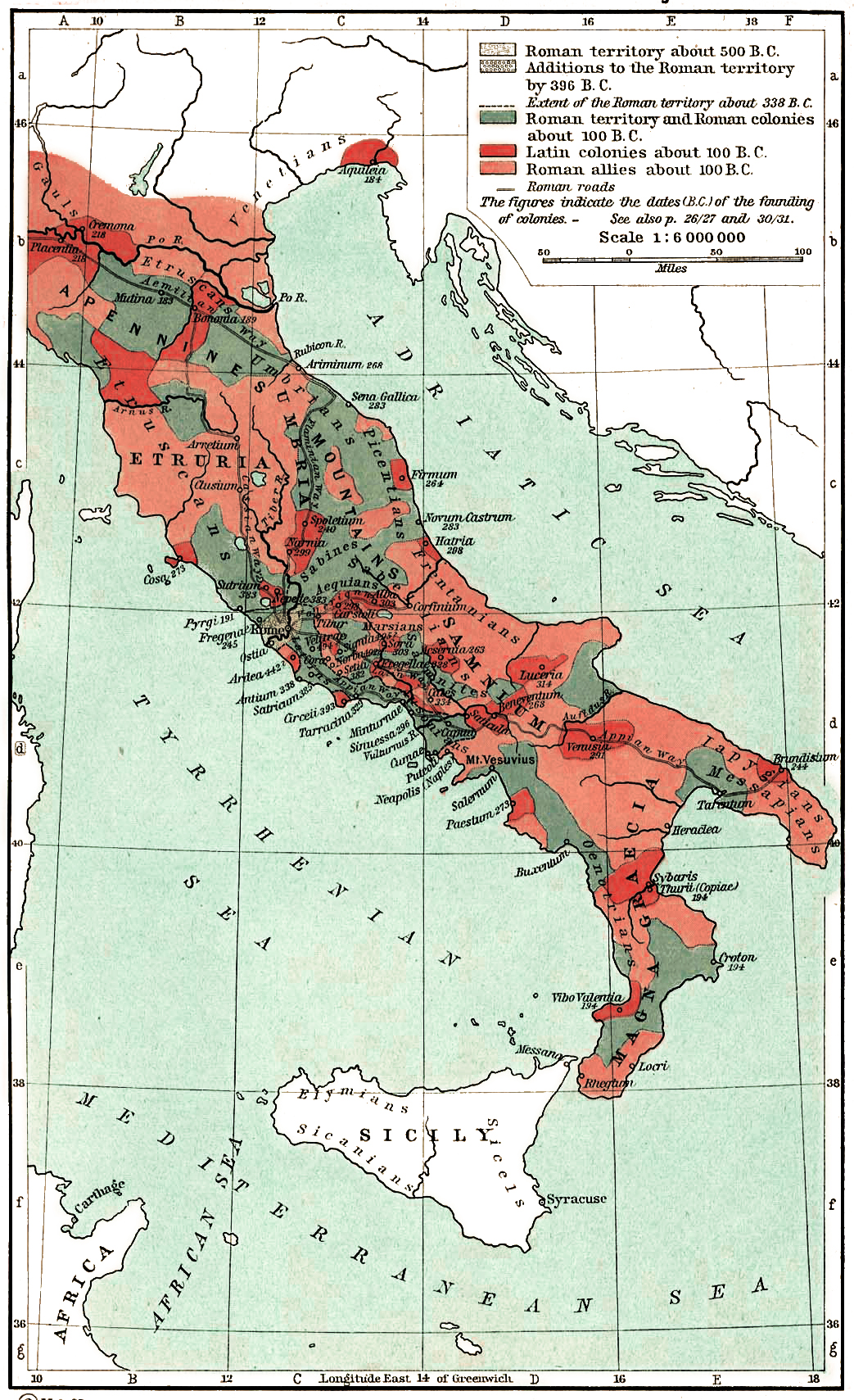
Consequently, the game essentially flips the proportions that Rome is going to have with its socii throughout its history: the socii from an early point modestly outnumbered Roman citizens, but in Imperator, even at the very beginning of the game, the Roman Republic is far bigger (399 pops) than all of its feudatories combined (23, 52, 22, and 30 pops; 127 combined). And that really matters because it changes what was historically a mid-sized Roman Republic leading a larger ‘alliance’ (really, subject) network to a larger Republic that is strong on its own, which happens to have a few, largely negligible ‘hangers on’ vassal states.
And that isn’t likely to change either: as Rome expands, either by player or by AI, it is going to tend to absorb those feudatories and – unlike the actual Roman Republic – not create any new ones, meaning that often by the early or mid-third century, Rome will have direct control over the whole of the Italian peninsula with no socii at all, a thing that did not happen historically until 87 BC.
The reason the player will do it is that whereas historically the socii system was crucial to Rome’s ability to mobilize military force in Italy, far more effective than direct imperial rule might have been, in the game feudatories are generally inferior to direct control. The way feudatories work is that they join all of their overlord’s wars with their own armies and contribute 15% of their manpower gain to the overlord. In a war then, feudatories make it slightly easier to replenish damaged armies and contribute their own, independent tiny armies (which have a nasty habit of just getting annihilated, ‘stack wiped’ in the parlance, because they’re too small). But that’s now how Rome’s socii system worked! The socii didn’t supply small, independent armies, instead their military system was wholly subsumed by the Roman one – there were no independent socii armies.
More broadly, the player is going to want to move out of this system for obvious reasons: why accept 15% of a feudatory’s manpower gain when you could control that territory directly and get 100% of that gain? Especially because feudatories require being in the same ‘culture group’ as the overlord, which reduces happiness penalties for not being the primary state culture (meaning it is less punishing to absorb them). Moreover, while feudatories contribute some amount of manpower, they do not contribute levy-capacity and generally speaking it is levy-capacity, which governs how many troops a state can field at once, more than manpower, that is important to maximize. While feudatories do have their own armies that fight the same war as you, unity of effort is important and it is simply more valuable to have that levy capacity under your direct control.
And I think the developers seem to have known this, because the AI makes no effort to generate a Roman-style system of socii either, instead directly conquering Italy as it can, and incorporating the feudatories back into the main Roman state as quickly as possible. The socii system thus becomes an odd quirk of Rome’s starting position, quickly abandoned by both the player and the AI, rather than the key to Rome’s military success.
In place of that actual system what Rome gets in Imperator is a series of direct and indirect bonuses. The direct bonus is that Rome gets a +2.5% flat bonus to levy size for ‘Roman Heritage’ (which makes it all the more important to absorb those feudatories so that the bonus applies to them too, as they get different ‘heritage’ (state-specific) bonuses). Indirectly, Rome’s ‘Roman military traditions’ (a military tech tree; each culture has specific ‘military traditions’ they can unlock) includes another +2.5% levy size multiplier, along with +5% manpower recovery, and substantial bonuses to infantry stats, along with access to a set of ‘military reform laws’ all of which (save for the ‘Marian Reforms’) come with substantial bonuses to levy size (5%, 7.5% and 2.5% respectively). Thus, unable to model the system by which Rome raised large armies, the game instead gives Rome a set of bonuses to ensure that it simply gets larger armies, regardless.
On the one hand, this is a theory of history, an awareness of what I’ve termed above the ‘manpower thesis.’ On the other hand, it is unfortunately a fairly unsophisticated version of that theory of history, understanding that Rome had ‘allies’ and that Rome had an advantage in manpower, but not quite able to put into mechanics how those two things relate. I don’t think this is necessarily because the developers didn’t know, but rather because simulating complex, composite states like the Roman Republic in a way that is fun to play and clearly legible is really hard.
Marrying Your Manpower
Carthage suffers the same problem, but processed through an uncritical acceptance of Polybius’ narratives. To be fair, Polybius’ position, that Carthage’s armies were made up of ‘mercenaries’ is still repeated uncritically in most textbooks, even as it has long been challenged in the specialist scholarship, so I am not surprised that this was the model that Paradox went with. But as with Rome, Carthage is a much more complex creature than the game lets on in important ways.
The tricky thing here really is simply the word ‘mercenary.’ The word Polybius is using when he describes Carthaginian armies as ‘mercenary’ is misthophoroi (μισθοφόροι), literally ‘wage-bearers.’ In English, the word mercenary implies a foreign soldier, serving purely for pay in a conflict to which they have no real part, but misthophoroi doesn’t carry all of those meanings. Instead, a misthophoros is simply a soldier whose compensation is in the form of a wage rather than rewarded with land settlement or a duty of citizenship; we might actually better translate misthophoros in some cases as ‘professional’ rather than ‘mercenary.’ Even then, I will note, Polybius is irregular in his use of the term (particularly when he turns it to the Hellenistic kingdoms), often classifying soldiers as misthophoroi or not when it suits his rhetorical purposes. He isn’t making things up, mind you, but Polybius will sometimes emphasize that wage-earning and in other cases de-emphasize it, as suits his purposes. He is trying to draw a contrast between Rome’s citizen soldiers and ‘inferior’ mercenary troops, but in doing so obscures that in many ways the Roman and Carthaginian systems are more similar than he’d like to admit.
Imperator, however, takes him at his word. Dotted around the map, throughout the game are mercenary companies which, for a large sum of ‘gold’ (I really wish the currency in Imperator was, as would be more correct, talents of silver) can be hired. These companies have the cultural unit mix of the culture that dominates the area they are hired from, and you can hire mercenaries from another country’s region easily enough if it is in your diplomatic range. Just as Rome gets bonuses to levy size, Carthage gets penalties to levy size, but bonuses to mercenaries, able to hire both more and (through their military traditions) more cheaply. Combined with Carthage’s strong economy (and a 10% export value bonus), the Carthaginian player is encouraged to rely on these mercenaries, recruited from wherever.
And you can see how that seems like a reasonable and straight-forward extrapolation of what Polybius says about Carthage’s armies…but that’s not how Carthage’s armies worked.
On the one hand, it is the case that Carthaginian citizen soldiers are exceedingly rare. Apart from serving as generals, Carthaginian citizens didn’t fight much and the Carthaginians do not seem to have put much value in one’s ability to do so (which doesn’t meant Carthage didn’t value war or was peaceful; it was aggressive and bellicose, like everyone else). But Carthage didn’t just hire mercenaries from wherever; instead Carthage recruited troops from the territories it controlled, directly or indirectly, and then paid them. That is a system which, at a good deal of abstraction, describes the military systems of most large ancient states (except Rome, which didn’t pay the socii).
Taylor, in Soldiers and Silver (2020), does a good job of taking an inventory of the various sources of Carthaginian manpower, particularly in the Second Punic War, where we can see it most clearly and identifies fundamentally four core sources. First off, Carthage employs a lot of troops recruited from the regions of Africa it controls, sometimes described as ‘Africans’ and sometimes as “Libyans” in our sources, often as many as 40-50,000 of them (it’s unclear if there is always a meaningful distinction between ‘Africans’ and “Libyans” as described by our sources, by the by). These fellows often serve as the heavy infantry backbone of Carthaginian armies, though some ‘Libyans’ may have been light troops.11
The next key source by distance (but not size) were the Numidians. There were two key culturally Numidian kingdoms, Massaesylia, and Massylia, and at any given time at least one of them was effectively a vassal-ally of Carthage. Carthaginian generals – the title was rabbim or rab mahanet – who served for long periods, have a notable tendency to marry into the royal Numidian families, especially strange because the impression we get is that the rest of the Carthaginian elite did not marry out. But, thinking back to how mobilization works in non-state or proto-state societies, you can immediately see that those generals are using a standard tool of non-state aristocratic power building: those marriages give them the ability to call those ‘Big Men’ with their retinues to war, giving them access to Numidian cavalry for their armies. And Numidian cavalry was some of the best in the ancient Mediterranean, so that was a formidable advantage to have. While Carthage recruits tens of thousands of heavy infantry from its settled, urban African holdings, Numidian cavalry was a scarcer resource, a few thousand here, a few thousand there, perhaps never more than 10,000 or so total, but very valuable.
The next key chunk – and by 218, by far the biggest – were Spaniards. Carthage had maintained trade contacts and a mix of both small trade posts and colonial settlements in Spain from a relatively early date, but it is after the end of the First Punic War (264-241) and the subsequent Mercenary War (241-238; a revolt of Carthage’s African mercenaries along with the subject communities from which they were recruited, which Carthage defeats) that a family of Carthaginian generals, the Barcids (first Hamilcar and then his sons Hannibal, Hasdrubal and Mago) begins a large-scale conquest of Spain. That said, when the Second Punic War starts in 218, Carthaginian control – very real and very violently enforced – on the Mediterranean coast of Spain is still quite new. The Barcids rule through a mix of diplomacy with ‘tribal’ leaders – including some marriages to Spanish tribal princesses – and force. They rely, in particular, on the support of key Iberian warlords called in our Latin sources reguli (‘little kings’ but more clearly ‘warlord, chieftain’) with whom they have personal alliances. In short then, this seems like a mix of colonization, but mostly an extension of the Numidian system to embrace a whole new set of Iberian peoples.
Those relationships in turn provide Carthage access to enormous numbers of Iberian troops over the years, making up around half of all of Carthage’s soldiers, providing both Iberian infantry (‘mediums’ who served as line infantry) and cavalry in quantity. Taking a snapshot in 215 (the year when Carthage has the most troops, almost 165,000, under arms) there’s about as much Iberian cavalry in Carthage’s army as Numidians, and about as much Iberian infantry as there are Africans and Libyans combined. Moreover, as the war wears on, while Carthage’s supply of African troops seems to decline, Carthage regularly raises huge fresh armies in Spain (until it is lost to them in 206), so Carthaginian reliance on Spanish manpower grows over time. For the curious, this is almost entirely Iberian manpower – the Celtiberians, though bellicose and famously willing to serve as mercenaries are outside of the zone of Carthaginian control and so figure only infrequently into their armies.
Finally, when Hannibal crosses the Alps and approaches Italy, he finds a lot of Gauls in the Alps and Cisalpine (Italy-facing) Gaul who had bones to pick with the Romans and were thus willing to side with Hannibal. Something on the order of 25,000 of these fellows work their way through his army over the course of his campaign, but we don’t see larger numbers of Gauls generally in other Carthaginian armies. Hannibal has them because he marched through their homeland and they share an enemy, though we ought to imagine their recruitment too probably looks like the Numidian and Iberian case (minus the marriages): alliances with local tribal leaders giving Carthage access to the troops.
Now it is the case that Carthage is clearly paying these fellows, but as you can see here, they’re not quite mercenaries in our sense of the word. All of these soldiers are being recruited from various peoples we might correctly describe as subjects of Carthage. The key difference between this system and the Roman system is that whereas Rome offers its subjects protection and immunity from tribute and then gets their soldiers ‘for free,’ Carthage imposes tribute and uses that money to pay for their troops. In that sense, they are misthophoroi – wage-earning troops – but hardly external foreign mercenaries. Polybius wants to make the point that Rome’s citizen-soldier model is more effective (and he’s right), but that isn’t the same as supposing that Carthage orders its armies on Amazon. Notably absent in nearly all Carthaginian armies are the Greek, Thracian and Galatian mercenaries which were everywhere in the Eastern Mediterranean. Carthage surely could have hired them, but didn’t, instead opting to recruit from its own domains.
We cannot know – no source tells us – but to judge by the sums of money Carthage is spending, one reason is that their sources of manpower in the West seem to have been a lot cheaper. We hear of one planned cash infusion of 1,000 talents (6 million drachmae) and another infusion where the number is lost in the text (Livy 23.13, 23.32), while recent estimates of Carthaginian revenues tend to be between 15-20 million drachmae.12 That’s a lot, but much, much less than the c. 50m drachmae we suppose the Seleucids pulled in annually, or the 75m the Ptolemies did.13 So with less than half of the revenue, Carthage is putting out twice the soldiers, suggesting they’re paying a fair bit less for these fellows. What is striking is that it isn’t clear that Carthage sacrificed much quality for this: their armies had plenty of war elephants and on average don’t seem to have been much more cheaply equipped than their Hellenistic peers.14 Sure, Carthage is employing lots of cheap light troops (Iberians, especially), but so are the Hellenistic states.
In short, then, one thing that is really important to know about Carthage’s armies is they’re not just mercenaries hired from wherever: if they had been, Carthage could never have matched, much less doubled the deployments of the much wealthier (in state revenues) Hellenistic states. Instead, Carthage is using its territorial control and aristocratic alliances, it sure seems (we can’t know for certain) to pay something like a ‘discount rate’ for its vast armies. Alas for Carthage, that was still too high as compared to the ::checks notes:: nothing that Rome paid for the socii.
The Trouble With Complex States
So on the one hand Imperator wants to express some true historical things about Rome and Carthage: that the former relied on citizen-soldiers (both Roman and then the citizens of the socii) while the latter relied on hiring wage-paid troops from its imperial possessions and vassal polities.
Where Imperator struggles on both points is capturing exactly how these systems worked, and I think the problem, apart from some outdated or insufficiently specialist history at work is that these states are just really complex in ways that are very hard to capture in a game context. Rome, if proceeding historically, by 218 should have dozens of socii or otherwise subject communities; Polybius breaks the socii in his census (Polyb. 2.24) into seven large groups, but each of those was composed itself of many subordinate communities, each notionally with just a bilateral relationship with Rome. For a player running another country, trying to even parse such a vassal swarm on the map would be very hard to make anything other than frustrating.
But the broader trend, which we’re going to see become a theme in this series, is that Imperator struggles to model the Roman Republic in particular because the design precepts of the game – and indeed, the broader genre of Paradox grand strategy games – demands a single set of rules that encompass most, if not all, of the polities on the map. Crusader Kings (both II and III) has traditionally dealt with this problem by picking a core focus kind of government (vassalage-based polities) and leaving the odd exceptions (Republics, the Byzantines) for later expansions, enabling the design to focus on a single broad model of governance.
But that approach simply isn’t available for Imperator, because the spotlight has to be on the Roman Republic, which as a state works very differently than every other Mediterranean polity. It is perhaps most similar to Carthage, but as you can see above, not very similar even then (something that will become even more clear when we get to politics). Indeed – and this too will be a trend – Imperator is best at simulating not the Roman Republic on which it is notionally focused (I mean, the title is the Roman word for ‘victorious general’ and Rome), but the major Hellenistic monarchies of the East.
And, to take a brief stop, the Levies-Legions-Mercenary system actually simulates those armies – Hellenistic armies – quite well. Under the ‘Royal Guard’ military reform (easily obtained for those kingdoms) they end up with an army that looks quite a lot like a Hellenistic army: a professional core raised from integrated culture pops (read: Macedonians) living in the imperial core (Syria, Mesopotamia, Alexandria – where the Greek-speaking colonies are!) reinforced by levies raised from their outer domains, with some Macedonians in them, but also bringing large numbers of local troops fighting in local styles, finally occasionally supplemented with mercenaries hired from the kingdom’s border regions. But it doesn’t fit the armies of the Roman Republic particularly well at all, which is a problem as those armies as the ones that are supposed to be the stars of the show!
I certainly think it is possible to create a military-political system which captures the complex ways that Rome and Carthage raised armies, but such a system would have to be granular and complex in ways that would fit every other power in the Mediterranean very poorly and would probably make playing a lot of them a tremendous chore. Instead, the clear choice is for different states to have lots of bespoke mechanics: one military system for Rome and Carthage, another for Hellenistic monarchies, a third for non-state peoples. But development time and resources are limited. One suspects the plan was always to launch with a single system that didn’t quite fit anyone perfectly, but captured something about everyone and then in DLCs and expansions to flesh out culture-specific systems with different rules, but of course Imperator did not develop a player-base sufficient to justify that development. In part, I suspect, precisely because its single military system ended up feeling a bit flat.
It is a nasty catch-22 inherent in the era, but also part of why I really hope Paradox does, in fact, go back to this era, either with an Imperator II or another, similar project, to iterate on these mechanics. After all, Rome wasn’t built in a day – and that’s where we’ll turn to next: Imperator‘s take on pops, development, ancient economies and urbanism.
- I get the sense – from public statements and dev diaries, I have no special visbility into Paradox development at present – that a move from development to pops may be in the cards for ‘Project Caesar,’ which would bring that series’ expression of this system into line with Imperator‘s.
- Roman Imperialism in the Late Republic (1968)
- War and Imperialism in Republican Rome: 327-70 B.C.. (1979). On the author, please note.
- On this, see also K. Raaflaub, “Born to be Wolves? Origins of Roman Imperialism.” In Transitions to Empire: Essays in Greco-Roman History, 360-146 B.C., in honor of E. Badian, edited by R. W. Wallace and E. M. Harris (1996).
- P. Low, “Looking for the Language of Athenian Imperialism” JHS 125 (2005): 93-111.
- This is something, I note, that Paradox’s design philosophy has changed on. Both EUIII and Victoria II feature a number of ways for wars to expand after they’ve begun, with new participants ‘jumping in’ after hostilities have begun. It’s not hard to see why they’ve shifted to a system where the participants in a war are basically fixed once it has begun: having a ‘surprise’ power jump into a war after it has started is extremely frustrating and unpredictable for players, even if it is a thing that happened a lot, historically.
- That is, the lack of Latin and later French as a shared diplomatic language (Greek comes close in antiquity, but not quite close enough) combined with the shared cultural touchstones provided by Christianity in Europe.
- Brunt, Italian Manpower (1971); De Ligt, Peasants, Citizens and Soldiers (2012). Among other technical issues here, Polybius has quite clearly double-counted a few small groups and has not accounted for less than a 100% response rate to the census.
- Before my publisher reads this and panics, worry not – I plan to have normal human section divisions. But also the third subheading under the second heading of the sixth chapter which is in section 2 is, in fact, titled ‘warlords and youths’ in my current draft.
- The key communities here are ::deep breath:: Cales, Volturnum, Casilinum, Capua, Atella, Abella, Calatia, Sabata, Suessula, Acerrae, Nola, Nuceria, Surrentum, Pompeii, Herculaneum, Neapolis, Puteoli and Cumae. For more on this region in the Second Punic War, the thing to read is absolutely M. Fronda, Between Rome and Carthage (2010).
- On the tactical composition of Carthaginian armies, see J.R. Hall, Carthage at War (2023), 28-30. We know a lot less than we’d like.
- Taylor, (2020) and D. Hoyos, Hannibal’s Dynasty (2003).
- Figures from Taylor (2020) again.
- This is actually a question I go at in some detail in my book!

The game I would like to see you cover is the Field of Glory II battle sim, covering a couple of millennia with DLC, and several hundred years with the Field of Glory II Medieval sequel.
Looks good, and we’re spared Total War-style tactics, but it feels like you have far too much control over your army – as if all your commanders did what you wanted them to do (at least until the troops run away..)
If we’re talking games that I’d like to see our good host cover, I’d really like to see his take on the old Avalon Hill Advanced Civilization. Not a war game really though, most of the focus is on trade and recovering from periodic and inevitable disasters that strike.
Just want to agree with Adam here.
‘Advanced’ Civ was heresy – something all Civ players will be familiar with! – not least as they did it without bothering to consult the designer of Civ.
Francis Tresham never took one year to design a game when he could take five (or more) and that shows in his two greatest: 1829 and Civ.
I might be jumping the gun here, but I find the term rab mahanet interesting. If you used those terms in Hebrew, you’d get something like “master of the camp”. Note that this is master more in the sense of like how a martial arts student in a kung-fu movie calls his teacher and not enslaved worker addressing owner (that would be ‘adon’), so perhaps leader or expert of the camp would be more thought to thought.
Of course, that assumes that whatever language the Carthaginians were speaking and using for their military terminology is similar enough to Biblical Hebrew that you can make a comparison, but I do find it interesting that they seem to name their war leaders after the camp and not say, the men they command or some sort of arm of the state.
Yes, they were speaking Punic, which is fairly closely related to Hebrew – both are West Semitic languages.
I’m no expert, but given that the Carthaginians are descended from Phoenicians out of modern-day Lebanon, and that they speak Punic, a Canaanite language closely related to Hebrew, that sort of linguistic connection seems very plausible.
Both Hebrew and Carthaginian are indeed Canaanite languages. However, the adaptation of “rab/rav” as an honorific for experts rather than nobility is a relatively recent (post-Revolt) Hebrew innovation.
ie Pre-Rabbinic “rabbi” (lol) is usually translated as “my master”.
For some examples – the sea captain in Jonah is “rav haKhovel”, some Babylonia officers are called “rav”, &c
“Master” not as in owner but as in “chief” or “head”, similar to “rashi” in Modern Hebrew.
Yes, and this usage of rav persists in modern Hebrew: a sea captain is still called rav ḥovel, and a number of top ranks use rav as an over-rank, such as the IDF’s chief of staff’s rank, rav aluf (one rank above aluf), or the major rank, rav seren (seren meaning army captain), or the chief of police’s rank, rav nitsav (one rank above nitsav).
Paradox’s unfortunate obsession to make all countries on the map playable means that they cannot go into too much depth with any of their mechanics.
This, incidentally, is explicitly why they’ve never successfully made a Cold War game. It’s too difficult to craft a game where both Vietnam and the United States are fun, playable, and understandable. East Vs West should’ve focused only on making the superpowers playable, and then expanding to a handful of other states via DLC.
I’d love it if Paradox made a game that focused solely on one political entity.
The above reply of mine was meant to be a stand-alone comment and not a response. Sorry about that!
Yeah, I should have been more precise; I was really trying to draw a distinction between master in the sense of owner of an enslaved person, as opposed to a more generalized sort of leader. The root is related to “rov” for having something in abundance (usually money), and yeah, leader, excellent person, rich, etc.
So, “magister” vs. “dominus”?
I don’t know enough Latin to say for sure, but judging from the Spanish cognates I’m gonna guess yes?
Well, Carthage spoke Punic, but they are both Canaanite languages, so there’s probably some link.
One of the little things I remember reading in one of the articles Bret linked was that the chief religious magistrates in Carthage were the ‘rab Kohanim.
The elected heads of state in Carthage were called “shofetim” (“judges”), if that gives you a better idea of how similar the languages were.
I know it’s outside your expertise, but I’d love to see a post on why and how Napoleon managed to (briefly) break the European interstate system (and why others before him failed).
The ‘classical’ answer I assume would be the enormous new manpower available to the French Republic and the elimination of fortresses as ‘army breaks’ (for various reasons, including the French breaking away from reliance on supply trains and deploying more foraging in enemy territory).
But I’m not an expert, hence my request for a better analysis 🙂
Speaking as a nonexpert myself, it’s mostly the manpower, yes. France achieved this through a combination of populist idealogy, comparatively egalitarian meritocracy, and simple economic advantage. Liberalism was a powerful motivational cause, and soldiers knew they could earn success through service and merit, which helped recruitment and performance.
There’s also something to be said for Napoleon himself. He really was a brilliant operational general, and his operations remain militarily relevant today. His ability to inspire and identify talented generals, Marshalls, and staff officers also deserves credit. He was also good at tactical combat and drill; his flaws were all on the strategic level. The scholarship has rebounded a bit towards just accepting that he really was that good, after a general negative reaction to “great man theory”.
Bret may know more, but I wouldn’t be surprised if he offloaded the analysis to a source entirely either. It’s a complicated question, even if the answers are simple.
I’d question Napoleon actually managing a hegemonic breakout: Notably despite his successes (and they were impressive) he was taken down by a coalition. In that sense balance of power politics remained at work, and he was never really in a position of absolute dominance when he didn’t have a near-peer poking at his side.
That’s a fair point, although he did conquer almost all of Europe, something which hadn’t been done in centuries, and within the span of less than a decade. Louis XIV, one of the more aggressive French kings, spent decades nibbling away at the borders of surrounding states. The comparison is pretty striking.
Napoleon then lost it all by trying to invade Russia (overambition). If he hadn’t, I wonder how long French continental dominance would have lasted.
The French invasions of Russia and Egypt were both intended as (very) roundabout attacks on its remaining peer competitor in Western Europe. They may not have been wise, but they were not frivolous.
But I would call him foolish for trying to displace the Spanish monarchy, pointlessly turning an ally into a bitter enemy. Still, that was hardly the only mistake anyone made in the wars.
One of the things about Napoleon is that France was the demographic and economic giant of Western Europe which made it poised to breakout unless contained for centuries prior. This only changed when 1871 up ended the league tables, and the psychological blow to the French ruling elites about losing that status was a major contributing factor to the outbreak of WW1.
France was the first country to undergo the demographic transition, through a combination of secularisation and contraception. This meant fewer soldiers, as well as fewer emigrants who could populate French colonies. Germany’s larger population frightened the French leadership. After WW1, Clemenceau stated that without a higher birth rate, the Versailles Treaty would be worthless.
https://worksinprogress.co/issue/frances-baby-bust/
Yes, and because of that obsession with birthrates, post-WW1 France didn’t even let women vote, arguing against suffrage with the line that in the countries that did let women vote, birthrates were falling.
There’s two main flaws with this analysis, although the first issue isn’t definitive.
First, while I can extend trust towards the data, the reasoning for why is suspect. For one the supposed measurements of secularism are much weaker than asserted; there’s stronger evidence than presented for a shift in England circa 1700 as well. For two the traditional cited cause is inheritance law, which provides a material alternative to secularism as a source of culture, and isn’t addressed directly.
The bigger problem is that the paper is missing the more pertinent question, which is why France didn’t expand via immigration. Immigration was a big part of UKs catch-up mechanism, and the driver behind America pulling away from Europe. The question shouldn’t be why did growth rates collapse, but rather what made America a destination for immigration and France a complete nonentity. The traditional answer is space and liberalism, but if France had such a clear demographic decline because of secularism that suggests both those factors might have been present there as well.
I’m much more interested in that question than why the demographics switched, because as the paper points out in a roundabout fashion it’s not like you can go back; the secularism they’re holding as a cause was brought about by attempts to enforce religion on the population and a corresponding backlash.
“Immigration was a big part of UKs catch-up mechanism”
I get the distinct impression that the UK had net emigration in the 18th/ 19th centuries. Do you have a source that demonstrates otherwise?
Ah, I made a mistake. I looked at the percentage of foreign born citizens over time and didn’t catch that both immigration and emigration were occurring. Embarrassing.
I might still be right because of how many Irish immigrated at the critical switchover point in the 1800s, but the easy data doesn’t provide a clear “net emigration or immigration” answer. The UK was clearly a net emigrater from 1900-1930, but the demographic balance had already basically switched by then.
My point applies to America of course.
“Immigration was a big part of UKs catch-up … but rather what made America a destination for immigration and France a complete nonentity”
The US had vast amounts of land appropriated from the natives so even the wealthy peasants in Europe (who could afford a ticket) could vastly increase the amount of land they were farming by immigrating to America. The United Kingdom was mostly getting immigration from across the Irish Sea where the native population was fleeing starvation at the hands of… the United Kingdom.
“there’s stronger evidence than presented for a shift in England circa 1700 as well”
England had an even more drastic transformation then France did. The Industrial Revolution didn’t just happen out of nowhere, the power of the British state (as in the power of the society to do stuff not the power of the government over the people) grew enormously in the 18th century. It was particularly visible in finance and maritime matters. The changes in France while drastic in comparison to most of Europe were clearly a step below the changes in Britain. If you look at the manner in which England won the Seven Years War (in particular the North American theater of the conflict) and the Napoleonic Wars, it shows the way that England had grown powerful even more rapidly. English power was very much on display when they could finance armies in Prussia and Russia while France could not even finance armies in New France.
On immigration to the US vs the UK in the late 19th century, worth bearing in mind that “peasant” is a very transferrable skill; perfectly plausible for a Swedish peasant to think to himself “I could go and live in Minnesota and do essentially what I do now, with a few slight changes, but I’d have ten times as much land to do it in. Brilliant. Let’s go”. Much less plausible for him to think “I’ll go over to Britain and get a job at Vickers or John Brown” – he’d need to learn English and acquire a lot of new skills.
The Swedish industrial workers did learn English, to be able to emigrate more easily or threaten employers with emigration if the employers didn’t recognize their unions, to the point that the unions held English classes in the evening; see Karadja-Prawitz (link).
Re France and immigration – France did allow considerable immigration in the early 20th century, mostly from Southern Europe. Its biopolitical strategy was both-and: keep women disenfranchised on the theory that it would boost birthrates, and also let in immigrants. (And then, after WW2, France had the biggest baby boom in Europe – after enfranchising women. Biopolitics isn’t based on good political analysis.)
As I understand it, the first is the (power of) the British nationstate.
Let me try that again, only this time without messing up my HTML tags
As I understand it, the first is the (power of) the British nation and the second is the (power of) the British state.
I know there’s some big overhaul mods out there for Imperator, and I’m curious if any of them address any of these critiques at all. I haven’t played I:R in a good long while, so I’m not super familiar with the mod scene.
“In place of that actual system what Rome gets in Imperator is a series of direct and indirect bonuses. The direct bonus is that Rome gets a +2.5% flat bonus to levy size for ‘Roman Heritage’ (which makes it all the more important to absorb those feudatories so that the bonus applies to them too, as they get different ‘heritage’ (state-specific) bonuses). Indirectly, Rome’s ‘Roman military traditions’ (a military tech tree; each culture has specific ‘military traditions’ they can unlock) includes another +2.5% levy size multiplier, along with +5% manpower recovery, and substantial bonuses to infantry stats, along with access to a set of ‘military reform laws’ all of which (save for the ‘Marian Reforms’) come with substantial bonuses to levy size (5%, 7.5% and 2.5% respectively). Thus, unable to model the system by which Rome raised large armies, the game instead gives Rome a set of bonuses to ensure that it simply gets larger armies, regardless.”
So, the professor does not explain what these numbers mean, and I think they may be quite deceptive for anyone not familiar with the game. A “+2.5% bonus to levy size” should be read as “one additional cohort (500 man unit) for every 40 free (non-slave) pops of an integrated culture”. A typical non-tribe polity with default laws and no other bonuses gets one cohort for every eight such pops (i.e., has a “12.5%” base levy size), so a +2.5% bonus actually translates to a 20% increase in troop count.
Just in case anyone thought those numbers sounded small.
I dearly wish that more people – and in particular more video game developers – were familiar with the difference between percentages and percentage points. It would neatly avoid misunderstandings like these.
I haven’t played the game, but to me it doesn’t seem too difficult to create a system that could approximate the different military and political systems:
-map full of political communities – civitates, poleis, ethnoi, and the like. They can subjugate others or be subjugated in various ways but almost never annexed in a way that makes them cease to exist as independent AI actors. (If there were too many of those in history for the computer to run smoothly, reduce them to the more important ones.)
-subjugating them allows for setting tribute and levy, but the system has inertia: if you do it differently from what they or your citizens are used to, the pops get mad; money can be used to recruit from them as an alternative to levy.
-the Seleucids and Ptolomais (and later on rebelling generals) are also treated as such political communities, but they don’t have a core territory.
-member-pops of one political community can settle on territory of other political communities, representing the Roman colonies in Italy or the Macedonian settlers in the Seleucid and Ptolomaic empires
So you have a three tier system: pops make up political communities (and most political communities hold territory), political communities make up states (a state can only have one political community on top, but that can be a city/citizen body or a dynasty or something else). If we don’t want to stray too mach from Imperator and make individual persons playable, then the player would play as those political communities, not as the states. So you could play as Capua and defect to Hannibal, for example.
Wrote up a more detailed idea list for this sort of game last summer. Was planning to finish some edits and post it in next week’s post, but responding to this comment works as well.
link
The main problem in your system and in conventional vassalage implementations is that the resulting gameplay is not necessarily fun. You conquer territory but can’t administrate it. You are large, but you can only really count on your tiny core, because your 20 AI vassals will backstab you as a coalition as soon as the artificial diplomacy penalties stack up high enough.
Paradox would have to provide a vassalage system that provides enough levers to be worth expanding and maintaining, so that vassalage is not just an inferior, early stage of conquest. CK accomplishes that, but CK is almost entirely about vassal management.
And EUiv, coming out of the CK era, starts with several regional powers that are built as these sort of heavily-vassaled complex places, and they really aren’t fun. The HRE and Japan have extra mechanics to extend that start well into the game and the HRE especially is super not fun to play in or against until you get to be a really experienced player. With the Buddhist mechanics the patchwork of minor countries east of Bengal can also be incredibly tedious.
I actually think the solution in imperator is just not to give subject states armies. Vassals in eu4 represent the remnants of semi independent feudal actors so the call swarm mechanic makes some sense (even if annoying). In imperator it doesn’t though., because armies were centralized. Just give Rome 100% of the manpower and levies from its socii and make administration easier.
Or to simply represent the socii as a form of internal administrative unit. Some designation that makes socii regions give their manpower, units, and levees to their owners at reduced cost without having administrative upkeep or providing tax. Maybe make them vulnerable to sieges based on a loyalty stat and have disloyal occupied socci give their manpower to an occupier, to represent the risk of a snowballing uprising, albeit only if mismanaged or new.
There were client kingdoms in this time period. Mechanically having clients with separate armies and national systems and bonuses makes sense, as these clients had all those things. The headaches and benefits of having semi independent allies that were varying degrees of integrated with the Roman military and of varying speciality and competency are pretty accurately modeled by vassals here.
It’s just that the socii aren’t that.
Honestly, one problem with doing a good vassalage system is that the AI is just bad. I haven’t played IR, but in CK3 I’m not exactly checking payback periods when I decide what income buildings to build yet I still consistently outbuild the AI. CK3 just straight-up forces you into vassal management by limiting your domain size, imposing drastic penalties if you exceed it even slightly.
To make the Socii system work and be desirable, an unintegrated Socii would need to provide more levies and manpower than an integrated Socii province, at least one that’s been freshly conquered instead of painstakingly diplomatically integrated. This is certainly possible, but getting 15% of their manpower is not it. Having their armies fight alongside you also isn’t a great reward because the AI won’t control them very intelligently; if you are lucky they will follow your main stack around.
I wonder if there’s a way to integrate allied/socii armies in a way that makes it clear they are not under your direct control, but that also makes them feel useful.
The obvious first step would be to make socii armies “free” but available in proportion to the number of troops you were able to raise in your core territory. Like, for every 10 romans you can put in the field, your socii will put forward somewhere between 5 and 15 of their own troops depending on how much they like you, up to a certain manpower limit (which might also be affected by their opinion of you).
On campaign, I think you’d want the option of keeping them in your main stack, where you control them, or sending them off to operate under AI control, perhaps with simple instructions.
I actually think this concept might work better in a game like Empire: Total War, where the player directly controls the armies in battle in real-time. I think in this case, allies/socii would be a useful way to field a much bigger army than you could otherwise afford, and that it would be easier to simulate different levels of control over your own troops vs your allies.
I certainly like the idea of this. It also seems like a good way to produce some of the tension present in other Paradox games that seems to be lacking in Imperator (i.e. it seems too easy to break out and have no genuine competition). You could do it through diplomatic and/or cultural technologies (potentially with multiple routes).
You could have a couple of different tiers of relationships with these different ethnoi, built through a combination of available technologies and in-world triggers (e.g. fostering a ‘shared culture’ mechanic).
The lowest tier simulates the poorly co-ordinated confederations talked about in the article above. In this one, you can form confederations with other small states but they do not provide a great deal of capital to you as a player, and their armies are not under your control so the effort risks being unco-ordinated.
The middle tier simulates the Hellenistic approach, with subject ethnoi providing proportionally more resources and supplying some troops that can join your armies.
The highest tier simulates the Roman approach, with subject ethnoi providing a great deal more resources and supplying an equal number of troops to your core ethnoi.
It might just be because I really enjoyed the whole counterfactual wildcard experience you got from things like Rome Total War, but making these mechanics flexible and achievable in-game by the AI would really help increase the late-game danger you’d face as a sizeable power.
Say you play through Bret’s Carthage campaign, merrily consolidating territory in Spain and North Africa. You come up against your first major hurdle with a Rome that has access to far more resources for a given land area than you. Cue life or death struggle with Rome. Let’s say you then beat Rome, and get to the point Bret trails off his game. However, instead of a mass of easily conquered territories, it turns out Dacia (or any other wildcard) has chanced into achieving a similar ‘state of mobilisation’ as Rome and has conquered a good chunk of territory in south-central Europe. Now you have another peer competitor to duke it out with, prolonging the tension of the playing experience.
Eventually, you could get to a state of play where even the surviving small political entities at the edges of the map (e.g. the Germanic tribes) have access to quite a sophisticated degree of deployment/diplomacy, and you might be able to wedge in some fun mechanics about the fall of the Roman Empire too (potentially in an expansion of some variety). Perhaps something along the lines of having high-mobilisation polities in close proximity makes it easier/cheaper to reach the required thresholds to achieve the higher Roman-style deployments. Meanwhile in the early game, Rome is one of the few places that already has it.
I think some tension here is that in most strategy games (CK being a big exception) the player takes the role of the state as an abstract and makes decisions to further the power of the state while in the real world decisions are made by elites who don’t necessarily have the best interests of the state as their top priority.
So, for example, as you point out “Rome’s decision to adopt an expanding, incorporative citizenship – in contrast to the closed ethnic hierarchies of its peer competitors” was a very VERY good decision from the point of view of the Roman state. In game like this adopting such a decision is a bit of a no-brainer from the point of view of the player. But if it’s a no-brainer from the point of view of the player then everyone will adopt it and what gave Rome its edge gets obscured.
Few different ways to model this tension I guess:
A. Just hardcode things so that only Rome has this kind of view of citizenship and the player can see how much this helps.
B. Make it POSSIBLE for anyone to adopt this and other things that gave Rome a big edge but make the backlash against these kind of policies meaningful in play. This would make a lot of gameplay involve the player trying to drag local aristocrats kicking and screaming towards more open concepts of citizenship.
C. Have the player benefit in some ways from having more closed ethnic hierarchies. One way I could see this working is the player gets points for how glorious their original founding city is. Of course having a grand empire helps feed the capital but also the more of an asshole you are to your conquered city states the more you can feed your capital…while the nicer you are to your conquered city states the more armies you can raise. I could see something like this working for a ancient Mesopotamia game where having a socii-like system of would have the real downside of not being able to suck as many resources into glorifying your capital.
I think there might be a fun way to do A and set up the three(ish) systems (say, Roman, Carthaginian, Hellenic) in a way that was asymmetrical but balanced within the context of the game. Sort of like an ancient, map game version of Starcraft.
Say, the Hellenistic kingdoms are the best at extracting wealth from tributary polities, but they also have to pay the sticker price for all of their good units. They raise lots of money in peacetime, but a war that goes on too long will bankrupt them pretty quickly. Their tributaries never like them enough to stick their necks out for them, but also care much less about the player’s choices.
Rome gets its best units for free and has enormous manpower reserves through the socii system, but still has to pay upkeep and has a much smaller tax base. This can result in them being caught short if they incur sudden expenses in peacetime. The socii are also extremely sensitive to the player’s behavior, since their survival is dependent on the credibility of Roman security guarantees.
Carthage plays somewhere in the middle; it still has to pay for its best troops, but it can vastly reduce their cost by marrying members of the Carthaginian court into the families big men of its tributary polities, and *still* collect taxes from them. I would try to make this really powerful, but balance it out by introducing tension between the tributaries and the court, where this practice of intermarriage sometimes causes conflicts between them that create problems for the player.
If you wanted, you could include a fourth option for powerful confederations of non-state peoples by having lots of very small polities that play a little like the micro-polities in CK.
Start out politically fractured, but the more time they spend in close proximity to the larger states the more some form of ‘confederation’ statistic accrues which binds these micro-polities together by favouring mutual defence (and/or mutual aggression) policies.
They operate like a more extreme version of the Roman model, with practically nil upkeep on soldiers and a very small tax base, but the ability to put staggering proportions of their population under arms at once. If it needed more balancing, you could simulate the effect of putting so much of your population on the field at once by simulating the fragility of that approach. A major loss should put you in a very precarious position (making war risky), but be one of the only ways you can amass wealth readily (encouraging you to do war).
As a gameplay experience of facing them, this would make it surprisingly challenging (in a good way hopefully) to defeat relatively small tribal polities as a large state (simulating the challenges the Romans had with the Gauls), while adding in a sort of ‘ticking time bomb’ mechanic that would hopefully result in some of the things we see around the fall of the Western Roman Empire. Far more unified and dangerous non-state tribal confederations appearing (seemingly) out of nowhere on a scale that can challenge what established big powers remain.
As a gameplay experience of playing them, this might offer a ‘hard mode’ option for dedicated players, especially if the ‘glass hammer’ mechanic is implemented. Taking the Arveni to conquer the entire of the Mediterranean at the head of a Celtic confederation should be really rather difficult.
That sounds like an absolutely *awesome* idea. I think the addition of a culture whose military strategy could be summarized as “fuck it, we ball!” would add a ton of variety and, most importantly, generate tons of memes from the player-base contrasting them with their more stable and cautious competitors.
(I’m being flippant here, but I really do think this would be a fun idea).
I think it’s amusing how, by pushing Rome out of Italy and into the east, you have functionally created the Eastern Roman/Byzantine Empire several centuries early.
If we start with the assumption of a dog eat dog world where states build powerbases by conquest, logically all states should race to gobble up their smaller neighbors before their peers gobble up those neighbors. But that’s the exact opposite of the actual historical result.
The most glaring counter example are the three big successor kingdoms. In game a player starting as one of these powers would race to gobble up smaller neighbors to form a power base: Epirus, the various greeks south of Macedon, Rhodes, Pergamum, Pontus, Armenia, Nabataea. When the Romans come knocking in these regions a century or more later, the big 3 had conquered none of them. Rather then using their armies to conquer a powerbase, the big kingdoms kept fighting each other, ignoring the easier targets. The big successors gained and lost territory among each other but collectively they actually lost territory to the minor nations, the exact opposite of what a player would do.
Carthage does establish a powerbase by carving out an empire in more easily conquered territory but all the while they are throwing themselves into repeated near-peer conflicts, first with Syracuse then with Rome. From the perspective of dog eat dog power accumulation this is utterly irrational, dont waste effort trying to conquer expensive territory in Sicily when there is more fruitful conquest to do in Iberia.
Now Rome does snowball. But Rome isn’t snowballing by avoiding difficult fights to build up powerbase conquering small fish. Rome is getting into peer and near peer conflicts again and again, the only difference is that they keep winning again and again.
I think Imperator is fatally flawed for being built around powerbase building in the first place. Things should be more like a tug of war where one side might marginally gain on an opponent but until that opponent is broken, things will remain near peer. The board game Twilight Struggle about the Cold War seems like a good example of that dynamic. Until a player loses they are still still have fight in them because they are still drawing cards and cards are the primary resource. Removing the snowballing allows for a lot of subtle twists and turns of the Cold War, the exact kinds of twists and turns that are missing from Imperator’s gameplay.
I feel a large part of this comes down to the political philosophy of the time being very different (and thus badly served as a mechanic) from the “map-painting” approach of territorial control. These ancient polities defined themselves as representing and ruling a certain, mostly closed set of people: The polis of the citizens of Athens, the king of the Macedonians, the populace of Rome. Under that model, the state can’t really “take over” a strip of land without establishing a colony of its own people. It might subordinate the people living in the land in some kind of overlordship relation, but this was seen for the most part as a different kind of ownership than actual physical presence of its people, and a more tenuous one. Representing both as “strip of land colored in imperial purple” does the whole thing disservice.
That model also explains why the big states don’t “clean up” their backyard for the most part, and instead are more focused on peer-to-peer conflicts: The profit of warfare is front-loaded (in terms of tribute extorted, loot pilfered and cities razed to make space for your own people), while longer-lasting imperial overlordship is resource-intensive and not very profitable, especially because administrative costs explode with distance from your political centre (something no Paradox game has adequately simulated in my experience). Thus, just smacking down uppity minor polities in your periphery, but leaving them to govern themselves, should be more profitable than trying to actually integrate them into a more permanent empire.
The problem with the kind of “tug-of-war” model you describe for a notional game set in the post-Alexander Mediterranean is that the game is specifically supposed to let you guide a power with relatively modest starting size and control (e.g. Rome around 300 BC) into a Mediterranean-bestriding juggernaut. Rome did in fact snowball, and they did in fact do it by first integrating most of the Italian peninsula into their political structure. If other contenders for power in the Mediterranean world (such as the successor empires in the East) failed to do so, that doesn’t mean the game would be better for ruling out what Rome did in favor of a less decisive and effectual tug-of-war.
A tug of war doesn’t mean static, the dyamic you are saying is needed is exactly the kind of tug of war Twilight Struggle shows.
T.S. very deliberately has a shifting power balance over the game. In the early war, the Soviets are contained in one corner of the map but they have powerful cards to grow, leaving the US feeling constantly on the back foot trying to hold back Soviet power. Then American strength grows over time until by the late game the Soviets are left trying to cling to pieces of their far flung empire. Yet none of it is deterministic, the conditions are good for the Soviets to advance early and the Americans to advance late but it’s possible for the game to go either way at either point.
In the historical period of I:R you have three different dynamics of great power growth. The successors tried to conquer their most dangerous and difficult to defeat opponents. Rome grew in power by bringing peer nations into it’s socii system and later by creating tributary provinces. And Carthage created a powerbase through it’s colonization and mercenary system. The game lets any nation do any of these. The first is fruitless so the AI wastes it’s time doing it while the player grows. The second didn’t happen outside Rome but happens everywhere in game, producing ahistorical blobs. And the third is extremely effective in player hands and helps the player blood even more. In twilight struggle terms, it plays out as if the Soviets and Americans were given symmetrical decks. So while T.S. has a back and forth that is highly predicatable, I:R is a consolidation of power where the arc of history trends one way.
I think there should be a general status quo tendency but that status quo should shift over time to favor Rome and to a lesser extent Carthage. All nations should have a range of tools at their disposal to try to curtail each other’s power, tools that amp up in power when you have skilled leaders available. This should generally have a tendency back towards a status quo, barbarian coalitions collapse when a leader dies, the poleis check each other’s ambitions, the successor balance doesn’t shift much for it’s marginal conquests (although potentially the shifts might have been greater). Then Rome and Carthage disrupt this, Rome by being able to consolidate it’s gains into lasting power and Carthage (and later Rome) by being able to grow a colonial empire. That doesn’t mean that Rome will inevitably win over time, it’s possible that one of the other powers will hold back the tide. If Rome consolidates gains, dont let them gain at your expense and you aren’t doomed. But it should feel like a relentless storm, Rome needs to just beat you once to shift the balance a lot while your victories are mostly just maintaining the status quo.
As a separate comment on the nature of conquest in the era, I think the reason we don’t see big powers just automatically absorbing small ones every time breaks down to a number of factors:
1) Loosely speaking, “skill issue.” Many of the major powers of the Mediterranean c. 300 BC were in some way struggling to maintain stable control of their own territory. Carthage and Rome both more or less solved the problem and were able to expand rapidly (until they collided and Rome won), but the successor empires weren’t in good shape to consistently conquer small neighbors, especially if those neighbors were, say, on an island or the far side of a couple of mountain ranges. They could try, but the risk of the army suffering a disaster or being called away back home to sort out a provincial rebellion was ever-present.
2) In many cases, the prevailing paradigm of warfare was a sort of grand scale raid-and-subdue, rather than “paint the map my color.” Radical realignments of the borders of the known world was the province of really spectacularly successful powers (Alexander yes, Alexander’s second cousin’s great-great-grandson no). Typically, if you wanted to go win a war with Pergamum, you’d go trounce the army of Pergamum, scar up the city walls a bit, and go home carrying big Santa sacks of loot and a treaty whereby they keep paying you tribute until the next time they see an opportunity to wiggle out of it. It was not necessarily profitable nor practical to “annex” Pergamum, as compared to just beating them up and taking their riches.
3) Many of the small and medium states of the Eastern Mediterranean were scrambling like mad bastards not to get snapped up by the larger powers, playing assorted political games. The fact that the big boys didn’t succeed in annexing them quickly reflects the fact that while a player nation in one of these games WOULD, a competent player will run pretty much any state in these games with extremely ahistorical and excessive levels of success.
Point #2 pretty much invalidates the whole dynamic of I:R described by Bret’s article. If every army that isn’t Roman is taking it’s victory in terms of loot and unstable tribute treaties (which is generally pretty accurate), they wont have much of a snowball. The snowballing is just a Roman thing where early on they grow their army not take tribute and by the time they are taking tribute they have immense power to maintain that tribute until it evolves into integration.
A rethinking of the “coring” dynamic might capture this kind of difference. Conquered territory would initially be turned into tributary (a little money, little military power) and gradually integrated into something better over time. For Rome within the Italian group, that shift would be nearly immediate. For established states that shift would be slow even within a culture group and extremely slow outside of it. And for non state societies that shift would be extremely long even inside a culture group, people on the top want to exploit that advantage not restrain themselves to make it last.
The reason the big powers kept failing to expand was that they kept outrunning the areas where they had actual positive ROI for doing do: the Selucids were most obvious here, being stuck holding an empire with extraordinary garrison, administrative, and logistics costs without being able to leverage it into real power. They could barely maintain their borders against rebellion some years.
The Ptolomies were rich but had no manpower nor way of turning most people into it in their social order, meaning they simply couldn’t use their conquests very well even if their Egyptian trade empire should have let them cheaply power project.
Finally the various Greco-Macedonian based inheritors had manpower but were smaller than everyone else and were legitimately threatened by coalitions of near peers.
But all three major successors did try to expand, explicitly into their weaker neighbors, it just usually got hard checked by one of the others. It’s not really that they chose tributary relationships because they were cultural; they were profitable and quick, something a general could do after a couple good battles to recoup losses before he had to be halfway across Asia to go fight another army.
Some of the smaller states close to the large successors were quite wealthy, the mainland poleis and Pergamon spring to mind.
“But all three major successors did try to expand, explicitly into their weaker neighbors, it just usually got hard checked by one of the others”
Which rather compromises the dog eat dog paradigm, no? And if they keep trying then you would think that after a century there would be a fair few number of times where the dice had favored the gobbling up and not favored the checking power. But in fact the successor territory had shrunk.
Yes, but the successors ability to leverage that wealth was limited. The Greek Poleis (autocorrect hates that word) were famously unruly, not helped by Macedonian imperialism and conceit.
Pergamon itself is actually a good case study for why attempts to leverage the regional wealth failed except by locals; the wealth of that region is via trade, particularly maritime trade into the Mediterranean. This requires some real investment in naval infrastructure and ships, as well as good relations with the surrounding Polis. Pergamon managed this through careful engagement with local independents and nuanced cultural outreach, which was only possible because Pergamon was nonthreatening and *local*.
The Selucids couldn’t occupy Pergamon without disrupting the trade that made it valuable and were largely uninterested in being a naval power given the unfortunate inability of ships to fly. This meant they largely leveraged their western territories poorly, although they were still worth having.
The Ptolomies simply couldn’t conquer the region; not enough men to leverage their naval supply. They actually made a couple shows of it, but kept being bled dry by the Selucids the Levant.
And the various Macedonian inheritors kept getting embroiled in mainland Greek politics.
Now, for the larger point, the issue is that Hellenistic kingship was fatally flawed as a governing principal and that the main way to shrink the ancient world was sea travel, and it just so happens that you still can’t fly boats across the Iranian Plateau. Without the Suez or ocean ships you really just can’t project that far into Iran from the Mediterranean.
It’s no mistake that ancient empires consistently form with the Iranian Plateau as either their absolute extent or antagonizing neighbor. Consistently we see a Mediterranean, Iranian, and Chinese empire arise throughout Eurasian history, with occasional bouts of Indian hegemonic breakout. But these empires are incapable of subsuming each other, even after an absolute victory; the logistics are just prohibitive.
For that reason Mediterranean powers are in a red queen race, because they can continuously expand whilst leveraging conquered territory at positive ROI, particularly if they engage in navy building. Rome was completely culturally uninterested in this and still ended up going down that path by pragmatic necessity. But non Mediterranean powers are really in their own race, one which the Selucids actually inherited breakout from in Persia. Because the Selucids are culturally compelled to try something that really is just probably impossible, namely conquer Macedonian whilst having a large landlocked powerbase centered in Persia, their influence more or less just acts as a spoiler.
Hence the story of the Diadochi is one where the weight of Alexanders conquests keep pulling potential hegemons into ruinous conflicts to the east, killing all momentum, until the western Mediterranean gave rise to a civilization that could subsume the entire region….up to Iran. Because even Rome couldn’t make ships fly.
Also you need some way to ensure that tactics other than map-painting are felt to be a success.
Yeah, that has been the weak link of most paradox games.
One of the things I took home from the “Phalanx’s Twilight” (and other) series was that Rome never actually had any peers during the Republican era. The powers that could match them were far larger/wealthier/whatever, but were completely unable to match Rome’s (for lack of a better word) skill even when they had equivalent force available. Because Rome Could Afford To Lose.
I’ve taken to referring to something I call Bradley’s Law: (Adequate) Tactics Win Battles, (Inadequate) Logistics Loses Wars. Throughout the period Prof D has covered, the Romans have peerless logistics, even if they only have adequate tactics.
I consistently find it really funny that Rome used the power of friendship to conquer Europe. I mean, it’s more like the power of “not treating their imperial subjects like complete garbage”, but that’s not as punchy.
Also… I feel like the problem of implementing Rome and Carthage properly within the game’s framework is actually a bit simpler than it looks? It’d be a bear to balance, but making it so that they both have unique traits that let them draw military forces from the pops of their feudatories on top of their own seems like a workable way of representing their manpower advantage.
Our great host did a post on how magic of friendship is one of the defining features of the battlefield, especially pre-modern battlefield (https://acoup.blog/2022/07/01/collections-total-generalship-commanding-pre-modern-armies-part-iiic-morale-and-cohesion/). The fun-hating military theorists just prefer to call it “cohesion”.
“I consistently find it really funny that Rome used the power of friendship to conquer Europe.”
An empire is a political coalition. Building one is therefore all about getting other other people to leave their existing coalition, and join yours. Or have them and their entire existing coalition accept a subordinate position in yours.
War is politics with an admixture of other means. Just because those means can look quite flashy, does not mean they are more important than the thing they were added into.
I still find it unconvincing, funnily even though it’s repeated often in this website and is literally its profile picture. Mostly because Rome never made socii outside Italy. Heck, did they even made one in Cisalpine Gaul? No sea barrier there! This is like someone saying that Temujin or Cyrus conquer the world with power of friendship, just because they consolidate their similar culture neighbors first and giving them privileges.
One, they had Auxiliaries and clients, whom they treated relatively well, actually, outside of Italy. This extended to steadily seeing more and more Roman citizens in various provinces, because notable Clients and distinguished Auxiliaries were given citizenship. The Auxiliaries were also a mix between Legionnaires and ethnic troops who fought in the legions and eventually just got Roman citizen at the end of their term. This was largely just the Socii system, but a bit more formalized, in keeping with the Roman transition to a more administrative state under the late Republic and early Empire.
Two, by the time the Romans expanded outside Italy they were maintaining control by virtue of their expansive citizenship, not the Socii. Cisalpine Gaul was steadily being Romanized throughout 200-100 BCE, and by the time of Caesar he had notable Gallic Romans acting as Tribunes in his army. In that vein, to answer your question-they never made a Cisalpine gallic socii to my knowledge, but shortly after granting citizenship to all Italians they expanded it to Cisalpine Gaul and had been trending in that direction for years. This is, in fact, one the main things Caesar did.
Augustus steadily expanded the citizenry from there, again through the Auxiliary system, and each further decade a higher percentage of residents were citizens until the entire Mediterranean was granted Roman citizenship.
So basically the issue is that you’re expecting to see the Socii system of the Republic after it was traded for the Auxiliary system of the Empire. There are differences, but not in how they leveraged the conquered population and instilled loyalty-the main differences were in how they handled the administrative burden (directly or indirectly), which is largely a product of how dominant and rich the empire was compared to the Republic.
Is it that fast? The impression I get is that number of citizen is still outdwarfed by number of outsiders, especially slaves. Up until Caracalla (who made everyone citizen) when it doesn’t matter anymore.
Not sure how you’re measuring “that fast”.
The point seems valid: even if the mechanism changed (socii -> auxiliaries), Rome continued to be able to make use of subordinate people by offering them advantages and integrating them into the system. Imperial armies using non-Roman auxiliaries (“service guarantees citizenship!”) was a real thing. Vs. more ethnically closed polities, that even if they used auxiliary troops, _kept_ them auxiliary and out of the main in-group.
Rome seems to have been “built different” from the very beginning: I think “freed slaves get citizenship” is basically primordial (i.e. so old that Livy, who had better sources than we do, had no idea how old it was or where it came from), and it’s completely alien to a Greek polis like Athens where even having a citizen father wasn’t good enough if you had the wrong mother. Not that I know of Roman freedmen ever being militarily important, but the idea of “citizenship is a reward that we can hand out” is there.
(Cynically, it probably helped that voting power was linked to wealth or unequal tribes; making a bunch of poor people citizens of the urban tribes didn’t dilute anyone’s power much.)
No one knows. Estimates range from a 10% citizens to 33% as an upper bound to 33% as a lower bound at the eve of citizenship being expanded to everyone free. To be frank everyone is just making shit up between like 50 AD and 200 AD, to my knowledge.
Actually, we do know the number of slaves wasn’t that great; they were never a majority of the population and were probably always dwarfed by the number of citizens, let alone freedmen. A good estimate based on actual data is 10% of the population were slaves, which fits the absolute lower bounds of actual citizens too. Sparta was the slave nation, Rome was built on free farmers.
The hard data is consistent with a meteoric rise in citizenship under Julius and Augustus, continuing at least until Cladius. between 85 bc and 47 bc the citizenship went from 400000 to 800000, although some scholarship suggests the real number is probably 2 million or so eligible citizens; not everyone registered. Then by Augustus the number was 4 million. By Cladius that number was 6 million.
As you can see, this wasn’t a slow process. It depends on the political forces involved so could vary in speed by emperor, but just from the published numbers the citizenship expanded 15 times over between late Republic and Empire.
Even if it just completely stalled until it was expanded to everyone, the point is made just from that.
This post seems to heavily imply that there would’ve been a hegemonic breakout in the Mediterranean even if Rome had not had such a good military system, but I have to say I’m skeptical given that after the fall of the Western Roman Empire such hegemony was *never* reestablished. The Mediterranean may have been good for facilitating trade but I don’t think there’s ever been a point in history where amphibious invasions have been easy. Combine this with all the mountains in Europe and you have recipe for political fragmentation, and the fact that Rome was good enough at mobilizing its resources to overcome this seems like an accident of history.
Indeed. The diplomatic system to assist balance of power alliances against prospective hegemon was, as stated, created in 15th century. What stopped reunification of Rome in the previous millennium? Likely candidates – Justinianus, Omaiyad Caliphate, Charles the Big. Were they brought down by coalitions?
The damage Rome did, perhaps?
I’ve seen charts of indicators such as metal production and the slide started long before the formal collapse, and they continued after, though the Dark Ages did managed to turn them around in centuries.
So Rome took over with a state of technology and other factors that really couldn’t sustain such a take-over, and then broke down the social structure so hard by misuse that it couldn’t be put back together.
There’s an argument that deforestation under Rome had serious negative effects on the Mediterranean (soil erosion, formation of malarial marshes and so on). See David Montgomery’s Dirt: The Erosion of Civilisations
Note that when our host discussed recovery from the Dark Ages, urbanization was an anomaly. All other factors recovered long before it. Possibly Rome was just too big.
Usually, internal politics and random disasters just ran out the clock. Justinian had too many enemies to worry about and couldn’t prevent plague from ravaging his empire, forcing his conquest ambitions to a halt. Charlemagne conquered widely, but eventually just straight-up died, and his heirs were both less impressively successful and heavily preoccupied with fighting each other. The Umayyads conquered an enormous area but found they were unable to control it indefinitely due to the nature of their political system- the Arab military garrisons they were depending on to hold down the provinces started getting their own ideas.
It wasn’t so much that coalitions stopped them, as that actually conquering the Mediterranean world in that era was the work of generations, which meant you needed multiple generations of leadership to “get it right” in a row. The Umayyads and the Ottomans came closest, really.
The Eastern Roman Empire reestablished hegemony over the Eastern Mediterranean just fine, and in Western Europe, the Carolingian Empire managed to establish hegemony before splitting based on internal forces.
Did the Carolingian empire actually use the Mediterranean? Wikipedia shows me a map without significant holdings in Spain, Egypt, Italy. It’s the map of a land empire that had access to the Med but did not extend its conquests through it.
They certainly had significant holdings in Italy – all of north Italy and much of central Italy was under the Empire. It was the richest part other than maybe Neustria and went with the imperial title (hence divisions that run north-south, from modern Belgium to Rome – Lotharingia)
There were post-Rome Mediterranean hegemons. The Byzantine and Ottoman Empires come to mind, and perhaps the Umayyad Caliphate. There might have been more if not for the Christian/ Muslim split.
Note that they were all based in the East, so it is not surprising they were less influential in the West. About the only parts of the Roman Empire never incorporated into a subsequent Mediterranean empire would seem to be Britain and France, and I think it pretty obvious why Britain would not be in a Mediterranean empire.
And IIRC, France has historically been dominated by the Ile-de-France region around modern Paris, which is also not near the Mediterranean.
The Byzantines aren’t a distinct phenomenon from the Roman Empire though. As for the Ottomans / Umayyads, I think absent Rome it’s fairly likely you get a MENA hegemon given that you can, in fact, just march an army from Turkey to Morocco, but I don’t think you get the kind of total dominance over the Mediterranean enjoyed by Augustus.
“The Byzantines aren’t a distinct phenomenon from the Roman Empire though.”
Indeed not. But by that argument you have a period of Mediterranean hegemony by a Roman Empire based in the central Mediterranean, followed by a period of Mediterranean hegemony by a Roman Empire based in the Eastern Mediterranean, followed by a period of Mediterranean hegemony by non-Roman empires based in the Eastern Mediterranean.
And it is not surprising that the power of an empire based in the East would not stretch as far west.
And it seems safe to say that by, say, 1000AD non-Mediterranean Europe was far more literate, civilized and formidable than it had been in the days of the Roman Republic. That might make little difference in the Eastern Mediterranean, shielded by mountains from the north, but it makes a big difference in the west. Anyone who wanted to control the French coast was going to have to reckon with the kings of France.
All that is true, but the biggest difference is ship design and technology. In antiquity, a naval chase always ended in a fight, a surrender, or (rarely) a retreat into a nearby harbor; hegemony could be established on everything that looked to the coast for supply just by fielding more ships than everyone else long enough. Once naval retreat became the most likely outcome (and not necessarily to anywhere nearby either), it gets a lot harder.
Anyone seriously trying to conquer Morocco as part of an empire based in Turkey, or for that matter Egypt, will be sending the troops much of the distance by sea.
Naval supply was even more critical than that. As late as the Napoleonic wars supply was still largely constrained by port access between adjacent nations, with Napoleon’s Italian Campaign first securing ports to buttress his logistics. He has to call off an Illyrian campaign later because the terrain was just prohibitive without control of the Mediterranean, and part of what screwed him in Spain was the inadequacy of local supply and insurgency tactics to deny it.
(I’m using Napoleon because I’m somewhat familiar and it’s a good example of land campaigns in rough terrain)
And, of course, Rome routinely supplied armies via sea. Attempts to cross mountainous terrain via land routes were somewhat uncommon operations restricted to brilliant or foolish generals, particularly if contested. Mostly you either went around mountains or were effectively restricted to friendly territory. Even Roman legions had a mixed track record of forcing passes given the supply constraints, and if a legion couldn’t figure out the logistics it wasn’t possible.
The Mediterranean is such a rocky, broken place that land invasion can be suboptimal between literally bordering nations, easily. There’s a reason all these nations keep building fleets if they even imagine themselves projecting power. It’s expensive but necessary.
Manorialism. It’s useful for simplifying logistics and state power but is ultimately just a trap; you can’t organize a nation around the estates of aristocrats. It cripples your economy.
The downfall of the land holding aristocracy and the rise of an actual economy was a key component of state expansion *everywhere* and the fact that the US almost completely lacked manoralist estates-first as legal entities, then entirely once the plantation economy broke-is one of the keys to it’s hegemonic breakout.
The precedent systems that eventually became manors also destroyed Rome, contributing to the final, fatal plunge after a brief recovery. The death of free travel was one of the final pushes into the abyss. The various successors inherited these systems then exported them, fatally.
Aristocracy and it’s systems suck. A lot.
The Muslim nations nearly did succeed in hegemonic breakout but had their own institutional flaws that held them back, which their own writers identified and which are too complicated to summarize. By the time of the Ottoman empire they had actually started finding solutions to this, but the Ottomans fucked it up independently. They got the closest since the Byzantine Romans, who were also to least bound to manorialism in a traditional sense.
Amphibious invasions are easy, opposed landings are literally unknown except in specific siege actions. Thiey only became hard after industrial warfare, which completely switched the paradigms of warfare.
Manorialism only takes off post-Rome in territories where the Roman fiscal system (based on a land tax) could not be sustained. Roman fiscal practice continued in the east, in Spain and in Italy up until the Lombard invasion. Aristocracy was not the problem – inability to collect and transfer wealth was, and then later the devolution of state power (which happens when manorialism is on the wane)
This is incorrect. I can’t speak to Spain specifically, mostly because I don’t know of many sources that actually engage with it during this period at all, but Italy had the beginnings of manorialism during the late empire pre Lombard. In fact I am almost certain the entire empire did because it’s in the legal codes.
One of the key parts of manoralism was the steady erosion of the rights of colonii, which starts under Diocletian. Constantine in particular basically made it illegal for tenants to freely move, enabling landowners to imprison tenents whom they suspected of trying to do so. These reforms created the legal classes of serf and landowner that persisted post dissolution of the western empire, and were established around 300 AD. The Roman world was still unified then, basically.
They also directly corresponded with the precipitous decline of the Roman economy as state. Manorialism directly corresponded with both the stagnation of trade and the devolution of state power. Manors briefly stabilized the state, but within a generation the system effectively crippled attempts to establish a real economy or tax system. While the eastern empire would eventually stabilize something approaching a working system after some reforms, the west just collapsed utterly.
Trading the rights of your citizens away in order to simplify administrative burdens is a terrible devil’s bargain, even for ancient empires with primitive substance patterns.
I would argue that Paradox already had perfectly good system for socii – one of HoI4’s subject types acts pretty much as those. They control their own economy and internal politics, but not external politics or military. They can produce military units, and they supply them on their own, but their overlord controls those divisions.
Why the devs hadn’t done smth similar here is beyond me.
> Section 2, Chapter 6, Part 2c
That is the hierarchical division in your works With Sections the biggest and Parts the smallest? That’s interesting to me because I’m writing my thesis right now and the LaTeX template I’m using for that divides a book in the order Part>Chapter>Section>Subsection>Subsubsection>paragraph, which is exactly opposite
I’ve considered buying this game several times, but I appear to see Romans with anachronistic lorica segmentata and rectangular scuta in some of the screenshots and videos. It’s bad enough when this happens in Hollywood movies and TV shows, but it’s really gross and unacceptable in a game that allegedly prides itself on historical research. So far I’ve taken a pass on the game just because of this.
The elephants have very big ears, too.
@TheShadowKnows, you are perhaps missing out on a game you would really enjoy for a reason that doesn’t really matter.
Mail armour is fricking tedious to draw, and everyone throughout history has tried to avoid doing so. The Bayeux Tapestry uses dots, giant circles, etc. I’ve seen photos of medieval English effigies where the sculptor very obviously has increased the ring size. Given the amount of historical detail in the Asterix books I suspect writer Goscinny wanted mail armour for the Romans, and was told by artist Uderzo that doing so would add years to the time needed for each book.
A computer trying to draw a whole lot of people in mail armour, in a few milliseconds, at sizes ranging from “hero” shots with hundreds of pixels down to massed ranks where each legionary is a single digit number of pixels in size … nope nope nope. It would take an enormous amount of time and effort to get something which wouldn’t make legionaries look like they were wearing fishing nets or being wrapped in foil.
My guess would be that the programmers gave it a shot, it didn’t look good, and Paradox decided that the time and effort could be better spent on other aspects of the game.
Nothing personal, but everything you just said is a rationalization, and virtually none of is addresses my objections.
1) The first image featuring anachronistic armor and shields I see in the first trailer on Steam is a piece of still art (possibly a loading screen). Nothing you said explains why someone producing a piece of still art couldn’t have just as easily given the Romans appropriate armor and shields as not. I could draw acceptable chain mail on D&D character sketches when I was ten, and I have to hope professional artists can do even better.
2) Oval scuta are no more difficult to render than inappropriate square ones.
3) I had GREAT BATTLES OF HISTORY titles in 1996 that featured Romans fighting for Caesar or against Hannibal in an acceptable rendition of mail. I find it hard to believe that modern computer graphics can’t equal or better this.
4) Judging from the screenshots, there are in fact at least some troops in the game in mail (not sure if these are thorakitai or actually some of the Romans), so it evidently wasn’t too difficult when they could be bothered to put in the effort. There are also troops with oval shields.
5) Republican Romans are also almost always wrongly shown in lorica segmentata and carrying square scuta in Hollywood movies and TV shows. Hollywood makes tons of movies set in the Middle Ages featuring mail and oval shields, so there clearly isn’t any technical reason for almost never getting the Roman equipment right.
6) You could use “but it’s hard” as an argument against any sort of historical accuracy in a game or other piece of media. Why bother to get anything right?
Your rationalizations aside, the actual reason this is almost never shown correctly in media featuring earlier periods of Roman history is that the ignorant rabble believe that “Romans = segmented armor and square shields”, and the artists involved in these projects are either ignorant rabble themselves or happy to pander to same. Probably usually the former. And it does matter even if it’s the latter, because I don’t care to have my intelligence insulted in that way.
Modern graphics can absolutely do better than that, although it’s on the fringes of possibly that the good software to do so with low load is all proprietary and paying someone to work around it is somehow prohibitively expensive. Very, very fringes of possible.
Certainly doesn’t justify the still art.
“The Seleucid army is the farther one, as you can see their elephants are deployed in reserve behind the phalanx (though a few should be out in front as well, but seem to be missing here), where they will eventually prevent Demetrius from getting back to the battle as it turns against his father, Antigonus.” – from your caption of the load screen.
For some reason, the image depicts the frontal elephants as embedded like command towers in a horse screen, but it does place them on both sides. For some reason the four elephants on the near side are colored the almost-white shade of gray that early color film sometimes produced in tropical direct sunlight, while all the Seleucid elephants are actual elephant-color. The Seleucid elephants are also a little shorter (or the Seleucid horses are larger?) but the total effect is that it’s almost impossible to see them in the horse line unless you know that they’re there or someone puts a magnified banner detail of the image where you can see, and even then they’re almost just horses with big African-elephant-ears on them.
Imperator should meet Crusader Kings.
Family was important for Romans and if family had several consuls etc., it was pride for whole family for centuries. That would add more incentive than just controlling a state.
Carthage, Greeks and tribes could always be sold as DLCs…
I haven’t played IR but I remember it was being advertised as combining the best of the paradox games. The Pops from victoria 2 (as well as trade to gain access to certain things), the conquest of EU4, and the family structures political system of CK2.
Seeing how another popular grand strategy game set in the roman times (rome total war) also has families, I bet they were planning to add families as a DLC.
The game does, in fact, simulate families and characters. Each polity has 3-5 “major” families that expect certain numbers of positions in the government, have independent (mostly abstracted) power bases, and will use them against the central government if there are sufficiently unhappy. Basic family dynamics like marriage and inheritance are also represented. When you conquer a country, you can choose between executing and incorporating their leaders, which sometimes leads to interesting decisions.
That said, families are much less central than in CK – you are playing as a country, not a dynasty.
IMO, the character dynamics don’t really add that much to the game, and are one of the main reasons that I:R is often criticized for not amounting to more than the sum of its parts cribbed from other Paradox games. You don’t get the relatively deep roleplaying of CK, and there’s not a ton of integration into the game’s other systems. The only real balancing act is between appointing talented nobodies (who do their jobs better) vs. blue-blooded incompetents (who keep the big families happy), and as long as you manage that you can mostly ignore the character system.
Really excited for this series this was a great read since I’ve been an on and off player of Imperator since its launch. I will say I personally think an interesting, if perhaps not extremely popular, way to handle this issue would be to not make Rome (and Carthage as well depending) playable at all. Essentially making a game that is focused not on Rome, but on the various polities having to navigate living around Rome. Personally, most of my favorite games of Imperator have been me playing like this. Desperately trying to cobble together a state capable of fighting the inevitable Roman blob. A game that recenters this era not around Rome, but on the societies that found themselves on the business end of Rome’s expansion could be an interesting avenue to take in my opinion.
Ironically, the Europa Universalis series (at least EU3 and EU4) had crafted a system through a set of mechanics which simulated that having a bunch of vassals / socii was much more beneficial for warfare.
German states in middle Europe belong to a unique, special system representing the concept of the Holy Roman Empire, where some of the states are electors, and one of the states gets elected emperor (until the third-to-last centralization reform, Proclaim Erbkaisertum, gets passed, which annuls elections). The emperor then generates over time a resource called Imperial Authority, which it can use to pass certain reform laws.
The second-to-last reform law, Revoke the Privilegia, sends out an event to every member state that asks if it wants to become a permanent vassal of the emperor (friendly AI states are likely to pick this option). Those that don’t the emperor gets a casus belli to force permanent vassalage on.
The last reform law, Renovatio Imperii, then allows the emperor to annex all of the vassal states, and changes his country tag to Holy Roman Empire. It also completely removes the Holy Roman Empire mechanics, making the new HRE nation more “normal”.
Anyways, due to some systems that add a bunch of minimum capacities to tiny states – each state having a manpower pool that starts at a minimum value and increases less-than-linearly with increase to territory; each state having one capital each; each capital getting bonuses to tax collection and manpower pool; each state having “mana” pools of government power, of which the excess, after being spent on research and government idea unlocks, can be invested into boosting the development of certain provinces, on which the capital gets a discount – the coalition of the emperor’s vassals becomes militarily much stronger than the unitary HRE state. I’m just making up numbers at this point, but, if we assume that the HRE can build up a standing army of 200,000 soldiers after Renovatio Imperii, the emperor before that reform might have some 40 vassals, each of which can raise about 10,000 men.
Add to that the fact that these vassal armies, controlled by the AI, manage themselves. This can absolutely trivialize warfare. If the emperor declares war on someone, and then calls all of his vassals in, all he has to do is just wait as the mass of small armies rush in, beat all of the enemy armies, and occupy all of the enemy territories. Then the player just needs to wait a bit, and sign the peace treaty.
Obviously, that’s not how the Roman military worked IRL. But I do find it a fun thought experiment as to how it would look if Paradox decided to reward players for decentralizing their power more, relying on a web of vassal states, having to manage internal diplomacy in lieu of external diplomacy, cooperating with the AI to achieve military supremacy for the entire block, while struggling to remain top dog within said block.
The thing is, without a guide to tell you to pursue those specific options and what to avoid, dealing with that system is infuriating for players. Indeed, for the neighboring countries common guide advice is to just dismantle the HRE early. Playing one of the well known German countries or Burgundy or Bohemia without knowing what you’re ‘supposed’ to do can leave you stuck for centuries not progressing at any of whatever goals led you to choose to play the country. Naval/Trade powers to the north who want to just add something small like Hamburg to their trade empire suffer game-quitting setbacks.
It would be different if you had a game where the whole world was set up like that, or could choose to set themselves up, but it never gets away from the fact that Paradox really really really wants players to have an understanding of what is happening in their play and the vassal swarm options make that hard.
They inherited the HRE having a different ruleset from the boardgame and they keep having to implement it, but it’s always been a headache.
Sounds just fine to me. After all, it’s not like the actual member states in the HRE proper managed to achieve much consolidation IRL. Sounds less infuriating to me, and more simply difficult. It’s a high skill floor system that rewards those players that do well with bonuses, and mainly ignores those players that don’t. At least, I don’t remember a way for a player to be screwed over by the HRE mechanics if they tried playing a tiny country, like Ulm, or Mecklenburg.
Also sounds fine to me. It’s like saying that “Naval/Trade powers to the north who want to just add something small like Calais to their trade empire suffer game-quitting setbacks.”. Sure. You shouldn’t go to war against the entirety of France and expect to win unless you’re really powerful yourself. You shouldn’t go to war against the HRE as well. The only real problem might be in signposting that the system protects the German minors from outside interference – but I don’t think it’s a flaw with the mechanics themselves.
Also sounds historical to me. If you’re a neighbor of the HRE, you’d end up safer and more prosperous if the HRE ceases to exist.
The mechanics I talked about were the last two imperial reforms – the very late end-game of the system (although I realize that some people somehow manage to achieve that by 1490). Personally, I found the system to be much less frustrating than the entire inheritance system of Crusader Kings 2 (I haven’t played CK3 myself), especially when it comes to Gavelkind and Cognatic inheritance (without matrilinear marriages). Losing the entire game because you forgot to check one checkbox 30 years ago when marrying off your daughter is much more hostile game design than the entire HRE mechanic.
And that’s a flaw of modern Paradox, in my opinion. CK2 would never have been popular if the simulation aspects of complex royal familial politics of the Medieval period were nerfed in favor of ahistorical control. Signposting and clear UI design? Sure, let’s on-board the player so that the choices they do get to make are meaningful and deliberate. But basing all of that on an intentionally complex and obscure system of game mechanics? That’s not wrong. Wresting control away from a complex system to achieve positive outcomes for yourself is most of the fun. In other words, looking at the board game Battleship and saying: “it’s bad because you can’t see the enemy ships” is a bad developer mindset.
Ok so Bret has made a pun about the number of parts in this series, at the start of the series.
Which deity do we expect to strike him down for this act of hubris?
Given how limited ancient diplomacy was, I’m curious how the Romans managed their alliances with the socii. i.e., if there was a dispute between 2 different socii communities, how would the Romans deal with that?
Good question. I’d be curious to know as well.
I imagine that diplomacy wouldn’t be as limited between Rome and the Italian socii. After all, their men fought in the same army; their nobles most likely intermarried; there might be limited cultural exchange and freedom of movement. Same with other close vassals to their respective empires – I bet that Carthage had a good handle on politics with the Numidians; Ptolemaic Egypt held good relations with the Syrians, etc.
As for further socii-like vassal communities, such as the Greek city-states subservient to the Romans – “Collections: Phalanx’s Twilight, Legion’s Triumph, Part V: Epilogue” shows that there indeed was a lot of miscommunication and subsequent warfare and bad blood as a result.
It’s complicated, and dispute resolution between socii is very situational, usually a Roman legatus sent to take care of the problem. Presumably a Consular (i. e., ex-consul), as you could be certain they’d at least know *some* people among the socii in question.
Bear in mind, unlike, say, Gauls, or Celtiberians or Greeks, the Romans *know* their socii. They have trade relations, they’ve been on the battlefield with them, they’ve at least heard of the weird gods and customs these guys have – but they help win Rome’s wars, so that’s okay.
And those relations are *old*, easily centuries in the making.
There also seems to be a decent amount of intermarriage between socii and romans. Listening to Partial Historians and there’s quite a few “Wait, that’s a Sabine name!” or “That guy’s name is clearly not roman” going on. (now they’ve not *really* gotten out of the mythical era yet, but there’s a point there)
This was also really important for intra-greek cities diplomacy: Though they greeks also had the entire guest-friend relationship.
But point is that diplomacy was often carried out via these elite ties.
Paradox’s unfortunate obsession to make all countries on the map playable means that they cannot go into too much depth with any of their mechanics.
This, incidentally, is explicitly why they’ve never successfully made a Cold War game. It’s too difficult to craft a game where both Vietnam and the United States are fun, playable, and understandable. East Vs West should’ve focused only on making the superpowers playable, and then expanding to a handful of other states via DLC.
I’d love it if Paradox made a game that focused solely on one political entity.
Yeah, eg for Crusader Kings I always felt should be basically Muslim World+Europe. Leave out India, Tibet, Sub-Saharan Africa. Instead go in deeper depth on what you have. Blurry at edges of course, but relatively natural limits.
I strongly agree with this. I would’ve focused on the Catholics and Sunni, and used DLC to flesh out the Orthodox and Shia. I understand that the Norse could not be ignored for financial reasons, but I’m still unsure why the map has gotten as large as it has. It’s not like the game depicts India well. Heck, it doesn’t even depict France faithfully!
On the contrary, I feel that the ability to play minor and regional powers is one of the key selling points behind the PDX approach to grand strategy. City-states in the Civilisation series exist to be tossed between the great civilisations, but nothing stops you from having an enjoyable game as Hesse-Kassel in EU4 or Finland in Vic3. This is definitely something they shouldn’t compromise on.
Instead, I will argue that the reason why the mechanics of games like Imperator feel flat and East v. West just didn’t work out is because the Paradox, and indeed the developers of strategy games in general, have not yet worked out how to convincingly model what I call low-power-density societies (I am not a social scientist and have no idea what the correct terminology is) using game mechanics.
What I mean by that is that sometimes circumstances make the *enforcement of sovereignty* difficult, and games don’t do a good job of modeling that. There is a difference between a state truly *governing* a province plus its inhabitants and a state merely controlling a province because it happens to have an army on top of it right at the moment. I’d argue that this is why Paradox games don’t really do guerilla warfare, their raiding mechanics – where they exist – are unconvincing, and why polities tend to be ahistorically stable.
It’s because Paradox games – and strategy games in general – struggle to imagine situations where a military force is strong enough to dominate an area but not strong enough to actually control it.
Paradox games (used to be) actually notable for trying to model this at all: That’s what all the revolt risk, tax maluses, and so forth were all about. Now, it is still relatively simple modelling (“You don’t get as much income from these areas”) and they haven’t really iterated on it much, but it was actually a significant chunk of what made Paradox games “different”.
Paradox developers have explicitly and openly stated that modelling each and every nation in a Cold War game is nigh impossible. They’ve also said the attempt is what killed East v West. If Paradox tries to make a Cold War game in the future, I hope they either focus entirely on the Superpowers, or pick one region (South-East Asia, perhaps, or sub-Sahara Africa) and model it as well as they can.
I agree with the rest of your post.
I’d think the issue with a Cold War game is that so much of the Cold War depended on economic growth that winning it was not really a matter of geopolitics – the US managed to recover from losing Vietnam just fine, and if Soviet economic growth had not ground to a halt under Brezhnev then the USSR would have bounced back from losing Afghanistan (as the US seems to be doing now).
IR almost had a theme – personal politics. The important people in your polity are, well, important, and have all kinds of characteristics and personal goals. Managing a succession is significantly more complex than in EU, and party politics gets pretty wild in a republic. The game flopped mostly because it wasn’t ready for release when it was released, with too many exploits, poor explanations of management tools, and most importantly, bugs, bugs, bugs. The grimmest one was an early autoupdated patch with a gamecrashing bug that literally destroyed almost every Ironman game on the entire planet. The player count dropped by 2/3ds right after that came out and never recovered.
The important element that it was (and still is) missing is that the personalities should be important for *interstate* relations as well. Personalities were important for war, politics, and internal economy, but the ancient world they were critical for interstate relations and trade as well and the game doesn’t do that. I think if engineering a causus belli required playing around in other polities’. internal politics the game would be a lot more involving than by just using Oratory points.
I wouldn’t say personal politics is developed enough to be a main theme, especially compared to CK. Characters all have basically the same personality; they want their family to be represented in politics, they like having offices, and they get ideas above their station when they have strong power bases. They also like money.
Volturnum, Casilinum, Capua, Atella, Abella
Calatia, Cales, Suessula, Sabata, Nuceria
Pompeii, Herculaneum, Neapolis, Nola, Cumae
Puteoli, Surrentum, Acerrae sunt socii romanae
(to the tune of “Modern Major General”)
“powerful states bluntly threatening smaller states (or equals) to try to force submission”
Considering Sparta’s challenge of (and then subsequent drubbing by) Macedonia in 331BC, I’d say it’s not just powerful states bluntly threatening smaller states, but also smaller states who don’t realise how small they are bluntly threatening more powerful states (with unsurprising results).
Or, arguably, Pyrrhus trying to quickly carve out an Italian Greek empire for himself from which he could then attack Macedonia from those pesky backwards Barbarians known as the “Romans”.
“Romans? Never heard of them. Bet they don’t even speak Greek…”
I think that a good way to simulate Rome in this system would be to reduce penalties for Rome to integrate different culture. And so, getting levies.
I got into Imperator because of this series, and I’d note that there’s some other mechanics thrown in to make Rome in particular rise.
Firstly, there’s the mission system; a selectable set of objectives. There’s some generic ones and some nations have specific ones, with Rome getting the most and possibly the best. Their initial mission to take control of Italia provides them with a ton of claims right off the bat, and all their missions establish Colonia, getting free pop culture conversions and free city establishments, with some territory bonuses. Notably, these missions demand conquest, not subjugation, so they missed an opportunity to encourage developing a socii system. They seem to have missions for every region Rome historically conquered in this period.
Secondly, the Antagonist system. Rome and the tribes north of Parthia are Antagonists if controlled by the AI, which gives them a pile of bonuses, notably including another 5% levy size.
Bret, I love your stuff, I really do, I’m currently binging all of your Paradox stuff, but…get a proofreader maybe? I’d bet some people on your Patreon would *pay* for the privilege.
For one of many instances:
>The first of these was the Third Samnite War (298 to 290) which began as a war between Rome and the Samnites (the peoples of the southern Apennines) but expanded when many of the Etruscan communities and eventually the Senones, a Gallic people.
When they…what? I don’t even know what this is *supposed* to say.
Please. My enjoyment of these posts is noticeably weakened by having to regularly try to figure out “wait, what did he *intend* this to say”?
>Alas for Carthage, that was still too high as compared to the ::checks notes:: nothing that Rome paid for the socii.
Doesn’t that depend on how much tribute Rome was giving up? If you get more in tribute than you pay for the troops, you’re coming out ahead!