This week we’re looking at a specific visual motif common in TV and film: the arrow volley. You know the scene: the general readies his archers, he orders them to ‘draw!’ and then holds up his hand with that ‘wait for it’ gesture and then shouts ‘loose!’ (or worse yet, ‘fire!’) and all of the archers release at once, producing a giant cloud of arrows. And then those arrows hit the enemy, with whole ranks collapsing and wounded soldiers falling over everywhere.

And every part of that scene is wrong.
Now the thing that, in the last couple of decades, everyone has realized is wrong (I suspect some early Lindybeige videos had something to do with how widespread this notion is), is that you don’t tell archers to ‘fire’ because their weapons don’t involve any fire. But the solution in film has been to keep the arrow volleys – that is, the coordinated all-at-once shooting – and simply change the order to ‘release’ or ‘loose.’ Which isn’t actually any better!
Archers didn’t engage in coordinated all-at-once shooting (called ‘volley fire’), they did not shoot in volleys because there wouldn’t be any point to do so. Indeed, part of the reason there was such confusion over what a general is supposed to shout instead of ‘fire!’ is that historical tactical manuals don’t generally have commands for coordinated bow shooting because armies didn’t do coordinated bow shooting. Instead, archers generated a ‘hail’ or ‘rain’ (those are the typical metaphors) of arrows as each archer shot in their own best time.
More to the point, they could not shoot in volleys. And even if they had shot in volleys, those volleys wouldn’t produce anything like the impact we regularly see in film or TV. So this week, we’re going to walk through those considerations: briefly looking at what volley fire is for and why archers both wouldn’t and couldn’t do it, before taking a longer look at the problem of lethality in massed arrow fire.
But first, if you want to help support this project you can do so on Patreon! I don’t promise to use your money to buy myself more arms and armor, but I also don’t promise not to do that. And if you want updates whenever a new post appears, you can click below for email updates or follow me on Twitter (@BretDevereaux) and Bluesky (@bretdevereaux.bsky.social) and (less frequently) Mastodon (@bretdevereaux@historians.social) for updates when posts go live and my general musings; I have largely shifted over to Bluesky (I maintain some de minimis presence on Twitter), given that it has become a much better place for historical discussion than Twitter.
What Is Volley Fire For?
We want to start by understanding what volley fire is and what it is for. Put simply, ‘volley fire’ is the tactic of having a whole bunch of soldiers with ranged weapons (typically guns) fire in coordinated groups: sometimes with the entire unit all firing at once or with specific sub-components of the unit firing in coordinated fashion, as with the ‘counter-march.’ In both cases, the problem that volley fire is trying to overcome is slow weapon reload times: this is a solution for slow-firing but powerful ranged weapons. That has generally meant firearms, historically, but we do actually see volley fire drill with crossbows in China from a very early period as well (but, interestingly, there’s no evidence I am aware of that volley fire was ever done with crossbows in Europe – when Europeans decide to do volley fire with firearms, it seems to have been an entirely new idea).1
Volley fire can cover for the slow reload rate of guns or crossbows in two ways. The first are volley fire drills designed to ensure a continuous curtain of fire; the most famous of these is the ‘counter-march,’ a drill where arquebuses or muskets are deployed several ranks deep (as many as six). The front rank fires a volley (that is, they all fire together) and then rush to the back of their file to begin reloading, allowing the next rank to fire, and so on. By the time the last rank has fired, the whole formation has moved backwards slightly (thus ‘counter’ march) and the first rank has finished reloading and is ready to fire. The problem this is solving is the danger of an enemy, especially cavalry, crossing the entire effective range of the weapon in the long gap between shots. This, by the by, was the volley fire tactic that was being used in China with crossbows before gunpowder; I don’t know that anyone ever did volley-and-charge with crossbows, which lack the lethality of muskets.

The other classic use is volley-and-charge. Because firearms are very lethal but slow to reload, it could be very effective to march in close order right up to an enemy, dump a single volley by the entire unit into them to cause mass casualties and confusion and then immediately charge with pikes or bayonets to try to capitalize on the enemy being demoralized and confused. You can see variations on this tactic in things like the 17th century Highland Charge or the contemporary Swedish Gå–På (“go on”). By charging rather than waiting to reload, the attacker could take advantage of the high lethality of firearms without suffering the drawback of long reload times.

This is also not generally how we hear of gunpowder-based troops firing from a parapet like this: more often what we hear is that each file has a single shooter and several men behind him reloading muskets and handing them forward.
Crucially, note that volley-and-charge works because it compresses a lot of lethality into a very short time, which I suspect is why we don’t see it with bows or crossbows (but do see it with javelins, which may have shorter range and far fewer projectiles, but seem to have had higher lethality per projectile). As we’re going to see in a moment, the lethality of bows or crossbows against armored, shielded infantry – even in close order – was pretty low at any given moment and needed to add up over an extended period of shooting. By contrast, muskets were powerful enough to defeat most armor and thus to disable or kill basically anyone they hit, limited of course by reload time: with a reload time of as much as 30 seconds for earlier matchlocks, a line of musketeers might only be able to fire a few times at an advancing infantry unit (which might take two or three minutes to walk through effective range) and given the limited accuracy of smoothbore muskets, only the last shots would hit at a high level. By contrast, a unit doing volley-and-charge is compressing probably close to 50% of the lethality of sustained shooting, devastating moment and then immediately charging.
Putting that much lethality into a singular instant was valuable from a morale perspective and of course it enabled a unit to quick march through the enemy’s effective range, stopping only briefly to fire and charge, limiting losses from steady enemy fire. But as we’re going to see, the lethality of bows (and, to a significant extent, crossbows) was much lower and so couldn’t be effectively compressed into that single, devastating, confusing moment.2
Why They Wouldn’t and Why They Couldn’t
But as you’ve hopefully noted, these tactics are built around firearms with their long reload times: good soldiers might be able to reload a matchlock musket in 20-30 seconds or so. But traditional bows do not have this limitation: a good archer can put six or more arrows into the air in a minute (although doing so will exhaust the archer quite quickly), so there simply isn’t some large 30-second fire gap to cover over with these tactics. As a result volley fire doesn’t offer any advantages for traditional bow-users.
And so, as far as we can tell, organized volleys with bows weren’t done. We do have evidence in China for volley fire with crossbows, but of course crossbows, particularly more powerful ones, have all of the same reload-time problems that firearms do, so it is no shock to see the same tactics emerge. But historians have searched the ancient and medieval sources for any hint of volley fire with bows and have come up wanting. Now, I should caution here that this is a topic where if you are reading sources in translation you are likely to be fooled: many translators will use the word ‘volley’ to describe things happening in the original Greek or Latin or Old French or what have you that are not volley fire, for the same reason that filmmakers keep putting archer volley fire in their movies: volley fire is a big part of how we imagine warfare. But as hard as it is to prove a negative, I will note that I have never seen a clear instance of volley fire with bows in an original text and so far as I can tell, no other military historians have either. And we have been looking.
Of course the other reason we can be reasonably sure that ancient or medieval armies using traditional bows did not engage in volley fire is that they couldn’t. You will note in those movie scenes, that the commander invariably gives the order to ‘draw’ and then waits for the right moment before shouting ‘release!’ (or worse yet ‘fire!’). The thing is: how much energy does it take to hold that bow at ready? The key question here is the bow’s ‘draw’ or ‘pullback’ which is generally expressed in the pounds of force necessary to draw and hold the bow at full draw. Most prop bows have extremely low pulls to enable actors to manipulate them very easily; if you look closely, you can often see this because the bowstrings are under such little tension that they visibly sway and wobble as the bow is moved. This also helps a film production because it means that an arrow coming off of such a bow isn’t going to be moving all that fast and so is a lot less dangerous and easier to make ‘safe.’
But obviously actual bows are supposed to be dangerous.
And here folks will say, “ok, that’s prop bows, but I hold a hunting bow at full draw while lining up a shot all the time.” But there are two considerations here. The first is that many modern hunting bows are compound bows (note: compound, not composite), which is to say they use lever and pulley systems with wheels (‘cams’) which enable the energy at each stage of the bow’s draw to be controlled and are typically designed so that the energy necessary for the final bit of draw (that is, holding the bow at full draw) is relatively low. As a result, the strength required to hold a compound bow at full draw for an extended period is actually lower that what would be implied by its raw pullback.
But also the pullbacks of hunting bows are much lower than those of war bows. Modern hunting bows generally feature pullback weights around 40-60lbs (going higher for compound bows but still generally topping out around 75lbs and typically being much less) and shoot lighter, thinner arrows than war bows. And that should make a fair degree of sense: deer cannot shoot back and do not generally wear armor. The military archer, by contrast, needs a lot of lethality and a lot of range because he is shooting at someone with armor and weapons who means to shoot back (or run up and stab him), although as we’ll see, even with extremely powerful bows the ability of war archers to inflict lots of casualties is pretty limited against properly equipped enemies. If your hunting bow mortally wounds a deer but does not disable it, that’s not ideal but the deer is going to run away, not charge at you spear in hand.3
As a result, the pullback weights of war bows tend to be higher. How much higher? We’ve actually run through this evidence before: at least in Afroeurasia, as far as I can tell, 80lbs pullback is about as light as a war bow will usually get. Draw weights anywhere from 100lbs to as high as 170lbs (see Strickland and Hardy, The Great Warbow (2005) for details) are known for the highest end bows like the English longbow and Steppe recurve bows. Which is to say that the pullback weight range of ‘old world’ war bows exceed at their lowest end the heaviest common draw weights of hunting bows and keep going up dramatically from there. The typical war bow was more than twice as powerful as the typical modern hunting bow. These war bows shot with enough force that they required specialized arrows with thicker, more robust construction to withstand the amount of energy being imparted.
Which neatly answers why no one had their archers hold their bows at draw to synchronize fire: you’d exhaust your archers very quickly. Instead, war bow firing techniques tend to emphasize getting the arrow off of the string as quickly as possible: the bow is leveled on the target as the string is drawn and released basically immediately. Remember back to our statistic that a good archer can put around 6 arrows in the air in a minute? Well, even the best archer can’t do that for very long. I often see folks asking about how many arrows an archer could carry, seemingly imagining archers shooting at their maximum rate for prolonged periods (like they do in video games), but if you imagine pumping a 150lbs weight as fast as you can, I think you’ll immediately recognize that you aren’t going to be able to keep that up for more than a minute or two (more on this as well in Strickland and Hardy, The Great Warbow (2005), by the by). Holding the bow at draw for any length of time is going to accelerate that exhaustion and thus lower the rate at which shots are made and the time that rate can be maintained.
So the reason we have no evidence for archer volley fire is because they didn’t do it and they didn’t do it because it doesn’t solve a problem that exists with bows (whose rate of shot is fast enough not to require volley tactics) but it does cause all sorts of new problems (exhausting your archers).
But there’s a second related problem to these scenes: arrow lethality.
Modeling Arrow Lethality
Because when these arrow volleys arrive, the result is usually devastating, with large numbers of men falling all over the place (often being shot straight through their heavy armor).

But how lethal were arrow barrages? Well, the short answer is that we don’t know and it must have varied considerably. Teasing out the specific lethality of one part of an engagement from others is difficult even with modern warfare; for pre-modern warfare, we are often lucky to even have reliable estimates of total casualties in a battle, much less specific estimates of casualties caused by a specific source or weapon. Still, we have more than a few solid indications that the lethality of barrages of arrows, in some cases even over extended periods, could be quite low, which isn’t to say such weapons were ineffective.

We can start with ‘modeling,’ thinking through the question as a thought experiment (since we haven’t the expensive computer hardware and expertise to actually simulate it).4 Especially at long range, our archers are not shooting at individual enemies, but rather firing en masse into a large body of infantry, so we can assume shots are probably distributed fairly evenly in the target area. That’s already actually significant because as we discussed before, even in close-order infantry formations, there’s usually quite a lot of empty horizontal space (file width) where an arrow is simply going to hit…no one.

Depending on the way the men in the target infantry formation are facing and the formation, in most fighting formations, upwards of 50% of the total horizontal space simply doesn’t contain and humans to hit and arrows plunging into that space are going to hit nothing but the ground. Now the vertical space is trickier: there’s going to be a lot of empty space between the ranks as well, though we are almost never informed about how much. One exception is the Macedonian sarisa phalanx, where we’re told (Polyb. 18.29) that the sarisa of the fifth rank extends two cubits beyond the first rank, which lets us calculate roughly a 90cm rank interval. Other formations might have been tighter or looser, of course. But the implication here is that an arrow shot on a flat trajectory (so at very close range) at least half of the target area is entirely empty space; for an arrow shot in a high arc, as much as 75% of the target area might be. And of course in this estimation, we’ve been treating our soldiers like they are large rectangular prisms (our army of gelatinous cubes will be very effective), but of course actual humans aren’t going to physical occupy a lot of the space we’re even giving them here (note the silhouettes below). So the majority of arrows are simply going to miss.

But of course then our target infantrymen are also not unprotected. Let’s assume here an average infantryman who is roughly 170cm in height (5ft 7in, a touch on the tall side, but not unreasonable for pre-modern agrarian soldiers). The first thing he is likely to have protecting him is a shield. For the purpose of our arrows killing or disabling our infantryman, a decent shield is essentially perfect protection in the area it covers: even very light shields can ‘catch’ arrows effectively (and indeed, this is what very thin hide or wicker shields are for). The one risk we face is the arrow punching through the shield into the shield arm, which could certainly happen, but many shields have reinforced metal bosses over where they are gripped, making this less likely. But as we discussed with shield walls, shields often cover quite a lot of the body; shields could be quite big. So let’s draw that out with some example shields, to scale with a human silhouette (again, 170cm tall) and see how much of this relatively big fellow (by pre-modern standards) typical shields covered:
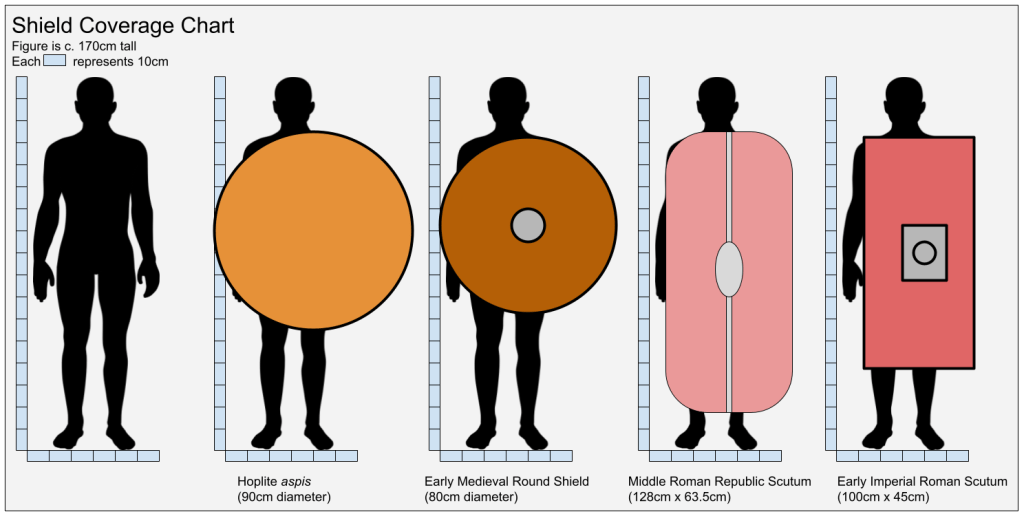
What you can immediately see is that just about any shield is going to massively reduce the target area of the body even if it isn’t moved. All of these shields are large enough to cover the entire trunk of the body, protecting all of the vital organs in the torso. Assuming our infantryman has crouched down a little and put his shoulder into his shield (and kept his weapon hand behind it), our archer has lost upwards of three-quarters of his target area (even higher for very large shields like the Roman scutum). Worse yet, the target area that remains is mostly legs where arrow strikes, while painful, are a lot less likely to be lethal and may not even be disabling.
And of course these soldiers can move their shields, angling them up if the arrows are plunging downward or crouching behind the shield if they’re arriving on flat trajectories. Moreover arrows at range move slowly enough to be actively blocked and dodged, to the point that we know that ‘arrow dodging’ was a martial skill of some import in cultures that engaged in small-scale bow exchanges as part of ‘first system‘ warfare.5 Of course, if the incoming hail of arrows is dense enough, soldiers might be unwilling to put their heads up to try to spot incoming and block (at Agincourt we’re told the French soldiers angled their helmets into the arrow-rain, for instance), but infantry under lighter ‘fire’ might actively move their shield to block specific incoming arrows.
And then behind that shield our infantryman is also probably wearing some kind of armor! Now a full plate harness is going to provide only extremely few points of vulnerability, but to give our archers a more favorable case, let’s stay in the ancient world and consider two ‘edge’ cases from the Hellenistic period: a mailed Roman legionary (the most heavily armored infantryman of the period) and a Gallic warrior (one of the less armored infantrymen of the period). By picking soldiers this early, we’ve given our archers a bit of a hand: these fellows don’t have fully enclosed helmets, or significant arm protection; later medieval combatants, particularly with wealth, would have been much better protected, with things like aventails to cover the neck and fuller protections for arms and legs. The Roman has a mail lorica hamata, a Montefortino-type helmet (with cheek-flaps protecting much of the face) and greaves, while our Gaul has just the helmet and probably some thickened textile body protection. The coverage might look like this (please forgive my very rough efforts to draw out irregular shapes):

Now as we’ve discussed, armor protection against arrows isn’t necessarily a binary. Armor often gets discussed as if arrows either always defeat it or never do and really only one of those is correct: arrows will not defeat good iron or steel plate armor at effectively any range. But for other forms of armor, the range and the power of the bow matter a lot. I’m going to summarize my previous estimates here (but I sure do wish we had more long-range bow-penetration testing!): at relatively long range (c. 200m) even powerful bows might struggle to reach the target with enough impact energy to penetrate mail and relatively weak war bows – which are still bows with 80lbs pullback (so our weak war bow is roughly 50% more powerful as a typical hunting bow) – may struggle to even penetrate a good textile defense with a solid hit. Even at moderate ranges (c. 100m), mail will probably sometimes defeat even the most powerful bows (but sometimes it will fail) and even a gambeson provides a degree of protection from the weakest (again, still 80lbs pullback bows).6
What that means for our Roman legionary up there the good news is that very few arrows are going to accomplish much; the situation is worse for our Gaul, but actually not much worse. For the Roman legionary, he has upwards of 85% of his body covered by his giant shield. Should an arrow get around that shield somehow, to hit anything vital (except his face) it has to contend with his mail. Now powerful war bows, especially at short range can absolutely defeat mail, but not every shot is going to be the most powerful bow shooting a point-blank range shot hitting dead on and for the rest, a decent chunk of them are going to fail to split the mail rings or else expend so much energy doing so that they don’t penetrate lethally deep through the thick textile padding (the subarmalis) beneath the mail. Meanwhile, his lower legs below the shield are covered with solid bronze greaves which will almost always deflect an incoming arrow (they’re both solid metal, but also curved so an arrow is likely to glance off). His head and neck remain the big point of vulnerability, but something like three quarters of that space is covered by his helmet and his cheek-guards: an arrow slamming into a solid, 1.5kg bronze helmet is going to be unpleasant, but the arrow isn’t usually going to penetrate (though the impact may daze or even knock out the soldier).7
And if we start stacking these ‘filters’ for our arrows, we see the lethality of our barrage drops very fast against infantry. Maybe two-third to three quarters of our arrows just miss entirely, hitting the ground, shot long over the whole formation and so on. Of the remainder, another three-quarters at least (probably an even higher proportion, to be honest) are striking shields. Of the remainder, we might suppose another three-quarters or so are striking helmets or other fairly solid armor like greaves: these hurt, but probably won’t kill or disable. Of the remainder, a portion – probably a small portion, because of those big shields – are being defeated by body armor that they could, under ideal circumstances, defeat. And of the remainder that actually penetrate a human on the other side, maybe another two-thirds are doing so in the arms, feet or lower legs, many of them with glancing hits: painful, but not immediately fatal and in some cases potentially not even disabling.
After all of those filters, we’re down to an estimated arrow lethality rate hovering 0.5-1%, meaning each arrow shot has something like a 1-in-100 or 1-in-200 chance to kill or disable an enemy.8 To put that in perspective with the images above: Aragorn’s book-inaccurate Elf allies (about five hundred of them) could all shoot over the whole approach (probably about a minute) and kill or disable about 25 Uruk-hai out of that host of ten thousand.9
Of course they wouldn’t be firing in volleys and numbers would matter. But we can extend our model a bit. Let’s assume an equal sized force of heavy infantry, advancing at the quick step (so a march, not a charge) against an equal sized force of archers. Bow shot is about 200m, which a quick march will cross in about 2-and-a-quarter minutes (quick step is 120 steps per minute, 75cm covered per step, roughly). Each archer can loose six arrows a minute, so each infantryman has, on average, 13.5 arrows to deal with. His chance of being killed or disabled by one of those arrows over the course of marching into contact (assuming our 0.5% arrow lethality) is thus about 6.75%. And that is under very favorable assumptions for our archers: our infantry doesn’t break into a charge, has no screening forces, the archers can shoot at maximum effective range, don’t tire out their arms and can all shoot effectively for the entire period (no return shots, no being blocked by friendly troops, etc). In practice, we should probably also impose a pretty sharp lethality ramp for these arrows: our 0.5% lethality figure is based on arrows loosed at pretty close range on flat trajectories, but of course the earliest shots in this scenario would be at much longer range, with less power and accuracy and so much less lethal; our 6.75% figure is thus something of a maximum. A 6.75% ideal disable rate is not going to stop the determined advance of heavy infantry: that infantry is going to march right on into contact and if those archers don’t have their own heavy infantry to meet it, they are going to be put to flight very quickly.
The Model and the Metal
Now if all we had was modeling, this sort of analysis would be shaky, because we’re making so many simplifying assumptions. But of course we now want to compare our model with actual battles to see if it seems like it is describing their mechanics accurately. At the Battle of Marathon (490 BC), a force of 10,000 Athenian and Plataean hoplites advanced over open ground into contact with a larger force (perhaps roughly double) of Persian soldiers, most of whom were likely archers, given how the Achaemenid army fought: the Athenian-Plataean army charged into contact and routed their enemy with just 192 KIA; many of these losses moreover were not from arrows, as our best source, Herodotus, is clear that the hardest fighting was in contact at the ships.10 At Issus (333BC), Alexander orders a quick approach for his infantry, worried about the large numbers of Persian archers (Arr. Anab. 2.10.3), but the Macedonians reached the Persian line and in the whole battle reportedly sustained only 150 killed, 4,500 wounded (Curt. 3.11.27). At the Siege of Nicaea (1097 AD) the relief army of Kilij Arslan, composed primarily of Turkish horse archers – some of the finest and most dangerous archers around – attempted to move the crusader shield wall but was unable to do so despite a prolonged effort (he eventually gets pulled into contact with heavy crusader cavalry and is quite soundly defeated).
And then, of course, there is Agincourt (1415 AD). On the one hand, Agincourt is held up as the great example of the victorious power of the English longbow. On the other hand, both the initial French cavalry charge and the subsequent French infantry advance were able to cross a muddy, open field into contact with the English force.11 Agincourt reflects, in many ways, an ideal battle for the English longbow: the enemy was forced to advance the full range of the weapon, without cover, over difficult ground and did so in distinct ‘waves’ (the French army was deployed in three successive lines), on a battlefield where the forests ‘canalized’ (funneled into a narrow space) the French advance and secured the English flanks. And yet under these conditions the French infantry were able to cross the terrain in good order and attempt to breach the English line. Of course, despite outnumbering the English, the French infantry attack was too weakened by the arrows to overcome the English men at arms and archers in contact and so the English won a great victory.

But the nature of that victory is actually quite telling: even in ideal circumstances, with one of the most powerful bows in history (and a body of experienced archers to wield them) the English could not simply ‘mow down’ the incoming infantry attack slogging forward. But at the same time, the continuous rain of arrows created the conditions for the English to win in the press of melee despite being outnumbered. The Roman historian Livy has these phrases that always jump to mind in these situations, describing men or armies – often still very much alive – as fessus vulneribus or vulneribus confectus, “tired/worn-out by wounds” (Livy 1.25.11; 22.49.5; 24.26.14). After all, an arrow that gives a shallow cut glancing off an arm or bangs off a helmet or other piece of armor or slams into a shield isn’t going to kill you and probably isn’t immediately disabling, but it does hurt and the added impact of cuts and bruises is going to contribute to exhaustion (and arrows stuck in a shield make it harder to wield), slowly but steadily diminishing the fighting capability of the recipient.
That is how I would understand the failure of the French infantry advance at Agincourt. It isn’t that the longbows killed them all, but that they injured, exhausted, confused and disconcerted the advancing infantry, so that by the time the French reached the fresh, close-ordered and prepared ranks of the English, they were at a substantial disadvantage in the close combat.

Now since I have brought up Agincourt, we also want to talk about cavalry. Because so far, we’ve been focused on infantry facing massed archery. But note that at battles like Crécy (1346) and Agincourt (1415), the French also try cavalry charges and in both battles, these are very roughly repulsed.12 That may seem strange because in strategy games and the like, cavalry is the solution to archers, able to close the distance and defeat them quickly.
But actual battles are more complicated. On the one hand, cavalry is faster: even heavy cavalry can cut the time spent crossing the ‘beaten zone’ of bowshot from around 2.5 minutes to just 1 minute. On the other hand, horses are big and react poorly to being wounded: a solid arrow hit on a horse is very likely to disable both horse and rider. And while light or archer cavalry might limit exposure to mass arrow fire by attacking in looser formation, as we’ve discussed, European heavy horse generally engages in very tight lines of armored men and horses in order to maximize the fear and power of their impact. Unsurprisingly then, we see from antiquity forward, efforts to armor or protect horses, called ‘barding’: defenses of thick textile, scale, lamellar, and even plate are known in various periods, though of course the more armor placed on the horse, the larger and stronger it needs to be and the slower it moves. Nevertheless, the size and shape of a horse makes it harder to armor than a human and you simply cannot achieve a level of protection for a horse that is going to match a heavy infantryman on the ground, especially if the latter has a large shield.
Finally, the other thing about cavalry is that they weren’t as numerous. The cavalry charge at Agincourt had in it only 800 horsemen, for instance.13 But horses are big and cavalry cannot be packed in a deep formation, for reasons we’ve discussed, so the cavalry would still take up a fair bit of space on the battlefield, meaning that they would draw shots from a lot of archers, potentially overwhelming the advantage of covering the space more rapidly. Michael Livingston, op cit, does his own modeled simulation of the longbow impact on the French cavalry charge, with a lethality ramp from 0.25% to 2% over the charge and estimates that well over half of the riders wouldn’t have made it to the English lines.14 With so many archers firing at so few horsemen, the imbalance quickly produces catastrophe, although it is worth noting that even at this point the French cavalry charge did reach the English line, albeit without the numbers or the morale impact to overcome it, with French knights being pulled off of their horses within the English infantry formation, having presumably slammed through in their initial impact.
Conclusions
One of the challenges in understanding pre-modern warfare is in navigating between the extremes of ‘wonder weapons’ and ‘useless’ weapons. If bows were so powerful that they could mow down heavy infantry or invalidate cavalry, no one would have fought any other way. We know that, of course, because eventually a technology emerges – firearms – which was so lethal that it steadily pushed every other way of fighting off of the battlefield, save for a bit of light cavalry. Bows and crossbows existed for far longer and didn’t have this effect, because they weren’t that powerful: they simply lacked the tremendous lethality of firearms. The very strongest war bows might deliver at most around 130 joules of impact energy, slicing and piercing through a target. By contrast even relatively early (16th century, for instance) muskets could deliver one to two thousand joules of impact energy, with a projectile that didn’t neatly slice or pierce the target (it didn’t need too), but smashed through, shattering bone and shredding issue over a much larger area.
At the same time, bows and crossbows obviously weren’t useless. Of course for nomadic steppe-based armies, they were the primary weapon and rapidly maneuvering horse archers could use bows to devastating effect (in part because unlike foot archers, they could repeatedly caracole into that higher lethality zone at very short range). For agrarian armies, archers and other ‘missile’ troops could screen heavy infantry or cavalry, harass enemies and under the right circumstances degrade an enemy force quite heavily, even if they couldn’t simply ‘mow down’ advancing infantry. To counter this, more sophisticated armies might advance their close-order heavy infantry with screening forces of light infantry, often with looser spacing (thus lowering the incoming arrow ‘hit rate’ even further). The Roman legion of the Middle Republic had a built-in screening force, the velites, while we see the French, particularly at Crécy, attempting (and failing) to use their crossbows in this way. Those screening forces existed in part because harassing ‘fire’ from missile troops, while it might not turn back the advance of a legion, could significantly hamper it and so it was worth tasking a significant portion of the army to preventing that (and harassing the enemy in turn).
Of course TV and filmmakers are not thinking in these terms, but instead deploying – often without much thought – a set of visual tropes for battles which all have their origins in warfare in the gunpowder period. Directors love, for instance, having characters hold each other at bow or crossbow point, something that makes sense with modern firearms, but not with bows or crossbows (if you had to hold someone at weapon-point in the pre-gunpowder world, you used a sword or a spear).
The visual film ‘language’ for ranged engagements, in turn is very clearly drawn from warfare in the 1700s and 1800s. I suspect we can actually be a lot more specific, with the touchstones here being the American Revolutionary War and the American Civil War. Film as a genre, after all, emerged and was in its early days substantially shaped in an American context and much of filmic language remains dominated by Hollywood and in the United States, reenactments of ARW and ACW battles are quite common and for many movie-makers would be the primary way of engaging with any kind of warfare before the emergence of the genre of film itself in the early 1900s. This, of course, introduces some of its own problems even for the warfare of the 1700s and 1800s, as reenactments tend to recreate parade-ground and field manual maneuvers and impose them on battles that were probably quite a bit more fluid and disorganized, but that’s a question for other scholars, I think, to unpack.15
But that mental model of warfare imposes both a physical logic and a dramatic logic on to battle scenes set in pre-gunpowder societies which simply do not belong there: the most obvious being the hero-commander dramatically giving the order to ‘fire’ at the key moment, something that calls back to the mythology around “Don’t fire until you see the whites of their eyes,” but which is inappropriate for bows and crossbows, which – among other things – we know often began slow shooting right at maximum range.
As with our discussion of “The Battlefield After the Battle,” I think there’s an opportunity here for filmmakers to break with that tradition and attempt to show the view a meticulously reconstructed battle and reap the dramatic benefits of how interesting and alien that would be. But until then, I suppose, I will have to suffer through more films showing archers doing volley fire drills, while kings shout for the men to ‘fire!’ their bows.
- On drill and in particular, counter-march volley fire with crossbows, see Andrade, The Gunpowder Age (2016), 149-160.
- It also didn’t generate a smokescreen to help with the final rushing charge, whereas a musket-and-bayonet unit might benefit significantly from firing and then charging through and out of its own obscuring smoke into a terrified and confused enemy.
- And for animals that might do so, there’s a reason that for hunting something like a boar there were specialized spears to deal with an angry charging one.
- This, it seems to me, should be possible with modern technology, to simulate each arrow’s physics reasonably accurately, but history research is almost never so well funded as to be able to do that kind of work and right now the federal funding for history research, the National Endowment for the Humanities, is facing cuts and possible extinction, rather than being expanded.
- On arrow dodging in a Native North American context, see Lee, “The Military Revolution of Native North America: Firearms, Forts and Polities” in Empires and Indigenes, (2011), 58, fn. 34.
- That said, even for a fellow with full plate protection, there are points of vulnerability: not every component is as thick as the breastplate, but the big worry are the eye-slits and breaths (breathing holes) in the visor. These are generally small enough that an arrow can’t get through whole, but an arrow striking one might shatter, sending deadly or debilitating sharp splinters through. Note, for instance, these experiments by Tod Todeschini.
- Roman helmets, like medieval helmets, were worn with padded textile liners, which would absorb some of the impact, but an 50-80 joule head impact is still going to hurt quite a lot!
- 100 * 0.25 (miss) * 0.25 (shields) * 0.25 (helmets, greaves) * 0.33 (non-disabling hits (arms, legs, feet) = 0.52%
- Of course the effectiveness of bows in sieges is that attackers looking to set ladders or scale walls are going to need to be vulnerable for a lot longer and a well-defined fortification is going to enable ‘enfilade’ fire (shots coming from the sides, via projecting towers), all of which means the attackers have to sit in that higher lethality point-blank-range zone for a lot longer.
- Hdt. 6.114-117. I have seen online many times the figure of 11 dead for the Plataeans cited to Hdt 6.117, but the figure is not there in the passage and I do not know where it is from.
- On the battle, a good and readable primer is M. Livingston, Agincourt: Battle of the Scarred King (2023).
- I want to note, because we’re trying to see how archers work when everything is going well, we’re focusing on English victories, but English longbowmen did not always win their battles either: sometimes the French infantry and cavalry were able to close the gap and win, as for instance at Formigny (1450). For the longbowmen to succeed, they needed quite a lot to go right for them.
- Livingston, op cit, 253
- I will note that Livingston breaks this simulation into ‘volleys,’ but I don’t think he means they’re actually firing in volleys (they don’t seem to have been, the sources describe ‘clouds’ and ‘hail’ of arrows, implying continuous shooting), it’s just a useful set of mathematical divisions to break his lethality ramp into.
- But consider reading Spring, With Zeal and With Bayonets Only: The British Army on Campaign in North America, 1775-1783 (2008). I also have with me, but haven’t yet read, but have very high hopes for A. S. Burns, Infantry in Battle: 1733 – 1783 (2025), so we might return to this topic at a later date.


I have written about how bows in the ancient world were probably not as stiff as bows in the 15th/16th century Old World here and following https://www.bookandsword.com/2022/07/02/how-heavy-were-iron-age-bows-part-1/ I need a snappy name like longbow festishishm or overcorrection.
Some recent tests by Rolf Warming, Tod Todeschini, and the older test in Barry Molloy’s The Cutting Edge suggest to me that at close quarters many ancient shields are not quite arrowproof and probably needed to be either used actively or propped up ahead of the body not held close to the chest like a wall. The Polybian scutum with its plywood core and calfskin face is on the sturdy side. Of course even a hunting bow will go through someone’s chest and keep going at 20 yards, and the arrow that penetrates 20 cm at very close range may get stuck in the face of that shield at 50 yards. Would like to do more tests when time and spoons allow.
Holding a shield close to the body is almost always incorrect.
– if a blow would knock the shield into the body it’s too close and it will not provide as much protection.
– if the archer is more than a couple of yards away holding the shield further away covers more of your body than right against you. If the archer is that close then the guy with the shield can close even further and then the archer isn’t using the bow as a bow anymore. No, Legolas firing arrows from a foot away wasn’t realistic.
– if the shield is close, then the arrow may pierce it and stick into either your armor or even into your body. In the first case now you’re hampered in movement. In the second you’re actually wounded.
If the shield is further away the arrow must fully penetrate the shield and continue with enough force to pierce armor. Assuming it doesn’t hit your arm. Which is a very small target compared with the shield.
Shield usage tends to emphasize intercepting blows as close to the enemy as possible, before they have time to build momentum. So you end up being used to having it out there. The position for arrow interception is slightly closer because it’s less open, but then you would have to practice that against opposite-handers anyway.
Technology in bows has increased dramatically since Medieval times. Having shot wooden long bows with pull of 90 lbs they were not as effective in distance as a modern laminated recurve with a draw wt. Of 45-50 lbs. Did most of my archery between 20 to 60 years ago.
Technology in archery has changed across tbe board. Arrows and bow strings have changed too, due to changes in tech.
But the purpose is different. The modern set up is sending an arrow that isn’t going to have the same effect as the arrow intended to hit an armoured target say. And the modern 50lb bow wouldn’t shoot as much distance if it was shooting a “war” arrow of the HYW say
We need to consider the purpose, as well as avaialble tech, and how all those work together holistically
The quality of posts like these is amazing. I read this after working my way through a couple of chapters in a fairly specialised Routledge collected edition; a book with a dozen different entries on the topic of unit cohesion in ancient warfare, each of which is about the same length (~8000 words) as this. In terms of amount of information conveyed, depth of analysis, clarity of writing, and general quality, this weeks post blows most of those chapter right out of the water. That Brett churns one of these out most weeks, and makes them available for free, is almost unbelievable.
Many scholars are good at research, but few scholars are good at writing.
Some scholars I read don’t appear to be that good at research either – or they’re so bad at writing that they somehow manage to hide their research. There’s a lot of stuff out there that boils down to a couple of half baked ideas, paraphrased, reiterated, summarised, and repeated until it hits the word count. And I’m not just picking on historians either, choose a random physics paper from arXiv and there’s a decent chance the same holds.
It seems to be a universal truth of human endeavour that most of what is produced in any area is not very good, with only a small minority having lasting impact.
“Sturgeon’s law (or Sturgeon’s revelation) is an adage stating “ninety percent of everything is crap”. It was coined by Theodore Sturgeon, an American science fiction author and critic, and was inspired by his observation that, while science fiction was often derided for its low quality by critics, most work in other fields was low-quality too, and so science fiction was no different.”
https://en.wikipedia.org/wiki/Talk:Sturgeon%27s_law
This is excellent!
I want to make a qualified defense of saying “fire” in this context. Virtually any book, movie, or show in which arrows are a major infantry weapon is one in which the characters are not actually speaking modern English. When we read their lines in English, we’re meant to understand that it’s translated from Greek, Mongol, Latin, French, Westron, &c. And since non-literal translations often capture the meaning better than literal ones, “fire” is an effective & thus valid way of communicating the meaning of the order to modern Anglophone ears.
While “loose” is a bit obscure, “shoot” is both well understood in modern English AND was in use in medieval times.
That’s an interesting take. Figurative translations can be more effective than literal ones, but only if the figure of speech is appropriate. You could translate a Greek hoplite shouting in surprise as saying “Jesus Christ!” but hearing that in a period piece would completely shatter the suspension of disbelief, better to transpose the figure-of-speech to something like “By Zeus! than to leave a devastatingly anachronistic one. Pre-gunpowder orders to fire fall firmly in that category IMO.
and even then, that specific example is made worse by written dialogue – be it in a script or book – having removed the ability to use the far more realistic ‘wu-ahhh!’ for surprise, given they’ve systematically removed everyone’s ability to say anything that isn’t actually a word. (i.e. it sounds comedic, in the same way them saying ‘errr…’ would sound comedic, even though saying err a lot is much more literally realistic than scripted dialogue).
> even though saying err a lot is much more literally realistic than scripted dialogue
Really? Are you British?
“Er” is a specifically British spelling of what Americans would write “uh”. No one ever says “er”.
…being British, I say ‘err’.
British people do, in fact, exist. More than that, we even speak British English…
Sure, but the bigger problem is that you wouldn;t order longbowmen to start shooting in the first place, since you didn’t really need to. (Much like you don’t need to order heavy infantry to start using their weapons on the enemy when thye are within rnage)
> (Much like you don’t need to order heavy infantry to start using their weapons on the enemy when thye are within rnage)
That’s a funny thought – I now can’t get the image of a medieval sergant‑at‑arms loudly shouting “Swing!” “Swing!” “Stab!” out of my head…
There is an example in film: that scene at the very start of the Fellowship of the Ring with the elves swinging *their two handed swords* in a synchronous wave.
More dramatic license I guess.
You may need to order them to stop. There was a battle in the Wars of the Roses where one side’s bowmen shot once at opposing bowmen, then stopped, drawing their opponents to shoot back into the wind and exhausted themselves and their arrow supply.
Other thing is that “fire” has become the modern term for “shoot a projectile from a device”, (Fire a slingshot, fire off a message, etc.), so while nitpickily it doesn’t make sense, having a commander order everyone to “send off your projectiles” makes perfect sense the way those scenes are done.
Of course, for filmmakers, the other advantage that having archers fire in volleys is the control over when the arrows are actually flying. Even with weak prop bows there’s still the potential for injury (and therefore lawsuits), so having all your extras wait until a specific command before releasing gives you the chance to have a safety marshal make sure the landing area is clear and nobody is pointing their bow at somebody else’s head. Then they all release together in a discrete, controlled manner, whereas a whole group of people shooting off arrows at random drastically increases the chances of an accident happening. Which might not be a concern if you’re a 13th century general, but definitely is a concern if you’re an insurance-premium paying 21st century film studio.
I think volley firing is also used to communicate something specific to the viewer. Loosely speaking: volleys => drill => discipline => highly skilled. So if the director wants to show that those elves or Romans are well trained or part of a professional army, he has them shoot in volleys. The converse, aka, orcs or barbarians, shoot at will.
Of course that link through drill and discipline is very suspect itself (as highlighted by a recent post)), but it is pretty deeply ingrained culturally. It’s inescapable that media will ditch accuracy (historic or scientific or of any other kind) in order to adopt a well understood visual language.
Drill works on the battlefield for certain specific weapons. The same ones for which volley fire does.
It lasted long enough, and the ones who implemented it were victorious enough, that it has stuck in the military mind (and the military-adjacent) for much longer than it should.
Bayonets have a similar mystique.
Admittedly drill does have some uses. The OCD level of detail in everything, can carry through to things like equipment maintenance. Which modern military equipment requires to continue functioning.
Assuming of course that the correct things are OCD’ed. The “cargo cult” version where you serve cold, inedible food because you must keep the kitchen spotless at all times is not a functioning version of this.
The Americans have been victorious enough that other armies are imitating odd things about them. For instance, generals wearing camo uniforms in press conferences means other armies now wear lots of camo. Including dress uniforms. Which results in camo uniforms in colors and patterns that are in no way actually camouflaging. At least not anywhere on Earth.
I think one important part why drill maneuvers persist long after they ceased to reflect up-to-date battlefield action is in signalling.
Firstly, and most importantly, unit of people doing anything in coordinated manner as a cohesive whole is both visually impressive and feels impressive to do. Such things have morale and propaganda value. (It also helps that particular forms of drill choreography have culturally coded content, so the forms are kept instead of replacing them with something else.)
Second part, doing drill well requires some training. Random large group of people never trained to march in formation and respond to drill commands often have some trouble at it. Thus, adequate performance of military drill demonstrates the organization has the basic competence to the troops until they do it well (including arriving on the set location on time, with the appropriate kit, following orders, fit to inspection). Naturally, showing off units marching in parade formation shows that they have been trained to march in parade formation and not much else, but it is still a step above of “not able to do even that”.
The oft’ stated reason that the drill trains attention to detail and command hierarchy (OCD’ing, as you put it) may be part of it, but I think it is tertiary. Why train the troops to OCD on drill when you could train them to OCD on something more immediately useful on battlefield? This is why I think the first two reasons are more important (army demonstrates that they can put together a visual spectacle that audience understands).
Swords also had drills for them through much of the 19th century, and I find Brett Deveruex’s explanation of drills as ‘forming cohesion through brutality’ to a bit reductive.
Drills are simply practicing what you’ll do on the battlefield, and building up a muscle memory to then do it on the battlefield.
Assaulting positions and out of ambushes are all things that are drilled so soldiers will automatically do them without hesitation and on instinct.
I would tend to disagree on this explanation. The traditional close-order drill has very little to do with battlefield. If anything, it is mainly useful as a tool to move military detachments around the garrison in a controlled manner.
Combat routines of a squad or platoon, on the other hand, are not something you drill in the same way: first of all, they are practiced in loose formation, and in most terrain, you need to actually think about where you are going. You are not just moving like a cog in a machine, but need to think about the trees, rocks, structures and the enemy. The difference is about the same as practicing ballet or soccer.
The William McNeill argument, based on his own military experience, is that drill, which he characterized as “moving in unison to music” creates strong feelings of camaraderie and thus significantly promotes unit cohesion and that it has persisted for that reason. I don’t know what others with military experience might think. Based on my own experience with group exercise classes, I am inclined to agree with McNeill.
McNeill also cited group dances and heaving in unison (as in the erection of large monuments). It’s observable that trades involving group effort have high cohesion
I’m sure there could have been better and more correct ways to indicate skill. Three elves shooting arrows in quick succession, then switch to the next shot of three adjacent orcs receiving an arrow in the left eye.
I’m no director, but that feels a bit too on the nose, to the point of bluntness. There’s a reason why cinema has a language which is used to communicate character traits without literally showing the consequences of actions.
> After all of those filters, we’re down to an estimated arrow lethality rate hovering 0.5-1%, meaning each arrow shot has something like a 1-in-100 or 1-in-200 chance to kill or disable an enemy. To put that in perspective with the images above: Aragorn’s book-inaccurate Elf allies (about five hundred of them) could all shoot all at once and kill or disable about 25 Uruk-hai out of that host of ten thousand.
Either a typo or an arithmetic error, but 0.5-1% of 500 is about 3 or 4, not 25. In fact, 25 is probably the total casualties they’ll inflict in their initial barrage before the Urukhai close the range or they’re so tired they have to seriously slow down their rate of fire.
Clearly there is a hidden multiplier for these being Elves
Multiply that by 6, which is given as a number of the shots an archer can make in a minute.
Oh, yeah, I was giving them about a minute of shooting time. I’ll revise to clarify.
The modeling of arrow lethality seems to assume that a war bow cannot be aimed. That is, you’re taking the point of impact to be equally likely for any point within some large area (hopefully the area being “where the bad guys are standing”), so the chance of striking a vulnerable spot is just the fraction of the area consisting of vulnerable spots.
Is this accurate? Obviously historical archers were not Legolas, but would they at least have been able to slightly increase their odds of hitting an enemy above random chance, especially for arrows fired at shorter range?
Has someone tried to simulate or test the pre-gunpowder equivalent of MOA or CEP here?
Interesting point, but I’m not sure aiming would make so much difference. Firstly, if you’re shooting 6 arrows per minute in the highly stressful situation of a battle, there’s not much time for aiming. Second, you’ve got on the order of 0.5-5s of flight per arrow (~50m/s at a range from 20m to 200m). That’s time during which the target is not only moving forward, but also bobbing up and down, limbs flailing, shield waving, etc… all in the hectic scenario of a charge. Considering the small target area the archer is aiming for, a few second of such seemingly random motion probably washes out most of the effect of aiming.
The same, naturally, wouldn’t necessary hold true in other situations like a missile exchange between skirmishers or in a stand-off-ish situation around a siege.
One of the limits of bows is that an arrow travels on the order of 50 m/s when it leaves the bow. So beyond a few tens of metres, the target has a pretty good chance of seeing it in flight and moving out of the way. Most hunters don’t trust themselves to cleanly kill deer with a bow at ranges over a few tens of metres (and while most hunters in the USA and Canada are not expert markspersons, deer don’t wear helmets or carry shields and they sure don’t shoot back- not like kangaroos and their Stinger missiles). I expect that is the kind of range where an archer in combat might aim for a specific target like “that man’s face over his shield” and not just “that bastard spanning a crossbow.”
That is one reason why there were diverse archery styles, from short-range high-lethality (often relying on pavises, shield bearers, or heavy armour), to “shower shooting” or clout shooting from several hundred metres away (common among unarmoured horse archers). Shooting at long ranges had disadvantages, but so did closing in.
IIRC accounts of horse archers preferring to shoot at extreme range are mostly from well into the dominance of firearms when they would be quickly smashed by musket-wielding infantry if they tried to exchange shots up close, but in the pre-gunpowder era a horse archer was very often loosing at extremely close ranges to make best use of the power of his bow and the ability of his horse to keep him from getting caught by men on foot.
Nations whose horse archery was mostly from long range and at a high angle are well documented back to the 11th century CE alongside nations which dashed in to shoot within a few dozen metres like buffalo hunters then dashed out. Naked Turks practiced horse archery different than east Romans with coats of iron lamellar, or Cumans with coats of hide lamellar. An excellent paper is “Light Cavalry, Heavy Cavalry, Horse Archers, Oh My! What Abstract Definitions Don’t Tell Us About 1205 Adrianople,” by Russ Mitchell
Nomad archery is optimised for long range, not penetration (light arrows, high velocity at release). Probably because the usual combat was with other horse-archers, and the main target was the horses.
Shooting skittish herbivores at distance allows those daily skills to be put to use in combat.
Horse archers would shoot from a longer range than a musket because they were mobile targets shooting at a more or less stationary one.
The idea was to enrage the gunpowder infantry into leaving ranks. Which meant their protection (either pikes or wagons) no longer applied.
At which point they could either be ridden down and lanced by the horseman or else the nomads would just *leave*.
Muzzle-loading smoothbore gunpowder infantry didn’t work well against nomad horse archers because the archers controlled when and where they confronted them. The infantry had to take *all* their supplies with them on any expedition because there were no settlements to forage against. The wagon equation applies there.
And there were basically no gunpowder cavalry, for many reasons, until much later. By which time the infantry pretty much outranged the horse archers.
Almost all nomad fights were with other nomads (or nomad-adjacent states with a lot of horse-archers, like the Seljuks, Mamluks, north Indian sultanates and so on). So their tactics and weaponry were adapted to that – outflanking, feigned retreats, quick charges by smallish numbers of medium cavalry as opportunity offered. Long-range fire to disorder the enemy while leaving room for manoevre.
They struggled against a combination of good infantry and heavier cavalry (it’s often overlooked that nomad conquests are the exception, not the rule). At long range their arrows failed to penetrate armour and shields, at close range they were vulnerable to return fire from Han or Crusader crossbows and a charge by heavy cavalry. The basic strategy was to establish forts or walls, limit grazing and hit in spring when the herds were weak. These worked so long as you kept to protecting key routes and areas.
Harder for infantry to move out of the way when they’re in formation, though, and the volume of arrows if walking into a barrage like that from English longbows means that if even if you avoid one arrow you might just be stepping into the path of another. Dodging arrows is probably (partially) viable in a skirmish environment where there aren’t many shooters and you have plenty of space to move about in, as with the native American examples cited, but not so much if you’re trudging in a phalanx.
As to overall accuracy, I would have thought that while strength is the key attribute for an archer, accuracy surely isn’t irrelevant either. A man-sized target isn’t a particularly challenging one for a skilled archer over the kind of range that shooting would take place, and given that archers can aim for specific targets they surely would. They are after all fighting for their lives, rather than just trying to exhaust their ammunition, they’re often shooting at ranges where they can identify and aim for particular targets, and arrows aren’t free – a scenario where the overwhelming majority of arrows miss entirely because the archers are spraying arrows at the vague overall shape of the enemy rather than marking particular targets doesn’t quite ring true.
But that probably doesn’t make that much difference to overall lethality rates. A lot of the arrows will still miss, not least because the targets are moving, and most of the rest will probably just hit shield (and/or armour).
Also, I don’t know of pre-gunpowder sources on this, but during the 18th and 19th century, it was considered cowardly and undisciplined for infantry to attempt to duck or dodge cannonballs (which can be seen and evaded if you’re quick, unlike musket bullets). I think commanders believed, perhaps with reason, that infantry in formation, even taking some casualties, was going to be more effective than infantry in disorder ducking and dodging.
Aiming a traditional bow is not particularly easy. The ‘point blank’ range, as in the distance to a target where you don’t need to meaningfully account for drop, is very short – in the tens of metres. As soon as you start to push out beyond that, small mistakes in your estimation of distance or your adjustment for it will make a mockery of attempts to pick out smaller target zones than a person.
One of the best practical demonstrations of that is Tod’s Arrow vs Armour films: https://www.youtube.com/watch?v=ds-Ev5msyzo Excellent and very experienced archer, point blank range with a stationary target, no pressure of battle – and he still often takes several shots to hit a specific target point. Some miss entirely despite the short distance and perfect conditions.
So to the extent “picking out weak spots” is an option, it only has very limited impact at the very last moments. And of course in real life, that’s the time the person you are shooting at is likely to be jumping at you swinging a sword or axe or something – which might well disrupt your aim!
It’s also quite hard to aim a warbow on account of the draw weight. It really is quite significant (imagine pulling anything from a car gearbox to a fully grown adult up off the ground with one arm). To aim you need to hold it there while you adjust the trajectory. It’s not impossible by any means, but it’s a clear tradeoff between expending the energy to do that and loosing another arrow or two before your arms give up.
Plus, all of that tension makes aiming itself difficult. Admittedly it’s with a longbow, so an extreme example, but check out the Tod’s Workshop videos with the excellent longbowman chappy (arrows vs armour I think is the series, though they do some additional ones). The accuracy is not brilliant at short range (though not awful), and there’s one where they attempt distance shots from a tower and have a hell of a time trying to hit anything.
Is it really one arm? One arm holds the bow and the other the string, so as a matter of physics and biomechanics, isn’t each arm exerting half the total force necessary?
I spent quite a while playing through the motions (and watching video of Tod’s longbowman friend) before commenting, and I think it’s at least overwhelmingly the bowstring arm that puts in the effort. The arm holding the bow either begins fully outstretched, or more likely for a warbow starts with a very small bend at the elbow and shoulder. The amount of effort that goes in to straighten that arm is fairly minimal as it’s only moving a small distance until the elbow and shoulder are effectively locked, and the muscles are already in a very favourable orientation biomechanically.
Meanwhile the arm drawing the string has a *lot* of work to do, and works through a number of angles that aren’t very favourable biomechanically at all. Also, a bow’s weight isn’t uniform across it’s draw, so the small movement your bow arm makes is in the initial (at least first half) movement of the string, whereas the string arm is doing pretty much all of the heavy lifting at the end of the draw (where that 170lbs actually sits).
Watching Tod’s longbow chappy (I must do better at remembering his name), there is some movement at the bow-arm shoulder towards the end of the draw as he starts with that arm slightly high and then brings it down at the same time as completing the draw with his string arm. There’s also not an insignificant amount of muscle used to keep that bow arm stabilised, but it’s clear that’s a lot less effort than drawing the string and the arm otherwise is fully locked.
In a physics sense, yes each arm is providing half the force required (equal and opposite reaction and all that), but plug that into a biomechanical model (essentially a whole bunch of partially-compounding levers) and that neat division gets a *lot* messier.
We see at least some evidence of this on the lopsided skeletons of English longbowmen, so I’m at least reasonably confident my observations are correct.
WordPress aside: Has anyone else had the “Like Comment” button start working again after a long period of not working?
Reading through these calculations makes me oddly nostalgic for a very old DOS game called Fantasy General. Missile troops in general had pretty low lethality if facing ‘technologically’ equal enemies; but it had a separate tracker for a morale damage. Troops coming under attack could be ‘disordered’ for the rest of the turn (bad) or ‘broken’ until they had a chance to rest away from enemies (very bad). And providing *THAT* was the main use of your skirmishers and archers; to be followed up with melee units for the kill once the enemy line was disrupted and broken up by your missile units.
I mean, I liked the game for its gameplay, but it’s neat to see a bit of uncharacteristic historical accuracy for a game that makes no pretense of being based in history.
That game was so good. The modern sequel is fun but seems to have missed a lot of the charm of the original to me.
I can see that. Being hot with arrows may not kill you but it is dangerous and really annoying. It would deny maneuvering options to some extent (how much depends on many factors).
And shield units have a front and flanks. Arrows to the flank have MUCH better odds of hitting (see castle construction). Again, the annoys shield men and keeps them from moving. Given that 85% or so of people are right handed you can readily predict how shieldmen will move, too, allowing you to position your archers to nudge the battle where you want it.
And archers are strong. Pull 170 lbs six times a minute and you build up arm muscles. NOT folks you want to have hitting you with maces or axes or bits of wood.
A surprising amount of war appears to not be killing your enemy but rather threatening them to control their movements.
Not only are 85% (or more) of people right handed, but it wouldn’t surprise me at all if left-handed soldiers were expected to suck it up and wield their sword or spear in the “right” hand. I mean, it’s only very recently that people have stopped forcing left-handed children to write right-handed (and I don’t even know if that’s universal). I can easily imagine any number of reasons why it might have life-or-death implications that everyone’s gear is oriented the same way.
I have no idea if its true, but somewhere I encountered the idea that some forces deliberately put lefties on the extreme right, so their shields would be facing an otherwise unprotected flank. But in the bulk of the line, you’d probably want everyone oriented the same way, so almost everyone fights righty.
Ferniehirst castle in Scottland has spiral staircases going
counter-clockwise, reputededly to put righties at a disadvantage on the stairs due to the large number of lefties in the defense force at one time.
Well, maybe not.
“The belief that the Kerrs, with their devilish reputation, had many left-handed members and so built the staircase at Ferniehirst anticlockwise to advantage their fighters seems to be circular reasoning. There is no evidence to suggest that the family really were overwhelmingly left-handed and their staircase at Ferniehirst twists both clockwise and anti-clockwise.”
https://triskeleheritage.triskelepublishing.com/2023/08/15/mediaeval-mythbusting-blog-24-the-left-handed-kerrs/
The ancient and Medieval world weren’t known for being kind to people who were different. We’re talking about a culture where dwarfs/little people were routinely put on display as an amusing spectacle. (No offense intended, I’ve met a few and they had different preferences so I’m genuinely not sure what the correct term is.)
There are a lot of implications of right-handedness being dominant. Even today most tools are built for right-handed people, which creates some pretty significant hazards for southpaws. For example, grab any random pair of scissors, and unless you intentionally grab a left-handed set you’ll see that they don’t fit the left hand very well. As the ancient world was more artisan-based, rather than factory-based, in manufacturing this may not have mattered as much; that said, I don’t recall ever seeing a left-handed set of sheers.
On a shield wall in tight formation (which I still contend is tighter than Bret says, though you may only be that tight for a short time) left-handed people also create problems. Either you have someone using their non-dominant hand to stab with the spear, or you have a gap in the line. This gap isn’t huge, but it’s not insignificant either. When you’re that close you need to practice a fair bit to coordinate movements to avoid fouling each other’s weapons and shields, too; a lefty can disrupt that pretty easily, even with training (had that happen to me a few times).
The funny thing is, the lefties I’ve known had as much trouble fighting left-handed people as us right-handed people did. For the same reason: they simply didn’t encounter very many.
All in all, I imagine that lefties quickly learned to fight with their non-dominant hands, and had significantly higher casualty rates than right-handed people. Maybe occasionally someone would put the lefties in a unit to provide unexpected resistance, but I wouldn’t expect it to be super common.
“I mean, it’s only very recently that people have stopped forcing left-handed children to write right-handed”
I imagine writing with the left hand has made a lot less of a mess on the page, and the writers clothing, since the invention of ball point pens, and the inks required for them. It could be a lot messier with fountain pens and their more liquid inks.
I mention this to make a more general point: If the people on the spot decided to do things one way, and you, centuries later, disagree, you should consider the possibility that that the people who could see the consequences of their actions, were right.
If people in the past could see the consequences of doing something with the left hand, and you cannot, they are probably the people with the best idea about whether it should be done with the left hand.
Not sure I appreciate your tone.
My point was that if left-handed people have been made to write right-handed over something as relatively inconsequential as soiled sleeves or smudged ink (a problem I am fully aware of, what with not all ink being quick-drying even today), it would be unsurprising if they have been made to fight right-handed if it has life-or-death consequences if they don’t.
konrad, I will apologise for my tone, but not my point: If you disagree with the people on the spot about something, the people with most relevant information are least likely to be wrong.
You should not therefore assume that everyone in the past who disagrees with you about something must have been motivated by prejudice or evil when there is always the possibility that you yourself are wrong.
Certainly I wonder how you claim to start from the belief that people in the past were taught to write with the right hand to avoid making a mess of the very page they were writing on, and deduce that armies would therefore drill their left-handed soldiers to get themselves, rather than their enemies, killed.
That is not a line of reasoning that suggests to me that you view people in the past with respect.
“I mean, it’s only very recently that people have stopped forcing left-handed children to write right-handed”
I imagine people writing with a fountain pen would make a lot more of a mess of the page, and their clothes, if they wrote left handed. Their sleeve would be a lot more likely to find itself draped across still-wet ink.
In general, if people in the past had immediate feedback about an action, and we don’t, then in cases of disagreement, it it almost always going to be us that is mistaken, not them.
It’s weird how Chinese, Japanese and some other Asian languages are written in a way to maximize this problem for right-handed people. I would have thought the people developing the writing systems would have immediately noticed how much it sucks.
There is a clear difference in writing style: when you write with a brush, like the East Asian languages have been traditionally written, you don’t support your hand on the leaf tht you write on. Thus, you are not smudging it when you write from right to left with your left hand. On the other hand, if you write from left to right with ink (or even with soft pencil) using a pen in the traditional Western grip, supporting the hand on the paper, you are sure to smudge, if you use your left hand.
And unlike konrad_arflane insinuates above, this is no trifling matter: in a society where you don’t have typewriters, being able to write cleanly and with good calligraphy is a significant professional skill. A sloppy hand signified bad education while good penmanship was often merit enough to get a position as a clerk. The same goes for smudging your clothes, too: in such a society, doing laundry is expensive, and ink stains often indelible, so staining your clothes when writing is a significant financial loss.
Conversely, the practice of _forcing_ people to be right handed is also relatively modern.
Fencing treatises discuss lefties in passing at times – the idea that you should be forcing someone to be right handed never really shows up. There’s a fun rapier book which has a set of plates for right vs right, a second set for right vs left, and a note at the beginning that if you want to see left vs right or left vs left you can hold the pages up to a mirror.
Isn’t fencing generally a one-on-one fight? If most people are right-handed, then being a left-handed fencer is probably advantageous, akin to being a left-handed boxer.
“I’m not left handed either.” – The Dread Pirate Roberts, to Inigo Montoya.
I wouldn’t be even a little surprised if the bias against left-handedness in things like writing originated from military drill
Through some excellent use-wear analysis on the pommel it was found that the king buried at Sutton Hoo was a southpaw. There’s an excellent curators video on YT from the British Museum discussing it.
Admittedly that was in one particular corner of the world at one particular time (and, if memory serves me rightly, potentially pagan). But it’s at least one evidence point against enforced right-handedness.
Back muscles, not arm muscles alone. Much of the strength of the draw comes from your large back muscles.
And legs? I’ve never fired a bow, so I don’t know, but does an archer shift weight or stride forward as one does hitting a golf ball or a baseball?
No, it’s just upper body. Moving your entire body when you pull the string back wouldn’t help because you just want the thing in your hand to get further away from the thing in your other hand. And when you actually shoot, you hold still except for your fingers letting go.
That’s only when you switch from shooting to running away.
Paraphrasing Clausewitz (drink!) the point of war is to make the enemy do what you want.
This may include becoming extinct, but that’s rare. Generally because “go away and don’t bother us again” is usually much easier to implement.
The other side of archers being strong is that they are almost always unarmored. And melee fighters are also strong – try putting on a harness and fighting someone.
On the subject of arrows and slits in visors – I heard a few years back of a sad fatality in show jousting, where they use balsa wood lances designed to shatter on impact. A rider was killed by a splinter through the vision slit.
IIRC there was a French king who died that way.
As I recall, there were two famous soldiers hit by arrows in the eye: Philip of Macedon and Harold, King of England.
I assume from now on they use safety goggles under the helmet. Probably didn’t think those could be necessary.
Seconding this – thanks, Brett!
two apparent typos:
“shredding issue”
“By contrast, a unit doing volley-and-charge is compressing probably close to 50% of the lethality of sustained shooting, devastating moment and then immediately charging.”
The Fellowship of the Rings → The Fellowship of the Ring
each rank releases and then knees → each rank releases and then kneels
just knock a new arrow → just nock a new arrow
“attempt to show the view a meticulously reconstructed battle”
Before I reached the conclusion, I was thinking exactly about the Mongols but also the Ottomans, the latter holding out against their rivals using horse archer-based armies all the way till the 18th century (though with increasingly poor results after 1600).
The Ottoman aristocracy thought of themselves as horse archers, but one reason the Ottoman Sultanate lasted so long was because the rulers were practical minded enough to equip their infantry with lots of firearms and cannon, and also encouraged domestic production of gunpowder weapons. (Armies of the Middle Ages vol 2, Ian Heath; Firearms: A Global History, Kenneth Chase). A bit slower than some Western European states, but by the mid 15th C a lot of the Janissaries and other Turkish infantry carried arquebus instead of bow.
Some of their rivals, notably the Mamluks in Egypt and the Safavid Persians, were much more confident about the effectiveness of mounted archery. The Ottomans, in large part thanks to their infantry guns and cannon, started beating them up in the late 15th / early 16th C; and by the 17th C or so even Ottoman cavalry are carrying pistols.
Indeed, the Ottomans are classified as one of the “gunpowder empires,” though not everyone endorses that concept. So are the Safavids, actually.
The Ottomans did eventually arm their Janissaries with firearms (though I’d place this at about 1500) and this absolutely gave them an edge against the Mamluks and Safavids. But until the 1600s, Janissaries remained an elite corps and the core of the army were the sipahi horsemen.
All of this just makes me wish we could see more slingers in media.
For the specific visual cinematic history of arrow volleys – I know Henry V from 1944 uses it. I don’t remember it being a thing in the 1938 Robin Hood, and that’s often the oldest movie I see referenced for an archery focus.
Also I would be interested in hearing what might have been the reference point for the ‘arrow wave’ from things like Hero (2002) beyond it being (a) gorgeous and frightening (b) a nice contrast of the ‘fusion fantasy’ of lots of people acting in unison vs the hyper-aware individual grace of the people being shot at.
It also helps me make sense of Drews’ theory in The End of the Bronze Age that there was a military revolution where expensive bow-armed charioteers began being overwhelmed by cheaper javelin-armed runners.
I’m not saying I am in any sort of place to find the theory plausible, I just had trouble figuring out exactly what he was claiming – but if your high lethality javelins can mess up enough chariot teams on the regular it might work out if the chariot archers can’t mow you down fast enough.
It’s almost impossible to safely film a sling in use; military slingers began training when they were so young that they were too weak to cause accidental death, and even so would do almost all of their ‘practice’ slinging in solitary hunting or herd-defending situations.
The ‘visual’ reference for some kind of arrow wave ultimately comes from Herodotus’s “block out the sun” line, which is never going to get a ‘historically accurate’ visual representation because it’s originally a description of a fearful prediction discussed ahead of battle rather than a thing observed in battle.
And there is a recurring belief in a pattern where a military equilibrium using a small portion of the population will create food security, only to be overturned when the subsequent generation is full of poor people who didn’t starve to death as children. I’m always skeptical of it, though.
On what basis is filming a real sling, let alone a prop for film purposes, unsafe?
You can’t use a false weighted bullet, as with a firearm blank, the sling won’t move correctly without enough weight in the pocket. Making the bullet travel in an intended direction is a difficult skill, requiring far more practice time than you can give to a crowd of extras on a one-day rate. In a sense, there’s no such thing as a ‘prop sling’ because that’s just a sling; they are incredibly simple devices, too simple to imitate.
Is there not a way to fake it with a combination of editing and a prop that is not actually capable of releasing its weight?
Either that or possibly making casting calls from among dedicated sling recreation enthusiasts, at least for the close up shots.
Mind, given how often something like bolas get featured in even TV productions, I question the premise that it’s especially difficult to recreate the appearance of a sling.
@Isator Levi
Okay I want you to understand what I’m visualizing, I think that will help. I’d like you to take a knee sock and slip a billiard ball into it; now what you have is mechanically similar to a sling with an attached stone, hold it by around the open end (grip securely), and if you decide you do want to try twirling it please be approximately bowshot away from anything breakable (especially people) in case the sock tears and the bullet flies out. Because one of the main reasons that filming a group of slingers would be dangerous is that everything you can design that moves like a sling is also dangerous.
I’ve yet to hear a reason that is meaningfully more dangerous than many other things that can occur on film and television sets (such as literally setting people on fire), especially in light of my point about how bolas are frequently portrayed in live action media.
Because unlike a bow or crossbow, an untrained person using a sling has a non-zero chance to hit something *behind* themselves.
@Isator, there are a lot of people in movie/TV who know how to safely set things, or themselves, on fire. It’s a very dramatic effect, so worth the cost of hiring an expert.
Every time I’ve seen a bolas used in movie/TV, it has been by just one person, usually a main character. The bolas user is standing by themselves, no people around them, and every time I can remember there is a cut between the bolas being thrown and the bolas hitting and entangling somebody. The dramatic effect is that it is a weapon for capturing or immobilising somebody, not wounding or killing them, which is something a writer/director might want to show. So again, worth the money to hire and/or train someone.
Bows, and for that matter crossbows and guns, have the considerable advantage for safety purposes that everyone around them can see which way the weapon is pointing. I’ve done safety for an archery range, and it’s mostly about making sure nobody steps in front of an archer. Even with absolute beginners there’s a clear danger zone to front and you don’t have to worry about people off to the sides or behind them. (Yes there is always a slight possibility of a ricochet or something weird and a bystander who “should” be safe getting hit, but insurance companies will generally understand the difference.)
So for movie/TV purposes a bunch of extras with bows are not that dangerous. The camera operator can even be somewhere in front but off to one side, and if some archer turns towards them they can see this and duck for cover.
Slings, as pointed out by Alien@System, are 360 degree dangers. Even if the bullet isn’t real, just a weight sewn into the end of a strap, there’s still a chance that an over-enthusiastic or careless slinger will have a strap break or just let go. Which way will this fast flying thing go? Nobody knows!
So a movie/TV slinger put everyone around them at risk, either of personal injury or smashing an expensive camera. There’s no safe place to stand.
And for dramatic purposes slings kill people, which isn’t really any different from bows and crossbows. So unless you’re doing “David and Goliath” where a sling is expected, why bother? Slings would require a lot more training and/or insurance costs.
I suspect a large reason is that most people would identify slings as children’s toy instead of a war weapon. Bolas are pretty intuitive how they work, but I doubt most people would believe a sling could kill unless you are David. David on the other hand is such a well known sling user the production has to go through the effort and expense instead of letting him throw a javelin. I’m not sure there are other so widely known sling users that they would be depicted in a movie.
If it’s anywhere around instead of just front or back, 720 degree. In 3D the full spatial angle is 4*pi, as measured by covered area / distance^2 instead of length / distance.
Just off the top of my head: make prop slings with stronger materials (like a chain concealed in the textile material attached to the weight), discreetly attach the prop via short strap around the extra’s wrist (so it can’t get released accidentally), have them stand just out of reach of each other horizontally (shoot from the right angle to hide the space between them), CG in the bullet leaving for the single frame it’s visible, and smash cut to the targets going down to a bunch of fake bullets thrown at a safe speed from off-camera (or CG’d in). It’s not perfectly safe, but movies routinely do moderately unsafe things and have people whose job it is to fake unsafe things convincingly in as safe a manner as possible.
Apparently the guys in charge of House of David managed to safely film a sling in use, although it helps that there’s only one person doing it.
Trying to film, say, a unit of Balearic slingers doing their thing would probably result in a lot of injuries.
When the slinger is your star, you can give him a lot more than one day of training.
The Moss, Jackson and Reeves apparently trained for four months for the Matrix movie. Which admittedly had a much larger budget but still.
You’re not going to train 30 people for that long, let alone 300.
> The typical war bow was more than twice as powerful as the typical modern hunting bow.
It’s important to note that the draw weight is the cost not the output. Modern compound bows are much for efficient than longbows (which get less efficient the more powerful they are since they expend more of their energy moving their limbs back to the starting point).
Todd measured [1] a 160lb warbow producing about 130 Joules of muzzle energy (launch energy?). Which is pretty close to that produced by a top end of modern compound bow like the Carbon RX-9 which produces about 120 J with a 70lb draw weight (ATA 342 fps). Modern arrows are thinner because aluminum/carbon fiber are stronger than wood and they’re lighter because a faster arrow gives you a flatter trajectory that’s easier to aim… but you could launch medieval style war arrows if you wanted.
It’s interesting to think about what a modern compound would be capable of if you built it with a 160 lb draw weight, could you actually get to a bow that produced 250 J (ATA 500 fps?)… but you run into limits to how fast you can actually get an arrow going and how useful it is to make the arrow heavier.
[1] https://youtu.be/BV8kt-bDxnk?t=495
Since you already mentioned Tod’s channel: He did a test with Joe and a custom 130lb compund bow (https://www.youtube.com/watch?v=YFAzmu505pM), they got ~250 J and they even managed to finally penetrate the breastplate that way (although not enough to hurt the wearer).
That’s awesome.
…and a 1911 has a muzzle energy starting out at 4/3 of that up to 3 times that (250-675 ft-lbs, for ft-lbs -> J, multiply by 1.35). For a pistol.
Brown Bess is closer to 1300 ft-lbs or 1700-1800 J.
Not surprising that a breastplate does not work as armor against a musket ball except possibly at really long range.
Well, it works fine – as long as you make it 3x thicker and proportionally heavier, and ditch the rest of your armour to compensate.
One thing about the longbow was that it was fairly inefficient (in terms of converting draw weight to arrow speed) even for the technology at the time. Things like composite materials allowing for lighter limbs, recurve, or a flatter cross section( as opposed to the “D-shape” of the longbow) all would have made for more efficient bows. But the longbow had the advantage is ease and cost of manufacture and sturdiness, since it was made of a single, rather thick, piece of wood (though they did allegedly benefit from combining heartwood and sapwood of the yew tree, but some say that mostly just saved time in manufacture ) than say wood, sinew and horn held together with pre-modern glue.
Another advantage of the longbow for its environment is resistance to damp. No bows enjoy getting wet…but composite bows using pre-modern glue *really* don’t like getting wet.
And the British Isles are famously soggy.
Clearly we need Tod to do a new set of trials with his lockdown longbow, firing at longer ranges on lighter armor to supplement the plate armor testing.
Thanks for the post, very interesting! Regarding the figure of 11 dead for the Plataeans, ChatGPT suggests that it comes from the excavation of the tomb of the Plataeans at Marathon, where a Prof Marinotos uncovered 11 burials. Secondary reference here: https://people.hsc.edu/drjclassics/lectures/history/persianwars/persianwars.shtm/sites/persianwars.shtm
Marinotos’ paper is here but I don’t read Greek so I can’t testify as to its veracity!
https://www.archetai.gr/images/pdfs/praktika/Publ_PRAKTIKA_1970.pdf
The claim that “the majority of arrows are simply going to miss” seems incorrect when we’re talking about firing at any sort of reasonably deep formation at very close range. It’s pretty unlikely the path of an arrow is going to exactly aline with the gaps between the files, so an arrow fired at a reasonably deep formation on a horizontal trajectory is going to hit *something*, even if it’s somebody’s shield. It’s only when the trajectory of the incoming projectiles is steep enough so as to *not* intersect several ranks that a miss becomes likely.
The trope being discussed, however, usually implies that the archers are filing a volley *into the air* towards the general direction of the enemy. So, a 15° angle might indeed hit a unit several ranks behind the first possible target, but a lot of these scenes have archers shooting at something like a 45° and where we see the arrows coming at a steep downward angle where they might only hit 5′ further up if there wasn’t a target there.
True, though that would play into the increased lethality of being able to aim a more level shot as your targets closed in.
I think there’s two more considerations of why volley fire is important for firearms that do not apply to bows:
A) Smoke. Black powder smoke is very dense, to the point where a lot of sources mentioning the effect continuous fire had on battlefield visibility. Having all soldiers shoot at the same time in a volley gives the smoke a moment to clear for aiming the next shot. Continuous uncoordinated fire would mean there’s always fresh dense smoke being produced somewhere, making aiming for another shot quite hard.
B) The movements. Reloading a firearm requires a lot of moving about with the gun, powder and (if early) match. Having all the men do those steps at the same time makes it easier to ensure safety, so that nobody is handling loose black powder in just the moment the person next to them waves the match about. An musketeer exploding at an inopportune time is a larger battlefield problem than an archer brushing their neighbour with an arrow by accident.
B was also the reason why drill became a necessary part of military life, so that all the men could load and fire in unison. The secondary effects of drill on unit cohesion are disputed: as I recall, Bret rather disagrees with William McNeill on this issue.
“deer cannot shoot back and do not generally wear armor”
*Citation neede*
*grabs shotgun, throws on camo baseball hat* “excuse me for a second”
I’ve read of another benefit of volley fire for smoothbore muskets is a moral effect depending on how well it was executed; which sounds plausible but I don’t know if there’s any academic work about that. (And even if it was this is true, it might not be an inherent effect of volleys)
On a black power battlefield when you’re standing in rows you’re not going to be able to see much, but you can hear the gunfire. If your unit is still making nice crisp unified volleys on command ( which you know is how it’s supposed to go) then that tends to reinforce your morale as it’s evidence of continued unit cohesion and discipline. If your volleys are crisper and more steady paced that your opponent then clearly you’re the better unit and things are going your way — so keep doing what you’ve been doing; standing there and slugging it out. Conversely, if your volleys start getting ragged, or you hear people ignoring commands and firing as quickly as they can, then that’s not what it’s supposed to sound like, things aren’t going well, and maybe it’s time to start panicking yourself.
But archers should be able to see the battle better, without the obscuring clouds of gun smoke covering it, and even if they did try to volley fire that’s going to be way quieter than gun fire so you don’t get the same acoustic signature of the unit acting as one.
I find it really interesting that despite archery not becoming the dominant mode of warfare generally, it did so for England & Wales – at least, the archer was the prime arm of the kings military force. I wonder how much of this was a cultural thing, how much about making use of the resources available, and how much it was based on success
Medieval England was a peculiar outlier. It was, for the first, a relatively unified kingdom with a strong central government. Second, it was pretty poor. This made the idea of raising armies based on peasant archers both feasible and appealing. On the Continent, everyone was using more expensive types of military, because they were more effective.
And frankly, if yeoman archers had been that good, Charles III would now be the King of the United Kingdom of France and Great Britain. Remember the Battle of Patay!
The real distinguishing factor in English archers isn’t the bows, it’s being integrated into a military and social structure which gave them a reasonable amount of respect and value. Which is why e.g. the French attempts to imitate never really went anywhere.
Which is why Edward I (apocryphally) said: “How do you make a longbowman? Start with his grandfather.” I.e., he is embedded in a whole culture, which is a point Bret has made in various contexts over the years.
It’s funny how films warp your understanding of these things.
I once went training with some medieval warfare re-enactors. One was a genuine expert with the longbow. He did some showing off near the end, hitting a variety of targets (including a mail-armoured one and a moving one) with snap shots and it was striking how graceful and continuous the movement was – for exactly the reason you state he never held full draw for more than half a second. It’s a pity they don’t show that sort thing in film more, but sadly it takes years of ceaseless practice.
Yeah when you see this sort of thing on film you see a close-up of the arm and then a quick cut to the arrow strike and then a close-up on the face. Motion capture has already changed this for videogame animations and I expect we’ll see some of that in film going forward, but the legacy of ‘how it’s supposed to look’ is going to cast a long shadow as always.
On modeling the arrow: you just need to team up with a local Tech University. “I have this small simulation problem, could you assign it as coursework?”
And doesn’t even need any fancy hardware; any computer made this century can simulate an arrow’s flight in real time.
Making such a model accurate enough to be actually useful would be super difficulty. It’s not just a question of telling a geek to make a computer calculate the answer.
You can’t just treat arrows as point masses; you’d need air resistance, the aerodynamic effect of the flights, the mass distribution between head and shaft, etc… But even that would be easy compared to modelling the physics of impact. The material, heat treatment, grain structure, sharpness, etc… of the head will matter. Even the rigidity and breaking point of the shaft does. Then you’d have to model the shield / armour / flesh on the other side. That means that you’d first have to obtain historically accurate data for that (and data than somehow represents the wide range of variety in kit in even a single battle). Such data doesn’t exist. But even if you had it, you’d have to incorporate that into a model (difficulty, but possible). Then you’d have to do a soft body simulation of that model to gauge whether (and how much) it penetrates (hugely difficult, developing software that could do that accurately would be a major research project in computational physics in its own right). And even that is not the answer you need: predicting which wounds cause which injuries is hugely difficult and something that even specialised surgeons examining a patient struggle to give a prognosis for.
Forget about student’s coursework: even if you dedicated an entire research team for a year to doing a scientifically accurate model of a specific arrow shot from a specific bow at a specified target, you wouldn’t be able to solve this problem. You simply will have to make a great many simplifying assumptions, leave some factors out, replace some calculations with heurestics, etc… to even have something to feed into a computer. Do enough of those and you will get an answer, but then how do you convince everyone that you made the “right” simplifications and assumptions?
The line between “make too few simplification and the problem is unsolvable” and “make too many, and the answer is just what you a priori picked” is razor thin. And that’s assuming we even had the data to make this a well-defined problem to begin with, which we don’t.
Rather than a purely abstract research project, make it an open-source videogame. Competing hypotheses can be represented by forks in the version control, anomalies in effectiveness highlighted by player efforts to deliberately exploit them, ongoing funding provided directly by members of the general public who enjoy playing through even a flawed attempt at realism. No central grant means no risk of it getting cut off by top-down politics.
Once such a framework is in place, technical challenges may be solved not at plodding hourly enterprise rates, but hacked apart for the sheer savage joy of proving someone wrong on the internet. To crush your bug reports, see them driven before you, and hear the lamentations of those who said it couldn’t be done! http://www.thecodelesscode.com/case/170
I disagree on how accurately you need to model this to get useful data. There’s a lot you can do encoding or interpolating data from physical experimentation.
You shoot an arrow from an appropriate warbow to establish arrow weight, velocity, and velocity dropoff over distance to determine your drag coefficient.
You then do penetration tests of various media at different angles and at different velocities to simulate the equivalent hit by an arrow at a certain distance. Tod’s various arms vs armor testing probably has sufficient data for this already to get a useful result.
Firing a bunch of arrows at a specific velocity and drag coefficient into a crowd of models and determining where they hit can be done accurately enough by any modern video game physics engine.
I don’t think we have anything close to accurate enough information to do full FEA simulation of the impact itself. But by comparing our impact information with our real world testing, I bet we can get pretty darn close. This is how a ton of engineering simulation works, especially in the age before FEA. Moreover, we can keep refining our impact effects as finer-grained real-world testing becomes available. It wouldn’t be perfect, but it could certainly get us into the ballpark, or let us test different variables (e.g., what if the bows are weaker? What the men are standing closer together? What if they shields but not armor?) to compare.
I’m almost tempted to try to throw something like this together in my spare time. I feel like it’s very doable.
Or, presumably, the comp sci department at NC State. Those guys are total geeks, some of whom would love this sort of project.
It works if you’re looking at coursework-level simulation. Thesis level would be better and grant research better still, where better means more things accounted for. Wobble in flight? Wind effect? Collisions with other arrows? Shattering on impact, whether penetrating or not? Secondary damage from those fragments/whole arrows that fly off after impact? Besides those theoretical considerations, a model can easily produce nonsense if it’s not validated by comparing to real world results in at least some limited conditions. Coursework will give you something like rigid body aerodynamics, at best.
Moreover, material/continuum physics is surprisingly tough. There’s all kinds of local forces and stresses that affect each other and different materials can have wildly different properties in areas that matter. An arrow can behave in qualitatively different ways when fired from different distances. Most material physics simulation nowadays focuses on the practical – looking for materials that are better at specific real world use cases. Stopping arrows is, fortunately or unfortunately, not a priority.
The Effectiveness of Persian Arrows Against Greek Armour: http://ethos.bl.uk/OrderDetails.do?uin=uk.bl.ethos.450089, as tested on undergraduates in hoplite panoply.
I would argue strongly against simulation of material physics (which as you say, is obnoxiously hard), and in favor of physical simulation of hit location/probability combined with real material testing. A ton of engineering simulation works off of real world experimental data condensed into a parametric curve, and it works exceptionally accurately. You don’t have to simulate the perfect aerodynamic flight of an arrow — we can just film an arrow shot off a war bow and match its arc and velocity! Or match the impact effects of a real test arrow on a reconstructed shield or armor piece.
At least to me, the purpose of this kind of simulation would be to find the overall effect of archery assault on a formation, not to simulate whether an arrow can or can’t pierce maille at a certain distance. We can (and have) done that physically at a small scale. So use the machine simulation to scale it up assuming that physical data was accurate.
I really want to know more about the countermarching and various formations of gunpowder troops.
Minor correction on your probabilities: If you have a 0.5% probability of being disabled by a single arrow, you don’t have a 6.75% probability of being disabled by at least one of 13.5 arrows. Instead, that probability is 1 – 0.995^13, or about 6.5%. Not a huge difference, but important once the numbers become big (your probability of being disabled by 200 arrows is not 100%).
“Crucially, note that volley-and-charge works because it compresses a lot of lethality into a very short time, which I suspect is why we don’t see it with bows or crossbows (but do see it with javelins, which may have shorter range and far fewer projectiles, but seem to have had higher lethality per projectile).”
Effective range with javelin is so short that you’re already in charge range when your weapons can reach the enemy line. The current world record for a javelin throw is slightly under 100m, i.e. just where bow lethality starts to ramp up. That’s in a stadium, where the thrower had no armor, no one shooting back, level ground, etc. The javelin may also be lighter than the ones they used in warfare too – it’s likely packed in a case for transport.
The greater lethality likely *also* comes from the shorter range. You can aim a javelin much better than an arrow from a bow even at their respective maximum ranges, simply because the target is physically closer and appears larger (covers more degrees of your view).
The big reason for a javelin’s lethality is simply weight.
A heavy war arrow is maybe 100g at the top end.
A light modern sporting javelin is 800g for men (600g for women). A heavy pilum or similar might be more like 2kg.
That translates to a lot more momentum on impact, and it also means you have a bunch of extra robustness so it’s easier to deliver that energy/momentum to your target.
This is another of those things that makes me think there is untapped dramatic potential in accuracy, as I mentally picture a scene in which the arrows are falling continuously and either unpredictably or where the focused characters actively attempt to evade them, as opposed to all coming down in a single sheet. That and the element of one side or the other dealing with that exhaustion of accumulating wounds.
It also makes me think about how that could provide an avenue for introducing varied arrowheads, a thing that seems to be quite apparent from the historical and material record but almost never shows up in fictional depictions. Like, if you’re shooting at a heavily armoured force, even your bodkins might be seen as of little use, but one of those ones with the rounded points might deliver the impact to an armoured head a bit better.
(That said, I honestly know little about the utility of different arrowheads, and would be readily corrected on that element).
Bernard Cornwell’s Archer series (books not film) discusses different types of arrows and has the protagonist choose the right one for particular occasions.
That or arrow-dodging. I’m imagining the implacable march of some royally p*ssed off infantryman (Achilles p0st-Patroclus perhaps) towards some skirmishers, dodging arrows as they come. It was already done in the initial duel scene of Troy with javelins, but I don’t know of another iteration (aside from Jon Snow’s march against Ramsey, though that was more blocking with a shield that left me mainly wondering why Ramsey doesn’t just aim somewhere else).
Or even some trickster-ish warrior (Odysseus?) parading in front of enemy lines, teasing them into firing and wasting their arrows as he deftly dodges them.
Great article! I actually am aware of a citation for ‘volley and fire tactics’ using crossbows in Europe: Philip von Seldeneck writing in the latter half of the 15th century (https://digital.blb-karlsruhe.de/blbhs/content/titleinfo/1609781) described what he called the “verlornn schuczenn”, a crossbow unit who’s job was to advance on the left side of a spear/pike formation and, as the opponent formation lowers their own spears/pikes, to run ahead, discharge their crossbows, then close to knock away spears, penetrate through their formation, and generally disrupt the line in preparation for their own formation’s impact. This job is described as being quite dangerous because not only are you faced with the points of your opponent’s weapons before you, but also those of your ally’s weapons behind you. Interestingly, he does note that arming the verlornn schuczenn with handguns makes it even more effective but this suggests that crossbows were the more common option.
First of all: A++ post. This made so many things *click* for me in a way they really hadn’t before. Thanks.
Now some questions:
(a) what about the older civilizations, like bronze era and earlier? They had a lot less armor than the Romans, right? I would think that back in pre-history the arrows would be a lot more effective, even if the the bows weren’t as strong.
(b) Was there any command for archers to do a slow, more sustainable rate of shooting? It seems like they were mostly limited from being *exhausted* doing 6 heavy pulls a minute, so if they only had to do 1 per minute or whatever that would be a lot more sustainable. And I would think that the psychological pressure of a long, sustained rain of arrows would be immense, even if it doesn’t kill a lot.-
(c) Do you know anything about early gunpowder/hybrid weapons, like the fire arrow: https://en.wikipedia.org/wiki/Fire_arrow ?
On your first point, they may have been armoured more like our Gaul than our Roman, but their shields don’t appear to have been any smaller and it’s the shield that’s doing the heavy lifting. They may even have been much bigger in some cases, like the awesome Mycenaean figure-of-8 shields.
Does anyone have material about archers shooting directly vs in-directly, or the types of formations used in shooting? I can picture 3 different archetypes:
1 – Screen Archers standing in a loose skirmishing formation in front of the army
2 – Front rank(s) Archers standing in a rigid linear formation just in front of (or part of the front rank of) melee infantry
3 – Back rank(s) Archers forming the rear rank of an otherwise predominantly melee infantry formation
The first two would be direct fire, the latter indirect (archers shoot over friendlies heads without seeing their target). There’s a bit of blurring between some of these, and the same archers could migrate between different roles over the course of a battle. But how do these different modes affect the lethality of archers? Or their combat abilities more generally? Were different modes preferred at different times by different cultures? Does this correlate with technology (crossbow vs self-bow vs composite bow)? How do field works change this?
Hollywood loves (3), having even huge blocks of archers shooting from way back, but I’m not sure even the moderate version (ie, Arrian’s “Order against the Alans”) was all that common. Similarly (2) is sometimes shown as an archery equivalent of Napoleonic linear warfare; but unless supported very closely by melee infantry, such a formation would be quickly swept away. So how exactly were archers deployed in battles?
Bret already discussed a (2) from history: The Hellenic Successor Kingdoms used their mercenary archers as part of their line of battle, in a light infantry position. Faced with opposing light infantry, the archers are pretty effective due to the lack of armour and the range advantage. Since infantry in the Successor doctrine was just there to pin and block space while the cavalry did the winning (or more usually, the running off the battlefield), that usually worked out.
But I think it’s notable that in doctrines focused on the infantry (like the Gauls and Romans) did use (1) or did not use archers altogether, because if you’re up against heavy infantry, all the issues Bret points out apply.
Yes, those are scratching the surface of the historical possibilities. I already mentioned Arrian’s order against the Alans as another example: a Roman army deployed deep as a quasi-phalanx with archers in the rear. Similar things can be seen in the strategikon IIRC and other byzantine armies, leading to formations that are almost like tercios with the shot replaced by bows / crossbows. Xenophon talks about putting slingers in his phalanx, and similar mixed-phalanxes are attested elsewhere. Then there’s also the Persian / Assyrian deployment of archers with shield bearers (aka spearmen) in small teams. And whatever is going on with the Mandarin Duck and its variants.
I don’t understand it all, but there’s clearly a lot of complexity in unit cohesion, formation, and deployment for archers. As they say: “More is Different”.
This has been mentioned before fairly recently. Usually it was #1, because archers *excel* at being little shits that loose off a few arrows and run away before you can do anything about it, which is perfect for a skirmishing force that’s fundamentally just trying to be annoying and either bait heavy infantry out of formation or to screen the approaching heavy infantry (usually from the other guy’s light infantry skirmishers) but #2 did occur, IIRC usually mixed in with the heavy infantry. (Not least because archers usually fought as melee infantry when the enemy actually closed to melee range)
#3 Functionally never occurred, because indirect fire in that sense isn’t generally a thing, because it’s generally a waste of arrows, since to clear the front ranks, you’d need to aim the arrow high enough that the energy at impact is too low to matter unless you get a lucky shot and hit somebody in the eye or something.
If #3 never happened, why are so many historical references to it? Don’t get me wrong, I don’t understand how it could be effective, but multiple manuals describe precisely such formations. That’s a contradiction that I’ve never seen adequately resolved.
We don’t have a lot of detailed accounts of how #3, melee infantry with a few ranks of archers, fought.
One likely interpretation is that the archers are the front rank, shooting, until the enemy are getting close enough to be able to charge. Then the melee fighters behind them open formation slightly, the archers step back to the rear, the melee fighters close up and are now the front rank ready to receive a charge.
when two ranks of infantry clash, then it makes sense for archers to keep shooting over the heads of their infantry rather than not shooting at all.
Doesn’t sound so simple to me. To hit someone 10m away but not the 5 guys in between, you need to either shoot a very weak shot at a lowish angle, or shoot a powerful shot at a very very steep angle. The former wouldn’t hurt anyone. The latter is horribly inaccurate, risks friendly fire, and would end up being very weak (ie, limited by terminal velocity) too. That sounds like it’s, at best, a waste of ammo.
That’s not to say it couldn’t be done or was never done, but there’s more got to be more to it than “shooting over heads”.
A fair number of archers who fight in close formation are dual-armed with melee weapons and wearing some armour as well, such as Persian Immortals, English longbow men, Ottoman Janissaries. So when the infantry do clash, the archers have stashed their bows and drawn their swords / mallets / spears.
medieval paintings seem to indicate either:
4 – archers standing at the flanks of infantry block
or
5 – archers standing among infantrymen in the the same formation
The primary mode of operation, at least in Europe, seems to have been approximately direct fire. Actual indirect fire, where you can’t see your target, can largely be discounted entirely with bows/crossbows and pretty much discounted with any pre-gunpowder siege weapons.
So the setups are largely “archers in front”, “archers on the flanks”, and “archers interposed”, with the third one coming in two sub-types – organic interposition where you have both shooting and melee troops standing together, and unit by unit interposition where groups of archers are separated by groups of melee troops (arguably you could treat “archers on the flank” as a sub-type of this).
Even actual indirect artillery fire is a pretty late phenomenon. Siege guns, especially siege mortars, were used for indirect fire quite early, but field artillery shot direct fire all the way until late 19th century. Indirect, non-planned, tactical fire requires a telephone connection. Semaphore flags are limited by smoke and runners will be too slow.
Yeah. In a siege context where acceptable accuracy is “it probably landed inside the city over there” it’s useful, in almost any more specific application indirect fire is basically just throwing money away.
I would correct you: unobserved and uncorrected indirect fire is waste of money. Even the late 18th century siege mortars could destroy point targets like gun emplacements by adjusting the amount of powder and length of fuze, although this was a slow process. The early 20th century field guns could have similar accuracy with proper forward observation, and also have the forward observer call for fire dynamically, in accordance with the evolving situation. For area targets, like infantry formations, traditional artillery firing indirectly is simply devastating: there are many historical cases from WWI to Ukraine where infantry formations of battalion or regimental size have been prevented from carrying out offensive operations by a single well-timed artillery strike.
The key here is either to have a very good ballistic and geodetic fix of the guns and targets, so that you hit with the first salvo and can start immediately with a heavy strike or to use more inaccurate fix and have the forward observer observe and correct fire so that after the first one or two salvoes, the grenades hit the intended target and they can call the actual strike on it.
> I suspect some early Lindybeige videos had something to do with how widespread this notion is
Does it? I remeber that people called it an stupid thing Hollywood did back before YT was a thing. I remember it being called out in RPG-Forums back in the early noughies. I remeber it being an plot point in some novel I read from the nineties.
It’s basically been the go to example how bad historic battles are portrait in media as long as I can remember.
Fascinating article.
On early gun volleys though, was there ever a habit of having to back line step over the front line and fire then duck down so the next line can fire? The reverse of the reverse-charge but not quite the highlander charge?
The Zulu movie with Micheal Caine has the British use this while defending the Ford after the Zulu breach the outer defenses. My dad was under the impression that it was a known British tactic and sort of was like an early machinegun. But as you didn’t mention it, was it not actually the case?
Yes, they developed forward-moving continuous volley drills like this eventually too.
“kneeling and standing again take longer to do than to just knock a new arrow and fire”
-> nock a new arrow (unless “knock” is an alternative spelling I’m unaware of)
“is compressing probably close to 50% of the lethality of sustained shooting, devastating moment and then immediately charging.”
-> into a devastating moment(?)
“These are generally small enough that an arrow can’t get through whole”
-> can’t get through the hole
“shattering bone and shredding issue over a much larger area.”
-> shredding tissue
To check some of my own possible misconceptions: were commands to shoot/stop shooting explicitly given to archers, in any historical context?
The way I had understood things, archers would not fire in coordinated volleys, but the first shot would have a volley-like effect. The commander gives an order “the enemy is over there, shoot at them”, the archers nock an arrow, pull, and release, and because that takes about the same amount of time for each of them (and they were likely anticipating the order), that first shot would hit like a volley, before quickly turning into just a stream of arrows. (To demonstrate with simple math: if an individual archer takes 8-12s to fire, the first “volley” has a 4 second spread, the second an 8 second spread, and the fastest in the third is starting just as the last of the second ends.)
That would have some morale effect, particularly if attacking an enemy engaged in another direction. I doubt that alone would have justified that sort of command system, but “keep your archers from wearing themselves out attacking enemies at the limit of their range” could. I’m aware that keeping soldiers from attacking hastily (like breaking formation to chase a seemingly-routed foe) was often necessary, and the impulse to shoot at someone who is on the battlefield to kill you must have been strong.
(I am not, to be clear, thinking that discipline was so strong that archers would never shoot without explicit orders. That sort of drill and training only makes sense with firearms, when the risk to fellow soldiers from uncoordinated fire is much higher. And soldiers are people, not NPCs, they can and will just do the obvious thing, like shoot at the obvious enemy who is obviously advancing towards them in particular.)
So *if* there was an expectation that archers would hold fire unless ordered or blindingly obvious, you would get one, maybe two *effective* volleys as a consequence, before turning into just continuous fire. And that would have some useful psychological effect, and such a system would have other benefits that justify its use.
So what I’m asking: did any historical cultures/armies work that way? And did it have the effects I’m inferring it would have?
I would expect (but I’m not the expert on battle) that each bow has a different range and so the archers would be there watching the enemy approach and once in a while one would fire an arrow to check distances. Once it looked like the arrows were in range everyone would start firing them off.
Unless you get a chance to mark off the battle field before hand it is hard to judge range. Even if you do, wind makes a difference and so you would watch your first arrows fly to see how it acts in the current situation. (at least for hitting targets – I’m not sure if you would aim or not in a real battle even if you had the skills to do so)
Why were the Mongols so effective if it’s so much easier to disable horses with arrows? Shouldn’t heavy infantry with bows have destroyed them?
“Heavy infantry with bows” wasn’t really a thing historically. A soldier wearing heavy armour capable of sustained shock combat was more effectively deployed in shock combat, because the morale effect of that is considerably larger than that of arrow fire, and bows are too big to combine with a full shock combat gear (that is, shock weapon + shield or long pole weapon). In addition, holding and drawing a bow is already hard enough without adding several hundred grams of weight in armour to the arms. (Maybe the Janissaries might count before they switched to firearms, but of course they were attached to a steppe-nomad-society-turned-empire and thus not in contest with horse archers). The Han Chinese I believe had heavy infantry with *crossbows*, which does make a difference in this situation given the difference in firing speed and thus tactical use.
And of course it should be noted that a large part of the advantage was *strategic* not *tactical*. The Chinese peoples did for a long time after all trade pretty even with the steppe peoples to the north simply because their respective logistics (agrarian infantry army vs. grazing nomad cavalry) did not allow them to permanently operate in the opposing side’s territory. The Mongols broke that by aggressively and successfully integrating their strong cavalry with the strong infantry of settled societies, creating a combined arms force that turned out to be very hard to stop.
A combination of ranged infantry (with heavy infantry for protection) *was* effective against horse archers through out history. The Romans more than held their own against the Parthians when they engaged them this way, and ditto for the Han Chinese, and even for Hungarian crossbowmen in the Second Mongol Invasion.
But there’s more to war than tactics. Mongolian supremacy arose far more from strategic and operational factors than one weapon system over another. Indeed, one of the main themes of this blog is to shine a light on how crucial operational-scale abilities are in war; and it’s not just a rock-paper-scissors kind of situation. It doesn’t really matter what the Mongols were fighting with or against, if they could move, hide, and concentrate their armies faster than their opponents could react.
On the thought experiment with equal numbers of heavy infantry facing archers (with each infantry taking 13.5 shots resulting in a 6.75% probability of a disabling/fatal hit). Doesn’t the assumption that the arrows are evenly distributed potentially change the conclusion? In this scenario I imagine the soldiers in front are far more likely to be hit by arrows than soldiers behind – obviously so when facing low-trajectory arrows, and presumably still true against a higher trajectory.
This obviously depends on sizes and formations, but assuming the infantry is in a formation 6-deep and a soldier in each rank is twice as likely to be hit by an arrow as a soldier behind him (I don’t know how conservative this assumption is, but it seems very conservative for low-trajectory arrows, since I assume only a very tall man in the back rank would have to be worried about arrows; since any arrow which reaches the back rank is more likely to be around head-height, maybe higher lethality evens some of this out).
Under these assumptions, for every 13.5 arrows launched, instead of 2.25 falling on each rank as per Brett’s model, nearly 7 of them fall on the front rank alone.
(clicked “post” too early, sorry).
This means the infantry in the front rank is roughly 3x more likely than the overall average to receive a disabling or fatal injury, bringing the casualty rates of the first rank to 20% while approaching the archers.
Would this be a high enough casualty rate to seriously impact the infantry’s fighting capacity, in addition to the tiring impact of non-disabling hits Brett describes below?
Assuming the archers are able to launch 13.5 arrows at the infantry, given the distribution by rank I’ve assumed, even if 75% of the arrows miss entirely, the front rank soldiers are impacted by an average of 10.2 arrows; 7.7 of these would be deflected by their shields, but presumably a large number would stick in the shields, making it harder to use the shield.
Obviously the assumption of arrow distribution between ranks can have a big impact here, but assuming the arrow strikes are concentrated in the front rank, wouldn’t that have an outsized impact on the infantry’s morale and fighting effectiveness?
You are right, the effect at short range is mostly on the front rank.
But the point Bret is making is that archery fire didn’t kill enemy infantry in vast numbers as portrayed by Hollywood.
Yes, the attrition effect is going to be concentrated on the front rank.
However – the front ranks of shock infantry are expecting to be in melee combat. Which is both even more concentrated on the front rank and even more psychologically stressful. The primary qualification for being in that position is being able to endure the stress of it!
… Counter-marching involves the whole formation moving backwards over time. Thus “counter” march. I’ve never put those facts together in my head, despite owning the book you used as reference. Thank you for that explanation.
Never knew that crossbowmen used to fire in volleys!
There’s a few instances of ‘energy’ in the discussion of holding drawn bows that really should be force.
It’s very rare for historians, professional or amateurs, to use energy / force / momentum correctly. In the same way that historians run blogs pointing out media that gets history wrong, a physicist could run a blog pointing out historians that get basic physics wrong.
I disagree. For one thing the term is used in the standard way it’s used in vernacular English and non-physics publications.
For another, to keep the muscles in that position in that situation would require metabolizing on the cellular level, meaning the cells ARE burning energy. A spring may not, but a human muscle operates on fundamentally different principles than a spring–to stay flexed against resistance muscles require the consumption of chemicals that store chemical potential energy. This is evidenced by muscle fatigue–which is, from a biochemical perspective, the buildup of toxins due to metabolism. It always happens, but when muscles are working hard they build up toxins faster than they can be taken away. There’s also a switch in the style of metabolism, which impacts the types of toxins created. So you’re not even correct in your statement.
More fundamentally, it’s a bit of a pet peeve of mine when people insist on using terms in their physics or mathematical meaning without recognizing the rather self-evident fact that words have different meanings depending on different contexts. I mean, would you be similarly upset by the use of “character” to mean “fictional or non-fictional person in a movie, TV show, or play”? After all, “character” has a very specific term in paleontology. Would you be offended by the use of the term “labor” in the context of delivering a baby? It means something entirely different in an economic context! I could go on pretty much ad infinitum here. The obvious answer is no, the fact that these terms change meaning depending on context is standard, accepted, and to remove it would more or less require the total restructuring of the entire English language. Yet every single time the word “energy” comes up someone has to be all “Well ACTUALLY it means X.”
It’s an example of a broader phenomenon I call Physics Envy–the evaluation of all human activities on the criteria applicable to physics, whether it’s appropriate or not. You see this a lot in experiment design; it’s why natural experiments (except for in astronomy for reasons no one can logically defend) are looked down upon as lesser experiments, for example.
There’s nothing wrong with using the non-physics definition of words. The issue is alternating between the two. When talking about archery and ballistics, we are very much in a context where “force” means the Newtons required to do something, and energy is the kinetic energy of the arrow or the potential energy in the bow.
When Brett said: how much energy does it take to hold that bow at ready? The key question here is the bow’s ‘draw’ or ‘pullback’ which is generally expressed in the pounds of force necessary to draw and hold the bow at full draw he muddles the waters by equating energy in that first sentence with the force in the second. This can be interpreted as either a direct comparison between physics energy and physics force (meaningless). Or he’s comparing a precise physics meaning of force with a colloqiual meaning of “energy”, despite energy being used in physics sense repeatedly in the rest of the article. It’s a pretty clear sign that the wrong words were used when the choice of interpretations is between nonsense and semantic whiplash.
It would have been 100% rigorous, clear, and natural English to say “how quickly would an archer tire from exerting the large force necessary to keep a bow drawn?” If you absolutely must bring in biology here, you can bring up how the archer’s muscles are releasing energy from ATP in order to exert this force. Or (far more relevantly) the strenuous effort causes a build up of lactic acid which drastically reduces performance in the short term. But none of that is necessary, just saying applying force leads to fatigue would have been perfectly fine on every level. There’s no need to use the non-physics meaning of “energy” in the same breath as physics is being discussed.
But Brett is far from the worse at this, I’ve read reputable history books where they give momentum in units of Joules. Or claim that conservation of momentum means that the kick from recoil has the same energy as the projectile itself.
“If you absolutely must bring in biology here….”
To be blunt, what on, over, or under the Earth do you think we’re discussing here? To view archery as anything other than biology is to completely fail to understand the realities of the battlefield–because literally everything about ancient warfare, from logistics to tactics to weapons to how commands were issued–was based on the fact that it was an application of biology. (Not a rigorous or systematic application–while the Greeks had several biology treatises biology wasn’t systematic until the 1800s–but still.)
There is NO other appropriate perspective. None. Because we’re talking about humans, and humans ARE BIOLOGY. If you refuse to accept that any confusion that results from that refusal is entirely your fault.
Bret’s use of the word “energy” is perfectly in line with standard biological uses. Look at any discussion of a food web, for example–we discuss “energy transfer” even though what’s actually being transferred is chemical compounds. We discuss the energy used to hunt prey, when in fact we’re discussing a quite complex series of metabolic processes, some of which would count as “energy” in the physics sense, some of which (like laying in wait) would not.
Physiologically speaking the draw weight of the bow is going to correlate to the amount of biological energy used to keep it drawn. It’s not a one-to-one conversion, but it absolutely is a relevant factor here. A war bow, with a higher draw weight, takes more energy (in the biological sense) to keep drawn than a compound bow today, and that difference is a function of the different draw weights. And while I get it can be confusing for someone who’s disinterested in how other fields of science work, I simply can’t imagine anyone with a biology background being confused by this; again, it’s standard terminology and standard usage.
> Would you be offended by the use of the term “labor” in the context of delivering a baby? It means something entirely different in an economic context!
When specifically discussing the economic costs of manufacturing newborn human babies, those meanings are almost equivalent. Confusion would be more likely to result from grammatical issues than referring to entirely different parts of the process.
> it’s why natural experiments (except for in astronomy for reasons no one can logically defend) are looked down upon as lesser experiments, for example.
I mean, we can’t actually do experiments (for the most part) in astronomy, merely make observations (there are some specific areas like impact tests for planetary studies that might count, but it’s not like we can repeatedly set off supernovae with different initial chemical compositions [much as astronomers might like to…]). Plus astronomy pretty much is physics (merely “writ large”), and has been for decades at least.
Not that any of that justifies treating other fields as lesser, of course! Everything is dauntingly complicated if you look at it close enough, and for many things the power of mathematics, so useful and essential a tool to physics, offers but little help.
“we can’t actually do experiments (for the most part) in astronomy”
We can’t mess around with actual stars. We can experiment with the properties of hydrogen at high temperatures and pressures, plus doing simulation, which I _think_ is fairly useful for stars though I could be wrong. As far as being “physics writ large”, my understanding is that being a star (doing fusion and not collapsing) is such an extreme condition that it kind of simplifies things. Constrains them. Big ball of hydrogen plasma plus contaminants, under pressure due to gravity but fusing to hold itself up, there’s only so many ways it can do that.
On the observational side, we have literally billions (“and billions”) of stars blasting information about themselves at us via starlight. For the Sun, we can even do a kind of seismology, based on the Doppler effect from clumps of the surface, plus a much more limited form of seismology for other stars.
Vs. planetary science, where the only big constraint is forming a sphere under gravity, with massively variable material composition, and only a handful of closeup data points providing far less information, and my impression is that every time we look closer at one of our fellow planets or large moons, we find new surprises. Heck, even the Earth still has mysteries. “What causes lightning?” is still a matter of ongoing research and speculation. We know more about the insides of distant stars than we do about the inside of the Earth, let alone any other planets.
It’s a continuing exertion of force that ends up quickly exhausting the stored energy in your muscles.
Your body can replenish that energy given time, allowing you to exert more force later on.
Yes, it’s technically inaccurate but not enough to negate the point.
I’m sorry, but that’s repeating the exact same mistake. You’re confusing energy as a physics quantity, and energy in the colloqiual sense of “the thing you have when you’re not tired”. The two are very different. Holding a bow at full draw uses no energy in the physics sense. Precisely nada. Energy is work done is defined as the integral of force over distance. If you’re holding something stationary, there’s no energy being spent or transferred. If that sounds wrong, it’s because you’re not using the physics definition of energy.
Am I being pedantic? Yes, and not just because that’s the title of the blog, but because technical terms have precise meaning. Start using them loosely and the explanatory power of hard sciences falls out of the window; too many people think they’re making a precise, technical argument when they’re just using sciencey-sounding words wrong.
And don’t even get me started on significant figures… The number of times I’ve seen a handful of very rough guesstimates combined to give an answer with 5 significant figures would give my old high school a heart attack lol.
“Holding a bow at full draw uses no energy in the physics sense.”
This seems incorrect. The bow is not in its natural state. You are exerting force to keep it from assuming that state.
It’s like how the floor keeps you from plummeting to the center of the Earth.
Is that energy being expended for something useful? Maybe, maybe not.
It has been a long time since my high school physics work, and I may have forgotten things. I think there may be a confusion over work versus energy here though.
I don’t know what to tell you – go read a high school physics textbook? I can absolutely guarantee you that my description of energy and work is correct, and that yours is not.
“You are exerting force to keep it from assuming that state.”
In a pure physics sense, ignoring the reality of muscles, there is no energy spent. Think of a crossbow once it has been drawn and hooked: the bow is exerting force ‘wanting’ to return to relaxed state, the hook is exerting force keeping it from doing so, but nothing is moving, so no energy is being spent, aka no work is being done. (Work was done to draw the crossbow in the first place, and will be done when it is loosed.)
If we could simply lock our arms into place, holding a drawn bow would spend no energy. But we can’t, and our muscles are such that holding them extended spends metabolic energy (and accumulates metabolic waste, like lactic acid), limiting our duration.
The physics textbook definition of energy use is that it requires motion of mass; but my (long-ago) physics textbook was careful to point out that this definition is not always used, or useful, in other fields. Such as biomechanics.
For example, a car with a flat battery that needs to be push-started. (Yes I’m old.) Telling the people trying to push the car into motion that they haven’t expended any energy until it actually starts moving is the reason why people make jokes about physicists and spherical frictionless cows. They are burning cellular energy to power muscles, and if the car is too heavy or otherwise impossible to move, everyone will eventually collapse with exhaustion even though by physicist standards they haven’t expended any “energy”.
Yes it does sound wrong to say that an archer holding a bow at full draw isn’t expending any energy, which is why lots of people don’t use the physics definition for many human activities.
The point is to understand that the system we are looking at is not just the bow but the bow and the bowman. The bowman’s muscles are not springs. To maintain a constant pull, they need to metabolise chemicals. This energy is not used to work the bow (I.e. increase its potential energy) but to maintain the muscle pull. This is because the muscle contraction is a chemical process that requires constant consumption of ATP to continue. However, the muscle is not transferring this energy to the bow, but it just heats. It is not necessary to speculate about microscopic vibrations of the bow consuming energy. The key is that the muscle is a very inefficient piece of machinery that is not able to maintain pull like a spring.
Conceptually, this is a bit like keeping a car fixed on an incline by letting the clutch grip just enough to maintain the car in fixed position. In both cases, you are using chemical energy to maintain a force in a very non-ideal engine, and instead of doing mechanical work, you are just transforming chemical energy to heat.
I wonder how many readers here can drive a standard. For those who don’t, be assured you will not have a transmission long if you use it that way.
If you were holding the drawn bow perfectly motionless, that would be correct. On the other hand, if the bowstring moves forward some tiny amount – a tenth of a millimeter, say – and then you pull it back into position, work is being done. Frictional losses from all those tiny adjustments add up. A stone pillar’s static stability involves no work, but a PID controller maintaining an inverted pendulum does plenty.
Excellent post as usual – makes me think that Total War-style games might work much better by having archers primarily provide a fatigue and moral debuff, rather than actual physical damage. It’d give you a better reason to target heavily armored units – which there’s normally no good reason to target – to reduce their effectiveness against your melee troops.
Yeah, fantasy in general has a bad habit of treating bows as guns. I remember one of the Witcher short stories, which actually illustrates one of the problems of using a bow to shoot a “warning shot”: the loudest sound an arrow makes isn’t when it’s being released, but rather when it hits its target. So, if you’re shooting at something past the person you’re trying to scare off, they’ll hear a sound behind them, which might cause them to panic and run towards you instead.
I find it kind of funny that Sapkowski recognized this problem of using bows like guns, but apparently didn’t take the next step and realize that therefore people probably wouldn’t use bows that way.
> so each infantryman has, on average, 13.5 arrows to deal with. His chance of being killed or disabled by one of those arrows over the course of marching into contact (assuming our 0.5% arrow lethality) is thus about 6.75%.
Given the numbers, following the binomial distribution the result should actually be slightly lower at 6.54%. Further proving the point.
“. . . the most famous of these is the ‘counter-march,’ a drill where arquebuses or muskets are deployed several ranks deep (as many as six). The front rank fires a volley (that is, they all fire together) and then rush to the back of their file to begin reloading, allowing the next rank to fire, and so on. By the time the last rank has fired, the whole formation has moved backwards slightly (thus ‘counter’ march) and the first rank has finished reloading and is ready to fire.”
It’s not necessary that the whole formation moves backwards: when the front rank turns to march to the rear, the other ranks can take a step or two forward to maintain the same position. Or, they can take a couple more steps forward to advance the whole formation. I have seen the method where they advance called “fire by introduction,” and when they retreat, “fire by extroduction.”
Counter-marching, itself, isn’t just moving backwards, it’s a turning around, in a follow-the-leader-kind of fashion (as opposed to a simple about face). The head of the column wheels 180 degrees to one side, and the rest of the column follows. When used as a firing technique (described above) each file counter-marches, but then they counter-march again at the end, so that they end up facing forward.
How about archers shooting from sides, just like in that Agincourt map? If arrows come from both sides, which way should the shield face and what kind of stance is best suited to behind shield? Looks like scutum is ideal shield for this kind of situations.
Did archers aim at first two-three enemy ranks, when Infantry is engaged in melee?
Unless the archers had a fair bit of elevation I think shooting when the enemy is engaged would be useless or even counter-productive.
Another reason to put archers in the “harassing” category. If you’re already stuck in to the enemy melee fighters you’re unlikely to notice arrow fire much unless you actually get hit badly.
I suppose that might produce more hits by the archers – if their own melee fighters weren’t in the way.
But melees weren’t how Hollywood depicts them. The fighters didn’t break off into individual duels. You were still dealing (until the route began) with ordered ranks of people which presented an essentially solid mass. If you have formations that are 6 or 8 ranks deep the guys won’t be within reach of the guys on the enemy’s front, but would be within reach of arrows (or axes or spears or the like). You’d have to be a pretty bad archer to hit your own men in such a situation, as long as you were aiming at someone behind the first 2-3 lines. That’s simple arching, something that archers trained at. It’s also entirely predictable and something that should be expected, making it something that you’d have to be a pretty stupid general to miss training for.
You can also position your archers to the side. If they can flank the enemy unit the sides will be vulnerable. And again, these are units in reasonably good order, multiple ranks deep; this is a fairly large target area without putting your own men at unreasonable risk (there’s always some, this is war). The reaction of the enemy would be to turn the shields towards the archers–which turns them away from the spears of the main threat and leaves people exposed. Creates a really nasty choice for the people being shot at. And remember, fundamentally you aren’t trying to kill my people(in the Middle Ages it was often counterproductive to kill high-ranking people, as ransom could pay for the enitre campaign). You’re trying to make them stop fighting. Confusion and disorientation as different people try to do different things is almost as good as outright killing, provided you can exploit it.
Once the route starts archers become even more effective. Someone running away isn’t blocking arrows (shields don’t work real well protecting the back), and thus make pretty good targets.
Shooting through or over your own troops was not done. Archers withdrawing to the sides (or being positioned there to encourage the enemy to group up towards the centre) was definitely a thing – as seen in several English battles against the French or Scots. But they needed protection against cavalry – usually also on the wings – stakes or good defensive ground.
I was wondering if shooting at staggered units in a formation was done. Much like how it’s far more effective as a spearman in formation to stab the guy standing next to the one in front of you, having archer fire shooting into the less shielded side of a bunch of men just a little ways along the line would have been a bit more effective. Especially if it was co-ordinated onto a particular part of the line so they’re getting hit from the front *and* obliquely.
> I suspect some early Lindybeige videos had something to do with how widespread this notion is
Does it? I remeber that people called it an stupid thing Hollywood did back before YT was a thing. I remember it being called out in RPG-Forums back in the early noughies. I remeber it being an plot point in some novel I read from the nineties.
It’s basically been the go to example how bad historic battles are portrait in media as long as I can remember.
” Each archer can loose six arrows a minute, so each infantryman has, on average, 13.5 arrows to deal with. His chance of being killed or disabled by one of those arrows over the course of marching into contact (assuming our 0.5% arrow lethality) is thus about 6.75%. ”
Statistics error. Probabilities should be multiplied, not added. 0.005 + 0.005 … Etc. 13.5 times is indeed 6.75% but this is not true. By this calculation there is a 100% certainty of death at 200 arrows.
The true chanche of NOT dying is (1-0.005)^13.5 = 0.935 or 93.5% so a 6.5% of death. For small numbers it indeed this not matter so much.
The chance of death after 200 arrows
Is roughly 63%. Quite high, but not 100%.
To further elaborate, when 200 volleys are fired on average you would expect everyone to receive one deathly arrow (so the mentioned calculation is not entirely incorrect) and this still holds, but it is the average. Some will have caught 0 and others 2 or 3, with these later arrows providing little additional effect.
Good catch!
Even if there were not commands to volley fire, presumably there would still have needed to be orders to start shooting (enemy is in effective range) and to cease shooting (friendly forces are closing with the enemy), since not all the archers would have been able to see this, and when shooting they wouldn’t necessarily be focusing on anything but the shooting process. Is anything known about this?
Historically commands would have been things like horn or drum signals (OGH has gone over this I think).
I suppose the general would have shouted at the lead drummer or horn-player.
It’s also possible there would be someone in the front ranks who’s known to be a good shot. When he starts shooting everyone else does.
I’m not sure archers would have been placed in ranks deep enough that the back ranks would a) be unable to see the target and b) still be shooting. Indirect artillery would likely have been confined to trebuchet, i.e. to siege operations, at least until cannon were common. Even then, mortars, i.e. high-angle artillery, were unusual.
A couple of thoughts after reading this
1) I can see a tactic where the first flight of arrows is on command (with nocked arrows but *not* drawn bows!) to give the initial flight of arrows a chance to come down more at less at once to maximize morale impact, followed by a steady hail where maybe 50% of arrows would be coming down at any particular moment as the archers shoot at will. To use the rain analogy, kind of like in a rainstorm where the first line of rain is quite heavy before it settles into a lighter but still constant fall of raindrops
2) Arrows as tripping hazards? If the arrow storm is heavy enough then possibly infantry stumbling and tripping over various length stubs sticking out of ground, or slipping and falling as some arrows roll underfoot, in both cases disorganizing the line as it advances. All depending of course on the overall terrain, and actual path and distance someone has to walk.
> As a result, the strength required to hold a compound bow at full draw for an extended period is actually lower that what would be implied by its raw pullback.
And not just slightly lower – the “let off” on compound bows can be as high as 90% of the draw weight!
> Remember back to our statistic that a good archer can put around 6 arrows in the air in a minute? Well, even the best archer can’t do that for very long.
One of the really interesting things in the Tod films are some of the comments from Joe Gibbs – specifically that he’s using a slightly lighter bow than the max he can draw precisely because that’s the weight he can draw all day (although only shooting once every few minutes, not every ten seconds).
Yeah, compounds are too easy. Can’t miss with those things, and can hold forever.
As to the lethality of bows against armour, there’s a quote from Gerald of Wales about the longbow in ~1191 AD, the Itinerarium Cambriae (this is possibly a less powerful version than the later longbow since they were apparently made out of elm rather than yew, which tends to be seen as more mechanically optimal, but that’s not necessarily the case):
“In the war against the Welsh, one of the men of arms was struck by an arrow shot at him by a Welshman. It went right through his thigh, high up, where it was protected inside and outside the leg by his iron chausses, and then through the skirt of his leather tunic; next it penetrated that part of the saddle which is called the alva or seat; and finally it lodged in his horse, driving so deep that it killed the animal.”
(he doesn’t give the range). I think it’s interesting that he’s saying this to emphasise the power of the bow, that it could penetrate two layers of mail, fabric armour, the thickest part of the saddle and then the horse, because while it’s clear that this was an extremely powerful kind of bow, it’s equally clear that this was an unusual kind of feat that most bows of the time couldn’t replicate (otherwise it wouldn’t be a noteworthy thing to mention).