This is the continuation – the first of several – of the fourth part of our series (I, II, IIIa, IIIb, IVa, IVb, IVc, IVd,IVe, V) looking at the lives of pre-modern peasant farmers – a majority of all of the humans who have ever lived. Last time we discussed the survival requirements (in food and textiles) of a peasant household as well as what different levels of material comfort beyond just survival might look like.
This week, we’re going to take those figures and begin comparing them to production, modeling out our farmers and their ability to grow the food they need to survive and perhaps a bit extra to sell, trade or gift away to get other things they want. We’re going to split this into two parts: this week we’re going to model out farmers assuming they own effectively infinite land. Then next week we’re going to revise those assumptions in light of the very small farm sizes we actually see in our sources. And after that – because we’re not done – we’ll move to discussing other kinds of labor in the household, like food preparation, cleaning, textile production and so on, to get a really thorough look at household labor.
In particular, on one of the persistent myths I wanted to address in this series is the idea that modern workers work more than ancient or medieval peasants, something that we’ll see is simply not true. Finally, note that while we’re going to be modeling farming subsistence here, we’re not going to get into the gritty details of how that farming was done; if you want to read about that, we already have a series on it just for you!
But first, if you like what you are reading, please share it and if you really like it, you can support this project on Patreon! While I do teach as the academic equivalent of a tenant farmer, tilling the Big Man’s classes, this project is my little plot of freeheld land which enables me to keep working as a writers and scholar. And if you want updates whenever a new post appears, you can click below for email updates or follow me on Twitter and Bluesky and (less frequently) Mastodon (@bretdevereaux@historians.social) for updates when posts go live and my general musings; I have largely shifted over to Bluesky (I maintain some de minimis presence on Twitter), given that it has become a much better place for historical discussion than Twitter.
Works and Days
The origin point for nearly all of those “you work harder than a medieval peasant” memes and articles is Juliet Schor’s The Overworked American (1993). The argument has been debunked quite a few times, so I won’t belabor the point here. Schor bases her estimates of medieval working hours on a 1935 article by Nora Kenyon,1 and an unpublished article by Gregory Clark,2 and in both cases ignores the authors’ careful efforts to distinguish between total days worked and instead just cherry-picks the lowest number, even as the authors caution that those numbers likely don’t represent someone’s total employment. Kenyon notes a set of day-laborers working 120 days per year which makes it into Schor’s work, but Kenyon’s final suggestion that the normal annual working year was 308 days does not, for instance. I can’t get at an unpublished article, but Clark has continued to write on the topic and in his 2018 “Growth or stagnation?” presents a detailed argument for a 250-300-day work-year with no sense that this is a revision of his previous positions, leading me to suspect similar cherry-picking as with Kenyon.
In short, Schor’s works is quite shoddy and we shan’t rely on it.
Now part of the complication there is that for the European Middle Ages, across so much area, what we see is a lot of confusing evidence – statutory minimums, required labor on a lord’s land and so on – which may or may not represent a full working year. What we don’t typically get is someone just telling us how many work days were in the agricultural calendar. But as you may recall, we’re anchoring this discussion in the Roman world and in a rare instance where the ancient evidence is better, Roman agricultural writers just straight up tell us how many working days there were in a year on the Roman agricultural calendar: 290 (Columella 2.12.8-9). He allows 45 days for holidays as well as inclement weather and another 30 days for rest immediately after the crop is sown, to recover from the difficult labor of the final plowing.
The medieval work calendar is not meaningfully different. As noted above, Both Clark and Kenyon end up with similar working-day estimates from the medieval evidence as Columella’s figure. The medieval number is probably slightly lower: the medieval religious calendar might have around 45 feast days but workers might also be expected to spend Sundays in religious observance, which might pull the work-year down to around 270 total working days, plus or minus.
By all evidence, those working days were both less rigid but also longer than modern working hours. On the one hand, peasant farmers are essentially self-employed entrepreneurs, making their own hours. They can arrive in the field a bit late, sometimes leave a bit early. It was certainly common in warmer climates for workers to take a midday break (a siesta) to avoid exhausting themselves in the hottest part of the day. I will say, anyone who has done functionally any outside work in a warm climate will recognize that a midday break can allow you to work more than just pushing straight through the heat of the day because you tire more slowly.

So on the one hand the work hours are somewhat flexible. On the other hand as functionally anyone who has ever worked on a farm or spoken with someone who has will tell you, the working day in absolute terms is long, essentially starting at sunrise and running to sunset. And this is certainly the implication we get from our sources. Because of atmospheric refraction, there are actually slightly more than 12 sunlight hours per day on average (it’s around ~12.3 or so, depending on latitude), though this of course varies seasonally. The bad news for our farmers, of course, is that the shortest days are in the winter when the labor demands are lower. While festival calendars feature events throughout the year, it is not an accident that major festivals in a lot of pre-modern agrarian cultures are concentrated in late Fall, winter and early Spring. For the Christian calendar, that includes things like All Saints Day (Nov 1), Martinmas (Nov 11), the regular slew of December holidays as as the holidays of the Eastertide in early spring. For the Romans, you have major festivals like the Parentalia and Lupercalia in February, the Liberalia in March, the Cerialia in April and the Saturnalia in December.
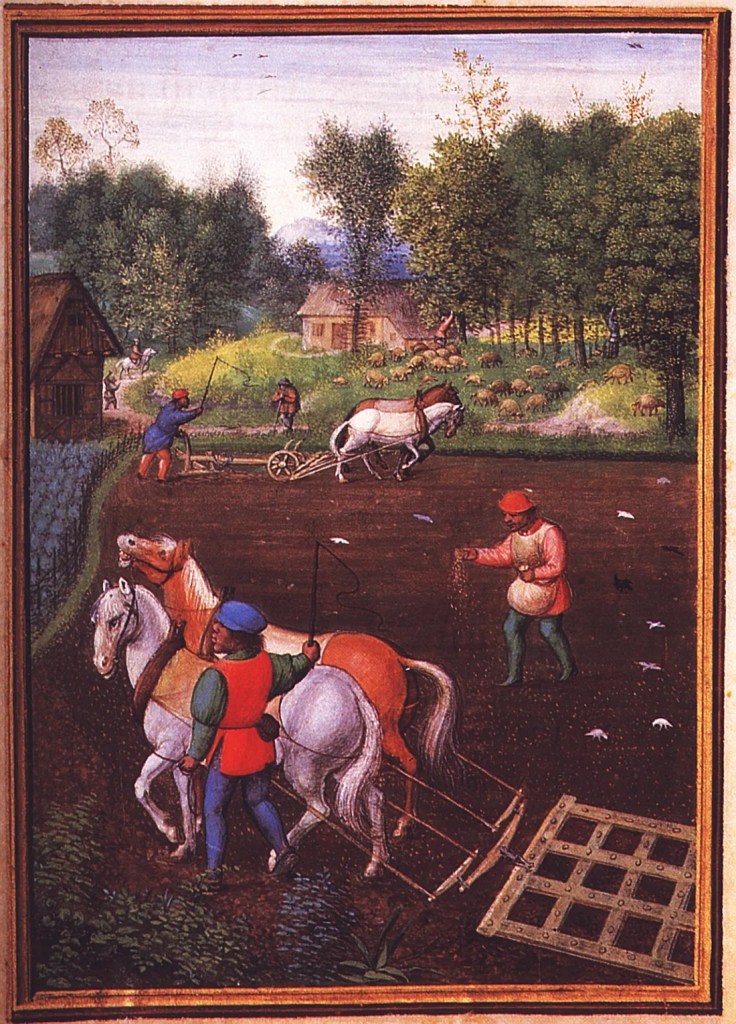
So in practice the average maximum working day might actually be a bit longer than 12 hours, but we should account for breaks and general schedule flexibility. We might assume, for comparison, something like a ten hour work day. By that measure, our peasants probably put in somewhere between 2,500 and 3,000 working hours per year. By contrast, your average ‘overworked American’ has 260 working days a year, at eight hours a day for just 2,080 hours.3
So to answer the question: no, you do not work more than a medieval (or ancient) peasant (despite your labor buying a much higher standard of living). But there’s more complexity for us to draw out here in the structure of peasant labor, so we need to go back to our model and start working through some implications.
Farming Time
As I noted previously, we’re going to anchor our model in the Roman evidence because I know it best and here the Roman agricultural writers – the agronomists (Cato the Elder, Columella, Varro and Palladius) – equip us with a lot of useful information, especially Columella. These fellows are writing guidebooks on how to run large estates – how to be good at being the Big Man – but the information they include, especially Columella, helps illustrate a lot about the labor and subsistence structures involved. As we’ve noted above, Columella already computed a standard agricultural work-year. We could convert that back into hours, but we don’t need to, because Columella does all of his labor calculations in working days.
The temptation here is to run our model on a single crop – wheat or barley – but that is a mistake. Columella himself suggests an estate (again, he’s thinking big farms) split between a wide range of crops, with primary plantings in wheat, a variety of legumes, along with turnips (and other root vegetables), barley, and so on. Our peasants will almost certainly do the same. There are a few reasons for this variety.
First, even from antiquity, farmers were aware that some crops exhausted the soil more rapidly or differently than others. They don’t fully understand it, but even Columella notes that some improve the land and others ‘burn’ it. And he is basically correct: lupines, beans, vetch, lentils, peas and such he regards are improving the land, while things like wheat reduce its fertility and some crops (he notes flax) put substantial strain on it (Columella 2.13). Of course farmers need those demanding crops, so rotation is necessary and was practiced since antiquity.
Second these crops all have different planting and harvesting timings. (Winter) wheat is planted in late Fall, barley in early winter, chick-pea can be sown in January or February, sesame in October, and so on and so forth (Columella 2.10). That’s important because planting and harvest create huge peaks in labor demand and our farmers want to try to flatten those spikes out a bit. If you plan nothing but wheat, you’ll never have enough labor to get all of it into the ground and then harvested again during the ideal calendar windows to do so.
Third is the perspective of risk management. All of these crops are vulnerable to different problems. A dry year will savage your wheat crop but barley is less bothered by dry conditions. Crops tolerate early frosts, high heat or low heat and so on differently. Pests that afflict one kind of crop may not afflict others. So by splitting your fields between different crops, you reduce the risk that any one problem will wipe you out. Remember that our peasants are not looking to maximize profit, but to minimize risk.
So our farmers are likely going to rotate a number of different crops. Now as to crop rotation, we often teach a fairly simple story of technological advancement from ancient two-field rotation systems (with half the land fallow) to medieval three-field systems to early modern four-field states (with the fallow largely replaced by fodder and grazing crops). And that description is more or less true but as always complexity abounds on closer inspection. As Pliny the Elder notes, the true maxim of farming was quid quaeque regio patiatur – “whatever the region permits.” For the Romans, we find attestations of two-field, three-field and continuous cropping systems where, in the latter case, extensive manuring was used to keep land under continuous cultivation,4 all depending on the local conditions: the richness of the soil, the availability of water, the local value of crops (and thus the affordability of manure) and so on.
For the sake of simplicity, we can think with three crops, wheat, barley and some legumes (in this case, vicia faba, the broad bean, for instance), though we also have to remember that about a third of our fields will be fallow in any given year. The legumes here are actually pretty important (and Columella seems to think a wheat-focused farming operation would sow wheat and legumes in even quantities, even while fallowing some of the fields, Columella 2.12.7-8) because they are nitrogen-fixing (technically, they have nitrogen-fixing bacteria) and so serve to maintain the fertility of the soil.

Different crops, of course, will have different productivity, demand different amounts of labor and so on. And here, as a reminder, since I am leaning on Columella, my background calculations are taking place in Roman units: modii (8.73 dry liters) and iugera (0.623 acres).
Wheat, Columella reports, was sown 5 modii to the iugerum (that is, it takes five modii – c. 43.5 liters or c. 1.2 bushels – to provide enough seed for 1 iugerum (0.623 acres) of farmland), and requires 10.5 days of labor. Columella (2.9) has barley sown 5 modii to the iugerum but Varro (1.44.1) suggests 6 modii to the iugerum; barley being more tolerant of bad conditions requires according to Columella only 6.5 days of labor for 5 modii for one iugerum. For beans, Columella says between 4 and six modii to the iugerum with 7 or 8 days of labor. That said, Columella’s labor-time estimates have left a number of things out – particularly threshing – and has probably somewhat underestimated plowing time5 so we need to account for that working time too. M.S. Spurr figures the wheat figure should be 14.25 days per iugerum, while Rosenstein estimates 19.5 days when accounting for the missing tasks, though note that we have not included a lot of background maintenance like maintaining tools or structures – this is purely the work for individual crops in individual fields.6 If we apply a similar under-count-adjustment to the labor requirements for barley and beans, we might come to a seed-and-labor-inputs estimate that looks like this:
| Wheat | Barley | Beans | |
| Land Area | 1 iugerum (0.623 acres) | 1 iugerum (0.623 acres) | 1 iugerum (0.623 acres) |
| Seed Required | 5 modii (43.65L, 1.2 bushels) | 6 modii (52.38L, 1.44 bushels) | 4 modii (34.92L, 0.96 bushels) |
| Labor Required | 14.25-19.5 days | 9-12 days | 10-14 days |
Now we have to think about how much labor our families have to throw at this problem. You will recall that last time we proposed three sample families, the Smalls, the Middles and the Biggs. How much farming labor do they have?

Labor patterns in these households were gendered, but not infinitely so. As Paul Erdkamp notes, in Roman artwork – and in my experience this pattern continues in medieval artwork – we do see women doing farming labor, but typically only in periods of peak labor demand (like the harvest, which has to be done relatively rapidly) or in households where some sort of misfortune has resulted in severe labor shortages.7 So for the sake of calculating the farming labor ‘backbone’ we may – for now – exclude the women of the household, though I want to be clear that women did farming labor when necessary and absolutely were not going to sit around starving to death if all of the men were gone. That said, as we’ll see in subsequent parts of this series, the women of the household were by no means idle: there was a ton of necessary work beyond farming required to sustain the household and they’re doing most of it.
Columella’s labor calculations are for large estates utilizing slaves or paid workmen and so assume fully fit adult males, but our actual peasant households are more varied than that. We ought to assume that each adult male (none of our model families has any very old men, so we don’t need to factor for that) is supplying a full unit of labor, 290 working days per year. Children under 6 or 7 or so are not going to be performing the main labor tasks, but we might figure that males in their late teens (16 and older) are providing something like three-quarters the labor-power of a fully grown adult and younger sons (10-15 or so) perhaps half as much. Based on those assumptions, our labor ‘backbone’ (which, again, would be supplemented by the women and girls of the household when needs be) looks like this:
| The Smalls | The Middles | The Biggs |
| Mr. Smalls (M. 40) 290 Work Days Per Year | Mr. Middles Jr. (M. 27) 290 Work Days Per Year | Mr. Matt Biggs (M. 43) 290 Work Days Per Year |
| John Smalls (M. 14) 145 Work Days Per Year | Freddie Middles (M. 16) 217.5 Work Days Per Year | Mark Biggs (M. 16) 217.5 Work Days Per Year |
| Mr. Martin Biggs (M. 28) 290 Work Days Per Year | ||
| Total Labor: 435 work-days | Total Labor: 507.5 work-days | Total Labor: 797.5 work-days |
Assuming then that land is no object (which it obviously is, but that’s next time’s problem) and a roughly even split between wheat, barley and beans, we might suppose totals for land under cultivation for each family very roughly like this (trying to get reasonably close to maximum labor employment without going over):
| The Smalls | The Middles | The Biggs |
| 11 iugera of wheat (c. 185 days) | 12 iugera of wheat (c. 202 days) | 20 iugera of wheat (c. 338 days) |
| 11 iugera of barley (c. 115 days) | 12 iugera of barley (c. 126 days) | 20 iugera of barley (c. 210 days) |
| 11 iugera of beans (c. 132 days) | 12 iugera of beans (c. 144 days) | 20 iugera of beans (c. 240 days) |
| Total: 432 work-days 49 total iugera (16 fallow), 30.5 acres | Total: 472 work-days 54 total iugera (18 fallow); 33.6 acres | Total: 788 work-days 90 total iugera (30 fallow); 56 acres |
Now, I see you there in the back, your hand already shot straight up because these farming areas are way, wildly bigger than what we’ve said typical peasant farms look like and yes, that is true. We’ll see how land scarcity factors in the next part, which is why I want to reiterate that this week’s analysis is not complete in itself for the obvious reason that very few peasants have unencumbered ownership of anything close to farms this large. Even a farm of 49 iugera would mark a household out to be very rich peasants. Nevertheless, we have to establish a baseline somewhere and this is a reasonable spot to do it.
Our next question has to be what these farmers might expect to get out of all of that work.

Farming Yields
As a rule, farming yields in the pre-modern are discussed not in terms of productivity per-land-area but rather in seed yields: for a given dry measure of seeds planted, how many of the same dry measure of seeds (because those are the tasty, edible parts of these plants) do you get back? So they are expressed in figures like 4:1 which means for every one modius/dry liter/bushel sown, four are harvested.
Yields were extremely variable, both season to season and region to region and our evidence for historic yields is often frustratingly limited or difficult. This is complicated by the fact that we cannot use modern farming yields to estimate, because hundreds or thousands of years of selective breeding have come to mean that modern crops are not identical to their ancient forebears and often have substantially higher yields, even if you used ancient farming techniques. As Theophrastus notes, ἒτος φέρει, οὒτι ἂρουρα, “the year bears [the harvest], not the field” (Theophr. Caus. pl. 3.23.5) by which he means seasonal variation was greater than regional variation: a bad year on excellent farmland was often worse than a good year on marginal land. That extreme level of variability makes charting an ‘average’ difficult. That problem is further intensified by the fact that our sources for antiquity often distort reported yields for rhetorical purposes – suggesting unreasonably low yields for crops they do not favor, or reporting absurdly high yields to simply the richness of specific regions.8
The best compilation of the evidence for ancient yields, which includes some comparative evidence for early modern and medieval crop yields, is in P. Erdkamp, The Grain Market in the Roman Empire (2005), 34-54.9 Yields on grains (like wheat and barley) might vary a lot, from as low as 3:1 on poor land in bad years to as high as 12:1 or more on good land in good conditions. Regional variability here is substantial: Spurr notes that in medieval Italy, hilly, marginal lands often yielded 3:1 or 4:1, while more typical flatter farmland might yield 5:1 or 6:1, but Sicily – with unusually good farmland – seems to have often yielded between 8:1 and 10:1. The general range for these yields is fairly consistent through the pre-modern evidence, improving modestly over time (so we might expect significantly, but not radically, higher yields for a peasant in 1500AD as compared to 1500 BC).
For our farmers, we probably ought to pick a pretty modest yield: our peasants probably don’t have the very best land available (the Big Man will have tried to get control over that) and also don’t have unlimited access to things like manure to really push yields at the upper end. On the flipside, our peasants are probably not on entirely marginal land (rocky ground, hills and so on). So we might propose something like a range of 4:1 to 8:1 to get a sense of the range from a bad year (4:1 yield) to a good year (8:1). For what it is worth, regions with very high productivity don’t tend to necessarily have richer peasants – they tend instead to have higher taxes.

Now of course some seed must be held back from each harvest to provide the seed for the next planting, but our yield ratios neatly contain this information. So while at a 4:1 yield, four modii/liters/bushels are harvested, one of those goes straight back into the ground, so the net yield is 3 units of whatever dry measure we’re using; at 8:1, the net yield is 7 units. In this case that works out to the following productivity per iugerum:
| Wheat | Barley | Beans | |
| Land Area | 1 iugerum (0.623 acres) | 1 iugerum (0.623 acres) | 1 iugerum (0.623 acres) |
| Seed Required | 5 modii (43.65L, 1.2 bushels) | 6 modii (52.38L, 1.44 bushels) | 4 modii (34.92L, 0.96 bushels) |
| Labor Required | 14.25-19.5 days | 9-12 days | 10-14 days |
| Gross Harvest | 20-40 modii | 24-48 modii | 16-32 modii |
| Net Harvest After Seed | 15-35 modii (~131-305L, 3.6-8.4 bushels) | 18-42 modii (~157-367L, 4.3-10.1 bushels) | 12-28 modii (~105-244L, 2.9-6.7 bushels) |
With that in hand, we can loop back to our chart above and calculate the range of net harvest after removing seed for next year that our model families might expect from their farming listed above.
| The Smalls | The Middles | The Biggs |
| 165-385 modii wheat | 180-420 modii wheat | 300-700 modii wheat |
| 198-462 modii barley | 216-504 modii barley | 360-840 modii barley |
| 132-308 modii beans | 144-336 modii beans | 240-560 modii beans |
That’s a lot of modii. But of coruse now we have another problem to account for: the modius is a dry measure. Pre-modern farmers mostly reckoned in dry measures because it was easy to measure but it is awkward for us because these crops, once harvested and put in sacks for storage, do not have the same density (that is, mass per unit volume) or calorie density (that is, calories per unit mass) as each other. So we need some way to convert these figures to our subsistence measure we developed last time which was kilograms-of-wheat-equivalent.
For wheat that’s relatively easy: threshed wheat has a density of roughly 6.72kg per modius (about 770 kg/m³), so a modius of wheat is 6.72kg of wheat equivalent. For the other two, we need to convert from a dry measure to a density to a calorie value to convert back to wheat equivalent. Barley is a little less dense than wheat, roughly 6.465kg per modius (740 kg/m³) but much less calorie dense – just ~2,160 calories per kilogram compared to wheat’s 3,340.10 So a modius of barley has roughly 13,960 calories in it, making a modius of barley just 4.17kg of wheat equivalent. A modius of beans (vicia faba) is about 5.43kg and contains about 18,842 calories, making that modius 5.64kg of wheat equivalent.
That neat exercise should also tell us something about farming strategies. A single iugerum, planted with wheat, yields (net after seed) between 100 and 235kg of wheat equivalent. Planted with barley, it takes much less labor and is more tolerant of bad (particularly dry) weather, but yields only between 75 and 175kg of wheat equivalent. Planted with beans, it consumes an intermediate amount of labor, helps the soil recover and provides unique and necessary nutrition – man cannot, as a matter of biology, live on bread alone – but provides only 68 to 158kg of wheat equivalent. A farm that finds itself strained – especially if the limit is land and not labor -might focus more and more heavily on barley (if it is very dry) or especially wheat at the expense other crops in order to maximize the yield per land area (which in turn means employing more labor). Keep that in mind for next time when we start factoring in land scarcity.
However for now, let’s head back to our tables and now factor our yield ranges into wheat equivalents to a get sense of how they stack up against our subsistence requirements (I’m rounding some of these figures off, so there may be some imprecision in the table):
| The Smalls | The Middles | The Biggs |
| 165-385 modii wheat 1,110-2,590kg wheat equivalent | 180-420 modii wheat 1,210-2,820kg wheat equivalent | 300-700 modii wheat 2,020-4,700kg wheat equivalent |
| 198-462 modii barley 825-1,925kg wheat equivalent | 216-504 modii barley 900-2,100kg wheat equivalent | 360-840 modii barley 1,500-3,500kg wheat equivalent |
| 132-308 modii beans 745-1,740kg wheat equivalent | 144-336 modii beans 810-1,895kg wheat equivalent | 240-560 modii beans 1,350-3,160kg wheat equivalent |
| TOTAL: 2,680-6,255kg wheat equivalent | 2,920-6,815kg wheat equivalent | 4,870-11,360kg wheat equivalent |
If we compare to the subsistence and respectability needs of our households, we can make a few observations. First, given maximum labor employment and no land scarcity, even in modestly bad years each family clears its subsistence needs (though only the Smalls clear their respectability needs). In something like an ‘average’ year, the Smalls produce around 187% of their respectability needs, the Middles 155% and the Biggs 150%.
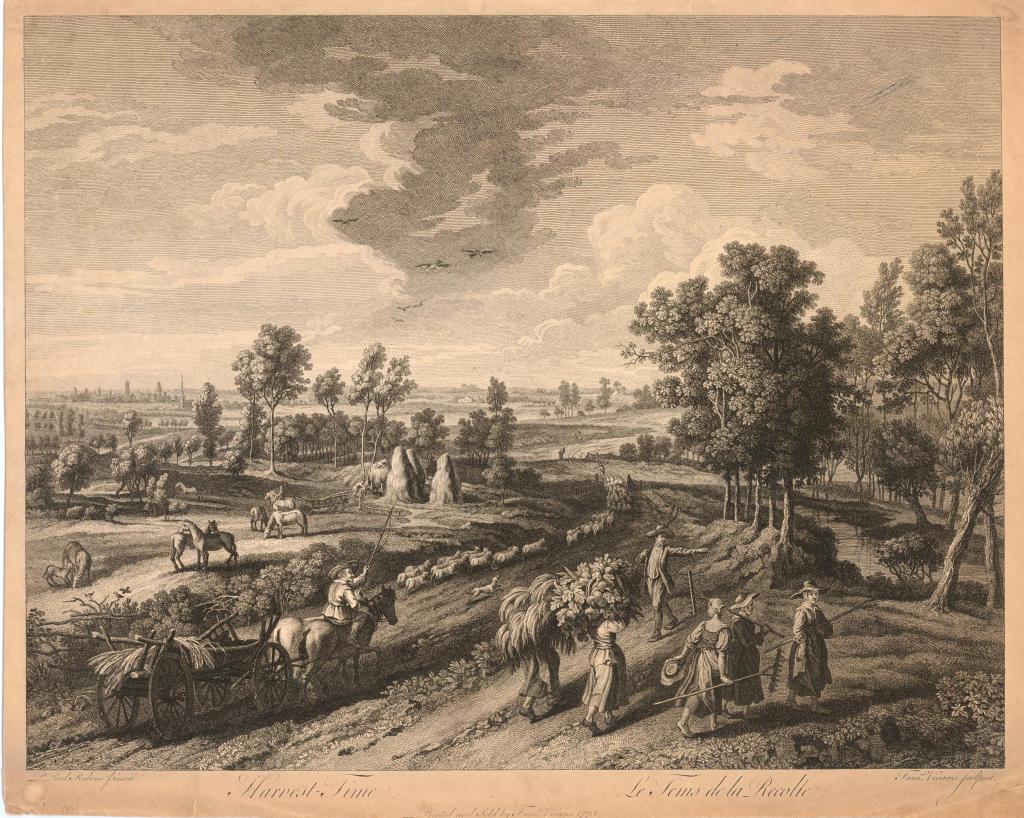
If labor and not land was the limiting factor in peasant agriculture, we ought to expect our peasants to live quite well. Of course even a casual glance at the first post in this series will warn against jumping to that conclusion. After all, by ignoring – so far – land scarcity, we’ve put our families on enormous farms by pre-modern standards, between 30 and 60 acres, more or less. But we know from the evidence that while our families might have the ability to farm 30-60 acres, the typical size of an actual smallholder farm was closer to 3-6 acres than 30-60; a farm of even something like 15-25 acres might mark a family out as ‘rich’ peasants. And above we can see why: a family on 20 or 30 acres probably has enough land to get close to or even reach its respectability basket without engaging in any kind of tenant or wage labor. Instead, that family may have so much land it can afford to rent out what it does not farm itself.
What we have done here so far is essentially simulated very rich peasants, which is well enough but as we’ve seen, rich peasants represented only a fairly tiny minority of the peasantry. In practice, households with as much land as above would be likely to begin repurposing some of it for things like livestock, vineyards or orchards – things with a lower per-acre calorie yield but which might provide greater food variety or market value. As you can tell from looking at the relative balance of labor- and land-intensity for crops, the “mostly grains” strategy is going to be a direct response to land scarcity rather than abundance.
Rather, as we’ll see, most families will have nowhere near enough land to match either their labor or their subsistence demands, which in turn will provide some of the wedges that the Big Men and the broader society will use to try to turn that ‘surplus’ labor to their own ends.
And that, of course sets up where we must go to next: how this model changes – and goodness, does it change – once we start thinking about land scarcity and tenant farming.
- “Labor Conditions in Essex in the Reign of Richard II,” Economic History Review 4.4 (1934)
- “Impatience, Poverty and Open Field Agriculture” (1986). I can’t obviously interrogate an unpublished article, but Clark revisited this topic later in “Growth or stagnation? Farming in England, 1200-1800” in The Economic History Review 17.1 (2018)
- If you are thinking, “wait, but don’t have nearly so many day-off festivals, how do we end up with fewer work days, the answer is weekends. The medieval Christian peasant gets one day off in seven; the Roman peasant got one day off in eight (the nundinae; the Romans count inclusively and so call their eight-day week the ‘Nine days’). You get two days off in seven and that adds up very quickly.
- On this, see Spurr, Arable Cultivation in Roman Italy (1986), 117-132. Various rotations discussed in Plin. HN 18.187, 191; Varro Rust. 1.44; Columella Rust. 2.9.4, 2.9.15, 2.10.7.
- On these points, see Rosenstein, Rome at War (2004), 68, n. 25.
- Rosenstein op. cit., Spurr, “Agriculture and the Georgics.” In Vergil, edited by I. McAuslan and P. Walcot, 69-93. Oxford: Oxford University Press, 1990.
- Erdkamp, op. cit., 87-90.
- On this, see Erdkamp op. cit. 34-46.
- Erdkamp’s major intervention is to pry ancient historians away from the extremely pessimistic yield figures for wheat given by Columella. As Erdkamp notes, Columella is an outlier compared to our other sources and his yield figures seem exaggerated to favor his argument (he argues for vineyards over grains as a cash-crop).
- This difference is following Foxhall and Forbes, “Σιτομετρεία: The Role of Grain as a Staple Food in Classical Antiquity” Chiron 12 (1982), 42-47, who argue that the combination of the heavier hull of barley with relatively inefficient hulling available in antiquity would mean that significant less of the nutritional value of barley as harvested would make it into the final barley flour; they assess a ‘discount’ of about a third, which I’ve followed here.


I don’t really have much to say about this, but I am fascinated. I do find these agricultural history ones the posts I think I just directly learn the most from.
“The Overworked American (1993). The argument has been debunked quite a few times, so I won’t belabor the point here. Schor bases her estimates of medieval working hours on a 1935 article by Nora Kenyon,1 and a 2018 article by Gregory Clark2”
I, uh, don’t think it’s possible that a 1993 book bases its estimates on a 2018 article?
It’s interesting that to meet even just subsistence a family needs more than double the land they’re likely to actually have. I suppose most of it is owned by the local Big Man, but that’s a remarkable disparity – the local Big Man (Big Men? Would you expect more than one local Big Man?) probably owns more land than all the local peasants put together. Though some peasants have a lot more, so maybe only roughly comparable.
Yeah, that graph got tangled in editing, I’ll revise it.
Found the problem. The wires that crossed is that Schor cites a 1986 unpublished paper by Clark which doesn’t seem to exist in any available format – because it was unpublished – so I had bounced to Clark’s 2018 revisiting of the topic to get a sense of what Clark’s own view is and then tangled up the two G. Clark articles, citing the one I had when I needed to indicate that Schor relies on the one no one can get or check or verify.
I can’t find any suggestion in the later article that Clark’s position has ever changed, so I strongly suspect the same sort of cherry-picking going on here, but it is possible that in this unpublished phantom paper that no one can find Clark advanced an unusual view which he then subsequently and quite quickly (as quickly as the early 1990s) abandoned.
Or as it was unpublished, it had uncorrected errors(typoes perhaps?) in the figures?
Or maybe it’s unpublished because Clark realized he’d made some serious errors…
Snopes: “In an email to Snopes, Clark, now a distinguished professor emeritus at the University of California, Davis, said he arrived at this number by comparing records of annual and day laborers.
Clark said he no longer agreed with the methodology used to calculate the estimate attributed to him in Schor’s book, but had since come to support a significantly higher estimate. In a paper published in the Economic History Review in 2018, Clark expressed support for an estimate closer to 300 days a year, representing a working year similar to those recorded in the 19th century.
Clark described his current methodology as being based on living standards. One of the classes of evidence he has used as a proxy for living standards is the amount spent on supplies required to feed workers while they were on the job, as recorded in medieval employers’ accounts.
If medieval workers worked only 150 days per year in certain periods, according to Clark, then the relative amount employers spent on rations during those periods should be roughly half what was spent during later periods on workers who, thanks to improvements in record-keeping, are securely known to have worked 300 days a year on average.
Instead, Clark pointed out, the relationship between the amount spent on workers’ food and the amount spent on their daily wages remained surprisingly stable from 1350 to 1869, something Clark has taken as strong evidence that workers in medieval England on average worked roughly the same number of days per year as workers in the 19th century.”
https://www.snopes.com/fact-check/medieval-peasant-only-worked-150-days/
It would have been helpful if you could state what you mean by “patriarchy”, in addition to “traditional agriculture” (as plough use was not typical for all parts of the world).
I suspect plough use was good for women in the long term. If men do not have to work to spread their genes, they will do something else. They will engage in more violence, create all-male societies that terrorise their women, and steal the proceeds of their labour. A woman can spend all day preparing a meal and still eat last. By far the best place to be a woman today is the Western world with its history of labour-intensive agriculture, which has granted women the highest social status among earth’s cultures. The worst place is the Islamic world, and interestingly Africa where men were less needed for women to sustain themselves. The greater independence of African women, e.g. in enterpreneurship, has not resulted in them being treated especially well. For that men need to be civilised.
Did you mean to imply that Schor based here 1993 work on a 2018 article? I’m guessing some editing made this a bit awkward.
This was addressed by Dr. Devereaux in a previous comment, but what happened is that Schor cited a 1986 work by Clark that Clark never published, and Dr. Devereaux couldn’t obtain a copy of that manuscript. Thus, when trying to figure out what Clark was actually saying and whether Schor’s citation represents his work accurately, Dr. Devereaux had to look at a 2018 paper by Clark on the same subject, and some wires got crossed I guess. The matter is, as of this writing, clarified in the original article text.
Your comment on women doing farm labor illustrates a pernicious thread that runs through these discussions: The definition of “labor”. For example, for a long time in England the poultry (ie the chickens) and the dairy (ie, butter, cheese, that sort of thing) were the domain of women. Men would help with the poultry–they were not welcome in the dairy–but these were things women did. The money also traditionally went to the women in the house (though you’d have to be a particularly stupid wife to let your family starve and not put your money towards the problem). In addition, the gardens were largely the domain of the women of the household. Again, men would help (particularly with things like providing manure, building walls, and felling trees), but by and large the garden was women’s work. And by “garden” I mean “place where everything not a grown in fields or foraged from the woods was grown”–some of these gardens could be substantial!
The question arises: Does this count as “farm labor”? I’ve done poultry, and it absolutely is work! Same with gardening–on a scale capable of providing even substantial flavoring for a household, it’s work! But it’s all too common for our sources to exclude this from “work” because it was women doing it.
On the masculine side, the issue is things like hunting, cattle raiding (common along the Scottish boarder), and the like. It all provided food, income, and stability to the family (provided you don’t get caught poaching or rustling), but can be excluded from “farm work”.
It’s also worth noting that calculating work time by daylight hours only gives you a lower boundary. Anyone who’s been involved in agriculture knows that while a lot of the work is sun-up to sun-down, there’s a lot that also includes staying up late. If you have animals you’re up when they need you, including foaling/lambing/calving, if they get ill/injured, if they get attacked, if they need driven to market, etc. For fields you’ve got a bit more flexibility–at the cost of plants being unable to tell you if there’s a problem–but there are still times when you’re working by moonlight. If a wall fails you need to get it back up, before the pigs, or wild animals, or other people get to your fields. Even Medieval peasants could do some things with drainage, and sometimes that meant staying up late. Some tasks need to be done in a certain timeframe, and you just had to do it, even if it meant staying up all night (harvest, thrashing, certain parts of building projects, etc). And remember, this was a culture where fire was central to life; this means that fire was an omnipresent risk. Then there’s the less-savory aspects, such as poaching–we should not pretend that these didn’t exist merely because they were illegal! So those work hours, again, represent the lower limit of what these peasants were working, not an upper limit. (Similarly, an 8-hour day is a lower limit–ask anyone in the trades!)
“(Similarly, an 8-hour day is a lower limit–ask anyone in the trades!)”
This was my first thought when I read the beginning of the post that calculated work hours. The average American is not working five 8-hour days a week and then going about their personal lives the rest of the time. Part of why we consider ourselves overworked is the seeming omnipresence of overtime or second jobs. Gallup found that in 2019, the average American full time worker worked 44 hours a week at their primary job (though it’s fallen to about 43 hours since then), which would bring the annual total to 2,288. Still less than the peasant, of course, but noticeably closer.
Looked at the other way, 2500 to 3000 hours a year equates to a modern workweek of 48 to 58 hours per week. Which is a lot, but we have a significant number of people who do in fact work hours like that, if not greater.
That’s not to detract from the overall purpose of the post, I just think that particular stat could have used a bit more nuance or precision.
If you’re just multiplying 44×52, you’re missing the impact of holidays.
Not to out-pedant The Pedant, but is that not how you got the 2080 hours for modern Americans? 52 x 40 (8 hours a day, 5 days a week) = 2080 hours per year. 260 working days a year divided by 52 weeks comes out to 5 days a week, every week. You approached it slightly differently, but that’s how that figure shakes out.
It is true that we do have holidays, and most of us also have paid time off. My intention wasn’t to throw the overall conclusion into doubt, just that one line hit me funny.
A LOT of workers do not get PAID time off. I can personally vouch for that. I had years of employment not getting paid “holidays,” sick leave, vacation time, or any other so-called perks.
I’m not convinced that this is true. For two reasons.
If the average is 44 hours/week, that’s already accounting for holidays. That’s how averages work, after all. And it’s easy to accomplish–a couple of 50 hour weeks quickly negates the lost work hours from holidays. I’ve been in my career–a good, solid, respectable, professional career that puts me firmly in middle-class territory–for nearly 20 years and I’ve only just gotten to the point where a 40 hour work-week is normal to me. A year ago anything less than 50 felt like part time.
Then you’ve got the unpaid work of childcare, homeownership, etc., but that’s another issue.
Second, not everyone gets holidays off. Retail workers tend not to, for example–when I was working retail I got paid pretty well (for the time), but I worked every holiday. Then there are jobs where the nature of the job precludes time off. I’ve got some friends on offshore oil rigs, and “holidays” for them consist of a somewhat nicer dinner than usual; they still work. And not everyone gets the same holidays off. I deal with this constantly in my job, as access to a site when the client considers it a holiday and you consider it a work day gets thorny. And you DO NOT want folks working at power plants to all take holidays off! Or doctors, or police, or fire fighters, or even cooks and waiters/waitresses. Some of these jobs offer substantial time off to compensate (the oil rig workers get weeks off at a time), but not all of them do (doctors are notoriously over-worked, especially early in their careers).
I’m not necessarily saying that the calculation is wrong, mind you. What I’m saying is that it glosses over some very significant factors in modern society. 8 hours a day, 260 days a year should be treated as a middle-class ideal, not as an accurate representation of our society.
Which, of course, applies as much to the number of hours a Medieval peasant worked. A naive, but reasonable, assumption would be: The variability around the ideal we see in our culture is going to be comparable to the variability around the ideal we see in past cultures. Meaning that some peasants are going to work less, and some are going to work a LOT more.
Let’s not overlook the time lost to commuting! Modern wage-slaves might spend a considerable time just getting to and from their work — unlike pre-modern farm peasants. E.g., my wife and I for decades spent *at minimum* 90 minutes on the road each working day. To and fro. That adds up very quickly. It might not have been “working”, but it subtracts from your waking hours as sure as any cow-milking or wheat-threshing.
They definitely had to commute to their fields. It’s hard to generalise but a household living in a village might have many strips of land around it
True, but I would hardly consider walking to work and driving to work to be the same thing. I did not consider commuting to work to be part of work when I was walking to work–indeed i found it relaxing, but when I got sent to a different office and had to drive to work instead I absolutely started considering that part of work, because driving is stressful and dangerous.
The average one-way commute in the US is 26.6 minutes each way: https://www.census.gov/acs/www/about/why-we-ask-each-question/commuting/
And for all the discourse on second jobs, part-time work is much more common; nowhere in the developed world is the average more than 2,000 hours per employed person – the top country (Greece) is 1,893, and the US is 1,805, on OECD numbers.
Supercommuting exists and so do very long work hours, but they’re usually middle-class phenomena. For example, the infamously long hours of Japanese and Korean salarymen are for decently well-off people – the workers serving the salarymen food and drinks during mandatory after-hours company socializing don’t work these hours.
When Part II of this series was discussed, I pointed out how even the supposedly very culturally similar Nordic nations ended up with markedly different migration-related policies – as measured by the EU’s Migrant Integration Policies Index.
https://www.mipex.eu/play/
Likewise, it’s an easy, but wrong, assumption that attitudes towards work in Japan and (Republic of) Korea can be safely lumped together. If you check out the OECD link in my other comment, you’ll see that from 2010 at the latest (which is merely where the table begins) the figure of Average annual hours actually worked per worker had consistently been at least 100 hours lower for Japan than it had been for the US! In fact, in recent years, the gap has widened, so that it is now closer to 200 hours!
On the other hand, the Korean figure is nearly 100 hours greater than the American one now (and so >250 hours greater than the Japanese one) – and this is after it had declined markedly in the past 15 years! In the early 2010s, the Korean average stood in the ~2100 hour range (vs. USA’s ~1800 hour), exceeded only by Costa Rica, Mexico and Colombia*. I recall that Moon Jae-In, one of the best global leaders of the recent years, had formally restricted work week length to 52 hours, when the earlier statutory length was 68 hours, and we certainly see the effects of that change reflected in the data.
*Which has the absolute highest figures for OECD. Nowadays, they are more like Mexico’s, at ~2200 hours, but in the early 2010s, they stood at ~2400 hours, seemingly making it the only OECD economy which approached the peasant figures in this post. (In theory, it might be because of the literal peasants – though apparently, just ~15% of the workers are employed in the Colombian agriculture, which is about the same as in Türkiye – and the latter has slightly lower working hours than the US, let alone Colombia or Mexico. Of course, a very large agricultural mechanization gap could still theoretically account for that.)
Yes, working hours in Japan are on average much lower than in South Korea. But the salaryman cultures there are rather similar, including the mandatory after-hours drinks with the boss. Japan has shortened its working hours as of late, and I think Korea also has longer working-class working hours, but the cultures remain fairly similar, and this includes the need to show a lot of face time.
I would argue, in addition to what Alon Levy says, that commuting time is over-estimated because it’s not JUST commuting. When I go into the office I also run errands–go to the grocery store, pick up dog food, get the kids from school, etc. So it’s trading time for convenience: I’d rather spend 20 minutes driving to and from work, if that means I can do other parts of my job more efficiently.
A lot of the commuting discussion stems from anti-car advocates, at least in my experience. And while I agree that cars aren’t perfect and there are better options in some cases, some people are fanatically anti car, to the point where they exaggerate statistics or flat-out lie.
Not really sure what a Medieval equivalent would be. As Alex said, peasants commuted to their fields. The fields were generally scattered over different plots, so even if you were living next to one field, you’d have to hike to the rest. Maybe they’d pick up some food or fuel along the way? I know that when I was working my grandfather’s farm it was routine to grab edible plants–nuts, berries, garlic, various greens, etc. And while peasants had rights to a certain amount of wood, we shouldn’t confuse the law with the practice; if a peasant saw an opportunity to grab some extra without too much risk I don’t see them refusing to take it very often.
And since they were walking, less than 1/2 hour is not very far in terms of your commute.
Four miles an hour is an extremely brisk walk, doable by a 20th century person in good shape with next to no encumbrance. I doubt 13th century peasants loaded down with tools (you’re not storing them in the field) would do that pace.
Are all of your fields within a mile or at most two of the others? If not, then your commute is longer than the 26 minutes posted earlier as the typical American commute.
Indeed, the medieval open field system was such that peasants commuted from the village where they lived to the fields. The commute length was the limiting factor to village size. Contiguous enclosed plots with a homestead in the center are a modern innovation – colonial New Englanders lived in town centers and commuted to their fields rather than in homesteads, so this is really a post-independence innovation from the settling of the interior Northeast and Midwest.
Oofda. I’m not sure if the methodologies are the same (in fact, I strongly suspect they’re not), but ONS data in the UK about working hours puts the average at 36.6 hours a week for full time workers in 2023, or 31.8 hours a week for all workers in 2022. These figures are slightly lower than those in 2019 (32.1 hours a week for all workers), but not *that* much lower. From a cursory google, it seems the ~43 hour working week is for full time workers, so is most comparable to the 36.6 hour week stat in the UK.
These are likely to be an under-representation as they’re an amalgam of various different measures that likely don’t quite capture the extent of unpaid overtime, but even still that’s a stark difference.
If the methodologies are in any way close to comparable, you folks need to get some labour movements going pronto.
I think one reason for the difference is that US workers do not have as much annual leave entitlement as we do in the UK, which makes a difference averaged over the year (for non-UK people who are wondering it’s 5.6 paid weeks of leave per year)
“Juliet Schor’s The Overworked American (1993). The argument has been debunked quite a few times, so I won’t belabor the point here. Schor bases her estimates of medieval working hours on a 1935 article by Nora Kenyon, and a 2018 article by Gregory Clark”
I might be being dim here. is this meant to mean that Schor referenced Clarks research that she had access to in 1993 and was then published in 2018 or that she doubled down on these arguments and used Clarks data later as more evidence?
love the work
On a related note, I’m pretty sure Schor’s book is a bit older than that. Wikipedia says 1992, as do some other sources, but there’s an Amazon listing that says 1991.
https://www.amazon.ca/Overworked-American-Unexpected-Decline-Leisure/dp/0465054331
There was an issue where Schor cited an unpublished 1986 manuscript by Clark, and Dr. Devereaux couldn’t find a copy, so to try and figure out what Clark was actually saying, he used the 2018 paper Clark DID publish on the general subject. Then some wires got crossed; this has been addressed in an edited version of the main post, I think.
I know technology and yields changed a lot between Rome and early America… but I feel this calculation tells you *so much* about American history and why it might lead to a different culture than Europe, given that the standard homestead farm sizes put you firmly into the “rich peasant” category.
Most of the “weird things Americans do” (sweet tea, obsession with lawns, “A man ain’t no kinda man if he ain’t got land”, etc) basically boil down to Americans trying to live like rich Europeans in the 16/17/1800s.
@Dinwar,
Also hunting, right?
(I certainly have nothing against hunting, and greatly respect hunters, but my understanding is it was another of those things that was much easier to do in North America, at least after the great depopulation of the native population, than it was in Western Europe).
The Eastern Woodland native agriculture system primarily involved the creation of forest clearings to house a more garden-style field than Eurasian peasant systems, with corn-squash-legumes grown in tandem (overlapping but not perfectly simultaneous growing seasons) instead of a monoculture rotation. One of the main ongoing labor tasks in that native system was whitetail deer control, as these animals graze preferentially on the transitional vegetation that grows between forests and open land; deer are attracted to the clearings to begin with, then discover they are full of crops. Centuries of contact plagues took away both the crops and the people who kept the deer at bay, but all but the longest-abandoned native farm clearings simply filled with transitional vegetation and supported a much larger deer population than a fully ‘natural’ forest would have.
None of the European settlers were aware that the clearings were human-made, well except maybe some of the earliest, but there’s no indication it would have changed anything if they had understood. The ratio of deer to humans became so extreme that trade in wild-caught deer hides became steadily profitable and professionalized, which may be unique for cervidae.
And whitetail deer control is still very much a concern for farming in the eastern US, along with feral hogs.
Some parts of Europe have a similar or even bigger hunting culture than the US. In Sweden, school closes for the opening week of moose season.
I can’t find the source, but I recall a post quoting some colonial sources on how little undergrowth there was in the forests — I think one marveled that it was possible to drive a coach through some areas. What they were seeing (but not recognizing) was the result of management by the natives, and a few decades later the forests had closed up again.
For Matt Cramer: The feral hogs are winning in a lot of places. There’s a meme about it – “This is serious: a problem Texans can’t solve with guns and barbeque.”
“how little undergrowth there was in the forests”
I think Charles Mann’s _1491_ mentions that; I don’t recall his primary sources.
If the question is “was it much easier to do a lot of hunting as a North American rural settler c. 1620-1920 than as a European peasant in the same period,” the answer is definitely “yes.” The depopulation of the continent meant a lot of forest suitable for game animals to reproduce quickly, so lots of hunting.
If the question is “was hunting pursued as a prestige activity for North American settlers,” I think the answer is “mostly no,” because a lot of the people actually doing that hunting were hunting for sustenance or as fur-trappers for whom that was their livelihood.
@SimonJester,
I wasn’t suggesting that hunting was a prestige activity, I was suggesting that it became very culturally significant (and remains culturally significant to this day in states like Pennsylvania, Michigan etc.). And, yes, it’s of course for food, but something can play both an economic and a cultural role.
@Matt Cramer,
That’s fascinating about schools in Sweden! I’ve heard about schools in the US taking a day off for the first day of deer season (and from personal experience, in some parts of Michigan, even if they don’t officially take a day off a lot of students are absent that day anyway).
I was thinking specifically about western Europe, so i can definitely believe that Scandinavia and Eastern Europe might be a different story.
Making people richer is not the same as changing their culture. What might change the culture is a less intense competition for land. It would be easier to escape the domination of the local Big Man. But remember there was a lot of land per person in the Russian Empire, and that did not end up, socially, much like the US or Canada.
It might be interesting to draw comparisons with Argentina. Or Quebec.
Possibly culture (as in, Protestantism plus Anglo-Saxon liberty plus parliamentary democracy) is as important as the material conditions of production. Although, to be honest, my crypto-Marxist tendencies usually lead me in the opposite direction.
Interesting. My natural tendency is to over-credit those very things for American success, so I try to downplay them as much as possible in my head to correct. But I’m a classical liberal/libertarian who’s determined not to get trapped by thinking I have all the answers.
I wish the answers could at least occasionally not be “It’s even more fiendishly complicated than you already think it is.” Then again, this blog wouldn’t exist if that weren’t generally true…
People have in earlier comment threads brought up the subject of life-cycle servants in Northern Europe. Presumably such a system, in which people are *expected* to leave the family farm as soon as they can do useful work, would be better suited to opportunistically expanding over any aborigines on the frontier.
IIRC there is something in de Tocqueville where he compares the faster spread of Anglo, rather than French Canadian, settlers throughout North America.
Russia and similar (Hungary, Poland) had to keep control of the peasantry to maintain the state structure – the surplus extracted afforded an army, bureaucracy, court etc. Without which they would be demolished by the Tatars/Swedes/Germans/Ottomans – or each other. The US had no need of a strong state, given that it faced no similar level of threat.
Note that for all its Protestantism and ‘Anglo-Saxon liberty’, Britain was one of the tightest states in Europe – high taxing and very stringently governed.
“Russia and similar (Hungary, Poland) had to keep control of the peasantry to maintain the state structure – the surplus extracted afforded an army, bureaucracy, court etc.”
Russia and Poland are nicely similar and contrasting, Russia for strong court and bureaucracy, Poland for weak court and bureaucracy.
But BOTH Russia and Poland relied heavily on “light cavalry” lower nobility armies. This meant that both had to allow serfdom – the peasants were not themselves able to serve as light horse, so the state had to back petty nobles and give them the tools to squeeze the peasants hard, to support a light horseman with as few serfs as possible, rather than spread the load lightly across a bigger number of free tenants.
The contrast is the tools of state the petty nobles ended up backing. Both Russia and Poland featured suspicions between light cavalry and heavy cavalry. In Poland, eventually the light cavalry and heavy cavalry agreed on collective institutions to make the prince weak and elective – and likewise in Novgorod. In Moscow, the autocracy enjoyed the support of light cavalry who suspected that collective institutions would be hijacked by heavy cavalry.
You ought to specify the history period are you talking about. The core of the Ruthenian forces in the medieval, the druzhina, most certainly was heavy cavalry (though they often fought as dismounted infantry depending on conditions) – as heavy as the Crusader knights, for one. Here is a video from a Russian museum about the Kulikovo Field battle of 1380, with the guide’s voiceover accompanying the reconstructions.
https://www.youtube.com/watch?v=gnzNqp9IAWc
Around the third minute, you can see stirrups (such an archetypal feature of heavy cavalry there is even a literal “stirrup hypothesis” about their role in the emergence of “feudalism” – albeit one our host disregards) while the guide mentions spurs as well, and says that with those two, they were fully capable of the same shock charges as the European knights. From the fifth minute onwards, armour is shown in detail – which for the elites was a coat of plates with thin chainmail underneath. This is basically the same as what many of the contemporary knights actually wore – our host frequently pointed out in early posts that plate armour had evolved much later than most people think. From the wiki:
So, the only difference is that plate armour was never adopted in Ruthenia – in large part because it so was quickly rendered obsolete by firearms, which spread much faster there than most people assume – the first firearm in Russia is dated to 1389, and Ivan the Terrible was reported to have ~2,000 cannons spread around various cities. This spread of firearms also rendered heavy cavalry irrelevant – which was another reason why Ivan the Terrible foolishly thought it safe to purge the heavy cavalry class, the boyare with oprichina after he conquered the Kazan and the Astrakhan Khanates. (Which ended up massively weakening the state, causing things like the Swedish advances into future St. Petersburg territory, the final Tatar raid on Moscow mentioned by Hastings and the assassination of the last Rurikid, Ivan’s the Terrible underage son (the remaining heir after Ivan had notoriously beaten his elder brother to death in a fit of rage). Altogether, this had spurred the state’s collapse into the notorious “Time of Troubles”, as demographically devastating as any other major 16th-17th century conflict, with double-digit population declines.)
I suspect his purge of the powerful boyare in favour of larger numbers of comparatively weaker and more state-dependent lower nobility (dvoryane) might be what you are referring to – though you have written it in such a vague manner it’s hard to be sure. Afterwards, though, it is certainly true that the cavalry sourced from such lower nobility classes (most notably the gusary – a Russian adoption of Polish hussar) certainly enjoyed far more prestige during the Imperial Russia than any sort of infantry besides the grenadiers (which had the role of royal guard formations.)
“and the assassination of the last Rurikid, Ivan’s the Terrible underage son (the remaining heir after Ivan had notoriously beaten his elder brother to death in a fit of rage)”
Not true.
The remaining heir was the middle son, Fyodor Ivanovich, 24 when the elder son was killed, 26 when Ivan died, 33 when his little brother Dmitry perished – and he survived the first public death of Dmitry in 1591.
Either Fyodor (if Dmitry died in 1591) or Dmitry (if his first apparition was real but his second was not) may have been the last Danilids, but they were definitely not the last Rurikids, nor even the last Rurikid czars.
By 1598, the title of “prince” or even “Rurikid prince” carried little clout above that of non-prince boyar – but the czars did not give out the titles. There were a lot of Rurikids available in 1598, but Godunov was elected (and was not one of the Rurikids). In 1606, a Shuiski got the throne – and WAS the last Rurikid czar. In 1613, there were still many Rurikid princes available – Prince Pozharsky, for one – but it was Romanov, again a non-prince, who was elected.
“Britain was one of the tightest states in Europe – high taxing and very stringently governed”
Not to make a moral point, but British taxation was incomparable to Continental taxation as it actually funded public goods (sometimes pretty much the same things we’d consider public goods, sometimes things that pre-modern people considered public goods, eg religious offerings) and paid a professional army.
In most Continental system, you paid your taxes to the state, got at the very best security (but in general much worse than the one enjoyed by the British) and everything else – roads, churches, stockpiles – was paid either by the local nobility with additional taxes, or by the village (and you were expected to contribute oc). Oh, also, if there’s a war you or your son will be pressed into service.
I don’t want to do the math rn, but it’s pretty easy to put a pecuniary value on military service (because richer people paid to send a substitute), and if we add village “contributions”, I’d be really surprised if most continental subjects were taxed less than the British ones.
“Local Big Man” arises in part when the Small Folk perceive the need for his protection. While the “Indian frontier” was certainly violent in North America, a heretofore unprecedented aspect of it was that even the Small Folk had individually possessed firearms, and so routinely possessed the capacity to inflict sufficient casualties on tribal attackers to frequently make even a tactically successful raid strategically pyrrhic.
In contrast, there was no such disparity between the peasantry in Moscow Knyazhestvo/Russian Empire’s heartlands and the raiders assaulting them – and the latter were enough of a threat that for nearly a thousand years, countless trees were regularly cut down and formed into the abatis obstacles (засеки) – with the most important one compared to the Great Wall in terms of its extent!
https://en.wikipedia.org/wiki/Great_Zasechnaya_cherta
You do not build and maintain such without the prominent Big Men – and like our host just wrote, they then demand great taxes, so while you might have a lot of land by Western/Central European standards (one source suggests allotment sizes around the time of serf emancipation in 1861 actually were at ~35 acres per household), that already brings household position well down. Then, we have discussed firewood the other week – peasants in warmer areas both required less of it, and were able to obtain a lot of comparably easy-to-harvest branches via coppicing. Neither was true at the latitudes where the dominant forests are coniferous (and therefore un-coppiceable.) This adds labour hours, and also means that your ability to spread out geographically can be tied to firewood supply in addition to the other factors discussed above.
I’ll also note that while some might be tempted to look at the nominal land area of the Russian Empire and think that it represents land easily available for the peasants, this would be rather misleading. After all, as many posts on here have noted, land travel in the preindustrial times is difficult and expensive. (Not to mention liable to kill via the diseases of poor hygiene.) A peasant at a crowded village in the heartland might have heard rumours of sparsely settled land a few hundred km northeast, but how are they going to safely get their family and possessions there?
There are studies showing exactly that! Combination of high threat requiring highscale mobilization and tying down manpower. The Tartars sacked Moscow in 1571. The last big raid to reach the Oka valley was in 1633! Rates of serfdom were *much* higher in the 1600s near the Zasechnaya cherta than in the rest of Russia. Peter ‘the Great’ and Catherine ‘the Great’ then did a lot to broaden and strengthen serfdom in the 1700s.
The Native American threat gets frankly seriously overrated outside the early colonial period. The French and Indian War was the last time you really had a conflict that could be called demographically significant on the frontier as a whole. In a macro-sense we barely even had to try to defeat the Natives. The US fielded about 3k men for the Great Sioux War. The two sides in the Civil War raised *400* times that at peak. Main benefit of US Army is it greatly reduced settler losses compared to pre-Revolution. But the settlers could have ground forward without them.
Well. I would add the wars of both Pontiac and Techumsah as demographically significant, but the latter ended with the war of 1812, so your point still stands.
Well, the foreign threat level to Russian peasants may have been higher than that to American frontiersmen, but as people have observed, that is not saying much. You could say that about a lot of people in the Old World. It was old, and mostly had time to reach technological equilibrium.
Certainly, it is not obvious that the threat to them was greater than that to the Cossacks further south. I don’t really get the impression that the Cossacks were reduced further into serfdom.
I gather from Azar Gat, and indeed our host and advisor, that a need for military effectiveness tends to produce greater equality among the militarily important sectors of the population. Whatever happens, the people who provide the musketeers/ rowers/ heavy infantry/ cavalry/ whatever-it-is-you-need have to be treated well. In Russia it always seems that the people who need to be treated well are the Oprichniki/ Okhrana/ KGB / FSB.
A cynic might say that the Grand Dukes of Muscovy were not the Golden Horde’s enemies but it’s tax collectors. That’s why they needed collaborators more than soldiers.
And these days, the ruler of Muscovy has an end-the-world button, and even less need of an effective army than usual.
The cossacks in this relationship are (basically) military settlers, and just like other military settlers they sometimes get into conflict with the central government, but the point is they aren’t socially really much like the peasantry either: There’s a reason “cossack” become a byword for oppressive enforcerer of authoritarian regimes.
Your narrative is really badly warped by what we shall politely call presentism.
For starters, the Golden Horde existed from 1224-1459. It actually is true that the contemporary Muscovite rulers had collected tribute to the Horde for most of its existence – after Moscow had initially resisted and got razed in 1238 alongside over a dozen (then)-major cities across modern-day Russia and Ukraine. (In fact, a major reason Moscow, which was only founded a century earlier, was able to assume a dominant position over the cities that had existed for centuries longer was due to the levelling effect of 1238, which had erased the enormous advantage Kiev* in particular had enjoyed until then, leaving the relatively remote Novgorod as the only major rival.) It also certainly wasn’t all they did – in 1380, Князи of Moscow and Vladimir have exploited an intra-Horde civil war to take battle to one of the claimants, Mamai, at Kulikovo Field, resoundingly defeating his forces (only for the other one, Tokhtamysh, to consolidate power and raze Moscow again.)
More to the point, there were no опричники during that entire period – because they were formed by Ivan the Terrible in…1565! All the previous Князи** – be they from Moscow, Vladimir, Novgorod, Kiev or Chernigov (northern Ukraine, and another place which never truly went back to its pre-1238 importance) had a very similar military system, which relied on the дружина, the kind of well-armoured “mounted warrior-aristocrats” (to use the our host’s terminology) not overly different from the contemporary European knights militarily or socially. In line with Gat, they certainly were treated well – but of course, they (generally) had to be the Big Men whose estates would support the cost of their armour, horses and training – so their peasants got soaked for the sake of all that. This system worked well enough for battling each other or giving major battles to pre-Horde nomadic tribes – it simply broke down all at once in their face of the Horde’s excellence (not unlike how the hoplite-centered system of all the Greek poleis had almost simultaneously crumbled in the face of the Macedonian phalanges.)
In fact, what makes your claims particularly ironic is that not only were the опричники formed well after the Golden Horde stopped being a threat***, but that they were also created as the structure of the Muscovite force became more egalitarian than ever before – the дружина ceased to exist (in no small part because опричники purged so many of the boyare it would have been comprised of) and the core of the fighting force were instead стрельцы, the unarmoured infantry with firearms and axes. It was with this new system that Ivan the Terrible was able to both utterly raze Novgorod, forever removing it as an alternate centre of power and to conquer two major remnants of the Horde – the Kazan and the Astrakhan Khanate, which have remained as core Russian territory ever since. So, the claim that any Muscovite ruler had prioritized опричнина over the regular fighting forces because they expected to collect tribute instead of fighting is completely, utterly backwards in just about every single way imaginable.
As for the Cossacks, they may not have been “reduced further into serfdom”…because by and large, the early Cossasks were runaway serfs in the first place! Ones who had initially intermarried with половцы, the proto-Tatars (also known as Cumans further west – a name Kingdom Come: Deliverance players ought to be very familiar with) – after all, the word itself appears to have originally meant “exile” in the latter’s language! Thus, they have also taken up their semi-nomadic ways from them, but it had taken them a while to form as a distinct group – the first historical references to them as an entity (rather than Turkic texts calling any exile “a Cossack”) appear to date to ~1400s – only a generation or two before the Golden Horde as a whole collapsed.
After that, as was already pointed out by Arilou, they fairly quickly settled into the role of enforcers of the Russian state at its frontiers. In fact, the bargain they struck, exchanging relative independence (including the right to exclude any and all Jews from their lands – just so that we avoid any excessive romanticism here) for the 20-year conscription of every single fit male appears completely in line with your “I gather from Azar Gat, and indeed our host and advisor…the people who provide the musketeers/ rowers/ heavy infantry/ cavalry/ whatever-it-is-you-need have to be treated well.”
https://en.wikipedia.org/wiki/History_of_the_Cossacks
*Apparently, Kyiv did not become the local spelling until much later.
**I am excluding the major Belorussian ones (mainly Minsk and Polotsk), since they have been under Lithuanian influence and were spared the Horde’s 1238 rampage, which might have also resulted in a divergence of their military system.
***- to the point that Ivan the Terrible’s father had razed the capital of the largest splinter still attempting to piece it back together, the Grand Horde – by pinning the bulk of their forces at the Ugra River without giving them a fight, while a side deal with the Crimean Khan ensured that the latter’s troops would block the Horde’s Polish allies from intervening. Mo
“Your narrative is really badly warped by what we shall politely call presentism.”
YARD, if we are talking about me, I can say what politeness prevents you from saying and call myself ignorant. Which I certainly am about Russian history.
I am just unconvinced by the idea that all the slavery/serfdom is a consequence of the low population density, given the comparison with North America. And I am unconvinced by the idea that it is a consequence of the greater military threat, given the comparison with countries in Western Europe e.g. Holland.
I think your point about the importance of light cavalry has a lot to commend it. It would help explain why everyone was so happy to step on the peasantry, a non-light-cavalry-producing class. And the difference with the West, where infantry were generally important.
@ad9: Honestly, I don’t think a person truly ignorant of Russian history would have written what you did. I.e. they would have simply not known what oprichnina is in the first place, for one. You, however, had picked four examples – “Oprichniki/ Okhrana/ KGB / FSB” – and claimed that they represent some universal law of Russian history in spite of only covering a very small fraction of it. This sort of overconfident grand-narrative making could seemingly only arise after exposure to a certain set of political narratives from the recent years – but the net effect is akin to that notorious claim, “Fox News viewers know less than those who do not watch news at all.”
As in, the recorded history of Rus’ (sometimes known as Ruthenia in the European languages) dates to about 862. Even if you want to limit the timeline to Moscow’s founding specifically since Rus’/Ruthenia was mainly governed from Kiev (never mind that Novgorod and other then-powerful and always territorially Russian cities like Pskov are even older), that still starts us off in the mid-1100s – 400 years before oprichnina, which is historically situated well into the “Early Modern” period, rather than any definition of Medieval, which this series is (mostly) about. It had also existed for only a dozen years anyway – in large part because the destruction they wrought had directly precipitated the end of the Rurikids and the state’s onetime collapse into the “Time of Troubles”.) Then, you skip forward another 300 years and only cover the most recent 150 years or so, as the (informally called) okhranka was founded in 1866 – in response to all the assassination attempts on Alexander II, who had just abolished serfdom five years earlier. (Though in a very half-hearted manner which generally burdened “the liberated” with debts and often caused them to sell their plots to former masters.)
So, your initial narrative does not really match the facts at all. Now, someone with the more comprehensive knowledge of this history could have had advanced a more plausible version of this argument – i.e. the aforementioned Rurikid dynasty consisted of the Norse elites recorded to have been invited to rule with the words “Our land is great and abundant, but it lacks order.” (Of course, many have argued that we have no way of knowing if this wasn’t invented to whitewash a simple Norse conquest not wholly unlike that of William the Conqueror. Though even if taken at face value, the fact that the Rurikids have mostly ruled from Kiev is…not very convenient to present-day political narratives.)
Wait, the same North America which had imported vast numbers of literal slaves? What happens to your comparison once they are accounted for?
What about Holland? I haven’t studied its history specifically, but a cursory look at Wikipedia just now certainly does not seem to suggest it went through nearly every major population center being systematically razed in the 13th century – which is exactly what happened in the Ruthenian lands in 1237-1241. It does mention frequent Viking raids over the “defenceless” towns in the 700-900s; however, I really doubt the Rurikids would have been “invited” to rule in 862 had there not already been a history of similar military dominance of the Norse. If you instead mean the Eighty Years War – well, the aforementioned Time of Troubles took place during that period and was at least as demographically devastating, if not more so.
If anything, the main reason to invoke Holland is because it had been the main inspiration for Peter the Great – to the point that he literally created the Russian flag of the then-and-now by tearing the Dutch one into strips and rearranging them! Peter the Great modernized the military from Ivan the Terrible’s times by bringing many Dutch and German officers into it, and this had continued for the rest of century (since the lover of Peter’s niece and de facto (co)-ruler was Latvian German, and then of course Catherine the Great was literally the German wife of Peter the Great’s half-German grandson). Their influence was in everything, from uniforms to terminology (i.e. the Russian army still calls its corporals efreitor) and most notoriously, the discipline. (I.e., “running the gauntlet” was adopted from them, and the thin wooden lash given to soldiers in the gauntlet was called another German term, Spitzruten.) It was also during this period that the serfdom became at its most severe and restrictive (i.e. before the Time of Troubles, there had been a Yury’s Day tradition where serfs were legally allowed to change their masters during that one day).
So, we have foreign-born elite officers carrying over their military traditions without doing the same for their civilian make-up (because they hardly cared about their own peasants’ lives, let alone those in their new country) and instead seeking to tighten control over the peasantry – taking advantage of preexisting conditions formed due to the long history of being militarily threatened and exacerbating them in order to have an easily tallied and therefore conveniently conscriptable source of manpower. This, in combination with even the local elites frequently not speaking the same language as the commoners (the court language was German in the 18th century, and French in the 19th – the next time you look at War and Peace, note how all the passages where Russian elites are talking to each other are nevertheless regularly littered with French.) and therefore generally taking the officers’ side is a far superior explanation for why serfdom lasted longer and had been more brutal in Russia than it had been elsewhere.
In fact, before Alexander II finally abolished serfdom, the peak of its cruelty had been with Alexander I’s War Minister introducing the literal “military settlements”, where the state-owned serfs had their lives subordinated to military requirements, so that they could always be called up as immediately drilled reserves whenever required. (And which obviously greatly impoverished them as the result.) Come to think of it, that system is somewhat reminiscent of what the Song Dynasty did, as we discussed in a recent Fireside – it certainly has nothing to do with (non-existent) okhranka being prioritized over the military classes!
https://en.wikipedia.org/wiki/Military_settlement
” (I.e., “running the gauntlet””
YARD: Hey, that’s stolen valour! Running the gauntlet is a proud swedish tradition! (indeed, despite the name it’s actually “gatlopp”, “Running the street”)
While Peter I was of course heavily inspired by his dutch and german contemporaries toa decent chunk he also copied the administration of the swedish empire (IE: the collegia division, etc.) that he helped dismantle.
YARD, I picked Holland because Holland because it was no ones idea of a particularly militarised or despotic society. And because its War of Independence was fought against the ruler of most of Europe, and after that found itself frequently at war with France, by far the most populous country in early modern Western Europe. And if it were conquered, its Protestant ruling class could be sure that it would be dispossessed by the Catholic conquerors. From the viewpoint of the policy-making classes, therefore, these were existential wars against powers with vastly greater manpower.
I imagine wars in Eastern Europe could be a good deal more destructive in human terms, with a lot more people being killed or enslaved in raids – but raiders go away and leave the existing power holders still holding power. In that sense they are akin to plagues and famines that kill a large fraction of the population, but leave the rulers still ruling. They are human disasters more than threats to the ruler. In that sense, raiders demanding tribute and slaves are less of a threat to the ruler than the most bloodless conquest.
I called myself ignorant of Russian history because I define ignorance in relative terms and am pretty sure I am more ignorant of it than you, but as I understand it, there was a great upsurge in repression/ slavery/ serfdom in Eastern Europe in Early Modern times, when any threat from steppe raiders was presumably lower than in late medieval times. You would probably know better than me – would you care to comment?
BTW – slave imports into the British America had nothing to do with population density and everything to do with the disease environment. Most European arrivals into the Caribbean died of something tropical within a few years of arrival, Africans were much more likely to survive. So you get societies in which almost everyone is African or of African ancestry. But since almost African immigrant was a slave, and slavery was hereditary, that means almost everyone is a slave. The fact the population density was far higher in Barbados than New England did nothing to make slavery less common in Barbados than New England. And then there were the southern Mainland colonies, half way between them, less malarial than Barbados, at least in the uplands, and with fewer black slaves than Barbados.
The more tropical colonies therefore ended up with more slaves because more of their immigrants had been enslaved before they arrived. Presumably this exact dynamic would not apply in Eastern Europe.
Yes, and as far as Russia is concerned, at least, this actually matches your hypothesis – since the Orthodox nobility just had the massive scare of being nearly replaced by the Polish Catholics during the Time of Troubles (awful translation of Смутное Время, which literally means something more like “Murky Times”, but it’s stuck in English, so I guess I have to use it) – first when the Polish attempted to place the impostor sons of Ivan the Terrible on the throne with variable success*, and then when King Sigismund III briefly got himself a bunch of nobles swear fealty to his heir in Moscow. They felt themselves falling behind Poland (and Sweden, which claimed a number of border areas earlier), so once they agreed that the Romanov family was the best suited to protect their interests, modernization was the next mutual interest of them all – which was done by extracting more out of peasants. Once this approach worked at beating back Sweden, it was turned to fighting Türkiye and Persia, etc.
So, what the steppe threat does is explain why the peasants in Eastern Europe were not able to build up wealth in the medieval times and live as prosperously as their supposedly abundant lands seem to imply they should have had. (I’ll also add a bunch of other environmental factors – i.e. a good number of lands which are arable now have been swamps that did not get drained until the Soviet or late-Tsarist times.) It also conditioned them to expect their rulers to demand a lot from them and justify it in the name of their own protection – and with the raiders directly observable since literally the beginning of Russian recorded history**, this “lesser of two evil” framings worked. As that threat receded, the framing stopped working as well – and so, this is when we see massive Cossack-led peasant uprisings. Ones so massive that they would have been able to take over entire Western European countries – suffice it to say that the second largest of those rebellions – the Bolotnikov one during the “Time of Troubles” interregnum – did not just manage to besiege Moscow, but had taken over some 70 cities at its peak.
https://en.wikipedia.org/wiki/Uprising_of_Bolotnikov
This here is where I think your approach to history is too “top-down”. You focus on what the rulers choose
to do or not do, and seem to minimize how their options are constrained by, amongst the other things, what their people could (and could not) do to hold them accountable. The tyranny of distance in Russia (and Imperial China, for that matter) means that the rulers could push their people very hard – and still feel fairly safe in the capital as long as the centre is strong for pure logistics-related reasons. As noted above, the Bolotnikov uprising was actually considerably smaller than that of the legendary Stepan Razin later in the century – but because the latter rebelled during the time of 2nd Romanov (Peter the Great’s father), when the system was much stronger, his forces ultimately ended up defeated 700 km away from Moscow. If the Dutch nobles were foolish enough to provoke something like this, they would have had all ended up hung or staked. In theory, the distances in America or Canada were large enough to attempt serfdom…but not when either country is reliant on the influx of colonists (if only to maintain the pressure on the Natives) who have to believe things would be better there than at home they left, which isn’t going to work if they know they are set to become serfs.
I’ll add that neither the North American colonies, nor Holland ever felt like they were “falling behind” in the same sense as Early Modern Russia had. In fact, Holland was able to bounce back quite rapidly from all the wars you mention both because they sat at the intersection of so many trade routes, and because they used to have the most literate population in Europe, allowing the average Dutchman to engage in more forms of higher-skill labour. Even in the 17th century, it wasn’t hard to see that imposing serfdom onto such people didn’t even make so much sense economically – and same was true of the many colonists. The peasants didn’t have such advantages, and the idea that they could use land more efficiently than the nobles and strengthen the country more in the long run in that way was way too abstract for that period. (Even The Wealth of Nations did not get published until well into the reign of Catherine the Great – and as she had famously corresponded with Voltaire, but still considered him a pie-in-the-sky idealist, she was unlikely to get swayed by such logic.)
And lastly, I still think it’s important to observe that both the European nations and especially the colonies in the Americas were able to obtain highly exploitable labour via the slave trade. Presumably, you know better than me just how much of the US’ historical GDP is directly attributable to slave labour. I have no doubt that if it were not available, they would have made every effort to create a white underclass as exploited as the Russian serfs to fill in that gap. (And if they couldn’t do it because of the aforementioned reasons, then the country might well have ended up just that much less powerful than it is/was.)
*There were at least four Fake Dmitrys – who have all pretended to be Ivan the Terrible’s final son, who was assassinated as a boy by servants of Boris Godunov, the “grey cardinal” of his childless elder brother Fyodor – the last Rurikid Tsar. After the latter died and Godunov crowned himself Boris I, a son of the very minor provincial noble became a monk who served in Moscow – and from there, he learned every detail of the assassination and every other skill he thought he needed at a royal court. His plot was eventually discovered, but he had already fled to Poland – and eventually managed to persuade Sigismund to back him with his army. His march on Moscow actually succeeded due to a confluence of the recent Great Famine (which provoked enough discontent that he was able to get a good number of commanders to pretend to believe him and switch sides – in the process gradually replacing the original Polish forces, many of which went home as the campaign stretched on and the loot stopped being enough to pay them all) and Boris’ own death, leaving only a teenage heir who himself got murdered even before the impostor entered Moscow. With his comparatively humble origins, he was actually far more sympathetic towards the peasants than any other ruler had been for centuries – but he arrogantly overestimated how many people believed in his myth, and focused on preparing for war with Türkiye about as soon as he got in instead of coup-proofing – so the nobles, upset at being sidelined by the Poles, overthrew him less than a year later.
However, the Poles then spread rumours only his body double was killed, and soon selected a second pretender – who even got to marry the same woman to complete the charade. He besieged Moscow and effectively ruled much of the country from his siege camp until then-Tsar Vasily Shuisky conceded enough to the Swedish to get them to intervene – but this also prompted Sigismund to intervene more directly in the name of balancing power. Many Polish forces left the second pretender for their King – but then, he formed a new army at Kaluga (~150 km from Moscow) and fought against both Shuisky and the Poles. In fact, he outlasted Shuisky and came quite close to victory – in a grand strategy game or some “cliodynamic” simulation, it would have probably been assured given the territorial control he had – but an assassination by an once-loyal Tatar noble disgruntled at the execution of his friend (a comparatively minor khan near present-day Ryazan) had ended it all.
If the above is not crazy enough, said noble, who Russified his name to Petr Urusov, had then backed another Dmitry pretender (who never got far beyond Astrakhan’, however), while the Polish wife of the two Dmitrys, Marina Mnishek, had declared the infant son she had with the second one the real successor, and retained the support of one of her late husband’s top commanders, the Cossack ataman Ivan Zarutsky, whom she married not long before they all got crushed by the Romanov armies. This does not even cover all the other Rurikid pretenders – during his brief siege camp “reign”, False Dmitry II is said to have ended up executing seven “nephews” – or a number of other leaders who attempted to seize power or secede without claiming dynastic continuity. There is a reason that period caused population losses well in the double digits.
**Some of the first things Rurikids are recorded doing is taking battle to Pechenegs – a steppe people they eventually managed to drive towards the Byzantines, who in turn drove them into what is now Hungary. Then, the Cumans have done a lot of raiding even before most of them joined the Golden Horde. And as I already noted earlier, there’s every reason to believe that frequent Viking raiding was a necessary precondition to Rurikids taking all the power for themselves instead of any Slavic ruler.
I would hope that people do not generally believe that they work harder than medieval peasant farmers. Almost any given person today works less hard than a *modern* farmer, much less a medieval farmer who had to work quite a bit harder than his modern colleague (since he didn’t have the benefit of industrial machines). Perhaps I am showing a familiarity bias (I did grow up on a family dairy farm so I’m intimately familiar with how much work it is), but the idea that people today work harder than medieval peasants is as obviously wrong as suggesting that the sun cools the earth rather than warming it. It’s the sort of thing I would never expect a person to say in any serious capacity.
I wouldn’t say it’s a common opinion, but it’s not particularly rare either. Lots of people have little knowledge of history or farming, and will happily swallow any perceived fact that reinforces prior opinions. In this case, the prior opinion is often some variant of “capitalism is to blame for everything, and society was better in the good old days before it” without much thought into defining “capitalism” or “the good old days” (or even “better”).
Well, there has already been a comment attempting to argue just that – less than 2 hours after you wrote yours!
For that matter, there is also the argumentation to the extent of “preagricultural life involved less work than the modern one” – one prevalent enough that even the lodestar of many such people, Ted Kaczynski (!), felt the need to write a fantastically long rebuttal to the most outright mythical conceptions of their life, based on his own experience and the extensive reading of anthropologists who studied the remaining non-agricultural societies (after all, he had a lot of time for that, being in prison and all.) There are a lot of paragraphs much akin to what we have seen in this series, highlighting the difficulty of things like net repair or food preparation. At the same time, he wasn’t prepared to renounce the idea entirely:
https://theanarchistlibrary.org/library/ted-kaczynski-the-truth-about-primitive-life-a-critique-of-anarchoprimitivism
At the same time, I think this paragraph might be more illustrative – at the very least, it is certainly much more concrete, with a minimum of speculation when compared to the above.
P.S. When I brought this up in earlier discussions on here, one counterargument was that the above would have only been true of the modern tribes left on marginal lands, while those in fertile regions actually would have had easier lives. Kaczynski actually briefly considers the idea, although he ends up looking at from a different angle entirely.
But let’s assume for the sake of argument that in the fertile regions of the world wild foods were once so abundant that it was possible to live off the country year round with an average of only, say, three hours of work per day. With such abundant resources it would not be necessary for hunter-gatherers to travel in search of food. One would expect them to become sedentary, and in that case they would be able to accumulate wealth and form well-developed social hierarchies. Hence they would lose at least some of the qualities that anarchoprimitivists value in nomadic hunter-gatherers. Even the anarchoprimitivists do not deny that the Indians of the Northwest Coast of North America were sedentary hunter-gatherers who accumulated wealth and had well-developed social hierarchies. [38] The evidence suggests the existence of similar hunting-and-gathering societies elsewhere where the abundance of natural resources permitted it, for example, along the major rivers of Europe. [39] Thus the anarchoprimitivists are caught in a bind: Where natural resources were abundant enough to minimize work, they also maximized the likelihood of the social hierarchies that anarchoprimitivists abhor.
The move from foraging to sedentism is difficult – it only happened maybe seven or eight times around the world, and in each case over centuries. Even when living next to sedentary people, foragers are very much disinclined to adopt it as a way of life (the evidence for this is archaeological and genetic – and Peter Bellwood argues linguistic as well. Farming spread into Europe from Anatolia via colonisation, not adoption).
I realise you’re relaying Ted Kaczynski’s…..”thoughts” here, not putting forth your own, but I really don’t think he’s a great secondary source though. Not only did he have a very obvious ideological agenda, he wasn’t actually an anthropologist, nor was he someone who studied this stuff for a living, or alternatively had firsthand experience of such societies.
If you want a look at a good secondary source that looks at a broad range of “primitive”* societies, through a range of methods (ethnography, oral history, archaeology, in some cases written history), and seriously tries to answer the question of what kind, and degree, of hierarchy and inequality is “natural”, versus a product of economics, versus a product of culture, I can recommend this book. It’s long and the archaeology parts can get boring if that’s not your thng, but in general quite readable.
https://www.amazon.com/Creation-Inequality-Prehistoric-Ancestors-Monarchy/dp/0674064690
The answer they come to is fairly nuanced and qualified, and while they’re clearly highly sympathetic to the ‘primitivist’ case, and to what they broadly consider hunter-gatherer values in general, they’re also quite clear that the values of hunter-gatherer and primitive horticulturalist societies tended to diverge quite sharply from what modern western liberal/progressives would consider congenial.
also one minor note, but the Mbuti and othr Pygmy groups aren’t really hunter gatherers in the traditional sense. They’re commercial hunter gatherer specialists. They hunt and collect forest products which they exchange for the goods produced by agricultural settled societies.
For what it’s worth, I’ve seen too many memes of reddit repeating it, and too many comments approving it. It even got to Historia Civilis, which makes a lot of video about Rome!
Two observations:
This article makes it easier to understand what motivated European settlers to move to the New World: HUGE tracts of land. A land where *any family* could obtain thirty to sixty acres of land sounded like Heaven to them.
Peasants diversifying their farms was what really motivated the Soviets to collectivize their agriculture, not the kulaks (those Big Men again) reintroducing hired labor. After the dust of the revolution and the civil war settled, most peasants, by the virtue of redistributing the land formerly owned by the nobles, were middling peasants with enough land to consume all available labor.
This meant that they were now free to plant legumes, vegetables, tobacco, convert the fields into orchards, vineyards or even pasture. They optimized their own consumption, but the government wanted them to maximize production instead, to grow lots of easily taxable and calorie-dense wheat that could be used to feed the cities and to pay for Western industrial expertise. Hence collectivization, with the government functioning as the Big Man letting peasants work on his plantations.
Sixty acres is 24 hectares. Approximating to 25 hectares to keep the math simple, that implies a square 500 meters on a side. To keep a million families in this style would require a square 500km on a side, 250,000 square km, about the size of Great Britain or Italy, consisting entirely of arable land. Which Britain and Italy are not.
Going to be tricky getting that anywhere the natives can’t be driven off, and aren’t thoughtful enough to die of smallpox.
“So by splitting your fields between different crops, you reduce the risk that any one problem will wipe you out. Remember that our peasants are not looking to maximize profit, but to minimize risk.”
But Columella isn’t trying to minimize risk; as a(n advisor to the) Big Man, he is trying to maximize average profits.
Women doing (non-peak) farming labor as ersatz men: in an interaction with reproduction patterns, it can be safely assumed that that year, the physical exertion will cause her to miscarry any pregnancy she may have. And presumably the next year the family will do some combination of starving and drawing on those horizontal and vertical links, assuming that they are available because only that one family, rather than the whole village, faces the sudden shortage of men.
It’d need a specific kind of missing man in the household – the vast majority of hard labour of the Smalls is Mr. Smalls, but if you want to add a Newborn Smalls, you need Mr. Smalls as well. There’s a 9-month time window to put an explanation in, but that’s fairly short. The Biggs (a less common household) are more likely to suffer a labour shortage without a pregnancy shortage.
Anyway, in such dire conditions, miscarriage is a minor concern compared to not having the resources for an extra child, so even a live Newborn Smalls is still likely to join the infant mortality statistic. A widow needs to rely on help from the community (well-known trope!) and remarry to restore labour balance long-term.
Given the gendered division of labor, and the high rate of death in childbirth, the Widow Smalls (leaving aside whatever personal charms she may have) is likely to find a man who is both interested and available.
“Women doing (non-peak) farming labor as ersatz men: in an interaction with reproduction patterns, it can be safely assumed that that year, the physical exertion will cause her to miscarry any pregnancy she may have. ”
Do you have a source for this?
Women did all kinds of hard work (ever tried to get clothes clean without a modern washing machine OR detergent?) and still do things like carry the family’s whole supply of water (in very dry regions, where the way the water must be carried would be very far, no less) from the well to the house.
I honestly fail to see what kind of farming labour would be even nearly as strenous as that. Certainly not weeding. I’ve done weeding. I don’t see any material difference to scrubbing a floor, which women certainly did at all times during pregnancy.
Ploughing (no idea how hard that is, but you can get kicked by the horse while doing it, and that would indeed induce miscarriage) and threshing would both be happening at the times of peak labour (sowing and harvest), hence likely with women having to participate.
Plus, in many societies farming was/is considered women’s work. (Mostly, it seems, in those societies where men found something more prestigious and/or financially profitable to do.)
I am not sure division of labour was even driven by differences in physical strength, and I certainly haven’t seen any proof anywhere of men voluntarily sparing women the hardest work to protect pregnancies. (Modern workplace laws do forbid employers from making pregnant women work too hard, but the fact that we need those laws are pretty much proof that this isn’t done voluntarily. )
Physical exertion sure caused miscarriage occasionally (as did malnutrition, accidents, domestic violence …), but I doubt it can be assumed to always cause miscarriage – women in some situations would never have had surviving offspring, otherwise. (Female slaves and maidservants. Women in societies where farming was considered women’s work. Women in societies where grinding grain by hand was women’s work. Et cetera.)
“By contrast, your average ‘overworked American’ has 260 working days a year, at eight hours a day for just 2,080 hours.”
This is so misleading as to be insulting. When people talk about being overworked they are referring to (often unpaid) overtime at 3,000 hours a year or more. So the low end of a modern exploited worker’s working year is at the high end of your estimate for a peasant’s working year. And a modern exploited worker is absolutely not enjoying the flexible schedule or lack of oversight of your average peasant. And sure as hell no entire month off.
Your own numbers and assertions completely prove the claim you are seeking to disprove. Though I’m not sure *why* you would be so keen to disprove it. Looking to undermine pro-labor sentiment? I thought you were better than this.
What alternate timeline are you typing from? The average American is not, in fact, working 57 hours a week (which is what 3,000 hours a year comes out to).
According to OECD*, the figure of Average annual hours actually worked per worker stood at 1796 hours for the United States last year. Interestingly, that was the lowest in 15 years (maybe even ever?); the recent high was 1831 hours in 2015. I presume someone like B K could argue that these numbers are “diluted” with workdays of whoever is to be defined as the elite worker class, but of course, the more one has to do to narrow the definition of an overworked American down, the less “average” they are going to become.
Having said that, these figures actually are still a little higher than the OECD average of 1736 hours – in large part because the Nordic and the Germanic countries do happen to be markedly lower than others, averaging in the 1400s. (Going down to ~1350 hours for Germany and Denmark.) On the other hand, Greece and Chile exceed ~1900 hours, and Costa Rica + Mexico** have figures in the ~2200 hour range.
https://data-explorer.oecd.org/vis?
df[ds]=DisseminateFinalDMZ&df[id]=DSD_HW%40DF_AVG_ANN_HRS_WKD&df[ag]=OECD.ELS.SAE&dq=AUS%2BAUT%2BBEL%2BCAN%2BCHL%2BCOL%2BCRI%2BCZE%2BDNK%2BEST%2BFIN%2BFRA%2BDEU%2BGRC%2BHUN%2BISL%2BIRL%2BISR%2BITA%2BJPN%2BKOR%2BLVA%2BLTU%2BLUX%2BMEX%2BNLD%2BNZL%2BNOR%2BPOL%2BPRT%2BSVK%2BSVN%2BESP%2BSWE%2BCHE%2BTUR%2BGBR%2BUSA%2BOECD…….._T….&pd=2010%2C&to[TIME_PERIOD]=false&vw=tb
* Large links like this can get screwed up by WordPress, so if that happens, select and paste all of it into a new tab instead of clicking on it.
**Looking at that figure, I can’t help but think back to that “banger” of a quote from Top Gear, about 15 years ago – “a Mexican car’s just going to be a lazy, feckless, flatulent oaf with a moustache, leaning against a fence asleep, looking at a cactus with a blanket with a hole in the middle on as a coat” and experience truly visceral revulsion. For that matter, the Greek figure consistently being >100 hours greater than the American one (and ~500 hours greater than the German one!) certainly places that common narrative of the yesteryear – “Greeks are lazy, so of course they have the debt crisis” in a new light.
Elite workers are the ones likeliest to work long hours in the US. The paper I’m relying on is from 2008 and gives data up to 2006, but, in 2006, the proportion of men working >= 50 hours a week was 26.8% in the top quintile (up from 15.1% in 1979) and 13.3% in the bottom one (down from 21.7% in 1979).
https://www.nber.org/papers/w11895
Okay so like, if you look at the statistics for how much Americans who are part of the workforce actually work, they spend an average of 3.43 hours a day working which is like 1250 hours a year (averaging work days and nonwork days; this includes “work related tasks” like commutes), and on days they do work this comes out to 8.04 hour days on average, including commute. (The wild reduction between what you’d expect from a 40.2 hour workweek given 5 days a week is that we’re also including part time.) Even including school and volunteer/ religious/ civic activities in our total, we only get to an average of 4.15 hours spent on “work” a day, something like 1515 hours a year. Including housework and caring for family members/ neighbors and hell shopping why not, we get to 7.51 hours a day, which does get us to 2741 hours a year, ~exactly in the middle of the 2500-3000 range – but the 10+ hour workdays our peasants are doing are *not including those tasks*, how much time they spent farming is in addition to any household and care tasks! And household and care tasks do not stop for feastdays, they’ll absolutely be doing those even on “days off”; even if you assume women are doing all the non-farming tasks (unlikely, since men will still repair things and work with livestock etc) on work days, you still need to add ~302 hours to their averages a year to account for housework on off days, bringing them up to still above the average American (AND housework took longer – if your roof leaks, you’re the one fixing it, you do not own a dishwasher or laundry machine or vacuum, so this would if anything be a dramatic underestimate). plus livestock still need care on off days, and at minimum chickens will be pretty common, and chickens can be shockingly high workloads esp if you don’t have all the modern amenities; Brett’s totals wrt workdays only include literally direct agricultural work on main crops. women also like… often did not stop working on “days off” afaict, spinning esp still needed to be done, children still needed care, water still needed to be fetched, the house still needed cleaning, the laundry had to be done, crops need to be processed and food needs to be cooked (way more time consuming before modern ovens and grocery stores, let alone microwaves and TV dinners), the fence needs to be repaired… you full blown cannot just walk away from a farm for a month, not a single peasant was actually taking a month off I can guarantee you
And for americans, the average 8.04 hours of work-including-commute like… Can’t add up to your total, since your total requires ~60 hour weeks, and only 30% of people work on the weekends on average (50% of people with multiple jobs, who are usually lower income, but the highest average weekend workday (for days that someone worked) was 6.4 for adults with no college), even if you ignore all the parttime workers. A 60 hour workweek requires either 5 12-hour shifts, 6 10-hour shifts, or 7 8.5-hour shifts… And that kind of workweek being normal would actually be an economic calamity and really against capitalists interests! I know nurses who routinely pull 60 hour weeks and they are SWIMMING in savings because they are spending literally *none of that*, they do not have time to go shopping or to the movies or out to eat or whatever. If you are sleeping, eating, or working your entire day, you are not consuming. The capitalists cannot get rich just off of selling to each other.
And these are self-reported numbers, NOT pulling from official hours clocked or paid
“you full blown cannot just walk away from a farm for a month, not a single peasant was actually taking a month off I can guarantee you”
I´m quite sure that more than a single peasant DID just walk away from the farm for month/s. But this did NOT mean “not working”. How about, walking the animals to the mountain summer pastures outside a day´s commute of the “home”/winter farm?
The problem with your averages is that they are averages across the entire working age population, which includes the unemployed and underemployed and massively skews the data on the amount of work expected and delivered by a typical wage worker.
You are correct that peasant life has a relationship to work that makes it practically impossible to truly “take days off” to the extent common in a modern work cycle, but that is also what causes the large number of average work hours among pre-industrial peasants to begin with.
You will find that the kind of people who put in 60+ hour work days tend to be concentrated on either end of the wage scale: On one end, you tend to have people who cannot subsist on only 40 hours of work and so have to increase their work hours in order to bring in more money. On the other, you tend to have people who work in highly skilled specialist jobs where the high demand of their labor translates into a requirement to work longer hours.
The reason self reported numbers are being used is because it is flatly common practice among employers worldwide to not accurately record overtime and generally to record worktime only when it is to the employer’s benefit to do so.
“Though I’m not sure why you would be so keen to disprove it.”
I think because his perspective as a historian is not only that there were a lot of ways that the past sucked for the majority of people in ways most modern folk can’t really comprehend or relate to, but that the narrative that it didn’t keeps being used to push reactionary politics.
“Looking to undermine pro-labor sentiment? I thought you were better than this”.
You don’t seem to think that when you’d leap so quickly to such a disparaging conclusion. Certainly, I don’t think anything related to arguments about pre-modern farmers having lower working hours is particularly helpful to modern labour.
“this week we’re going to model out farmers assuming they own effectively infinite land. Then next week we’re going to revise those assumptions in light of the very small farm sizes we actually see in our sources.”
What is “effectively” infinite land? And are you sure we don´t see it in the sources where we have reasons to look for them?
“If labor and not land was the limiting factor in peasant agriculture, we ought to expect our peasants to live quite well. Of course even a casual glance at the first post in this series will warn against jumping to that conclusion. After all, by ignoring – so far – land scarcity, we’ve put our families on enormous farms by pre-modern standards, between 30 and 60 acres, more or less. But we know from the evidence that while our families might have the ability to farm 30-60 acres, the typical size of an actual smallholder farm was closer to 3-6 acres than 30-60;”
Your estimate is 10x the land?
“Instead, that family may have so much land it can afford to rent out what it does not farm itself.
What we have done here so far is essentially simulated very rich peasants, which is well enough but as we’ve seen, rich peasants represented only a fairly tiny minority of the peasantry.”
No, you haven´t.
What you simulated, a bit problematically, is peasants in labour-scarce, land-rich environments.
Rich peasants are quite different!
A rich peasant can profitably rent out the land he does not farm himself, because he is in a minority in his village – he can find takers among his poorer neighbours. A peasant in a land-rich environment cannot rent out the land he does not farm himself because he cannot find any takers. All his neighbours also have more land than they need or can farm.
“In practice, households with as much land as above would be likely to begin repurposing some of it for things like livestock, vineyards or orchards – things with a lower per-acre calorie yield but which might provide greater food variety or market value. As you can tell from looking at the relative balance of labor- and land-intensity for crops, the “mostly grains” strategy is going to be a direct response to land scarcity rather than abundance.”
Another key thing to consider might be working days to produce year´s food supply? Picking crops to minimize that?
“And that, of course sets up where we must go to next: how this model changes – and goodness, does it change – once we start thinking about land scarcity and tenant farming.”
It is not just “model” that changes. It is the “life itself” that changes – because land scarcity is not just a matter to “think about”, it is a thing that may appear, in observer´s lifetime.
Now going back to my question about “effectively” infinite land and estimate of what it means – Bret´s 10x.
A counterexample from England. Abandoned medieval villages.
They were deserted as a result of Black Death. Which cut the population of England to about 50% or even more of early 14th century peak.
With less than a half of the farms empty, what did the survivors of the marginal villages do? Inherit and expand to exploit the lands of their dead neighbours and kin?
Nope. They chose to move to the vacated farmsteads of the more central villages. Deserting the marginal villages.
Already with less than 2x increase of land per capita, the English peasants were acting like they the labour were scarce and the land abundant.
Now to the relevance of this to warfare in general, and Roman republican warfare in particular…
Turning a land-scarce peasant society into a labour-scarce, land-rich one might happen by epidemic killing off the labour (as the Black Death of Europe), or by the labour sailing to an isle formerly devoid of people (Iceland, Greenland, New Zealand…).
But a common way to create labour-scarce, land-rich peasant societies is warfare. The labour is killed, or runs off from being killed, or driven off as slaves.
Sometimes the land-rich peasants on scorched earth are survivors of the former people. But often they are newcomers… and often they are the same men who scorched the earth to start with.
This may very well be the war aim. To kill off, drive off or sell off your pesky neighbours, centuriate their lands and get outright ownership of the land in the newly land-rich peasant society.
Roman poor peasants had votes (30 votes of the 193 in centuriate assembly were fifth-class citizens!). They could use their votes to elect politicians and vote for wars and laws that resulted in them getting bigger farms that they started with.
Now returning to the issue of the “model”, actually rather the life changing when land gets scarce.
Human life is, by a long standing and justified military assumption, a renewable resource. Peasants in land-rich, labour-scarce societies breed.
England was actually unusual in getting stuck in low level equilibrium of Merry Old England through 15th century (repeat plagues?). In the lifetime of Bess I, between 1533 to 1603, population of England grew about 70%, from 2,3 millions to 4 millions.
And then only 25% more in the next century, 4 to 5 millions.
Over Elizabethan period, the population managed to recover to approximately pre-plague level – and revert from land-rich, labour scarce society to land-scarce, labour-rich one.
With predictable results for those who had the fortune to live as landowners from land-rich into land-scarce society. And for those who had the misfortune to live as labourers from a labour-scarce to a labour-rich society.
This must have happened many times in history – in any generation where postwar recovery from a labour-scarce to labour-rich society happened. Did it also happen in aftermath of the wars of Roman Republic?
“England was actually unusual in getting stuck in low level equilibrium of Merry Old England through 15th century (repeat plagues?). ”
Coincidentally, I have just recently seen this essay blaming the medieval English governments Prices and Incomes policy: https://substack.com/home/post/p-170003775
This seems so absurd it almost has to be true.
Snorkack, I disagree with your proposition that Dr. Devereaux has not simulated rich peasants, but rather land-rich, labor-poor peasants. The current ‘simulation’ calculations are for a single family, yes. But this does not somehow imply that all other families in the surrounding area are farming identical copies of this specific 30-60 acre farm.
It is reasonable for Dr. Devereaux to point out that a real family that owned this much land would rent it out to tenant farmers or start grazing livestock or things like that, because that is exactly what large landholders did in historical medieval societies. And that this would make them, in effect, rich.
Could we also get the land areas converted into hectares and not just acres please?
Multiply by 0.4.
‘ So a modius of barley has roughly 13,960 calories in it, making a modius of barley just 4.17kg of wheat equivalent. A modius of beans (vicia faba) is about 5.43kg and contains about 18,842 calories, making that modius 5.64kg of wheat equivalent.’
implies beans fall between barley and wheat
‘Planted with barley, it takes much less labor and is more tolerant of bad (particularly dry) weather, but yields only between 75 and 175kg of wheat equivalent. Planted with beans, it consumes an intermediate amount of labor, helps the soil recover and provides unique and necessary nutrition – man cannot, as a matter of biology, live on bread alone – but provides only 68 to 158kg of wheat equivalent.’
implies bean yield is less caloric than barley.
Am I missing something?
A single modius of barley has less calories than a single modius of beans. But, you can plant and harvest more barley per iugerum than you can beans, 6 to 4 for planting, net harvest 18-42 to 12-28. So while each individual modius of barley is less caloric, the overall yield from barley is more than from beans.
Note the different sowing amounts per iugerum – you are getting substantially more modii of barley from a given field than beans so even though the beans are more calorie dense, the calories-per-acre for barley is higher.
Good morning!
As a point of comparison, a typical modern-day Australian wheat yield (similar climate to your Romans) is 2000 kg/ha from about 60 kg/ha of seed, so a return of 35:1 to 40:1.
Pedantic note: I think you may have used a gross energy value for your beans rather than a digestible or metabolisable energy value. FAO have wheat at 3340 kcal/kg, barley at 3320 and broad beans at 3430 (source: https://www.fao.org/4/x9892e/X9892e05.htm). (One of my first jobs was coding an animal nutrition model for farmer use, so the thicket of energy content measures is imprinted on my brain…)
So the beans are only a little off? I’m using wheat at 3340kcal/kg, and beans at 3470kcal/kg, because my numbers are based on the 1982 “Food Composition Tables for the Near East” rather than the 2001 “Food Balance Sheets” and it has the same wheat number but a slightly different beans number. And I’m doing that to keep the numbers consist with the wheat and barley numbers I’m using, which are from Foxhall and Forbes “Sitometria” Chiron 12 (1982) and they’re using the Near East tables on the assumption, as I recall, that (at least in the 1980s) the varieties of plants there were closer to their ancient counterparts.
The larger point was running through why my gap between wheat at 3340 kcal/kg and barley at just 2,160 kcal/kg and that’s coming from Foxhall and Forbes, “Sitometria” (1982) where they use the FAO wheat figure adjusted but argue that the heavier hulls of barley and more primitive hulling techniques mean that per-volume (or per-mass) ancient barley ends up with less digestible material and so they have to downward adjust the kcal figure for barley about a third, leading to that 2,160kcal/kg figure.
Is there something else going wrong here? I am very open to the idea that either I or Foxhall and Forbes have made an error here.
Something to remember about calculating hours of work for Medieval peasants is how much further North Europe is from the US. The latitude of Paris is close to the latitude of the border between the US and Canada in the prairies, the 49th parallel, and a lot of peasants lived well North of that. The implication is that in Spring and Summer there are many more hours of daylight available for farm work in Northern Europe.
And in the fall and winter there’s much less… That’s why it is called “average”.
I mean, I was raised in central Europe, and I can tell you in summer you get a sunrise at 4 AM and sunset at 9 PM, for 17-hours-long day. In winter you can get less than 8 hours of daylight (say, 7:45 AM to 3:30 PM)
And where I live (just south of the Arctic Circle) we get constant “daylight” for the summer months (the sun does set, but it never goes dark) and winter gets like 4 hours of sunlight+maybe an hour or two each way for post-sunset light.
Although you absolutely will not get a representative picture of how medieval farmers lived by examining the patterns of anything that takes place on or just south of the Arctic Circle.
“The medieval work calendar is not meaningfully different.”
“Second these crops all have different planting and harvesting timings. (Winter) wheat is planted in late Fall, barley in early winter, chick-pea can be sown in January or February, sesame in October, and so on and so forth (Columella 2.10). That’s important because planting and harvest create huge peaks in labor demand and our farmers want to try to flatten those spikes out a bit. If you plan nothing but wheat, you’ll never have enough labor to get all of it into the ground and then harvested again during the ideal calendar windows to do so.”
Yes, there are excellent reasons for the farmers to spread out their worktime and make use of slack seasons for other crops – wherever they could.
And in lowlands central Italy, they could. Along with a few other places.
And middle ages did occur in lowlands central Italy, too.
But middle ages did not only occur in lowlands central Italy!
“wheat is planted in late Fall, barley in early winter, chick-pea can be sown in January or February” is absurd in most of Europe. For “early winter” or January or February, nothing can be planted or sown for the simple reason that the fields are predictably frozen and snowbound. No crop is going to give a return for labour.
The peasants of Europe would like to have had a 290 day work year like those of lowland central Italy – but they could not. Because for them, as far as farmwork is concerned, several months of winter are not merely a somewhat slack season with nevertheless some crops sown between the holidays, but outright (and involuntary) unemployment.
And that is a meaningful difference
Though conversely they get longer days during the warm season! So may well sort of wash out. London gets about 1.5 hours more sun in the summer than Rome.
“Though conversely they get longer days during the warm season! So may well sort of wash out.”
It does not. Because we run into limits of daily sleep requirements. Quite some of these hours are unusable because we do have to sleep each day whether or not there is a night.
I once spent a few days working in central Finland in June. I’m sure there was enough light to work outside throughout the night (twilight is a thing). But people still have to sleep, even when there are 24 hours of day.
The winter time was not just unemployment. The short days meant that anything you want to get done, needs to be done quite fast during daylight. Just feeding the cattle and chopping firewood take a lot of time, and the frozen lakes and sea make it relatively easy to fish, but maintaining the open holes that you need to access the nets drawn under the ice also takes time.
And around February, when the days are manageable long and the snow makes transport easy, you need to start felling timber for your summer (preferably, the next year’s summer) building projects and for next year’s firewood. A hard-working household was more or less assumed to build one minor outbuilding every year. And naturally, around March, you would use the last snow to transport the dung to the fields, spreading it on the snow so that the field melts faster.
Midwinter is also the time for hunting, because snow makes it easy to do a longer regular path for checking the traps. In late winter, the snow conditions make it possible – for a man in excellent condition – to overtake a moose or other larger animal by skiing. (Midwinter is also a good time for visiting towns and for war, because of the excellent travel conditions.)
The darkness was used mainly for crafting and maintaining with the tools and other household wares indoors. This was as much a pastime as work, but productive nonetheless. If anything, the late autumn is less productive than winter, because you can’t really do much before you get snow – and days are already short.
Of course, the above is how it worked in early modern Finland, which is close (or beyond) the limit of sustainable subsistence agriculture – and where the day is less than six hours in December even in the Southern part of the country.
“For “early winter” or January or February, nothing can be planted or sown for the simple reason that the fields are predictably frozen and snowbound.”
Well, they were. They are getting less so.
@chornedsnorkack,
Depends on what part of Europe, though. The British Isles have historically had an extremely mild “maritime” climate, due to being islands plus the additional effects of the Gulf Stream.
Is there any good data on hours of hunter-gatherer labor or pre-modern pastoral labor?
Good data on foragers unaffected by proximity to settled people is hard to find. One estimate for aboriginal Australians is that around 4 hours a day sufficed to gather all the food needed. Most of the calories were gathered by women (plants but also small animals and insects).
That accounts for gathering food, but what about hunting big game (did they hunt kangaroos?) making clothing, shelter, tools, etc.?
They hunted kangaroos and other game (wombats, koala, possums), took waterfowl, fished, built eel-traps, made canoes, shields, baskets and such. They travelled long distances to gather rocks and pigments and some particularly useful materials (eg sting-ray barbs for fish-spears). Women made fur cloaks. Shelters were rudimentary, given they moved around a fair bit. They did build and maintain earth and stone foundations in places they regularly stopped.
One issue is that all this was entwined with ceremonies, gatherings, feasts, fights, story-telling and so on. Is re-sewing your cloak while sitting around a fire ‘work’?
I dunno. A lot of today’s wage-serfs, of which I was one, work more than a 40-hour week. Or the hours are spread across more than five days, and it’s more exhausting to work six days a week at a slightly shorter shift than five days a week at longer shifts. And a lot of today’s minimum wage workers work more than one job to make ends meet. Because you can’t live at a “subsistence” level in the USA on a minimum wage job, especially if you have dependents to support.
“And a lot of today’s minimum wage workers work more than one job to make ends meet. Because you can’t live at a “subsistence” level in the USA on a minimum wage job, especially if you have dependents to support.”
Unfortunately, that’s true. What’s also true, however, is that a very low percentage of people work at or below federal minimum wage–according to the Bureau of Labor Statistics, less than a million. Further, this doesn’t take into account the fact that nearly all of the workers paid below minimum wage are in jobs that are exempted due to tipping.
https://www.bls.gov/cps/cpsaat44.htm
According to the note on that chart, it was collected from worker-reported wages where the reporting workers were allowed to round their hourly wage to the nearest dollar. It also says that tips, commissions, bonuses, overtime are not included in the hourly wage. Taking the number generated by such a survey, and comparing it to a $7¼ minimum wage, does not give you an accounting of who is making less than minimum wage per hour.
The chart does not seem to include anyone who is actually making less than minimum wage per hour, as most of the people who are are either salaried (no salaried workers were included in the chart) or being paid by criminals who know they are engaging in criminal wage theft (the note on the chart also says they don’t think the chart shows any criminal behavior).
Here’s the actual chart note:
“NOTE: The prevailing Federal minimum wage was $7.25 per hour in 2024. Data are for wage and salary workers; all self-employed workers are excluded, both those with incorporated businesses and those with unincorporated businesses. The data refer to a person’s earnings on the sole or principal job, and pertain only to workers who are paid hourly rates. Salaried workers and other nonhourly workers are not included. Hourly earnings for hourly-paid workers do not include overtime pay, commissions, or tips received. The presence of workers with hourly earnings below the minimum wage does not necessarily indicate violation of the Fair Labor Standards Act, as there are exceptions to the minimum wage provisions of the law. In addition, some survey respondents may have rounded hourly earnings to the nearest dollar and, as a result, reported hourly earnings below the minimum wage even though they earned the minimum wage or higher. Estimates for the above race groups (White, Black or African American, and Asian) do not sum to totals because data are not presented for all races. Persons whose ethnicity is identified as Hispanic or Latino may be of any race. Updated population controls are introduced annually with the release of January data.”
Some working-class people do hold multiple jobs, but most are not and there is also a higher proportion working part-time or not at all. Hours worked is actually *higher* on average for the higher income quartiles.
Back in the day, everyone worked a six day week. From sunrise to sundown. And commuting meant not an hour in the car but an hour walking to the fields carrying the tools for the day. Try not to forget something you might need later.
If you want to claim a longer than average working day, go ahead. If you want to claim moral value to that, I won’t stop you. That doesn’t mean that medieval peasants didn’t work longer.
My understanding is that one of the more prevalent theories about the origins of patriarchy is that in traditional agricultural societies men can produce significantly more than women can. Is that understanding correct?
I get the impression that that is more of an aggravating factor than the One True Cause.
The Big Man is always a man, agriculture or not. They can hit you harder. Or an enemy, if they are on your side.
“The Big Man is always a man, agriculture or not. They can hit you harder. Or an enemy, if they are on your side.”
Great majority of Big Men, but not exclusively. A lot of societies were unequal enough to acknowledge ladies.
19th century data about agricultural wage labourers in Europe. No standard about equal pay for women. And yet the men farmhands were sufficiently low social status that if the peasants could have kept them at wages as low as the women were getting, they surely would!
The pay of women agricultural labourers seem to have ranged between half and two thirds that of men. Suggesting that this was their productivity.
Also, about the productivity and gendered labour… Remember the Widow Smalls? Assume she wasn´t pregnant?
Yes, most of the labour force of Smalls household would be gone with death of Mr. Smalls. But so would the biggest MOUTH of the household.
When you compare the true labour productivity against the basic food needs, who is going to be worse off? A subsistence peasant household of one adult working man and only one mouth (like a childless widower), or a subsistence peasant household of one adult working woman and only one mouth (like a childless widow)?
By how big margin would a healthy young adult woman with a farmstead for herself be worse off than a healthy young adult man with a farmstead for himself?
Would a healthy young widow with no children to raise, and a clear title to farm with no debts to pay have been in serious need of village assistance?
One widow feeding only herself sounds like an unusual situation. Does this widow have no parents? No children? Starred in an episode of Sex and the City?
A health young person of either gender, with land and no parents to take care of, will do well. But what if the man or woman needs to also feed two parents?
A rich independent widow can negotiate marriage from a strong position, but I expect gender norms to be determined at the margin, not by such extreme cases.
It’s important to keep in mind that ‘productivity’ here means ‘productive of appropriable surplus’ – things that can be taken as rent or tax. Keeping the house and yard, making clothes and food and providing the next generation are all essential but not included as ‘productive’, in the same way that non-monetised work is not included in gdp.
On the flip side, though, excess clothing could definitely be taken as rent, tax or traded on the market, and that was in fact the primary source of textile before the advent of industrial textile production, to the point where the first industrially produced textiles caused mass poverty among the rural population in modern day Germany and Poland in the early 1800s as households struggled with the sudden loss of disposable income previously afforded by home-produced textile sales.
Going back to the words of “our host and advisor” for a minute…
https://acoup.blog/2020/07/31/collections-bread-how-did-they-make-it-part-ii-big-farms/
And from his own comment under the same post:
I feel my above comment should have been phrased with greater care. I should have said that “The *stereotypical* Big Man is always a man.”
It’s a rare generalisation, especially about people, that lacks a single exception.
It is not. We see in patriarchy-affected societies a gendered coding of work that preferences men for raw-material-sourcing jobs (grain agriculture, mining, timber-cutting, sometimes hunting, and so on) and preferences women for value-adding jobs (brewing, washing, textile work, food preparation). In fact we repeatedly see work moving to men when an improved product becomes a societal staple, like bread baking. This is separate from the pattern of kinds of work gaining prestige and then becoming male-coded, but may be related.
Patriarchal societies emphasize the value of production in male-dominated industries and devalue the production of female-dominated industries, and so patriarchy-affected analyses of historical production will always manage to find that men are/were more productive than women (although there are cases of racist analysis from the bad old days that flipped this to assert racist points).
I asked a well-regarded historian friend of mine and he said that it remains one of the most prevalent explanations. Few if any historians believe it is the only reason, but a great many believe it is part of the explanation.
No.
This whole idea is based on several VERY bad ideas.
For example, there’s the idea that women are inherently weaker than men. And okay, if you look at averages, sure, the average woman is weaker than the average man. But the overlap is so large that this becomes essentially meaningless. The averages are within the normal range for both groups, meaning that we can treat them as close to identical (outside the very outer limits of capacity, like sports–a controversy I’m only naming, not getting into, I am not qualified to comment). I grew up in an agrarian area, and believe me, the woman were fully capable of working alongside the men!
There’s also the pervasive dismissal of women’s work as not “real” work. The most traded substance in the past was cloth–a product made predominantly by women. If that’s not productive I don’t know what is. There’s also the dairy and poultry, which in some areas were exclusively the province of women. The book “Stolen Harvest” goes into some detail about this, though the author tends to view women working as subsistence farmers for no wages as a good thing.
Then you have the domestic chores. SOMEONE has to do the cooking and cleaning and mending and such, and if one group is away in the fields it means someone else has to do them. Is cooking and cleaning productive? It’s certainly work–I’ve beat rugs and worked as a cook for five years, it’s work! And someone infested withe fleas and diseases while being malnourished is hardly going to be productive. In some cases the women went further, being in charge of the household in their own right (mostly nobility, where the men were expected to be away much of the time).
The families I knew that worked small farms were absolutely partnerships. The work was divided equitably–along gendered lines mostly, but they’d learned these roles from the cradle, so it made sense. Simply put, the men and women in those situations could not survive without each other.
“And someone infested withe fleas and diseases while being malnourished is hardly going to be productive. In some cases the women went further, being in charge of the household in their own right (mostly nobility, where the men were expected to be away much of the time).
The families I knew that worked small farms were absolutely partnerships. The work was divided equitably–along gendered lines mostly, but they’d learned these roles from the cradle, so it made sense. Simply put, the men and women in those situations could not survive without each other.”
The accidents of mortality and (with longer forewarning) birth mess with preferred gender composition of farming households all the time. Indeed, the noble households are bigger (when counting in servants and slaves) which might shelter them from accidental shortage of gendered labour more than farming household.
What do you mean with “simply put, could not survive without each other”? For example, if a healthy adult peasant was left a widower, with granary and larder full for two and all his late wife´s cooking implements, did he not survive because he normally starved to death with full larder for his gendered inability to cook the food? When the peasants marched off to the army camp and left their women back home, did they starve to death for their gendered inability to cook?
Well, I’ve never thought about it before, but we do know sickness from military cookery was significant while sickness from home cookery was rare. And one of the factors in modern ‘widower decline’ is a reduction in food variety.
That was probably due to less to “men aren’t as good at cleaning/cooking as women” and more to “doing anything at a large scale is going to be less sanitary than doing things at a small scale.”
The problem of ‘where does the poop go and where does the drinking water come from’ is a much harder one for a lot of men jammed together in an unfamiliar terrain. Especially as they most likely don;t know where the people who live upstream are putting their poop.
This is not my area of expertise, but my understanding is that men are a bit less than twice as strong as women when it comes to upper body strength, or at least they are when both have not focused on weight training.
I did a small bit of Googling on the subject, and this is what I found:
https://pmc.ncbi.nlm.nih.gov/articles/PMC11540993/
“Strength is significantly higher in men compared to women, as is countermovement jump. The strength of women corresponded to over 50% of that of men, whereas the quantity of lean mass in women corresponded to 55% of that of men. We found a significant relationship between strength and lean mass.”
https://link.springer.com/article/10.1007/BF00235103
“The women were approximately 52% and 66% as strong as the men in the upper and lower body respectively.”
Finally, there was a paper released in 2016 that suggests that there is not much of an overlap: Evolution, Medicine, and Public Health [2016] pp. 117–132 doi:10.1093/emph/eow00
While I have no difficulty believing that’s correct, I think it was mentioned in the comments to one of the previous week’s posts, that some forms of agriculture require intense bouts of physical strength (e.g. handling an ox or horse that’s pulling a plough) while other forms require less peak strength but more long term endurance (e.g. spending all day weeding with a hoe).
In many parts of Africa, disease pressure meant that using oxen or horses was less common than in Europe, while weeding was more of a challenge (I remember seeing an estimate once that weeding alone accounted for 60% of the energy expenditures in tropical African agriculture), so that would tend to favor women’s productivity relative to men.
“handling an ox or horse that’s pulling a plough”
This confuses me a bit. Is one really using upper body strength to push ox or horse around?
OTOH I was doing some reading on plows, and manipulating the plow itself might take a lot of strength. Especially for the heavier iron plows, and if you have to adjust it a lot around rocks or roots.
@Mindstalko,
Maybe! I’ve never handled an ox-drawn plough myself, though I’ve seen it done (I do have plenty of experience weeding with a hoe though). My impression was that handling an unruly ox (horses seem smarter and more tractable, but my experience with them is pretty nonexistent) can take at least some strength, but you might be right that the plough itself is the bigger issue.
Until the invention of the modern plough (Veverka brothers, 1828 in Bohemia), European medieval ploughs tended to be rather primitive, ineffective and presumably required lot of strenth (as evidenced by them using at least six oxen in one plough team).
Handling a very heavy plough while keeping it in the ground and/or handling six notoriously finnicky and easily angered big animals is not easy.
The more modern tilling ploughs that spread mid‑18th century in various designs (often copied or changed, as Veverkas haven’t patented it) all over Europe were considered truly revolutionary by agricultural workers back then. The only more revolutionary thing came with the motorisation of it (steam cable ploughs, tractors).
Presumably because they allowed one step less of ploughing and tilling, and needed less draft animals (at least the later steel designs).
I asked a well-regarded historian friend of mine and he said that it remains one of the most prevalent explanations. Few if any historians believe it is the only reason, but a great many believe it is part of the explanation.
In practice, the question Sergei asks relies heavily on very specific definitions of “produce significantly more.” There are very important tasks connected to agricultural subsistence that men can do more effectively than women, on average, because of greater upper body strength. There are also a huge number of other important tasks without which the farming household would collapse and die of various causes, which were historically mostly performed by women.
When I see linkage of productivity and gender issues (-lineality, -locality, -archy, or power balance), it’s generally been in “who produces the most food/calories”, maybe with a veer in “who produces the most protein”. For more monetized economies it can be “who produces the most money”, like ‘matriarchal’ villages dominated by female pearl divers.
Maybe some edge cases where men get the food (fish) using means obviously provided by the women (large nets).
https://hraf.yale.edu/ehc/summaries/residence-and-kinship#patrilocal-residence-versus-matrilocal-residence was a long resource; what I gathered was “it’s complicated”. Subsistence patterns matter, especially for hunter-gatherers; so do warfare patterns (internal vs external); so does recent migration. So does population size (matrilocal societies more likely to be small) but cause and effect aren’t clear. My notes say that matrilineal [sic; lineality and locality are both discussed] societies are more common with horticulture, less common with cattle.
Producing children is important but isn’t variable: in all societies 100% of children are born by women.
Aye, that is exactly what I was aiming for. The hypothesis I mentioned above suggests that pre-agricultural societies tended to be more egalitarian because men and women operated in a kind of equilibrium where neither consistently outproducing the other.
According to this view, one key factor driving the rise of patriarchy was that men’s agricultural productivity became significantly higher than women’s, particularly in the context of “dry” farming (wheat, barley, and similar crops). The introduction of the plough further amplified these disparities, tipping the balance even more heavily in favor of men.
I should have been significantly more clear. I wish I could edit my post, or even delete it and try again.
I was specifically talking about the “robust negative relationship between historical plough-use and unequal gender roles today” (https://cepr.org/voxeu/columns/women-and-plough).
Ester Boserup in the 1970s argued that one factor leading to patriarchy was the plough, since men’s increased upper body strength meant they were more essential farmhands, and I was wondering if historians still believe that.
I don’t think that was ever an uncontroversial hypothesis. As a practice, patriarchy is fundamentally a way of socially engineering wage theft; women are expected to choose between some number of men who are thereby entitled to demand significant unpaid labor from them, and non-patriarch men similarly owe free labor to a patriarch. The implicit (rarely–but potentially–never made explicit) threat of direct violence against women by men is what creates the value proposition that leads women to participate in that bargain; for non-patriarch men the bargain is that if they serve temporarily as both the threat of and the protection against direct violence, they can themselves acquire a unpaid domestic servant who will both serve and valorize their right to demand service.
A person commanding the labor of several other people gains a body of leisure time great enough that they can regularly engage in competitive violence both within and external to their society. Their natural gifts with regard to inflicting violence are meaningless if they lack the time to engage in it. This is generally how we explain the spread of all sorts of practices.
I’ve done some more reading on the subject today. Not that one can become all that knowledgeable in one day, but it is enough to see that there are historians creating work predicated on the idea that the adoption of the plough (or dry, non-rice based agriculture in general!) led to more patriarchal societal norms. It is, at the very least, not a dead hypothesis.
Intuitively I agree with ad9’s comment, and that patriarchy became widespread due to several factors, one of which may have been related to crop production.
To be clear: I’m not saying you are wrong! It’s a hypothesis that is intuitively graspable, but that doesn’t mean it is reflective of reality.
I asked a well-regarded historian friend of mine and he said that it remains one of the most prevalent explanations. Few if any historians believe it is the only reason, but a great many believe it is part of the explanation.
Honestly, I think that the biggest factor pushing the (genuine) perception of overwork in America isn’t the absolute hours worked, but an observed management culture that pushes to extract a mentally and physically unsustainable amount of effort during those hours for an absolute minimum of return. It’s not the time, it’s the burnout and falling relative buying power.
People feel like they’re being overworked because pretty much everyone, in every field, has several stories of having a quarter of your department laid off and another quarter quit, with management not even pretending to intend to hire replacements, increase pay, or otherwise make the effort of covering twice as much work as you should be responsible for in any way worth the extra commitment needed.
Meanwhile prices go up faster than wages and production costs alike.
The real pain points in modern American society, at the economic level as experienced by the individual, can be traced overwhelmingly to the rise of modern American MBA culture in business management.
The MBAs don’t even have to be good at making the business productive; they just have to be good at convincing stockholders to hire them.
And the stockholders don’t have any incentive to care about anything but the next quarter, so looting everything down to the ground works just as well for them, yeah.
I do think that there are a lot more causes of this ongoing mess than just the Empty Suits taking over, but they’re definitely one of the more malignant comorbidities.
What will be interesting, and critical, for future historians, whenever they exist, to study about this period will be figuring out how we’re getting such a disconnect between professionally gathered sociological and economic data (showing a relatively healthy economic situation and work environment) and the on-the-ground observations of considerable distress (gig economy, double-jobs, etc).
I don’t think either of those observations is false, which to me points at something critical missing from how the data is measured.
“getting such a disconnect between professionally gathered sociological and economic data (showing a relatively healthy economic situation and work environment) and the on-the-ground observations of considerable distress (gig economy, double-jobs, etc).”
I suspect, although I can’t prove, that this disconnect is because the majority of the people who are publishing their observations on the Internet are also trying to live in major metropolitan areas without living in the ah, bad parts of town on entry-level salaries in industries that don’t pay very well, and most of their friends are in the same predicament.
I think at least part of the missing picture is inequality. Professionally gathered sociological and economic data tends to attempt to produce a single averaged picture across an economy. This averages what are, in all likelihood, two diverging populations in terms of economic success and sociological comfort. Because the rich are getting richer at a faster rate than the poor are getting poorer (in part due to speculation), it looks like the economy as a whole is improving. However, this is masking a population with two distinct peaks, a ‘high’ one and a ‘low’ one.
It just so happens that our political leaders (and the vested interests that skew their policymaking) are part of the ‘high’ peak so the data finding of ‘the economy is doing fine’ confirms their biases that everything is in fact all gravy, and it’s just all those deplorable poors complaining about nothing again.
You should look at measures of inequality before uncritically repeating the line that the rich are getting richer and the poor are getting poorer.
Here’s the Luxembourg Income Study, directed by Branko Milanovic: https://www.lisdatacenter.org/lis-ikf-webapp/app/search-ikf-figures
You may note that American inequality rose a lot in the 1980s and 90s, but only slightly crept up in the 2010s, and if anything crept down a bit during and after corona. French and German inequality is flat, and British inequality is actually down as the Great Recession and ensuing austerity hit the middle class more than the poor.
I have. It’s a well known criticism of most measures of inequality that they are imperfect tools for actually understanding the true distribution of wealth. I talk in a comment further down this page about one of the issues we have is that the tools we use to measure the key aspects of our economies unhelpfully flatten the complex real-world situation into something that attempts to produce easily understood metrics.
Take the Gini coefficient as an example. A society can have two very different distributions of wealth and achieve the same gini coefficient. This is easiest to grok visually, as in the graph in figure 1B in this paper: https://pmc.ncbi.nlm.nih.gov/articles/PMC7614289/
The whole paper is quite a good exploration of the challenges we face in uncritically relying on these sorts of measures, especially where they validate the biases of those in power.
All of that aside, the link you provided gathers data on *income* inequality when it is well known that the richest in society do not rely on income, they rely on wealth. In contrast to income inequality, wealth inequality in the UK has increased by 50% between 2011 and 2019: https://fairnessfoundation.com/risks/measuring-the-wealth-gap
Interestingly, the same Cross National Datacentre in Luxembourg *does* measure wealth inequality as well (LWS vs LIS). This does not show an improvement in wealth inequality for the UK or the USA for either measured variable, shows a worsening of financial asset wealth but not disposable income for Germany, and the French data is too patchy to draw a firm conclusion from.
https://comparability.lisdatacenter.org/shiny/comparability/
It should be noted that the linked datasets do not go past 2020 into the effects of the covid pandemic, which by all reckoning has made the situation worse. For the UK data at least, they also rely on ONS data for wealth estimation, which has been demonstrated to under-record the wealth of the top 1% to the tune of £225 trillion (~10% of total population wealth share in the UK), so in all likelihood the wealth distribution for the UK is *worse* than that published in the LWS. I would bet my mortgage the US stats have similar challenges with officially recording the net wealth of the 1%.
So no. I am not uncritically repeating a line. I’d suggest you’re either deliberately or accidentally cherry-picking unrepresentative information.
While I have never been in Britain (although my country is still technically under the British crown), something makes me suspect that when the British talk of their perception of increasing inequality, what they have in mind is something like the return of literal scurvy and rickets while you can encounter, say, gold-plated Lamborghinis around London (or at least you could pre-Brexit), as opposed to the technical truth of the middle class losing a larger fraction of their wealth in the recent years.
https://metro.co.uk/2024/04/18/victorian-diseases-surging-uk-20667855/
>And the stockholders don’t have any incentive to care about anything but the next quarter, so looting everything down to the ground works just as well for them, yeah.
This is a take that is somehow both widespread and incredibly off the mark. Investors care about quarterly numbers only insofar as they can be extrapolated to the next 30 years. A company reporting a jump in profits yet having its stock price crushed (because the market had been expecting higher growth) is an everyday occurrence.
Could we have a cage match between the people who think that [TSLA|OpenAI|Soylent] is an overvalued cult of personality because of low/negative profits, and the people who think that the market only cares about short-term profits? I often see them whinging together but they never seem to notice that they hold opposite views.
The hottest companies today have very little capital relative to their valuations. A $230 share in Apple is backed by $4 in actual assets (buildings, computers, cash etc). This is what will be left for you as a stockholder if you buy shares and “loot everything down to the ground”.
Companies are valued at (roughly speaking) current earnings * growth * years of expected lifetime * discount factor for risk/inflation/price of money/etc. There are a lot of people expressing this crazy and novel belief that “years of expected lifetime = 1”, at a time when P/E ratios are only going higher. It’s stupid and I can only explain it with Marxist misinfo and general innumeracy in the schools and media. Stupid explanation for a stupid observation, I know.
In the moment I wrote that, I was, I admit, being glib. But six years ago I was working a bottom end job for a major US Grocery chain, as I had been doing for the five years before that. The desperate penny-pinching, the inadequate hiring, trying to force the same amount of work on too few work hours – these are my lived experience, as well as those who report it in the news and in blogs, and speaking to those I worked along side when I return to the same store as a customer makes it clear that the problems have grown worse, not better, independent of COVID.
Otherwise profitable businesses are being run unsustainably. Those companies are being stripped and destroyed, enshittified in the more recent parlance. This is happening; it cannot be ‘That’s not how it’s supposed to work’d away.
Conscious overvaluation of those practices by investors and investment funds who do not intend to retain their shares in those companies long enough to be left holding the bag is one explanation for why. So is an ideological commitment to harming and dehumanizing labor. So is active deception of investors by high-level management teams who do not intend to remain in their current positions and want to maximize their personal payout when they head out the door. So is false reportage and desperation by lower and midlevel management desperate to retain their positions or advance. So is plain, self-destructive and willful ignorance about what good operation actually looks like on the part of every level of management and/or investors.
Speaking seriously? I think it’s all of them, all at once. Any given individual acting on some smaller subset of those reasons and others, both acknowledged and unconscious, but together they add up to a whole stupider and more destructive than the sum of its parts.
And as for AI Techbro crowd? They’re gamblers chasing the Next Big Thing and idiots chasing the nerd rapture. Or at least I can’t think of any other reason to fall for that trash. I suspect that they themselves largely don’t overlap with the problem I was discussing, though their hired investment managers and so on for the money they aren’t paying attention to probably do.
That’s a more defensible position, principal-agent problem is definitely a big thing. Sometimes management is wrong to cut things (see Boeing), but sometimes the employees are also overstating their jobs’ importance to the product (see Twitter).
The success of KKR shows that the approach of “acquire firm, then saddle it with debt to force efficiency cuts” is economically sound, but the average performance of course contains companies that tripled their profits, companies that fired employees, and companies that went bankrupt after a couple years.
I will “dehumanize labor” and say that people are too eager to look at such restructurings from the perspective of employees. We get wealthier as people start enterprises, capture the profit, use the profit to start more enterprises and so on (more companies -> more and cheaper products, more jobs, higher salaries etc). If you are a line employee sitting in one of those companies, in many ways you have the same incentives as management – you sit on the established business with fat profit margins and would prefer for everyone to be happy with good salaries and nice office perks. But that is the principal-agent problem! We want the company to make profits with which new companies are started, and to make good and cheap products. “WidgetCo existed for 20 years, provided cushy jobs and closed with no replacement” is the story of a shrinking economy with no long-term viability!
I recall that when that same KKR did this with the British pharmacy chain Boots (which had existed for over 150 years before the buyout) it led to a quite literal abuse of a government subsidy scheme, amongst other things.
https://www.the-pda.org/how-boots-went-rogue-the-pdas-reaction-on-the-impact-of-the-feature-in-the-guardian/
The link above is the British pharmacists’ association reaction to the reporting I quoted from, which includes the following.
(To underline this point – according to Wikipedia, two years after that article was published in 2016, the BBC reported that three patient deaths were linked to “self-checking” at the same pharmacy chain.)
Except that somehow, the incentives end up aligning towards making products worse more often than this would suggest. In a fairly stark example, Google literally ended up rolling back many years of improvements to its core product because it derived more ad revenue from forcing people to search for longer.
https://www.wheresyoured.at/the-men-who-killed-google/
To underline the point.
Those are the words of one who had been working at Google on search since the literal 1999.
We want the company to make profits with which new companies are started, and to make good and cheap products.
We also want a society in which as many people as possible are productively employed. Beyond a point, I don’t think “good and cheap products” is worth mass unemployment or underemployment- these things are really, really bad for individuals and society.
In a fairly stark example, Google literally ended up rolling back many years of improvements to its core product because it derived more ad revenue from forcing people to search for longer.
@YARD,
This seems totally unsurprising and predictable to me, but it’s no less grating and irritating for all that.
I mean, I have a very dim view of Robert F. Kennedy, Senior, mostly for his Cold War hawk foreign policy, and an even dimmer view of his son, but I think he was dead right when he said this (few people are wrong all of the time).
Our Gross National Product, now, is over $800 billion dollars a year, but that Gross National Product – if we judge the United States of America by that – that Gross National Product counts air pollution and cigarette advertising, and ambulances to clear our highways of carnage. It counts special locks for our doors and the jails for the people who break them. It counts the destruction of the redwood and the loss of our natural wonder in chaotic sprawl. It counts napalm and counts nuclear warheads and armored cars for the police to fight the riots in our cities. It counts Whitman’s rifle and Speck’s knife, and the television programs which glorify violence in order to sell toys to our children. Yet the gross national product does not allow for the health of our children, the quality of their education or the joy of their play. It does not include the beauty of our poetry or the strength of our marriages, the intelligence of our public debate or the integrity of our public officials. It measures neither our wit nor our courage, neither our wisdom nor our learning, neither our compassion nor our devotion to our country. It measures everything, in short, except that which makes life worthwhile.
Alec Nove said something similar, in the last chapter of his (sympathetic but highly critical) analysis of the Soviet economy, cautioning about the limitations of GDP as an index of human flourishing. I just grabbed the book off my shelf so I’ll quote him directly.
“Suppose there are two countries, A and B, both of which grow fruit, and in fact produce the same amount of, say, apples. In country A there are many thieves, so policemen are needed to guard the apples. In the other, the citizenry is honest. By the Soviet (or Adam Smithian) method of computation, the extra policemen, being unproductive, appear clearly as a cost, a charge on the national [material] product. By the western method, their wages are an addition to GNP!”
The limitations of GDP have been known for decades, which is why the UN has the Human Development Index and Inclusive Wealth Report, there’s a Genuine Progress Indicator, a Happy Planet Index, the Gross National Happiness metrics …
Despite this, Marxist governments have always paid just as much attention to GDP-like measures of production and material goods as capitalists do. Because, as immigration patterns across the world show in the late 20thC and early 21st C show, human beings would much rather live in countries with high GDP than low.
Despite this, Marxist governments have always paid just as much attention to GDP-like measures of production and material goods as capitalists do.
GDP *like* measurements, sure (although as noted above they tended to track material product rather than GDP, which is going to be weighted more towards manufacturing and primary production, less towards services, etc.). There’s no doubt though that whether you go by material product or GDP, or really most other economic indices, a country like Canada is still going to be more productive than a country like Madagascar.
Since so much of the growth of the US economy in recent decades has been in the service sector though, and we’re well beyond the threshold where we have achieved clean water, contraceptives, cheap food and the other benefits of modernity that you mention, one might definitely start to question how much of the US economic growth over these last few decades really contributes to a better and happier society.
I wonder if you have encountered Ed Zitron’s Era Of The Business Idiot.
https://www.wheresyoured.at/the-era-of-the-business-idiot/
Another sample:
I think you’re probably right that moderns don’t work as much as preindustrial peasant farmers. But I also think you’re heavily underestimating the amount of work that modern people do. 8 hour days? Holidays off? Laughable. Most people these days are working two jobs in food service and/or retail (or some other entry level equivalent) and get neither 8 hour days, holidays, or weekends.
> Most people these days are working two jobs in food service
Ridiculous. How many people do you personally know working two jobs totaling more than 45h/week? Even if you only know a couple dozen people, “most” would mean that any random person off the street can name ten or twenty friends with such schedules.
I find an assertion that having to work two jobs and getting extremely long hours with literally no time off ever to not only be frequent, but the majority experience, to be a claim so extraordinary that it demands something to back it up.
You talk about how legumes fix nitrogen. This was obviously a simplification, but plants require many nutrients other than nitrogen, which is another limitation on farming practices. Medieval farmers wouldn’t have known these details, but their farming would’ve needed to account for the other nutrients in some manner.
And quite a few people are complaining that modern Americans work more than you claim, often saying that most work multiple jobs. These figures contradict the actual data, in which it’s about 5.1% as of July 2025 (https://www.advisorperspectives.com/dshort/updates/2025/08/06/multiple-jobholders-account-for-5-1-of-workers-in-july-2025). Figures like this are expected to be underestimates, but they’d have to be underestimates by an order of magnitude for most Americans to be working multiple jobs.
Not a farmer.
But in my limited understanding the really big limit on crop productivity is nitrogen in the soil.
It does make some sense. Life on Earth is made from CHON with trace amounts of other elements. OF those four, Nitrogen is the big problem.
Yes, plants require other nutrients than nitrogen, but nitrogen is usually the weakest link.
I wonder how close, in practice, farmers in early colonial America would be to looking like the land-unconstrained peasants?
So much sound and fury generated by a couple of paragraphs in the original article saying that no, modern people aren’t working harder than ancient or medieval peasants.
I’m tempted to dismiss most of it as Monty Python level “help, help, I’m being repressed.” It’s some other people, or average people, that work harder than medieval peasants; the few commentators with actual farming experience don’t seem convinced.
Even if it were true, I’m not seeing the point or what we’re supposed to learn or do differently. If you’re a Marxist, capitalism and exploitation is a necessary step, we won’t get to the socialist utopia by going backwards to “feudalism” let alone hunter-gatherer.
Or is this longing for Ye Good Olde Days? Apart from antibiotics, vaccines, clean water, sewer systems, safe abortions, contraceptives, … what has industrial civilisation ever done for us? The entire history of industrial societies and nations is that the people living the supposedly relaxed farming life flood into the industrial cities and nations, not the other way around. The number of people abandoning the overworked industrial lifestyle to become peasant farmers is microscopic in comparison.
(My reply to some of the commentators would be: OK, OK, maybe I am working as hard as a peasant farmer. Given all the advantages of my life, I’d consider that a wonderful bargain.)
Or maybe it’s just nominative determinism. Call a blog “A Collection of Unmitigated Pedantry” and you get commentators who strive to out-pedant the original author and each other.
Personally, I think there’s a fair few things at play in the reactionary response.
1. There are lots of people who have been on the receiving end of full-on societal propaganda about how they’re feckless lazy layabouts (be it the godawful generational war rubbish, or the evergreen ‘poor people are poor because they’re lazy’). Thus, any suggestion that they’re not hard-working feels like an attack (because most of the time, it is).
2. There are genuinely a significant chunk of the population whose living situations are genuinely getting much worse. Prices of essentials increasing, wages stagnating, increased automation/outsourcing to other countries removing employment opportunities, house prices exploding, employment terms getting increasingly more exploitative, increasing commodification of leisure time. Take your pick. Many of these issues have been present for a while, but only recently exposed in a grand way (the US’ downright predatory healthcare system being a prime example for Americans).
3. Connected to both of the above, there are a large number of people who have been effectively gaslit that the challenges they’re facing in their day-to-day lives don’t exist. Broadly because the way we measure these things (e.g. GDP growth) look for societal averages that disguise diverging populations within our society. Because the folks in power are part of the ‘getting richer’ bunch (and/or their jobs depend on making the number go up), the wonky stats validate their biases, or they are aware but don’t care, or they do care but are pushed by vested interests not to fix it.
4. Because of all of the above, there’s a growing proportion of the population for which ‘the future will be better’ is rapidly turning out to be a lie. It’s becoming increasingly clear that if you’re lucky enough to be in the winning top 20-30% you’ll probably be alright (which in all likelihood is set to shrink further), but if you’re not then you’ve effectively ‘lost capitalism’ and the future for you and your children is increasingly looking like a Victorian poorhouse. This isn’t helped by a lot of the latest technological developments being transparently for the benefit of the richest and the disbenefit of everyone else (e.g. AI and robotics effectively removing the requirement rich people have for employing poor people to do things for them).
5. As we can no longer trust that the future will be better, or even that technological development will be for our benefit, and people tend to want to hope for something, there’s a significant chunk who are romanticising the past to provide that hope. ‘If the future isn’t better, then maybe the past was’. This happens to various degrees, and tends to operate more on ‘vibes’ than factual evidence. If you want evidence of this happening in real-time, just look at the whole ‘Make America Great Again’ movement. There is no specified time at which America was great that they are seeking to return to. Just a general vibe that ‘it was better before’.
6. The cynic in me is suspicious that this aligns quite neatly with the apparent goals of the 1% (enrich themselves at the expense of everyone else), so if they can convince people that living like a peasant was actually good and fun…maybe the public won’t fight so hard at being deprived of all their wealth and influence.
7. It’s particularly telling for me that the whole revanchist movement seems to be strongest in the US (among Western countries at least), where the public has been indoctrinated that socialism is the work of the devil. This is also corroborated by the next-strongest reactionary-revanchist groups appear to be former Soviet satellite states (East Germany, Hungary). So if you believe that socialism won’t help, and future development won’t help…what else is there? Revanchism and scapegoating minorities seem to be the most popular alternatives.
What annoys me is that I think there’s a gem of something interesting there (in terms of “work” as a separate category of time you do for someone else vs. “work” as basically a self-directed category that you basically just… do) There *is* a distinction there (and you can still see it in housework vs. wage labour, like housework to some extent *has to be done* but there is still some flex in it in a way wage labour often doesen’t have, you can let the dishes pile up, etc. at least for a while)
Now farm labour (which of course ALSO includes housework and all sorts of things like that that was way, way more labour intensive, washing without modern machines is hell) is way more just in terms of raw labour and also has some timings inherent to it, but there’s still a point somewhere there.
And that distinction then gets blurred together by pop historians into “medieval people worked less than moderns” and that’s just…. aaargh.
Yea I think our main takeaway here ought to be that pre-industrial farm work is largely incongruous with our modern conception of what “work” is and how it be measured.
@scifihughf,
I mean, I haven’t personally weighed in on this thread because it seems beside the point to me. I’m strongly opposed to capitalism, but not because I think that people in, say, modern America are overworked. I might think there are too many people working long hours in pointless or unproductive jobs, but that’s a different thing than being overworked in general. For all I know, in a future socialist or communist America people would be working more hours than they do today. The problem/threat that really gets me fired up is quite the opposite, it’s unemployment and underemployment (much of it caused by automation), not overwork. On the list of, say, 10k things I dislike about modern America, I don’t think overwork would be one of them. And while I have lots of sympathy for past societies (including both some agricultural societies and some hunter-gatherer societies) it certainly isn’t because I think they worked less. I’m not an ideological primitivist either (nor am I a progressive), I think deciding about whether particular modern innovations are good or bad has to be done on a case by case basis.
That said, I think your statements need some qualification.
the few commentators with actual farming experience don’t seem convinced.
I would certainly never say that peasants or farmers, whether in a premodern, semimodern, modernizing or fully modern context, work less than most modern Americans living a typical American lifestyle. What I would say is that their lives and work, in many cases and in some particular ways, were/are more meaningful and ‘better’, in spite of the fact that they were in many cases working harder and longer. I’d also say that it’s necessary to separate agricultural ways of life, on the one hand, from specific technological innovations, on the second hand, and from specific patterns of economic ownership and control, on the third hand. And I’d say finally that while I certainly agree that *many* of the technological and social changes that accompanied modernity have been for the better, I certainly wouldn’t say that of all of them, nor would I subscribe to the idea that if some of X is good, more must be better. I think it’s better (not in every way, but *on the whole*) to be a country like Canada which is efficient enough that only 1% of people work in agriculture, than an unquestionably “third world” or maybe “fourth world” country like Madagascar where 70% of people do. But, is modern Canada better than a Second World state like Hungary in the 1980s, where 17% of people worked in agriculture? I think opinions could reasonably differ about that. I think unthinking faith in progress is as dumb as knee-jerk primitivism (both of which I reject).
Even if it were true, I’m not seeing the point or what we’re supposed to learn or do differently.
Well, I think the more *thoughtful* people who have studied premodern or semimodern societies would certainly say that there’s a lot we can *learn* from, e.g., hunter gatherer or primitive horticulturalist societies as far as elements of their work life, or their patterns of ownership of resources, or their culture, or their religions, or how they handled issues like ethnicity or gender or sexual mores, without actually wanting to get rid of modernity and become hunter-gatherers again. Unless you think that *every* change over the last few centuries (or if you’re looking at hunter gatherers or primitive horticulturalists, for the last couple of millennia) is for the better, then there’s certainly individual elements that we could borrow (wholly or in part) from past societies.
If you’re a Marxist, capitalism and exploitation is a necessary step, we won’t get to the socialist utopia by going backwards to “feudalism” let alone hunter-gatherer.
That’s true but can also be misleading. Marx himself certainly believed that (although he hedged a little bit about Russia, I think), but he also died 150 years ago, and people in the socialist and communist traditions have evolved in their thought quite a bit since then, not least because we just know more than we did then. (And Marx was never the only or even the first theorist of socialism anyway). Many such people, in the 20th and 21st centuries, came to believe that while industrialization and technological development (certainly up to a point) are certainly necessary for socialism, capitalism isn’t, and that industrialization could take place within the context of a socialist or communist state, or within a state with some mixture of socialism and capitalism. You can certainly disagree with them, but it’s not as simple as just appealing to Marx. Whether *exploitation* is necessary for industrial development is going to depend on how you define exploitation, but I think just saying that “getting paid less than the value of what you produce” is exploitation is an….inadequate definition.
Or is this longing for Ye Good Olde Days? Apart from antibiotics, vaccines, clean water, sewer systems, safe abortions, contraceptives, … what has industrial civilisation ever done for us? The entire history of industrial societies and nations is that the people living the supposedly relaxed farming life flood into the industrial cities and nations, not the other way around. The number of people abandoning the overworked industrial lifestyle to become peasant farmers is microscopic in comparison.
I certainly agree that the things you mention are triumphs of human achievement and that we’re better off for them (as we are for a number of other innovations). And I would never describe farming life, whether premodern, semimodern, modernizing, or modern, as “relaxed”. That said, I think one can also make too much of this point. People flooding into industrial cities doesn’t necessarily reflext that agricultural life was inherently terrible. In some situations it might reflect exploitative patterns of land ownership in the countryside, and might have been ameliorated by a fairer economic model. In a lot of situations it just reflects the fact that rural populations were growing, and the excess people had to go somewhere. In an era of contraception and sub replacement fertility, that last factor, at any rate, is no longer operative, and we may start to see urbanization gradually decrease.
Great read as always, just a minor nit pick. The boy in the painting is not repairing the scythe, he is sharpening the blade by peening it with a hammer and anvil. Continental european scyhtes are typically not hardenend and are thus sharpened by peening. Nordic scythes are typically hardened and sharpened by grinding instead.
I think the “boy repairing a scythe with a hammer” may be sharpening it.
Scythes are still made of very soft steel, which won’t hold an edge (but is tolerant of things like finding a rock, or hitting a hummock). So the sharpening process is.
1: Peen the edge with a hammer to work harden it.
2: Sharpen it, and sharpen it often in the working day, because grasses will wear down an edge a lot faster than one thinks.
3: When sharpening no longer works… go back to 1.
Because they are curved someone using a scythe usually has a stone designed to maintain angle to the edge, as the arms sweeps along, with them. Regular stones don’t work well on scythes because of the concave curve.
Learning to sharpen one in the field is exciting, because one is always afraid of moving too far, too fast, and finding the edge with a thumb.
But properly fitted they are as fast as a walking behind a lawnmower; though the learning curve is steeper, and the effort much greater.
If a scythe is non-functional without a proper edge, I think sharpening versus repairing is a distinction without a difference. At least as far as being an example of regular and necessary tool maintenance.
He’s peening it, which is technically both work‑hardening, sharpening and repairing (because it also returns the edge when done properly).
So yes, the proper term would be ‘peening’, but ‘repairing’ works here as well, as just the less technical term. Even though it makes the pedant in me cringe.
And yes, it’s done very often. I’ve only been scything grass meadows, not cereals (different type of scythe), but you peen every evening. Each day for weeks until the harvest ends.
And you maintain the edge with a stone like several times an hour during the next day’s actual mowing.
At least for grass, mowing is also started well before proper sunrise*, because you can’t really scythe dry grass, you need it to be still somewhat moist from dew.
* “make hay while the sun shines” is true, but “making hay” here likely refers to (repeatedly every few hours) turning it over and spreading it again to dry in the sun. Generally, you still want to start scything when it’s still a bit wet with dew.
Mind you, that’s with Central European‑style scythes and climes. Several decades of experience with it from meadow rewilding and conservation projects requiring traditional techniques.
And yes, it can be pretty hard work. Also quite relaxing (in the modern times), at least until you see there is an afternoon storm coming and you need to get your essential dried hay into haystacks ASAP.
Building proper haystacks (there are several different regional styles) is another art in itself. A good one will survive any downpour without any spoilage inside.
Funnily enough, the artist depicted him peening it totally wrong. The edge should be parallel to the “anvil’s” top surface (not sure what the English term for it is, and nobody here likely understands Czech), not perpendicular to it.
I guess it was an artistic licence, to make the scythe more prominent. But it still feels totally wrong.
A question regarding the original text: I was very interested in the topic and went to read the original text in De Re Rustica, and found out that Columella’s calculation of the total working days seems to only count the plowing and sowing, while leaving out the harvest. Did he really leave out the harvest, or were Roman harvests part of the first plowing or something?
I think this implies a lot about the stereotypical small farmer in North American history. Obviously, by the 19th century they had access to much more tech than the Roman farmer would have had – better crops, better plows, etc. – but the traditional farmland grant in the Midwest was 40 acres. Given that you discuss 30-60 acres as being totally massive by European standards, and that had probably gotten even worse as populations grew in the industrial era (though offset a bit by urbanization), then a farm family who was used to living on 10 acres in Germany or Ukraine would have thought 40 acres for free was a dream come true. And once they had gotten established on those 40 acres then they’d be very well-to-do farmers who could afford some of the nicer things in life.
I suspect that this land availability, more than anything else, was the biggest difference between dirty European peasants and upstanding American yeomen. (And the second-biggest difference was the lack of Big Men charging Big Rents).
“would have thought 40 acres for free was a dream come true”
Indeed.
“they’d be very well-to-do farmers ”
Well, maybe. That depends on how much work it’d take to get established (clearing stumps and rocks, say), and even more on _where_ those 40 acres are. Go far enough west and rainfall levels start dropping a lot.
On the flip side, a lot of the soil was very fertile — glacial loess deposits that had never been farmed much if at all. A farm in Illinois or Iowa, with both good rain and great soil, I’d think would do quite well indeed. Nebraska before large-scale irrigation, I dunno.