
This is the first post in a series (I, II, IIIa, IIIb, IVa, IVb, IVc, IVd,IVe, V) discussing the basic contours of life – birth, marriage, labor, subsistence, death – of pre-modern peasants and their families. Prior to the industrial revolution, peasant farmers of varying types made up the overwhelming majority of people in settled societies (the sort with cities and writing). And when I say overwhelming, I mean overwhelming: we generally estimate these societies to have consisted of upwards of 80% peasant farmers, often as high as 90 or even 95%. Yet when we talk about these periods, we are often focused on aristocrats, priests, knights, warriors, kings and literate bureaucrats, the sort of folks who write to us or on smiths, masons and artists, the sort of folk whose work sometimes survives for us to see. But this series is going to be about what life was like for the great majority of people who lived in small farming households.
We’re actually doing two things in this series. First, of course, we’ll be discussing what we know about the patterns of life for peasant households. But we’re also laying out a method. The tricky thing with discussing peasants, after all, is that they generally do note write to us (not being literate) and the writers we do have from the past are generally uninterested in them. This is a mix of snobbery – aristocrats rarely actually care very much how the ‘other half’ (again, the other 95%) live – but also a product of familiarity: it was simply unnecessary to describe what life for the peasantry was like because everyone could see it and most people were living it. But that can actually make investigating the lives of these farming folks quite hard, because their lives are almost never described to us as such. Functionally no one in antiquity or the middle ages is writing a biography of a small peasant farmer who remained a peasant farmer their whole life.1 But the result is that I generally cannot tell you the story of a specific ancient or medieval small peasant farmer.
What we can do, however is uncover the lives of these peasant households through modeling. Because we mostly do have enough scattered evidence to chart the basic contours, as very simply mathematical models, of what it was like to live in these households: when one married, the work one did, the household size, and so on. So while I cannot pick a poor small farmer from antiquity and tell you their story, I can, in a sense, tell you the story of every small farmer in the aggregate, modeling our best guess at what a typical small farming household would look like.
So that’s what we’re going to do here. This week we’re going to introduce our basic building blocks, households and villages, and talk about their shape and particularly their size. Then next week (hopefully), we’ll get into marriage, birth and mortality patterns to talk about why they are the size they are. Then, ideally, the week after that, we’ll talk about labor and survival for these households: how they produce enough to survive, generation to generation and what ‘survival’ means. And throughout, we’ll get a sense of both what a ‘typical’ peasant household might look and work like, and also the tools historians use to answer those questions.
But first, a necessary caveat: I am a specialist on the Roman economy and so my ‘default’ is to use estimates and data from the Roman Republic and Roman Empire (mostly the latter). I have some grounding in modeling other ancient and medieval economies in the broader Mediterranean, where the staple crops are wheat and barley (which matters). So the models we’re going to set up are going to be most applicable in that space: towards the end of antiquity in the Mediterranean. They’ll also be pretty applicable to the European/Mediterranean Middle Ages and some parts – particularly mortality patterns – are going to apply universally to all pre-modern agrarian societies. I’ll try to be clear as we move what elements of the model are which are more broadly universal and which are very context sensitive (meaning they differ place-to-place or period-to-period) and to the degree I can say, how they vary. But our ‘anchor point’ is going to be the Romans, operating in the (broadly defined) iron age, at the tail end of antiquity.
But first, if you like what you are reading, please share it and if you really like it, you can support this project on Patreon! While I do teach as the academic equivalent of a tenant farmer, tilling the Big Man’s classes, this project is my little plot of freeheld land which enables me to keep working as a writers and scholar. And if you want updates whenever a new post appears, you can click below for email updates or follow me on Twitter and Bluesky and (less frequently) Mastodon (@bretdevereaux@historians.social) for updates when posts go live and my general musings; I have largely shifted over to Bluesky (I maintain some de minimis presence on Twitter), given that it has become a much better place for historical discussion than Twitter.

(Bibliography Note: The standard first-stop reading for a general overview of the structures of pre-modern society is P. Crone, Pre-Industrial Societies: Anatomy of the Pre-Modern World (1989), although it is somewhat older and does not engage in the sort of statistical modeling here. Agricultural modeling here follows P. Erdkamp, The Grain Market in the Roman Empire: A Social, Political and Economic Study (2005), N. Rosenstein, Rome at War: Farms, Families, and Death in the Middle Republic (2004). Note also M. Bloch, La Société Féodale (1940; available trans. Manyon, 1962) and E. Le Roy Ladurie, Les Paysans de Languedoc (1966; available trans. J. Day, 1976) and T.W. Gallant, Risk and Survival in Ancient Greece: Reconstructing the Rural Domestic Economy (1991). Demographic modeling follows B. Frier, “Demography,” CAH2 XI (2000); note also W. Scheidel, Death on the Nile (2001), R. Bagnall and B. Frier, The Demography of Roman Egypt (1994) for Egyptian demographic data as well as R.P. Saller, Patriarchy, property and death in the Roman Family (1994) for the same in Italy. On marriage, birth and childrearing, I have leaned here on S. Blundell, Women in Ancient Greece (1995), S. Pomeroy, Families in Classical and Hellenistic Greece (1997), G. Nathan, The Family in Late Antiquity (2000), and A.B. Freidin, Birthing Romans (2024). Additional bibliography on farming, textiles and demography are available in the previous blog posts that focused on them.)
Building Blocks
We want to begin by thinking about the basic constituent units of pre-modern agrarian societies. But before we launch in, I want to note that we are, somewhat unavoidably starting in the middle here. Household, farm and village sizes are, of course, products of patterns of marriage, births, deaths and the economic underpinnings of farming life, which we’re going to discuss, but not yet. But those patterns also depend on the sizes of households and farms and so on; the thing wraps around on itself and we have to start somewhere. We’re starting here, with the size of households and their landholdings for two reasons: first, it is conceptually simpler to do so than to start with the demography that produces these households, because that demography is easier to explain through ‘model’ families of a given size.
But second, this is where our evidence generally starts as well. After all, our sources do not generally record demographic or economic statistics.2 Instead, what we have to work with are usually surviving records – often fragmentary – which often give us a single snapshot of a community in a moment of time. Another key source of evidence is funerary evidence – records of death, tombstones, other dedications – which also offer us not a complete history of a family but a snapshot of it in a single (quite sad) moment in time. We have to work backwards, as we’ll see in the next several posts, from those ‘snapshots’ to a complete model of a society ‘in motion.’ So even though the snapshot is a product of the processes we’re going to discuss, we’re going to start with the snapshot and the snapshot starts with households.
We are used to thinking about this question in terms of individuals, but this is a modern framework, both culturally and economically. As a cultural notion, modern societies tend to be quite a bit more individualistic than pre-modern societies, for reasons that, I suspect, are going to become clear as we go. But for economic reasons, while an individual in a modern society can hold a job, pay their bills and generally live ‘on their own,’ effectively no peasant farmer can run their farm alone.
Instead, the initial basic unit of society in the pre-modern, pre-industrial world was the household, which almost always functioned as both a social unit (these folks lived together) and an economic unit, which pooled resources and labor collectively. We tend to associate households with nuclear families (a parent-pair and their children) and indeed the most common sort of pre-modern households generally have a nuclear family at their core, but that is hardly the only form and even nuclear-family-based households often have ‘add-ons’ – (from the children’s sense) grandparents, uncles, aunts, cousins and also in many of these societies various forms of non-free dependent laborers, which is to say slaves.
We’ll get back to the structure of households in just a moment, but before we do, we need to establish the next key unit: a group of households makes a village. Modern folks, especially Americans, often think of ‘farms’ in the form of a homestead: a single isolated farming household (often on quite a bit of land) generally well away from other households or settlements. But pre-modern communities are almost never organized this way. Instead, a number of households nucleates together to form a village, a small farming settlement; villages tend to be anywhere from ten to a few dozen households in size. In some societies, land is understood to be really held by the village, but certainly in the broader Mediterranean it was more common for land associated with the village to be mostly owned by the household (with some ‘common’ areas held by the village). However even where land is privately held, the village often is understood to have some collective claims on the land, sometimes formally defined, sometimes informally defined. After all, the village exists precisely because the single farming household isn’t really a sustainable social or economic unit on its own. As we’ve discussed before, pre-modern farmers rely on close relationships between households to survive, which – combined with these being relatively less individualistic societies – tends to mean that the members of a village broadly understand themselves to have a right to be in each other’s business to a meaningful degree.

We’ll come back to the village in a moment when we talk about land holdings, but let’s first return to our households.
The Structure of a Household
Now, I keep saying household rather than ‘family,’ because pre-modern households tend to be rather more complex than our idealized image of a modern ‘nuclear’ (two parents and their children) family, although to be fair, modern households are also often more complex than that idealized image. The instinct we tend to have about past households is that of a complete ‘stem’ household – multiple generations, in their entirety, living together – often leading to the assumption of very large households in the pre-modern period. In practice, some of the assumptions there are right, but many of the conclusions are wrong and it is best to rebuild our assumptions about these households from scratch.
When we say ‘household,’ we want to be clear that we mean an economic unit that almost always includes a core family, but may include individuals beyond that family: enslaved laborers, longer-term hired workers, lodgers, distant kin and so on. It is important, as an aside, to be really careful about words that feel like ‘family’ in ancient languages: Latin familia means ‘household,’ not family and includes those enslaved dependents, as does Greek oikos (‘house’). The household is the unit of people generally living together which in these societies generally functions as a single economic unit (that is, household members do not – generally legally do not – have an independent economic existence from each other).
Needless to say the household is not understood as a collection of equals, but exists in a hierarchy. The Romans actually define this hierarchy legally: the pater familias – the ‘father of the family’ (defined as a male with no living male, male-line ancestors)3 exerted full legal authority over all members of the household, including adults. The women and children of the household were under the direction of the mater familias (herself under the legal control of the pater familias, recall), generally the wife of the pater familias, who exerted non-legal, customary but very real authority over them. The mater familias also had charge over enslaved household staff. Enslaved workers were in turn subordinate to all of the free members of the household (which, for societies where outside laborers might be free wage-laborers, this is generally where they fit too: the bottom rung). Other societies might define the hierarchy in the household more or less clearly (for societies with written laws, it is generally legally defined and enforceable in court) but the hierarchy and its basic pattern tend to be quite similar across cultures.

That said actual households can often be complex in their structure when we see them in the evidence and the reason for this is that the household represents the uneasy collision of two systems which are, in the moral vision of these societies, supposed to align, but which often don’t.4 Generally speaking, the ideal these societies have is for the claim to the farmland that makes up the economic basis of the household and the biological family that makes up its core to be co-extensive (a Venn-diagram that makes a single circle, in a sense). What is supposed to happen is that a father is supposed to have enough land to divide between his (male) heirs – the Romans call this inherited property patrimonium – who in turn pass this on to the next generation and so on. But of course in practice the biological family might not line up well with the property: you might have a farm too small to split, with more than one heir, resulting in the pater familias‘ sibling being in the household. Or you might have a household without enough labor to farm all of the land, so more distant relatives might move in.
These complex households are created by a relatively simple but important interaction: in a society where there is very limited wage labor and so life without land is very hard, families are extremely reluctant to kick any familiar member or relation off of the farm. As a result there is a strong desire to keep family members inside the household, leading to complex structures. This is going, as we’ll see, to result in families that are often awkwardly large as units of labor for the farms they have (that is, they’re long on people and short on land), but they don’t ‘right-size’ to the farmland because they’re unwilling to exposed beloved relatives to poverty and starvation unless they absolutely have to.
The normal formation pattern for these sorts of complex households is that children who marry don’t immediately move out (move to where? there’s only the one farm and very few opportunities outside of it), creating a complex family of elderly parents, their adult children (and spouses) and their children’s children. As those parents pass away, we might end with the head of household’s brothers remaining (because where else would they go) sometimes termed a frérèche. As we’ll see when we get to mortality, the frequency of death in these societies may also layer these complex households with multiple marriages even in non-divorce cultures and you might also have a situation where, say, the children of the head of household’s deceased brother are present. And then on top of this as noted, you might have enslaved laborers or various kinds of lodgers or in-dwellers: distant kin, hired hands, and so on.
Now the instinct is to then assume that these households must generally be enormous, because they are so complex and main thus contain multiple linked nuclear families (“and didn’t everyone have a ton of kids back then?” – we’ll get back to this). In practice these households are larger than typical modern households, but by a lot less than you think and also the statistics here can be deceptive in terms of what they actually mean.

We can jump to the ‘topline’ figures and then spend a bunch of time explaining them. Households in pre-modern societies vary wildly in size, but the average size tends to live in a reasonably small range, varying roughly around four to five-and-change persons5 (compared to the average household size in the United States for a family is 3.14; globally the average is 4.9).6 That said, while the average is reasonably consistent between societies, within a society we can find households in a very wide range of sizes, from single-person households (typically the result of the deaths of other household members, rather than fission) to very large, complex households with 10 or more members.
However that topline figure can be deceptive in a few ways.
The first is that it is a snapshot which is going to catch households in a range of different stages of their existence, which plays with our perceptions in odd ways. The big problem is that when I say “the average household has five members” what folks tend to hear is “the average household peaked in size at five members” but that is, of course, not what we have said. We have said that in our snapshot of a single moment in time the average household has four or five members – across many households at various states of growth and contraction!
To get a sense of what I mean, we’re going to dive a bit into the figures for Roman Egypt offered by Bagnall and Frier, op. cit., which reflect data on around 300 households (of which they have complete census returns for about half). Fully 16.2% of the households in their set were solitary – a single family member living without kin.7 Obviously those households exert significant downward pressure on the average. Our very modern instinct is to interpret these households as bachelors and spinsters, a household that began as and remained solitary – we mentally project out their current state outside of the snapshot. But that is very unlikely to have been the story of these households, if for no other reason than – and we’ll get to this later in the series – nuptiality (the rate at which individuals get married)8 was extremely high; in Roman Egypt the marriage rate was likely in excess of 95%.9 Instead, these solitary households typically represent individuals who are the last survivor of what was once a larger household. So for instance, a man who married (this works the same if we flip the genders of the survivor, I should note), had three daughters and no sons might – his wife having passed and his daughters married – show up as a solitary ‘family’ of one – but obvious his experience of life was not as a solitary householder, but as the member of a family of (at least) five. For a lot of folks, their intuition is this man’s ‘household number’ is ‘five’ not ‘one,’ but of course it is one in the snapshot.
In short, what we’re running into is the distinction between average household size and average completed household size, which is the term I’ve seen used to mean, in essence, peak household size. Now average completed family size, just mathematically under the mortality conditions we see in antiquity, is going to be right around five, too. It can’t actually be much different: much lower and population shrinks, but it can’t push much higher under the conditions of such high mortality.10 But as we’ve noted, a lot of these households include non-kin residents (slaves, hired hands, etc.) or near-kin outside of the core family. So an average completed household size would necessarily be larger, but more difficult to calculate and I haven’t seen a solid estimate for it. Going by what I have seen, I’d take a stab around 6 to 8 for the average completed household size: multiple family households tend to be as common or more common than conjugal (husband+wife+children only) households in the data11 and they typically mean a mean household size roughly double that of conjugal families.12
At the other end, breaking our intuitive sense of what “an average household size of five” means is the other side of mortality: extremely high child mortality. When I say “an average household size of five,” we moderns think in terms of a family tree. But this is a snapshot! As we’ll see, a core family of, say, four (with perhaps one non-family household member) might be a single married pair and two (living) children, but their family tree likely includes roughly two deceased children who never lived to adulthood (along with, moving up a level, two deceased siblings), who, being deceased, are not counted in the snapshot. Equally, children who will be born are also not counted in the snapshot. So we’re not measuring households at their maximum size (how we tend to think about it, in my experience) but their size at the moment of measurement in our sources.
The second way that the ‘average’ household size is a bit deceptive is that it’s an average per household not per person. But precisely because households larger than average are larger than average more people will tend to live in them. So for instance, Bagnall and Frier (op. cit., 67-9) note the average household size in their census data from Roman Egypt is roughly 5, but this is in a data-set where 40% of the people live in multiple-family-households (that is a household with at least two conjugal couples) – 50% in the villages! as these complex families seem more common in the countryside than in town – with a mean size of almost 10 persons, so a smaller number of larger households contain a disproportionate amount of the people. The average household size is five, but at any given moment in time, most of the people are living in households somewhat larger than this.
Now I want to be clear how those large households form, because they are not generally jumbo-sized families, but rather multiple families in a single household. As various scholars have noted,13 a single family household of only co-resident kin under conditions of pre-modern mortality – again, we’ll discuss this later – simply isn’t going to ever have an average size much above 5. (Grand)parents don’t live long enough, too many children die young and so on, forcing the average back down. So when we’re talking about larger households – which do exist! – we’re talking either about households with non-near-kin residents (slaves, workers, etc.) or we’re talking about two families (that is, two married pairs with their children) bolted together in a single household. Which is exactly what we see in Bagnall and Frier, op. cit.‘s data: the big households are almost invariably multiple-family households.
If we want to ask not “what is the average household size” but rather “what size household is the average person living in” (a less useful statistic for demographers, but more useful to get a sense of the society) we get a higher number. Going back to Bagnall and Frier’s dataset, by my math, if we weight households by the number of household members (note: household, not family, so we’re counting slaves, etc.) we end up with the average person living in a household of roughly 6.5 people, which may provide a better sense of what a ‘typical’ peasant household looks like. This is why, by the by, when asked “how large were their households” despite the statistical household average being ‘five,’ I often answer with a range of around five to seven, which tends to capture what people are actually trying to grasp, which is how large a household is the average person in or how large is the average completed household.

As we’re going to see when we get into it, even that figure conceals a lot of variability, particularly in mortality, but for now, “around five to seven” will have to do.
If that’s the size of the household, how large is their peasant farm?
Landholdings
Small.
We’ve actually done this exercise before, but we can lay out pretty quickly a set of examples. Note that we’re trying here to capture a specific kind of farm: the peasant farm. So we’re going to exclude examples of land allotments designed as estates (where the owner isn’t expected to be doing any farming).
Although farms as small as 1 iugera (0.623 acres) are reported in our sources, our evidence suggests the typical size for Roman smallholding farms was around 5-10 iugera (3.12-6.23 acres).14 The derivation of heredium, which means both ‘a hereditary farm’ and a unit of two iugera, suggests it was imagined at some point as something like the ‘minimum viable farm’ at c. 1.25 acres. The archetypal figure for pre-Han Northern China (also a wheat farming region at this point) was 100 mu (4.764 acres).15 Land allotments for native Egyptian infantrymen (machimoi) in Ptolemaic Egypt, intended to be worked by those soldiers, were in units of 5, 7 or 10 arouras (roughly 3.4, 4.8 or 6.8 acres).16 Somewhat larger, Gallant notes of Classical Greek colonial foundations that four to six hectares (9.8-14.83 acres) were considered typical in colonial foundations.17
Finally, in a survey of land holdings in Saint-Thibery (Languedoc, France) in 1460 AD, the land was astonishingly concentrated. Measured in setérée (1/5th to 1/4th of a hectare (0.49-0.62 acres), an inexact unit of measurement), out of 189 households and 4,500 setérée of land, 100 households (out of 189) on farms of less than 20 setérée (12 acres or so; the setérée appears to be an inexact unit of measurement); 75 of those were on less than 10 setérée (about 6 acres), with neither figure counting the 33 households on 1 setérée (~0.6 acre) or less.18 Another 24 households were between 20 and 40 setérées (12-24 acres). So the great bulk of households were on very small lots indeed and almost certainly relied substantially on working the often much larger holdings of a handful of wealthier households.19

This is, as we’ve noted before, the other side of the “no one is going to leave their beloved family members to starve unless they have to:” if a peasant household has multiple heirs and it could divide the landholdings down to provide more of them the ability to form households and survive, it does. But the result is that over time, peasant holdings tend to fractionalize down to the smallest possible farm capable of supporting a household. Land quality, household size and what qualified as a ‘respectable’ amount of production (in terms of surviving and also aquiring non-agricultural goods) varied, but that pressure to fractionalize leads household sizes to broadly cluster in that 3-8 acre range (we’ll talk about what the households on even smaller plots are doing later in the series too). Of course that is a fairly big range in the sense that an 8 acre farm is twice the size of a 4 acre farm, so the range here is relatively wide. But one fact worth noting here is that this is a lot less land than the households we discussed above can generally work.
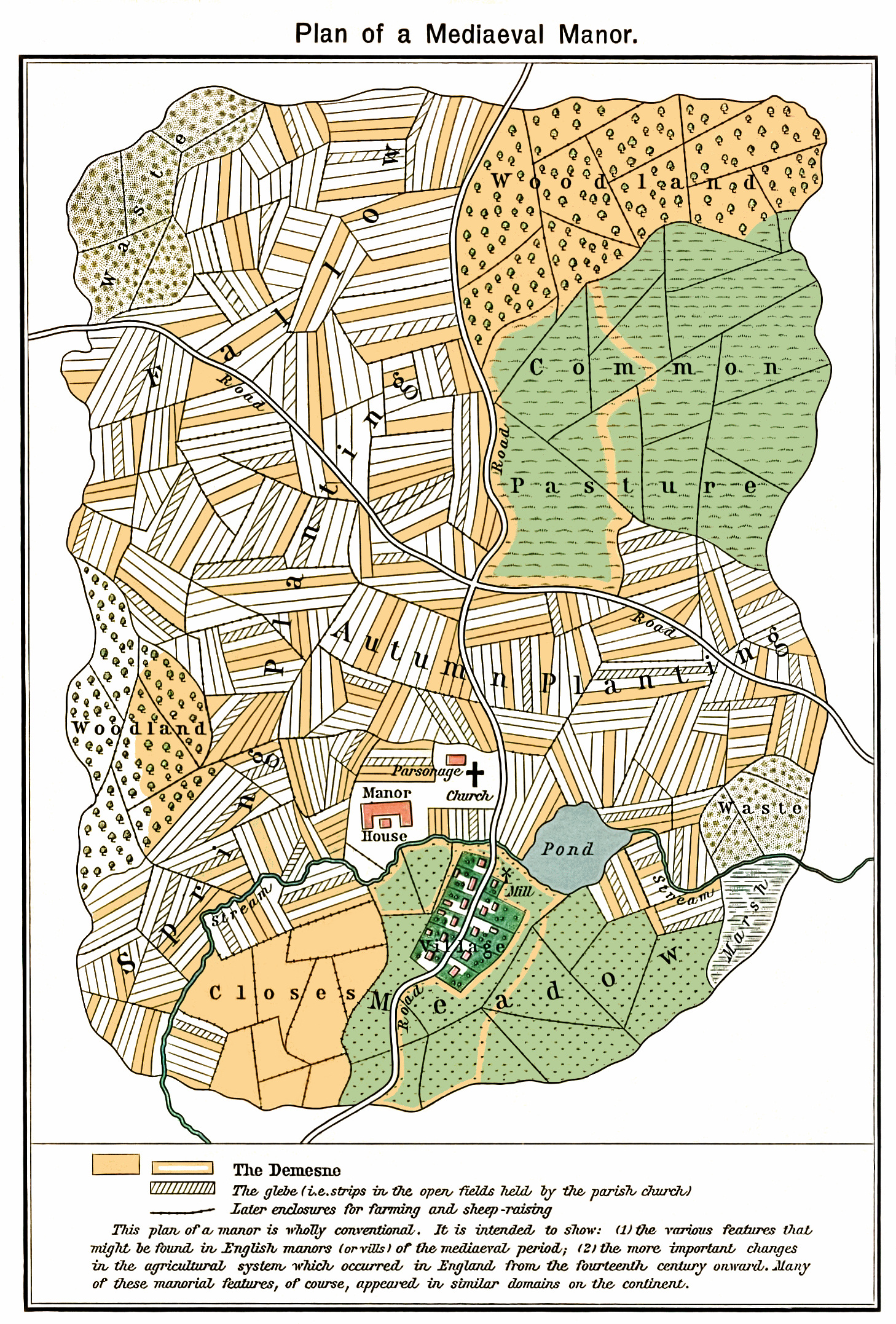
This land was almost never in a single large parcel the way we imagine a modern homestead. Instead, you will recall, these farming households, each with their 3-8 acres (often with a few rich peasants with larger farms and perhaps a nearby aristocrat with a massive estate), are nucleated into a village which is surrounded by farmland (as well as land not suitable or cleared for farming). If all of your household’s farmland was in one spot it was vulnerable to catastrophic failure, from pests, weather, warfare or what have you. So for farmers aiming not to maximize profits but to minimize risk (because in a bad year, you starve), the imperative is to spread out land holdings. In some cases this distribution might be handled by the leading figures of a village (the patriarchs of the most important families, generally), in order cases it was simply a product of who owned what. But the net impact was generally the same: rather than owning a single large plot of land, the peasant household owns (or otherwise has claim to) a lot of small parcels of land, often in small strips, spread over different ‘microclimates’ around the village. You can see an idealized image of just how fragmented the farm holdings were below:

Of course there were in these communities always larger landholders. These might be proper aristocrats with estates of hundreds of acres, often with entire villages contained within their landholdings. The gap between even a very poor aristocrat and your typical peasant was vast and unbridgeable. I am always put in mind here of the Bennets from Jane Austen’s Pride and Prejudice (1813), who are a relatively ‘poor’ family in the landed gentry (the sub-aristocracy, as it were) – nevertheless, Mr. Bennet’s estate (Longbourn) is large enough to include a village (also called Longbourn) from which he is in his rights to refuse Mr. Wickham entry. In short, even a relatively modest just-below-the-aristocracy-proper estate was large enough to include an entire village inside of it. We’ll not deal too much with these Big Men here – they get enough attention in any case – save as a source of employment for our peasants.
The other group to note, of course, are ‘rich peasants’ – landholders who are still peasants in the sense that they are engaged in the work of farming their land but who hold significantly more land than the labor available to a single family unit or household is going to be able to farm. These fellows show up very clearly in the Saint-Thibery data: in 1460 there were 27 households with between 30 and 60 setérées (18-36 acres) and 9 households with 100-250 setérées (60-150 acres). The latter group are our gentleman farmers, medieval proto-Bennets who function as employers for the smallest farmers who lack land, but the former group with those mid-sized holdings are our ‘rich peasants’ – not so wealthy to be entirely detached from the world of farming but still possessing substantially more resources than their neighbors. This is the sort of stratum in a Greek polis might have composed the bulk of the hoplite class or in the Roman Republic the ‘first class’ of infantry: not rich enough for a horse, but wealthy enough to afford expensive heavy armor. Naturally, these households are also going to wield disproportionate political power in the village.
A Peasant Community
Having all of that laid out, we can put it together to think through what a ‘model’ pre-modern peasant farming community looks like. Our peasants do not, for the most part, live in a town, but rather live in a village, which may in turn ‘orbit’ a larger settlement like a town. Villages range substantially in size, from very small settlements that might be only a dozen households to large villages of around 100 households (Saint-Thibery, discussed above, was a very large village of 189 households, in part because it had a substantial abbey in it (dating from the 8th century), which preserved the records used to discuss it). ‘Typical’ village size is trickier, but the mean seems to be around 30-60 households or so.20
As noted above, the mean size of our households is around 4-5, so our 30-60 household village has anywhere from 120 to 300 people in it. A disproportionate number of those individuals are going to live in larger households, around 6 or 7 people, as noted above, but equally there are going to be a handful of small households consisting of widows or widowers. Those houses aren’t going to be stretched out at random, but rather nucleated into a core settlement, with farmland radiating out from the village core. I should note, nearly everyone in a village of this size is going to be a peasant farmer – settlements this small aren’t going to have many, if any, specialist craftworkers or something like their own mill.21 A tavern or public house is somewhat more likely, but if there is, there will only be one. For specialist craftwork – metalwork, for instance – a peasant may have to go to another village or into town, or else rely on itinerant craftworkers (though as we’ll see, these households can produce most of what they need themselves).
Land holdings in the village are unlikely to be equal, though the precise breakdown of land holding patterns are going to vary a lot from one society to the next and in a lot of cases we simply cannot observe this clearly. I can’t speak to an ‘average’ or even ‘typical’ distribution, but something like what we see in Saint-Thibery might be broadly normal ‘rule of thirds,’ – about a third of the land controlled by large, potentially absentee landlords (aristocracy, gentry, church – the ‘big men‘) who we might understand as outside of the core ‘population’ of the village, another third controlled by a handful of wealthy peasant households who might represent about a fifth of the households and the remaining third owned by the meaning four-fifths of the peasant households.22 That is going to very naturally play into the hierarchy of relationships in the village, both the presence of the ‘big men’ – who are generally distant and ‘outside’ the village, often literally – but also the ‘rich peasants,’ who will be the leading voices of village politics by dint of their greater resources.
But most of the population of the village are not ‘rich peasants,’ but just regular peasants, whose landholdings are far more humble, on the order of 3-8 acres, with some households on even less than this. As we’ll see, many of those households are going to need to reach beyond their meager landholdings, something that the larger landholders – rich peasants and aristocrats alike – absolutely rely on.
Finally, we have the households themselves, with most of the people living in households of around 5-7 persons, most of whom will be kin, but many households will have a non-kin member or two (again, hired hands, enslaved laborers, very distant kin lodging, unrelated lodgers, etc.). Each household in turn functions largely as a single economic unit: one pantry or larder, one set of property, one house, rather than separate pools of resources. As we’ll see, households are not only hierarchical, but specialize labor based on gender and age (that is, men, women and children do different sorts of necessary work; everyone works).
So that is our baseline: a collection of a few dozen households of around 5-7 individuals each, most on very small plots of land to form our village. Next week we’ll look at how this reality is shaped by fertility and mortality patterns, which is to say birth and death.
- And, as we’ll see, these societies generally have almost no social mobility, so extremely few – functionally none – of the sort of people who write to us will have ever been peasant farmers.
- Or, in the latter case, they do not do so for small peasant farmers, being instead interested in state finance or the large estates of the wealthy.
- Meaning both his father and paternal grandfather have died.
- Much the same way humans are going to spend a lot of time trying to get the lunar and solar calendars to align when they just…don’t.
- Note for instance Bagnall and Frier, op. cit. 67-8, fn. 59-60, the average size of Egyptian families recorded in their data is 4.3 (going by households might raise the figure to roughly 5); they note other estimates at 5.1 and 5.3 (as well as 7.3). Mitterauer and Sieder, Vom Patriarchat zur Partnerschaft (1977; trans. as The European Family, 1982), 24-47, compile a range of European example data in the same 4-5 range while busting the ‘big pre-industrial family’ myth. In practice, for primarily monogamous societies, the impact of pre-modern fertility functionally forces family size to be in this 4-5 range, to which we would add non-family household members (generally just one or two at most in most cases).
- For those who are already wondering, “wait, there are regions on Earth right now with average household sizes well over 5, what gives?” the answer is societies in the midst of the demographic transition, at a stage where mortality – as we’ll see, a major governor of household size – has fallen, but fertility has not (yet). I suspect a great deal of the myth of ultra-large pre-modern families is a product of extrapolating from family size in the early phases of the demographic transition where there is rapid population growth as a result of falling mortality running far ahead of declining fertility, before the latter catches up, but of course pre-modern societies had very high mortality.
- This is probably a high percentage. For whatever reason a single papyrus in their set contained only the returns of solitary male taxpayers from Theadelphia, so these might be overrepresented in the same.
- The term also refers to the patterns of marriage, like the age at first marriage, prevalence of divorce and so on, but here we’re interested in the rate of marriage and family formation
- Frier, “Demography,” 799; Bagnall and Frier, op. cit., 112-3. Notably they calculate these numbers as the number of women in the sample who were married or known to be married, so the statistic represents a minimum, not a maximum. As Frier notes, “Rome had no spinster class.” The Romans assumed everyone got married.
- Gallant, op. cit., 22-30
- E.g. Bagnall and Frier, op. cit., 68
- ‘Extended’ families – a core family plus ‘add-ons’ but without a complete second conjugal pair are less common than multiple family or conjugal family households, but still quite common and tend to sit right between the two in terms of size.
- Gallant, op. cit., 22-30
- Rosenstein (2004), 75, n.68; Erdkamp, (2005), 47-8
- Cho-yun Hsu, Han Agriculture: The Formation of Early Chinese Agrarian Economy (1980).
- Johstono, The Army of Ptolemaic Egypt (2020), 101; Fischer-Bovet, Army and Society in Ptolemaic Egypt (2014), 121
- We may come back to this some day, but this does not seem, to me, to speak so much to a broad, healthy Greek yeoman peasantry as the broad assumption in the Greek world that the ideal household disposed of a meaningful amount of enslaved labor. Greek social structures seem predicated on a rather higher incidence of slavery than, for instance, Roman social structures (note the Greek citizen-hoplite is often assumed to have an enslaved servant to carry his equipment, whereas the Roman infantryman is assumed very much not to be bringing an enslaved servant on campaign by the Middle Republic).
- Le Roy Ladurie, Les Paysans de Languedoc (1966)
- In a “things may move forward in time without getting better,” by 1690, the amount of land in Saint-Thibery had increased to 4,922 setérées, but the landless or nearly landless households had grown from 11 to 73 (from 6% to 20% of all households). One of the historical questions that I think is underexplored is what social structures tend to lead towards this sort of intense concentration or away from it (I take a stab at this for the Hellenistic Mediterranean in my book project, but it is a very rough stab indeed).
- You can more or less derive this range from the data in the very old G.G. Coulton, The Medieval Village (1925), 439-443, but obviously there has been a lot more micro-historical work charting individual villages since then. I haven’t seen a rigorous effort to crunch that data into a clearer range, but if this were to be done, it would have to be done for the Middle Ages – the data to do this in antiquity simply doesn’t exist.
- Though in the Middle Ages, we’d expect most villages to have their own church; in England, my understanding is that a church was what differentiated a village (which had one) from a mere halmet (which did not).
- Again, estimates follow Le Roy Ladurie, op. cit., 314 which I had to hand, but that accords broadly with the patterns I’ve seen in other economies. I’d estimate the ‘first class’ of the Roman system is probably about the same size and c. 20% of the population is also not a bad stab at the size of the hoplite class, for instance. That said, these patterns are more likely than most to be very sensitive to cultural factors (and different crops with different labor intensities!) – in particular, the landholdings of the ‘big men’ as a percentage of the whole might vary quite a bit.


This is very interesting – these overviews of real ordinary life often are (I’m still getting over your revelations of how much spinning went in pre-maodern households).
One thing that I think might be interesting as a digression somewhere would be to sketch out as a contrast how the weird US homestead system arose & worked (I understand that the direct cause is how the US govt allocated land, but that must in itself have been the result of factors that made homesteads feasible?). As a rural European I still take it as read that most farms still orient towards a village (even if farmhouses are more spread out nowadays) and that most farmers have still diverse patches of land. It’d be interesting to understand the alternative.
As for “pre-modern communities are almost never organized this way”: the classical established medieval example of dispersed homesteads is Norway, with Iceland and parts of Sweden.
It also happened in ancient times – Tacitus commented it occurring in Germania. But Tacitus´ evident surprise in describing this dispersed settlement suggests that it was otherwise unfamiliar across the Mediterranean world.
yeah, i was noting, how, having looked into local history here in Iceland that villages around here simply aren’t common enough, even today, to have contained most farmers – and from elsewhere (e.g. Scotland) you tend to have at least some evidence if there used to be more that aren’t there any more. One of the nearby fjords (Önundarfjörður, for those interested), whilst quite well supplied with agricultural land seems not to have had a ‘village’ in it until the late 1800s. The most accessible nearby village wasn’t just ‘not near’ any farms there, it was physically over a ~1000 foot mountain pass that is still unreliable in winter. As a result, it’s traditional church (rather than the new one, built in the 1930s) is basically on a farm of its own, with the graveyard and church located next to the vicar’s farm (which is still used as such, incidentally). There are a few more farms in that area, but nothing that seems like the remains of more than 1–2 foundations, though it’s possible the local tradition of building new farmhouses rather than fixing up old ones is messing with my sense of how many buildings could have been in that area originally (farms tend to end up being quite… expansive here, as no-one seems to bother demolishing the old bits, they just relocate to the other side of the farmyard and wait for the wind to do the job for free).
The sense one gets from the sagas is that Icelandic life revolved around the households of the godi, the district leaders. Farmers themselves, but with more land and the right to allocate land. the other households spread out around them, with no real village. This may relate to relatively low productivity of the land.
As I understand it, the Germans of Tacitus’ day were exceptionally “primitive” in their farming techniques. In particular, they rarely practiced crop rotation or fallowing, and would instead move to completely new land every 5 or so years when the soil wore out – not true pastoralism, but a lot more mobile (and a lot less dense) than a Mediterranean farming community. In the following three or four centuries, they gradually adopt more advanced farming techniques and hence have a rapidly growing population – with notable unfortunate consequences for Rome.
Wait, as their population density increased, it should also have become increasingly possible for Rome to conquer and govern the Germani. Now there existed an extractable surplus per square mile.
Which is precisely what Merovingians in 6th century did – conquered Thuringians and Alemanni between Rhine and Elbe.
It had a long term effect that e.g. 4th century Romans failed where 6th century Merovingians succeeded.
Jared Diamond also discusses rural Finland as a place where habitations were traditionally extremely dispersed, although he’s talking about more recent periods.
This was a result of Isojako, Big Distribution, where the village lands were split among the villagers during mostly the 1700s. I am not sure whether colonizing of Savonia and other inland areas was done by building homesteads or villages.
That was probably largely caused by the Great Partition that was started in 1749.
https://en.wikipedia.org/wiki/Great_Partition
I think you both are probably correct. Western Finland traditionally had very typical European habitation patterns, albeit perhaps with a bit small village. (Four houses per village seems to have been pretty standard around 1550’s.) This pattern was disrupted by the Great Partition, which caused the farms to be moved into the center of their newly-assigned unitary plots. For example, my own farmhouse is about half a kilometer from its nearest neighbour.
Eastern Finland pursued slash-and-burn agriculture where the field was exhausted in a few years, and then abandoned. The farmhouse needed to have a rather large area of forest available, and therefore, the houses needed to be separate from their neighbours for natural, production-related reasons.
@Finnish Reader,
Thanks, that was very informative!
The United States has always been land rich and labor poor. So the pressures to keep all of your family members on your farm and eventually subdivide it into plots that can only support one family described in this post haven’t been present. Wage labor has also historically been more available and more respectable (at least since the Revolution) than in Europe.
Combined, this means that the children of farming families could generally leave the farm, either to acquire their own land or to find other work, without starving.
Note how New England has villages, not dispersed homesteads. Whereas Virginia has dispersed plantations. How about Middle Atlantic – New York and Pennsylvania?
I’ve been in farming villages in New Jersey too, along the Delaware. Somewhere between 1700 and 1840 something changed which made Americans comfortable a) with living a long way from their neighbours and b) risking their all on a single (large) plot
The short answer is, state capacity took over road planning. Initially a truly astonishing amount of inter-community travel in the colonies was via sail and completely outside of the control of resident farmers.
This isn’t really an answer to your question, but I would note that the New England and ‘Southern’ settlement patterns both reflect the influence of the kind of people who dominated local politics among the first waves of European settlers.
The New England (and Pennsylvania) colonies were initially founded by organized religious movements aspiring to found new communities Thus, to some extent they might well tend to organize themselves into villages recognizably like those common at the time in Europe, only with their particular (Puritan/Quaker) religious idiosyncrasies coloring the political and social customs of the new community.
The Southern colonies were dominated by younger sons of the English gentry who moved to the colonies because they would otherwise not stand to inherit a satisfactory estate. In America, where land was extremely cheap, they could set up enough land to establish themselves as “big men” with large estates (‘plantations’) with themselves cast as literal lords of the manor. The only potential obstacle was the need to find a labor force to play the role of the tenants and surrounding villager day laborers who would work such an estate in Europe. Hence the extensive forcible recruitment of enslaved Native Americans, enslaved Africans, indentured servants, and criminals sentenced to deportation. Southern plantation settlements were arguably an attempt to ‘hothouse-cultivate’ a manorial system of agriculture, establishing it as fast as possible and to an extent doing so without recreating the social substrate such manors rested upon any farther than necessary.
There is a parallel in Eastern Europe, the tanya system.
In a form of “human land use succession” — to parallel ecological succession — as land use intensity grows, first you have itinerant pasturage (in this area this means transhumance, not nomadism; the women and children stay in the village) with very minimal temporary shelter for the men moving with the herds. Then as the extent of the movement gradually gets shorter, this turns into ranching and then into low-intensity crop agriculture, with a fully-family part-time shelter being used during the periods of intensive work (planting and harvest) but the family lives in the house in the village during the rest of the year. Then as crop agriculture intensifies further, the family moves to live in the “work-period” house throughout the year. Then, I assume, further intensification (the plots fragmenting as population density increases) as well as simply the periodic rebuilding of houses leads to new villages forming.
Consider, likewise, some industrial-era patterns. People who for now consider themselves to live with their (rural) families find work in the cities (as that’s where the factories are), sleeping in some form of housing there (renting a room in an otherwise normal house/apartment, or in a dedicated dormitory or rooming house) and visiting their family perhaps on weekends, perhaps every few months, depending on practicality. Then they tend to find a spouse and form a new household in the city. (In the 21st century, the above pattern may be more recognizable with university students, particularly in the regions where traditionally universities are integrated into cities rather than having “closed” campuses. They often own some dorms, but those are not necessarily adjacent to their other facilities (which themselves are often spread in multiple clumps); there exist some independent dorms; and many students rent/flatshare.) Equally and in the opposite direction: families with weekend houses outside the city often ended up permanently moving there and commuting into the city.
This is a really good summary, and underscores that “rural” vs. “urban” is really more of a spectrum than a binary. Historically there have been lots of people that move back and forth between the two. I’d add that you can still see these kind of seasonal migration patterns in developing societies in Africa and South Asia (and a few decades ago in Latin America). Someone might work during the week in the city but go home to the family village, maybe even help out with agricultural labor, on the weekends, or during times of the year where there isn’t work or school in the city. They might well consider themselves “rural” or “peasant” even if that’s not where they actually spend most of their time.
For whatever it’s worth, modern farming in the US also features farmers owning land scattered about. It was initially relatively concentrated per farmer, but as farming mechanized and more families packed up and moved to the city, you end up with the farmers who remained owning land scattered across the county and occasionally into neighboring counties. The person who leased my grandparents fields lived a couple miles from them but also owned and farmed fields 2 counties away
To a significant degree, the weird US homestead system is a product of wildly different technological and economic conditions. I don’t know much detail on colonial North America, but I think it operated in a much more village-oriented manner. The homestead thing comes into its own later, in a thoroughly marketized world with railroads and everything, where you could farm a cash crop, do a little gardening and keep some livestock for your own table, and expect to sell that main crop for money and buy many of the goods you need with that money.
Certainly by the time you’re settling west of the Mississippi, in spite of the story of rugged self-reliance we tell, these are households that are isolated only in a day-to-day sense, not year-to-year. There’s a lot of real self-reliance, yes! But there’s also a LOT of factory goods supplied from hundreds or thousands of miles away. Nobody’s rocking homespun, they’re buying cloth by the yard.
As an illustration, consider that In the Little House books, featuring homesteaders in the second half of the 19th century, Ma sews, and the girls embroider, but nobody spins or weaves. They buy bolts of cloth with Pa’s earnings, originally from trapping and then from farming.
Interestingly, in the third book of the series, “Farmer Boy”, Almanzo’s mother weaves. The Wilders are a wealthy New York farming household: they own more than 100 head of cattle, raise horses, farm a large area (and hire local day-laborers for harvest and land clearing), and are among the wealthiest in the area (Almanzo’s father rents the largest horse stall at church to park their wagon/sleigh). But they see self-reliance as paramount. His mother weaves and sews all their clothes, though the boys want “boughten” (store-bought) caps. His father threshes their grain, thinking that the new-fangled horse-run threshers (that Laura’s pa hires in “Little House in the Big Woods”) waste too much grain and encourage idleness.
Perhaps one could compare them to the “wealthy peasant household” of previous centuries.
Which is one of the reasons the general store played such a big part of early western homesteading narratives. It was the hub for buying all those manufactured goods, either from the stock on hand or having the store owner order something, since the store owner had the connections to the distribution networks for such things.
And why the sears catalog and Wells Fargo delivery service played such a big role in the later parts of the western homesteading narrative, once they came around. Because the sears catalog had practically everything you could want to order, and Wells Fargo could haul whatever got ordered to practically any town. Meaning you often didn’t need to handcraft anything, unless you lacked money entirely.
Combine those with innovations in farming methodology and tools that reduce the amount of manpower needed per acre, and single family group isolated farms with lots of land under cultivation for cash crops becomes possible.
I have a couple of caveats, all related to the medieval period rather than late antiquity.
First is that a significant part of the medieval population was in the church – around 5% were monks or nuns. Many monks still did peasant work, but they also ran social welfare, kept records, prayed …It was a major avenue of social advancement for peasants, given that a connection to even a mid-level churchman fed back into family influence and fortune (and up to c1100 priests often married or in informal arrangements). A quick shuffle through the medieval papacy suggested around 10% of popes were from humble origins, and the ratio is probably higher for deacons etc. Note that social mobility was generational – it was rare to make the leap in one lifetime, but common over several.
A second is that towns were population sinks as well as (if you survived) avenues of social mobility. Villages constantly sent their surplus sons and daughters off to make their fortune.
A third is that the mobility of medieval populations is much under-estimated. Between the church, soldiering, mobile occupations (packman, boatman, drover, master mason’s gang …), pilgrimages (often quite local), moving with elite households as servant or retainer, moving for work at harvest or planting or just seeking opportunity, a significant fraction did move.
“First is that a significant part of the medieval population was in the church – around 5% were monks or nuns.”
An overestimate by an order of magnitude.
In times of Henry VIII, the muster rolls give population of England as about 2,3 million in 1520s.
At Dissolution in 1530s, there were something like 7000 monks and 3000 friars totalling 10 000 men, and 2000 nuns. So 0,5%, not 5%
That’s Renaissance, not medieval, and after a period of decline. Further, there were ordained clergy, lay brothers/sisters and secular members of church institutions . Josiah Cox Russell estimates between 1.6 and 4% for England in the late 14th century, not including mendicant friars and clerks – and around 3% of adult males. So 5% overall is not too far off.
I’ll amend to ‘roughly 5% were in some form of religious life’ – in full or minor orders, or attached lay brother/sister hoods. This is a notable departure from classical life.
The no mobility myth comes from a reading of the church recouds, they have births, deaths and marriages.
But that ignores people doing any movement in the mean time.
Some one that get an occupation that leads to them moveing away, most trades had a journeyman phase an well your going to try an find a new market not enter competition, they return to marry and they return again in there old age.
I think the most ‘fundamental’ drivers of the weird US homestead system are:
1) That any given part of the US north of the Rio Grande was already largely depopulated by epidemics before the settlers arrived and that the remaining native populations were usually killed off or displaced off most of the land within 50-100 years of large scale contact with settlers. In Europe, it was very rare for any really large tract of land to be parceled out entirely to ‘new’ families, whereas in the US this was a routine occurrence happening constantly roughly the entire time from 1620 to 1900.
2) That the ratio of people to land was very low compared to European norms. It was not uncommon for single homesteading families to lay claim to dozens of acres, which as we see would be enough land to set them up as local aristocracy in Europe… if the surrounding area had a labor force big enough to work that land, which it often did not.
3) That the system never achieved equilibrium within a more or less static technological background. Many of the dynamics that result in such similar farming villages and household structures in different parts of the world come from centuries of gradual adaptation and accommodation to a lifestyle that is (relatively) optimized to the constraints in question. By contrast, European settlement in the US began in 1620 and did not spread beyond relatively minor coastal enclaves prior to 1700. By 1800 a revolution in agricultural productivity was already well underway and changing what “the optimal farming household” would look like irreversibly. By 1900 farming conditions were radically different from the 1800-era norm, and by 1950 they were completely unrecognizable. Many areas were only under cultivation by Europeans for 2-5 generations before the rise of agricultural machinery shifted the paradigm far away from the “rural village” concept. As such, pressures that might have gradually led to the American colonists consolidating into small farming villages if they’d spent a thousand years cultivating the land with Iron Age tools evaporated long before this had a chance to happen.
That’s part of why the most rural states are actually the rugged Eastern ones. Initial settlement has low population density, then grows with natural population increase and backfilling of more marginal land (a shockingly large share of New England and Appalachia was farmed by the late 1800s). Urbanization increases, but since the US has fairly strong natural population growth, rural areas hold up relatively well in absolute terms with smaller towns. Once you get much past the Mississippi rapid urbanization prematurely cut short this. The farming population in the US plateaued by WWI then started falling.
I grew up in Georgia, with pine forests everywhere. In a warm climate, pine forest is *new* forest (and it has since become hardwood); it all used to be farms and pastures. In 1950, Georgia had hardly any wilderness except for the mountains and swamp.
I had to look it up, but that’s more or less correct. Of the 8 most “rural” states or territories, all 3 states in Northern New England are included, as well as West Virginia. Vermont and Maine are the most rural two.
How much is state capacity a part of it? If state capacity is low, people need to band up in villages (preferably in a village with a big man and maybe also a few armed smaller men) to ensure their rights are not stepped over. If state capacity is high, there is less need to.
This might be a bit tangential to the main thrust of the articles, but something that I’m curious about. Take the example given for Saint-Thibery, for instance. 4,500 setérée would come out to very roughly 2497.5 acres by the figures given or very roughly a bit under 4 square miles. That supports 189 households, which if the average household size is 5, there are about 945 people living here.
That makes the population density of the village about 236.25 people per square mile, which isn’t quite an order of magnitude more massive than the overall population density of France in the 15th century, but we’re still talking a fairly sizeable multiple.
That in turn implies that between these farming villages, there must be pretty significant stretches which are very thinly inhabited or completely uninhabited, to bring the population densities back into matching. And especially if there was often significant pressure to keep an otherwise ‘unproductive’ family member on a small farm because otherwise would be to sending them into destitution, I guess what I’m asking is why weren’t these empty areas colonized over? Were there sharp limits as to what sorts of locations could support farming communities? This seems to imply arable soil is actually reasonably rare. (Which it might very well be, I don’t have much in the way of intuitions for pre-modern farming)
This has often been my question when seeing these sorts of figures presented, here and elsewhere. What is the other land being used for, and why? Pasture and woodland, perhaps (if the pastureland isn’t already included in the total for the farms), but it would have to be a substantial majority of all land.
My assumption would be that most villages are not *nearly* so densely populated, and that this extra jumbo sized village has its residential and land usage patterns distorted by a big famous (and therefore presumably monstrously rich) abbey being located there.
Actually, very close to 1300s England population density per arable acre! France in 1460 would have had population density of about 70 per square mile. So maths out if ~30% farmland. England in 1300 was about 40%, but dropped after Black Death so seems reasonable.
That sounds about right! Remember it is only measuring cropland. England and Wales in 1300 probably had a population density of close to 100 people per square mile. About 40% of that area was cropland. So almost exactly the same as your figures.
In the England case, another 30% or so would have been pasture. The remaining 30% would have been mostly forest (much of it managed), moorland, and swamp. Pretty much all the land not absolutely terrible was being actively used in some fashion. Also, remember even in rich flat areas like East Anglia where nominally near-100% *could* be cropped, you still need some heavily coppiced forest for wood and some supplemental grazing area for livestock
Apart from food, people needed fuel and fibre and other material. Also more protein than grains could supply. Plus ploughs and carts need animal traction (roughly a quarter of US farmland was given over to the horses that were the main source of power). Woodland provided timber and fuel, marshes reeds for thatch, fowls and fish and fibres (linen), waste provided rough grazing and also small animals (hares, dormice, small birds). Maintaining the balance was a main communal responsibility.
So 1) that is the total amount of privately held land. I don’t think it counts church land (there’s an Abbey there) or commons, so the total village area is probably a fair bit larger, leading to significantly lower population density. And it is a *very big* village.
That said, you’re right, we often see significant stretches of land that aren’t under intense cultivation. Sometimes the land is just unsuitable – marshy, too rugged, etc. – but also frequently it is simply not (yet) cleared. Clearing forest land and making it suitable for agriculture is pretty labor intensive. And you want to leave some forest as forest for firewood and other materials.
Right, need some woodlands to let the pigs out into by autumn so they can grow fat on acorns!
I think thinking ot is a binary is wrong, theres not “arable soil” and “none arable soil” but a wide variety of soil types suitable to varying degrees to various kinds of cultivation (and with varying degrees of work required for that to be the case)
But there’s *a lot* of land not really suitable for cropping (too acidic, too sandy, too wet, too rocky…) at least not without a lot of work. But can be suitable for other types of use.
Acidic soils are good for some types of agriculture- blueberries and cranberries for example. Though those are both North American domesticates that of course Europeans, ancient or medieval, didn’t know about.
This is actualy a bit of an interesting tidbit, because “bluberry” in scandinavia commonly refers to the (related) Bilberry: https://en.wikipedia.org/wiki/Bilberry (the american blueberry is called “american blueberry”) while the bilberry isn’t really domesticated is/was a useful source of food along with other berries.
Interesting! I remember getting into a similar argument on social media about what the French word for “blueberry” is. Francophones in Canada, where they grow and export a lot of (American) blueberries, think of the American blueberry which they call “bleuet”, and living in North America that’s the only term I was familiar with. French speakers in Europe presumably think of the European bilberry, which they call “myrtille” (and which I guess, as you say, isn’t as much of a commercial or widely grown fruit).
“while the bilberry isn’t really domesticated is/was a useful source of food along with other berries.”
It’s domesticated in the UK – you can buy tubs of them in supermarkets (though the wild ones are nicer).
ajay: Are those grown or just picked though? You can buy them here too but they’re collected by berry-pickers, not grown.
I must say, it was fairly shocking to realize from this thread that much like the potato, cranberry arrived in Europe via North America. By the time I was born, it had effectively become a fixture of (post)-Soviet sweets at household level, particularly in teas and syrups typically provided to speed up recovery from respiratory diseases. (The below is nowhere near as detailed as I would have liked, but it perhaps gives some idea of how frequently it is encountered in day-to-day life.)
https://en.wikipedia.org/wiki/Mors_(drink)
Thus, even though I have encountered repeated references to cranberry sauce as a Thanksgiving tradition, I always assumed it arrived with the settlers, and the feast represented the fusion of old with new (the turkey). The idea of cranberry as just another useful plant “which had always grown” in the (Eastern) European swamps was too engrained. I suppose it’s a useful reminder of how little time is actually needed before something can become a tradition – particularly to those who weren’t alive when it first appeared.
Some of the land is used for animal pastures instead, and a big portion is going to be forest- either kept deliberately for wood and hunting, or just because no-one has gotten around to clearing it yet. Turning an acre of forest into an acre of farmland requies a lot of labor- not just cutting down the trees, but pulling up the roots and underbrush and thoroughly plowing the land to break up the hard soil. Newly cleared land is also not going to yield many crops until it’s gone through multiple cycles of crop rotation, which means people aren’t going to clear forests for new land unless there is a very pressing need. Furthermore, if a villiage get’s destroyed entirely by war or plague- which could happen quite often in some places and times!- then the forest could reclaim farmland quite quickly.
Also, a lot of lands just aren’t very good- bad soil, bad rainfall, far from an rivers, literal mountains- which will drag down averages.
Medieval lords (lay and church) were very much into clearing forest or reclaiming marsh (assarting), usually offering considerable incentives and sending to peasant surplus areas like Flanders or eastern England to recruit labour. The forest had reclaimed a lot of land in the post-Roman dip, which was steadily brought back into cultivation from c1000 on.
Chinese Legalist texts like The Book of Lord Shang go on and on about how coercing peasants to convert wilderness to farmland is one of the most important functions of government–because, as parent comment points out, the peasants aren’t going to do it on their own (note that this is Iron Age Northern China, so they’re talking about wheat and millet agriculture, not rice paddies)
“the peasants aren’t going to do it on their own”
I expect that security of land title would have a lot of effect here. More motivation to go clear land if you believe you’ll be allowed to keep it and pass it on to your children.
Coming from a country with lot of forests, and where the last state-supported new homesteads were built around 1960’s, I would say that if there is convertible wilderness available, the main obstacles are two-fold:
1) The “wilderness” is not quite wild. It probably already has an economic use (e.g. hunting grounds, natural hay growth for cattle, wood and timber extraction). So, you need the permission of the owner of these rights, which may be difficult, especially if those rights are held in common.
2) Actually cultivating farmland is slow and onerous work that yields results only a year or two later. You need the capital to get tools, build a shack and survive until your land carries first harvest.
The state can help this process considerably by removing legal obstacles (e.g. in Finland, expropriating “overly large” forest holdings) and helping economically (in the Finnish case, by allotting free land from such expropriated forests and freeing new farms from taxes for the first years). I would believe that in China, these obstacles were different in detail but could be similarly eased by administrative means.
Would it be fair to say that Eastern Europe retained more of its forests or other “wild” lands, over the course of history, than Western Europe did? (I’m just thinking of the fact that many animal species have or had persisted in the east longer than in the west, though that might just be a result of larger continguous land areas, more mountains, etc.). If so, why was that?
I know that in the early modern period Britain had to import ship masts from the Baltic because they ran out of suitable trees. That’s not a direct measure of land use because the trees needed are fairly specific and require a long time to grow, so land could be stripped of suitable trees but still largely forested, or even totally replanted but generations shy of producing masts.
Because of lower population density, generally speaking.
Well, Eastern Europe (Poland and Belarus, specifically) have the Białowieża. I do not think there’s really anything comparable to it in Western Europe, and though the article below dispels some myths, it seems to agree on that “it is one of the few remaining landscapes in Europe where one can still experience something of the scale, richness, and wildness of pre-modern forests. It is a palimpsest—a layered landscape—of human restraint and ecological continuity.”
https://www.medievalists.net/2025/05/bialowieza-forest-europes-last-medieval-woodland/
(One notable aspect not mentioned there – this area is also notorious for being the place where the USSR was officially dissolved in 1991, and hence its name is attached to the Accords which ended it.)
Some places like eastern Finland, relied on constant forest clearing. Slash and burn agriculture was the method, forest would be burned and the land cleared and farmed for a few years, then another plot would be burned. The first year after burn provided the most grain. The earth was too poor for more normal farming practices there.
“people aren’t going to clear forests for new land unless there is a very pressing need. ”
I don’t really get the impression it was difficult to get people to do that in, say, 1700 New England. People in Old England were indenturing themselves to get there. Then again, I imagine the economic system of dawn-of-the-Industrial-Revolution England was quite unlike that of Shang China, quite apart from the technological differences.
Another factor to consider that hasn’t been mentioned yet is transport. Everyone* in this village is getting everywhere they need to go by walking. That takes time, and puts a pretty hard cap on how physically spread out things can get – especially when you remember that a given household’s land isn’t just in one spot, but spread throughout all the fields around the village.
So land beyond feasible walking range can’t be easily brought under cultivation. It can be used for pasture for animals like sheep, with some members of households going out further afield for a period. But otherwise if you’re going to really try and farm over there as well, the result is going to be setting up a _new_ village out a few miles away.
*Approximately.
I’m thinking yet another factor could be protection. A man who left the village to set up an independent homestead or live like a mountain man might find himself raided by bandits or the next invading army. If he and his family are isolated enough to not encroach on pre-existing land divisions, then they’re too isolated for anyone to help if they get in trouble.
In Sicily and southern Italy the villages were larger, and many of the fields beyond what one could walk to and back from in a day. The solution was small huts for stays of one to a few nights. The driver may have been insecurity.
As far as I understand, there was indeed quite a loot of non-arable land. It is pretty hard to clear woodland, and forests might be preserved as a hunting ground for nobles, a source of timber and as pastures for swine and cattle. Hills, mountains, moorlands and so on are generally not suitable for agriculture and were mostly used as pastures for sheep (and sometimes cattle). In some cases it is possible to make terrace fields on hillsides, but again that requires a lot of hard work. Wetlands, such as marshes, swamps and bogs, are also not suitable for agriculture without a lot of work to drain them. So while agricultural colonization of (some) non-arable land was possible, it required a lot of work and organization by the elites. And since the quality of soil in this marginal lands was often poor, it was common that such settlements were abandoned after several years or several generations, since people living in them were able to find better opportunities.
Actually, one other question occurs to me. There should be the very real demographic reality that sometimes a household goes extinct. What happens then. You’ve presumably got a literal house and some farmland that is laying around unclaimed, so someone’s going to want it, especially if you again have pressure from families that are overcrowded. I imagine what exactly transpired in that event would vary across different times and places, but do we have any recorded instances of what villages did when a given peasant family died out?
Inheritance law applies, so you’re going to find the nearest living relation of the extinct household and they inherit the property. Inheritance cases are extremely common in these societies, just the most bog-standard sorts of lawsuits, constantly happening in the background.
Even today, Property Law + Wills and Trusts are the two most convoluted and complex areas of US law, largely because they are also the least changed from the English body of common law that we inherited it from. There’s a massive array of different ownership types and tiers, as well as rules governing how co-owners share control, that make no sense today, but which you can see the roots in agricultural societal disputes.
Inheritance. Which was usually a complicated thing but is constantly ongoing in the background. If a household dies out you look to whoever stands to inherit and divide it up according to whatever local rules exist.
This gets to my more general question: How would land be aggregated? If land was only divided among male relatives, there would be division to the (asymtote) minimum farm, and then below that minimum, presumably the household dies out.
But beyond aggregation after that, there would be dowries, so some allocation of lands to daughters, right? There would be purchase/sales transfers (for whatever reason, the landowner decides to sell.) There would be grants from the Big Men.
What am I forgetting/missing?
Debts, cannot pay them, so land is confiscated.
I would guess the land sales mostly go to the big men; they’re the people who are going to have the capital to actually pay for the land. Moneylenders might finance it against the proceeds of the land, but again the big men are the people who have contacts with moneylenders. They may also wind up with the land of collapsed households, either directly or because the person who inherits can’t effectively work the land and so sells it off. Or in a sharecropping relationship it may have been their land in the first place.
This happened a lot in the Black Death. A lot of marginal villages were abandoned as the inhabitants moved to claim better land now vacant. Apart from inheritance, it was not in the interest of the village or the manor to let farmland lie idle, so they recruited new settlers (of course some connection was required, but one could be made up if needed).
If there isn’t a nearest relative, then you get all the fun of escheatment.
In medieval England, it would depend on who the land was held from. If the peasant was a villein (serf) to the lord of the manor, or the land was leased (usually from a “rich peasant”), then the villeinage or leasehold would lapse and the land reverted to the landlord.
If they were a yeoman, holding land in fee simple (freehold), then it should theoretically revert to the crown in most of the country – but it would pass to the Bishop of Durham in the County Palatine of Durham, and some of the Marcher Lords on the Welsh borders held the right of escheatment in their march. However, full escheatment like this really applied to whole manors after a lord died, not to peasant holdings after a yeoman died, and the more likely result would be that the lord of the manor would just take the property anyway. It wasn’t like there was a land registry, and even if the yeoman had papers proving the land was his and not held from the lord, the lord would usually have physical control, and if he burned them, then who was going to care – the yeoman would have done, but he’s dead with no living relative, and his neighbours, who might well have witnessed for him, have no reason to witness on behalf of a distant king against their local lord.
I expect that in practice, the lord of the manor (or his reeve, the official who ran the village on his behalf) would usually seek out a new tenant for the house and land and then place that new tenant in villeinage. A useful way to convert yeomen into villeins, something that lords were always seeking to do (a villein can’t legally leave the village, a yeoman could).
Excellent, settling in for part 5b of your new three part series.
In spirit, this post is already part V of the “bread: how did they make it” series. Hence the frequent links to it.
Oooh, I have a little story about this one.
The wave of literary realism of the late 19th Century and later, shall we say, romantic realism produced a lot of novels and stories about the life of a peasant, so on and so forth, that tends to clog the lists of required reading in schools in European countries. Tend to be boring as all hell. But you know, just by virtue of having been written back when that lifestyle was still extant, even with all the idealizations and generalizations and demands of the intended plotlines, they tend to open your eyes a bit in regards to life back then.
That personal story I mentioned is that recently I decided to read through one of these literary classics. On my own, strictly out of an interest in historical peasant life. And yes, it was boring as hell, but I tell you – by no means whatsoever would I appreciate it if I did read it when I was expected to as a schoolkid. Dropping that on kids is kind of a waste. Meanwhile, all of those cottagecore, wannabe prepper simple living, idealization of the past folks would really benefit if they put themselves to it.
One of those books (Chłopi by Władysław Stanislaw Reymont) was turned into a movie recently: The Peasants (2023). Much less of a commitment than the book, but probably still nothing for adolescents.
Well, in general, the idea of a film about such a lifestyle becoming a hit is not truly implausible. I have already seen that happen myself – a few months earlier, a Nepalese film, Unko Sweater (apparently the first word, also spelt as “oonko” is just “woollen” in their language) not only became a massive hit in their country, but also in Australia – I have been to few screenings in recent years as packed as the one for that film, and while most Asian films leave mainstream cinemas here after a week or two at most, this one managed a full month. (I think only Ne Zha 2 also managed that – AKA, still the highest grossing film of this entire year.) A lot of the audiences were probably from the Indian rather than the Nepalese diaspora specifically, but again, not many actually Indian films manage the same here.
https://en.wikipedia.org/wiki/Unko_Sweater
Now, it’s set in contemporary times, and a big theme is the loss of such a lifestyle as people keep leaving for the cities (and the people staying behind often not being the best of the community*), but it still goes into quite a detail on how the traditional lifestyle, with all of those horizontal ties the Bread series (and this one) goes into playing a prominent role – treading across a hill path to deliver items, to fix someone’s roof with the expectation of a future favour, haul a sack of potatoes, etc. (And this on a larger scale; too people at the foot of the hills and at the terraces planting different crops and bartering them in a process which built community ties – up until food driven from elsewhere became more convenient for many.) It’s fairly soft-focus; I definitely saw families in the audience, so adolescents should be fine, even if it’s pacing is fairly sedate.
Last year, there was also a German portrayal of Western “Enlightenment”-era peasant lifestyle – The Devil’s Bath, which seems to depict preindustrial fishing, cooking, etc., reasonably well. However, that is a borderline horror film; one which opens with a woman’s execution for infanticide, and depicts another one stuck in a loveless marriage to a closeted husband, up until (spoilers, I guess?) the unending work and unsupportive community drive her to stab a young boy in full knowledge she would be caught, committing suicide by proxy. (Due to the belief actual suicide sends the soul to hell – as explained to us when husband’s “friend” hangs himself, but sending a boy to heaven before he had time to sin wasn’t so bad. The end credits cite historical research suggesting there were ~5,000 such cases.)
*A point made in a much more graphic in Korea’s Bedevilled from 1990. I think I mentioned the latter a few times on here already, but since that is a film which makes Oldboy look tame, that says a lot.
Some folktales have peasants as main characters, like “Hansel and Gretel” and possibly “Red Riding Hood”. Of course they aren’t useful for the sort of analysis Bret is doing – although the demographics are arguably accurate, with so many tales having one or both parents dead.
All the dead mothers and evil stepmothers in Grimm’s Fairy Tales are the result of censorship. The first edition had the stories as they were told to the Grimm brothers, with a lot of violence that city-dwelling readers found unsuitable for children. So in the second edition they took that stuff out, and also replaced the evil mothers with evil stepmothers, because they thought it would be less disturbing.
“Functionally no one in antiquity or the middle ages is writing a biography of a small peasant farmer who remained a peasant farmer their whole life.”
One big exception can be court records: (especially inquisitorial records and other records of trials for heresy) they sometimes come with a small biography and such.
The problem is of course that they are *by their very nature* exceptional cases.
Manor records and inquests do this too.
Barbara Hanawalt’s efforts at combing through English coroners’ records were one of the first things that came to my mind when I saw this post, as these inquests were triggered by all sorts of circumstances. These were late middle ages or early modern, but probably still similar to antiquity except for forced labor.
Hooray for more “everyday life” topics!
Now, to be perfectly honest, I am a little surprised this happened to be the choice, as opposed to something teased more explicitly in the previous posts – i.e. a series on bronze production or…
(The above was written a mere 4 years and 3 months ago…)
However, I can also see the case for why this topic would be of a higher priority than the above – if only because of how badly subsistence/preindustrial lifestyles continue to be misunderstood in the popular culture. A few acclaimed examples off the top of my head:
1) Both Gladiators romanticizing farming (all those supposedly iconic “wheat stalk” shots) in a way that apparently appears authentic to the overwhelming majority of viewers, yet clearly calls back to, at best, Little House on the Prairie rather than anything of Antiquity. As was already briefly alluded to in the recent series about the first film, effectively all the physical work on Maximus’ farm in Spain* would have been by dozens of slaves. The exact status of Maximus’ son and his soon-to-be-dead wife* in the second film’s intro is unclear, since everything about it is such a wild fantasy; however, we can say for sure that either all the actual farming would have been done by dozens of other people again or they would have been far, far poorer and fought in far worse gear if it was just theirs. (Not to mention they were seemingly portrayed as newlyweds in a modern “nuclear family” and not anything like the family structure above.)
2) Frieren: Beyond Journey’s End, now supposedly the best anime of all time (implausibly, this 2023 newcomer is ranked 1st on the IMDB equivalent for this medium, MyAnimeList, almost immediately displacing much older series after getting a ludicrous amount of perfect scores) features a whole lot interesting ideas on how preindustrial life worked. While it technically depicts something much more akin to 1600s than the Medieval period and does have magic, that is hardly sufficient to explain things like…a whole city which walls itself off completely for fear of demons and somehow intends to keep this up for several years, as opposed to descending into hunger riots by the end of the week. Likewise, the next city considers itself safe due to a magical barrier around it, and the demons’ main recourse is to attempting to bring it down from the inside through a sneak attack by “peace negotiators”*** – vs. simply ravaging all the farmland around the city until it starves. Of course, that farmland does not seem to exist in the series anyway – all the cities are perfectly lonely – yet, they still have good food easily available. (And though magic is semi-common and can be used for food production, it seems to be for small-scale delicacies rather than bulk staples.)
3) The Last of Us TV show (never played the games) has an utterly ludicrous depiction of a “cozy apocalypse”, where most characters somehow continue to lead rural middle-class American lives while living in isolated communities and fending off zombies, Raiders (yes, capital letter) and, in the 2nd season, also the primitivist zealots named Seraphites (just called Scars by their enemies). The latter seem to not-so-subtly present a parallel between the fungus infecting people and the religion “infecting” society, and amongst other things (i.e. ritually disemboweling their opponents and all blindly venerating a prophet who was martyred not even that long ago) they despise technology including firearms and all obey the “brown sackcloth robe” trope – and yet, that is still more realistic than, well, everyone else, friend and foe alike, rocking clothes that look brand-new in spite of the international trade collapsing ~20 years ago. At best, the last of those industrially sewn clothes ought to have been patched so much as to be barely recognizable. At worst, they would have had to wear the same rough clothing as those Seraphites.
Likewise, way too much in the way of electrical appliances and way too many motor vehicles appear to still work. Most incredibly, gas stoves in Seattle somehow remain operational; let’s just say that when the local warlord is totally unable to secure the perimeter even inside the city, with handfuls or even dozens of his people getting killed seemingly daily (arguably, that’s what they deserve to get for not figuring out walls/barricades around the city in all those years) the idea of him being able to exert control over gas extraction and storage facilities and maintain their technical operation goes right out of the window. Of course, so many people even being in Seattle is no more plausible than Frieren’s autarkic walled cities – but then again, the “good guys’ town”, Jackson, is not much better in that regard. They somehow retain a psychiatrist who seemingly does nothing outside of her therapy sessions with the main characters, but only one person is shown to even indicate any concern about farming – and that is played as a butt of a joke! See the start of the scene linked below.
https://www.youtube.com/watch?v=5z0MGV2OVe8
That scene is effectively fractally wrong; not only is their dismissal of him very revealing, but there is absolutely no way a seemingly stable and mature settlement wouldn’t have settled a question as fundamental to survival as to what is the best staple crop to plant many years ago.
So, perhaps, with luck, this series will give the next writer pause and eventually give us a worthwhile representation of these things in so-called “prestige dramas”.
* Which wouldn’t have been in Spain either. For any readers (particularly those from the future) who might be seeing this post out of order with the previous ones: Maximus isn’t going to go back to a farm in Spain after this battle, because he is a senator and thus required by law to live close enough to Rome to attend meetings of the Senate.
**Predictably, the main character abruptly swings from wanting to avenge her killer and then die to be reunited with her to practically forgetting her in favour of being concerned with the interests of Rome itself, only getting a vision of her at the end to motivate him to get up and win the inevitable final duel over “the fate of Rome”. The funniest thing is how totally he forgets all about her and (at least, at one point) his countrymen who got enslaved alongside him. While the Collections on ‘Antarah Ibn Shaddad did point out even a former slave like him was totally fine with enslaving others, one would think even he would not have foregone any opportunity to free those he knew personally?
***Demons, who mostly appear as horned humans but are made out of mana and dissipate into it upon death (which somehow doesn’t stop both themselves and humans talking about them being “sent to the grave”, at least in translation) can speak with humans, but only to deceive them to prey upon them more easily. To the point they have no idea what “mother” and “father” means, yet still say these words when they think it’ll make humans take pity on them. (Our main character learns this secret 70 years ago, yet somehow doesn’t bother to ensure it’s printed out and disseminated widely throughout all that time, in spite of literacy seemingly being fairly high in the setting, and a similar dissemination of key demonic magic already being a major plotpoint.) With its characteristic subtlety, this is underlined by lead “negotiator’s” name being Lügner – “Liar” (everybody has a name which just tells you their most important trait and/or tells you of their fate in German – and names of spells are the same, Harry Potter-like.)
The latter is also able to solidify his own blood such that it can not only impale but cut through plate armor that is worn by seemingly every single city guard in the setting – and same was achieved by the magical wire of “Draht” (guess what that translates to.) It makes you wonder what that armour is even protecting (besides’ the animators workload by saving the need to animate more faces) – particularly as the party’s warrior and comic relief Stark (actually pronounced in correct German) fights in no armour whatsoever, only in seemingly fine clothing and relies on his two-handed axe alone – yet he kills a fairly large dragon alone with not a scratch, then later gets up after getting hit with an equivalent axe in the shoulder because a flashback to an inspirational speech let him understand “it was fake with no strength behind the blow”. While admittedly, I don’t think that manga/anime ever made ASOIAAF/GOT-like claims of authenticity, it’s still hard to unsee these things – or to avoid wondering how come so few people apparently care.
Wow, the Japanese sure are taking their revenge for Europeans (ab)using their language to make their tattoos and character names seem cool … or perhaps it is the universal “just name it what it is, just use a language no one understands” phenomenon.
I don’t think I could even get past the title. Adjective names like “Stark” okay, but verbs? If nomen est omen, that poor character would be permanently cold!
Well, from what I can tell from the anime (haven’t read the manga) the main character’s name is primarily in reference to her hair colour, which is practically silvery (she is an elf, after all). It also sets up a contrast with her (long-gone) human mentor, Flamme, who was obviously red-haired.
I should also clarify it doesn’t just use German names – occasionally, it switches to “normal” descriptive names (English in the translation, and presumably Japanese in the original), mostly for places. I.e. the King Arthur-style magical sword was protected by what was simply known as Sword Village – I am 99% certain the reason they did not use the German name for sword, (“Schwert”) is because that village was already located in the Schwer Mountains! In German, of course, the latter word means “heavy”, but to non-speakers, seemingly nearly-identical names of two places would only be confusing, hence such a choice. (Though, I really wonder how the poor translators of the German version handled it all.)
P.S. The talk of flames and swords in German brings Mantus lyrics to mind. Of course, if you know which part of antiquity their name refers to, it should be no surprise the outlook of the song, and the band in general, is almost as far opposite of Frieren as one can be.
Frieren is openly and proudly video-gamey, so people don’t expect or even particularly want anything resembling historical realism from it.
Playing devil’s advocate for the linked scene – I haven’t seen the show otherwise – it seems possible they *have* answered the “which staple grain” question, years ago offscreen, and Scott is being shut down for having derailed an important military strategy discussion with an attempt to re-litigate long-settled, and basically unrelated, logistical issues. He’s not saying “we need to start making food at all,” but rather, arguing for specific adjustments: more turkeys and less chickens, and switching to a type of corn which is, by his own admission, harder to work with than whatever they currently mostly grow.
Gas for stoves could be made with solar power https://www.terraformindustries.com/ from panels that can last a lot more than twenty years. Given that they’ve got *some* kind of power source, as well as surviving preapocalyptic technical expertise, synthetic fertilizers and maybe even limited industrial textile production don’t strike me as utterly ridiculous.
Please read the series on preindustrial agriculture – already linked in the post above. In fact, even this very post already makes the point that such agriculture is particularly risky and vulnerable to catastrophic failure without extensive measures to mitigate risk. It is not to be taken lightly, and the merits of anything as basic as crop type ought to be understood intuitively (without “plotting a graph”) by the decisionmakers by now. While I understand that the scene is meant to be viewed the way you described, I don’t think it works at its intended purpose.
To clarify, a startup alleges it can economically produce gas in this manner – besides a year-old demo, it does not appear to have actually done so yet. While the founder does have NASA credentials, apparently, and got a softball interview with The Economist (alongside more niche outlets), he also wrote things on his personal blog like (all from the same post in December)
and
and
and
I should also say that even if we assume the above is not a grift (which is IMO, being very generous – just ask yourself “if this technology is so simple and effective and relies on already existing components, then why hasn’t the PRC, the center of solar panel manufacturing, done it already at a much larger scale?”), it is still meant to rely on the 2020s solar panels. The solar panels available in 2003 (the year of the apocalypse in the show) were literally orders of magnitude worse.
On the other hand, Jackson (in the series, at least) has a dam, and the Seattle area apparently has seven, so assuming even one stays operational, they could get reliable power supply. Getting CO2 for gasification via direct-air capture process though (if you are burning something else to get the CO2 to turn into a gas, just burn that something else for heat directly) is…something else, though. This is a diagram of what is apparently the most widely used method. It may be using widely available mineral agents, but I have grave doubts all the operating steps could be carried out properly in the post-apocalypse.
https://en.wikipedia.org/wiki/File:Direct_Air_Capture_Process_Flow_Diagram_using_Caustic_Soda.png
Well also if you have gas generation you’re probably doing a lot of other borderline-industrial shit and if you have dams and *don’t* have gas generation or only have small amounts of it why not just use electric stoves?
I mean, most people don’t care about the unreality of depictions of farming and cities, because most people don’t know. It looks reasonable enough, and most people don’t think about it. The people who read this blog are a small minority compared to the wider anime demographic, and the knowledge about this isn’t part of pop culture. Most people focus on characters and story instead of worldbuilding, a lamentable fact but it is natural given most people don’t care about the fictional world that much to dive deep onto the lore.
“Our main character learns this secret 70 years ago”
Pretty sure she knew it 1000 years ago, from her teacher, the founder of human magic. 70-80 years before the present, her human and dwarf companions had to rediscover it for themselves because they didn’t believe her.
I would posit it is sort-of well-known but easily subverted by demons _because_ they’re so good at appearing human and sounding reasonable.
Frieren has roots in Dragon Quest, and thus in D&D, with wide swings in “non-magical” martial power. Stark’s toughness is what having lots of hit points would look like. The physical damage he can do… is beyond D&D scales, probably, dunno about DQ. Certainly beyond realism: he’d carved out a small canyon in his training. But also he’s supposed to be an extraordinary warrior, with an extraordinary teacher, doing feats that might as well be magic.
I wouldn’t be so sure. Not only is the scene shown in a manner that makes the question to the dying demon seem genuine, rather than confirming what she already knew (not to mention the implications of not vocally bringing up the point the first time if she already knew, as opposed to the generic and less-persuasive “demons can’t be trusted”), but, much more importantly, there are other things which you would have expected her to learn a long time ago, but are a recent discovery. Case in point: in the episode 10, she seems genuinely surprised to hear that Aura is able to detect not just the visible level of her mana, but whether or not it pulsates.
Yet, apparently, not good enough to have tried that trick before in that city’s…1000 years of existence under the barrier? (Or at least, not to the point of getting anyone inside – Lügner mentions that the barrier being lowered to let him and the other two in is new.) Granted, things which stay unchanged for far too long is common to way too much fantasy (see our host’s 2019 posts on GOT), but if there’s any one thing which sets Frieren apart from the rest, it’s probably the representation of passage of time between the two journeys, so the times when it falls short are still disappointing.
P.S. I understand the “video game logic” thing, of course (as noted in yours and another’s comment) but I am not sure how far the appeal to that can be taken before you would then logically have to start conceding something like “Oh well, Siege of Eregion was meant to look like WWII and should be judged on that basis”. Video games can be quite different even if you could technically group them under a single genre (i.e. fantasy RPG/dungeon crawler) and appealing to Dragon Quest specifically means little for those who don’t care for it. I.e. in a number of video games, the “warm-up” fight between Frieren and Aura’s headless “zombies” wouldn’t have happened at all – since as someone who can levitate, she would obviously be an air unit, immune to melee attacks from the footsloggers.
And even after the canyon, I thought we might be meant to see him as a melee “glass cannon” (Stark doesn’t necessarily imply Stein or Stahl, after all!) – which is hardly uncommon for two-handed melee weapon fighters in games. Sadly, it wasn’t meant to be – and while I guess people with “main character syndrome” find the idea of one with extreme willpower shrugging off blows that bring down “NPCs” inspirational, I am just annoyed by the idea (though Korean media gets more of a pass, because in examples like Oldboy and Bedevilled, doing this requires effective insanity on the part of the character and mostly delays the effects of injuries on the character rather than denying their severity outright.)
P.S. Since we are now talking about “hit points”, and I have already mentioned The Last of Us, the conclusion of the aforementioned battle from there is an “amazing” example of a boss enemy’s hitpoints just suddenly running out, with little visible difference in terms of injuries or impediment beforehand. It’s particularly funny it happens in the adaptation of a game which is specifically (in)famous for striving to appear “cinematic” vs. “gamey”.
In fairness to the ‘boss enemy collapse’ scene, one could interpret that as “this thing can persist in the face of surface charring caused by fire, but once it’s properly ignited (and in those last shots it sure does look to have taken real fire damage)… Well, it’s only a matter of time before flames reach whatever it’s using for a brain or nerve system and it falls down just in time from the cumulative damage.” Our boy with the flamethrower survives because the monster is reduced to staggering by superficial fire damage all over its front, and finally drops dead of cumulative deeper effects a few seconds before it can reach him and tear him to pieces.
One could equally well imagine something less paranormal, such as a bear or rhinoceros, sustaining multiple gunshot wounds and not dropping dead of cumulative shock and blood loss until a suitably climactic moment. Wouldn’t necessarily be great cinema, but it’s not laughable as a concept.
To be honest my main problem with that scene is that he’s clearly not using an actual flamethrower, which would be liquid-fuelled, but some sort of low-temperature (yellow flame) gas torch. Never mind the Huge Invincible Fungus Monster, a normal human in an heavy overcoat would probably be fine in that situation.
“Not only is the scene shown”
I just checked chapter 14. Frieren is ready to kill the demon ‘child’, but gets blocked by the villages. She starts telling Himmel he’ll regret it, “After all she—“, but Himmel cuts her off. Given what Frieren as a person was like at the time, it’s plausible she would give up and go “let’s see what happens”… After fatally wounding the demon, she exposits what she thinks she knows about demon biology, then yeah, asks the question. Not clear to me if it’s genuine ignorance, or confirming something, or being a tool to educate the reader. Back in the ‘present’, she seems to attribute her knowledge to Flamme.
“she seems genuinely surprised to hear that Aura is able to detect ”
It’s not like she would ever have had a free dialogue with demons about their capabilities. And Aura was a Great Demon.
“video game logic”
Well, tabletop RPG logic for me. But it’s a recurrent thing that “high level” martials are super strong, fast, or tough, without any explicit reference to their using magic/magical nature (unlike vampires, Exalted, or Shadowrun physical adepts). Stark can jump onto a dragon and one-shot it, carve out a canyon, lift boulders, get hit with an axe, get chewed on by later dragons. Eisen can fall head-first from great heights. Himmel can move faster than the eye can see when he needs to, and cut down multiple trees with a sword slash.
The work never deeply explores what all this means or what consequences it might have, which is a disappointing weakness (among many, for all that I obsessively re-read the manga several times), but it never quite forgets it either. The fact that Stark can shrug off axe-blows without wearing real armor is a case of “no, he really is that tough, and this will occur repeatedly”.
I remember that the motivation of a lot of the plot of Frieren is that travel to and from the north is restricted to stop demons raiding in the other direction, so that Frieren and companions can enter towns but can’t continue their journey without resolving some problem. I can’t remember if the town with the demon peace envoys is explicitly one of those towns or whether it’s compatible with what’s shown that the demons are coming from the north and the town can farm safely to the south.
Eh, some of us wear clothes for 20+ years without needing the motivation of an apocalypse…
I imagine that post-apocalypse the end of machine washing and drying would extend clothing lifespans some, as well.
Sure, but look carefully at the linked scene (perhaps on mute to focus on visual details only.) Does anybody look like their clothes are ~20 years old? Maybe the one concession is that the clothing appears unironed, but there is certainly nothing like signs of patches or newly formed seams on anyone. (I am also unsure if all of hairstyles in the scene would have been necessarily achievable once modern hair care products are largely absent, but I’ll defer on that to either historians or hair stylists.)
And if the argument is that due to the important occasion, everyone is in their best clothing… the (show-only, apparently) big battle scene in the previous episode is a sudden attack, so nobody would have had the time to dress up for that occasion. Yet, what we see of the defenders’ clothing does not really look any more degraded. I could cite a lot more examples, but these are some of the most apparent ones.
https://www.youtube.com/watch?v=gdVVwgYaS8o
P.S. Let’s just say that if our host ever decided to analyze that battle scene, it might make for another multi-part series. The fact that the top recommendation video (in a private browser) is “How I’d PROPERLY Defend Jackson: The Last of Us Season 2 Ep. 2” ought to be telling. However, even the above is probably not that important next to the fact that if the series took its own lore seriously, the attack should never have happened in the first place. After all, zombification there occurs due to the tropical fungus Cordyceps, known for “zombifying” ants in the real world, managing to cross over to humans because of climate change, which ought to preclude any zombies in sub-zero temperatures. Of course, the inevitable implication of actually trying to be consistent with this, in both the show and game, would have made the Nordics, much of Russian and Canadian territory, etc. fairly safe. And the one thing which appears to be fairly consistent about apocalyptic fiction is that no matter how bad things are for the main characters, whenever they are is usually still one of the best places to be in relative to the rest. Though much more realistic, a series where the apocalypse had devastated the proudest U.S. cities and “Middle America” and presumably continental Europe (not to mention the actual tropical countries of the developing world), but “the rednecks of Alaska” live in almost the same way as before (and Greenland is 99.999% certain to get occupied by whichever military (militaries?) decides to abandon post and save themselves first) is clearly not what the creators of either the game or the show wanted to write, and it would have been a much tougher sell to the core of their prospective audiences even if they did – probably insurmountably so.
The number of properties that actually deal with “zombies in sub-freezing temperatures” properly can be counted on your fingers with some left over once you’re done.
Quite seriously, once you get above the snowline, winter would basically kill any kind of rage-virus type zombies from exposure and freeze in place the undead type. In fact, given that even places like Alabama can have temps go down into the teens, it’s not implausible that after the first winter or two 90% of the US would be clear of the zombies.
Just like mosquitos!
Perhaps zombies are seasonal?
If zombies have living human bodies without human intelligence, you don’t even need winter to kill them. They’ll just starve.
Funnily enough, I heard that Sony’s other mid-2010s AAA game about zombies, Days Gone, sought to explain it by mentioning that its zombies consume any kind of plant matter whenever they cannot find humans. I think that in many locations this would still require them to rapidly evolve a whole bunch of changes to their digestive system, but it’s definitely a much smaller mental leap to make compared to most examples.
Of course, the Romero-style, truly dead zombie type must possess the ability to somehow supply muscles with energy in the presumable absence of working mitochondria (and to figure out some other way to offload electrons besides breathing) as their underlying assumption. At least zombies in all but the lowest-magic settings can be excused by saying magic handles all of that.*
Moreover, in almost every instance, both the “real-world” and the sci-fi/fantasy undead would also have to have something essentially sterilizing >99% of all other microorganisms effectively in perpetuity. While some settings do make nods to zombies decaying over time (i.e. I checked out very early from The Walking Dead show, but I recall from stills that it had its zombie make-up evolve in that direction over the seasons), even those almost universally underestimate the speed with which that happens by several orders of magnitude.
https://pubmed.ncbi.nlm.nih.gov/9456526/
Yep, that’s the timeframe for the body being reduced to a skeleton in Alberta. It’s way faster in hotter climates: according to the Australian Museum, In summer, a human body in an exposed location can be reduced to bones alone in just nine days. And the fact that the zombies are generally expected to be shambling around, and thus placing strain onto various parts of that dead body, ought to accelerate the process considerably. So, it seems like in almost all instances, “rage virus” zombies would be a worse threat than the undead ones – if only because the latter ought to stop functioning so quickly, while the former could plausibly have enough intelligence left for basic survival strategies.**
*Softer sci-fi can do that too – i.e. Dead Space‘s Necromorphs directly receive a ton of energy from the alien Markers – apparently, so much of it their dead cells can effectively convert that energy to matter by growing new limbs, etc. which obviously require much more biomass than they started with. And that’s not to mention that every game has had setpieces where the protagonist is chased by a creature which regenerates damage so quickly as to be effectively immune to your weapons, requiring likely ludicrous energy amounts. I believe that Cataclysm: Dark Days Ahead, already mentioned in this thread, does something similar by effectively making all its zombies into
greyblack nanomachine goo carriers, which the Scientists Who Didn’t Whether They ShouldTM got out of some alien dimension – and its zombies’ evolutions also eventually seem to rather transcend the limits of their biomass.)**This point got me to wonder if there have been any settings where the infected in the contemporary world are reduced to the status akin to most fantasy orcs – that is, they are still wholly or largely unable to be reasoned with, but are sapient enough to take care of the basic survival, knowing how to seek shelter in buildings, make/gather around fires, pick whatever tools they can as basic melee weapons and wear whatever clothing is scavengeable (probably using hides, etc. once that runs out.) Then I remembered the Splicers in the first two Bioshocks are basically that. (I also wanted to mention The Omega Man, but there, they are basically still fully human – merely unable to tolerate the sunlight and unwilling to be cured by the technology they blame for their predicament.)
Larry Niven in “Night on Mispec Moor” has a zombie disease that restarts the heart and runs off metabolizing tissues, so the hero realizes if he can hole up overnight he’ll be safe when the zombies die again.
Oh, that sounds like a cool story!
In the meantime, I finally checked out the Pedant’s BlueSky in recent days, which eventually led to the discovery that Roel Konijnendijk, a historian he considers to be one of the best critics of the classical Hoplite/Western Way of War model, had also made a thread about the very same scene from the show. His view is comparatively narrow (not going into all the “this should never have happened at all” reasons we have gone through here), yet is distinctly uncomplimentary nonetheless.
https://bsky.app/profile/roelkonijn.bsky.social/post/3lp2b7eeww22r
I might be misremembering, but I think the relationship between the cordyceps fungus and climate change presented by the show is a bit different than what you’re implying here.
IIRC, the show said that cordyceps previously couldn’t infect humans because the inside of the human body was too hot for it. However, due to climate change, it gradually became adapted to hotter and hotter temperatures, until it was able to make the leap. So it’s not that temperate areas heated up, allowing a tropical disease to spread there, but rather tropical areas heating up, allowing the disease to make the leap to an even hotter environment (the inside of the human body).
All that to say, the temperatures at which the fungus can survive is a separate question from the temperatures at which an infected host can “survive” (to the extent that zombies can be said to “survive”). Since humans are warm-blooded, the temperature inside our bodies is (mostly) unaffected by the temperature outside.
Of course, there is the question of how zombies walking around in the snow without winter clothing don’t get hypothermia but, as someone else pointed out, this is a problem with basically all zombie fiction (and really, if we start to get into the question of how zombies can continue to operature without most of the things typically required for human life, we’ll be here all day).
Sure, I understand that part fine – and in fact, this actually is drawn from real science. My issue is that this explanation does not cover its persistence across areas. Whether in the game, where people catch it through airborne spores, or in the show, where they claimed “this would have made humanity extinct” and nerfed it to instead spread via filaments on the ground*, in both cases, it would be deeply sensitive to ambient temperature and humidity. As the article below notes, Candida auris, the notorious “golden staff”, is already believed to be a fungus which had evolved in the wild to tolerate the heat of the human body – and yet, its geographic spread is still very much affected by ambient conditions – same as the other pathogenic fungi that can already infect humans.
https://journals.plos.org/plospathogens/article?id=10.1371/journal.ppat.1009503
So, in all, as soon as any cold region suspends mass transit, both international and domestic, it ought to be fairly safe. (Incubation time appears short enough that it seems unlikely anybody would manage to spend long behind the wheel of a car before turning.) At worst, there would be the first generation to deal with, but even if we disregard all the reasons why they would soon fade away naturally elsewhere in the thread, I still don’t see them being all that numerous or hard to avoid in such places.
*At least, up until they needed to replicate a certain scene from the second game, which forced them to reintroduce the airborne spread again, and describe it as a newly potent evolution. Of course, many have cynically suggested that the real reason for the change was to avoid forcing the actors to regularly wear gas masks, thus concealing all their effort from the viewer and forcing them to rely on voice alone. (Which is rather ironic given that Pedro Pascal of course rose to prominence specifically in a role where he is frequently helmeted.)
Eh. I have clothing that’s lasted me many years, but part of the reason it lasts so long is that I don’t put much wear and tear on it and don’t do a lot of manual labor in it. The trousers you wear to go out and toil in the fields with are going to get scarred up by random accidental damage a lot faster than the trousers you wear to an office job. And the fact that you’re sweating in those clothes every day and can’t machine-wash them may well reduce their lifespan in its own way.
You’re pretty hard on Frieren. It’s a good anime!
Honestly, on the whole, I actually don’t disagree at all – that particular arc wasn’t my favourite, but I enjoyed pretty much everything else.
If anything, my expectations were probably set a bit too high by its “best of all time” reputation, so I had to apply standards of authenticity it was never that interested in. Altogether, it definitely stands well above so many others. (I.e. Netflix’s Castlevania, to use a contemporary and similarly well-known example, loses out to it in more ways than I can describe. One of them even earned the attention of our host 5 years ago – “It is depressingly common to hear ‘hot-takes’ or pop-culture references to how the ‘medievals’ or the Church were supposedly responsible for destroying literature or ancient knowledge (this trope runs wild in Netflix’s recent Castlevania series, for instance) – the reverse is true. Without those 9th century monks, we’d probably have about as much Latin literature as we have Akkadian literature: not nothing, but far, far less.)
https://acoup.blog/2020/03/27/a-trip-through-dhuoda-of-uzes-carolingian-values/
I haven’t watched any of the TLOU show and am only tangentially familiar with the games, but that video you linked *opens with* the guy saying “[I’m?] saying we need to invest more in turkeys and less in chickens” implying that this group is actively engaging in some level of poultry farming. Furthermore, the corn thing isn’t rejected for the idea of farming, but as Scott bringing up his previously made arguments of corn’s advantages over *other* crops, which is evidently a debate that’s already been well and truly settled. If I had to guess, Jackson probably is using potatoes as a staple crop, apart from all the other advantages they can be planted and harvested with nothing but shovels
With the gas stoves, again I have no idea about the context, but in the US depending on the region a lot of rural/semirural homes have natural gas/propane/whatever tanks attached for running gas stoves and water heaters. If you rationed a recently filled one carefully and only for cooking, you could probably make it last a good long while. After that, people would go straight to hooking up propane cylinders or trying to bring in fresh tanks from nearby- this is the apocalypse, there is no shortage of vacant houses to scavenge. There would also be some tanker trucks around somewhere, bringing one of those back could keep a community fueled for decades.
One the subject of clothes, again, people would just scavenge them from all the abandoned homes. Fabric kept in dressers or the original packaging would be mostly protected from the elements even in all the buildings inexorably returning to nature, and once people got into the survivor mindset they would probably start preemptively stockpiling suitable clothing in protected conditions for later use or trade. From my experience playing Cataclysm: Dark Days Ahead, accumulating large quantities of practical clothes in the right size while scavenging comes naturally enough even without deliberate efforts like pulling up to a farm supply store with a truck and running off its entire stock of jeans and work boots. The lack of visible patches you describe can be explained away as people selecting undamaged, *good* clothes for social events, traveling, or combat.
That’s the one big difference between zombie/pandemic and nuclear apocalypse. With zombies there would be massive amounts of non-perishable material just laying around. You can just walk around and pick up any electronics you would need, the main things limiting their life span will be capacitors and Li-Ion batteries. You can probably find working spare capacitors for decades to come. For the batteries you can gather couple EVs and by charging up the batteries once a month or every six months you can probably make them last decades and they contain thousands of 18650 cells you can use in other devices after dismantling.
I was thinking of commenting about radios in the Mad Max thread. The lack of them is unrealistic, basically all the cars they are using would have been equipped with radio receivers and they could have found the transmission equipment from any rural AM radio station. And the story is located in Australia, where pretty much any rural farm would have had radio set. It probably wouldn’t work directly with car radios, but could probably be modified. The assumption probably is that the nuclear war would have fried all the electronics, but my understanding that is not realistic.
This might be feasible if the apocalypse had occurred today, depending on the country, but this discussion began with The Last of Us specifically. In the show, the apocalypse occurred in 2003 – when there were effectively no EVs of note. In the game, it happened in 2013 – but even then, this gets you to about ~2,500 Tesla Roadsters and maybe 10,000-15,000 Model S Teslas, worldwide. (The source says 3,000 in 2012 (including about 200-300 Roadsters), and 22,477 in 2013 – but obviously, the apocalypse will interrupt that production, probably somewhere halfway through.) I believe other EVs were still largely on the drawing board at the time, so in all, the odds of doing what you suggested look quite slim for anyone not living right next to that Fremont Tesla factory or at least one of their dealership.
https://licarco.com/news/how-many-tesla-cars-have-been-sold
P.S. Speaking of radios – it’s a plot point in there that the more technological rebel faction, the WLF (there are still remnants of a massively oppressive government, too) are able to allocate them to practically everyone, and also do not bother with radio discipline/codes because their main enemy have rejected all technology and so would not be listening in anyway. Of course, the main characters have no such qualms.
While I am aware of the immense work which the C:DDA team had placed into their world (from the countless zombie variants attempting to catch every stage a human might have died in (+ subsequent mutations of that), to 30 or so martial arts, to the dutiful replication of all the modern items which would go unnoticed as “clutter” everywhere else, to the need to have an adequate intake of vitamins and minerals to survive), I don’t think it’s a very relevant comparison in this case. After all, if the closest pop culture counterpoint to The Last of Us would probably be the 28 Days/Weeks/Years Later series, C:DDA‘s setting shares almost none of that DNA, instead being effectively a much bleaker Half-Life from a range of perspectives and with (a lot) more Lovecraft in it. Like, it’s a multiverse with an untold number of alternate dimensions, one which has the literal Mi-Gos in it! (As well as the Triffids, Borg-like Mycus, and several robot/cyborg factions from said alternate dimensions.)
https://cddawiki.danmakudan.com/wiki/index.php/Lore
Most importantly for our purposes, the titular Cataclysm is apparently so incredibly rapid that it utterly decimates humanity within 5 days. Things unfold so quickly one of the scenarios is described as “You were outside of civilization when the bombs fell; you didn’t even know the end had come, or that everyone was (un)dead. Will this ignorance save you from the fate of the rest?” I don’t see how you can compare the availability of clothing in such a world to one where the apocalypse was 20 years ago (or even 10-15 years ago in the game, I think), and where there are like several orders of magnitude more humans around. (I.e. if we add the two warring factions together, than the Seattle area alone has for years had a population in the high hundreds-low thousands range.) It’s just a completely different situation. There is also the issue that if we are to follow the setting’s rules, then some clothing would be incredibly risky to reuse, due to the risk it’s been contaminated by the fungus. (More of an issue in the game, where it can thrive in many a dark, damp place than the show, but still.)
I think I have already discussed the rest in the other replies. It’s hard to continue a discussion given that only one of us has seen it, so I’ll reiterate that in my view, life in such world should already be much closer to the patterns depicted in this (and the related) blog series than what the game/show was able and/or willing to depict.
(In the spirit of pedantry, I’d like to point out that when writing about a “Venn-diagram that makes a single circle” you’re probably thinking of an Euler diagram. Rather than drawing two overlapping circles (which means you must know X and Y overlap before you start scribbling), John Venn suggested you start out by always drawing (or even stamping) the same shape with all logical possibilities and then go through a process of scratching out those that you find are not true. So you end up with single circle in a Venn diagram if your conclusion is ‘there is X that is not Y, and X that is Y, but no Y that is not X’, which I don’t think is what’s meant to be said here.)
A note on individualism: I once read an article in an agricultural newspaper from 1864 which argued that old way was for every man to farm for himself, whereas in the current day people thought about the improvement of society as a whole. And while we sometimes have a rosy vision of the sense of community in rural places, a century ago they were considered backwards because villagers weren’t spending any free time in charity, music or sports clubs. Which isn’t to say that the individualisation theories are wrong, but that we should realise that its terminology isn’t entirely unambiguous. Rough translation of some key sentences:
“[Once] [p]eople lived, as it were, in a society of personality and individuality, where everyone kept the advantages and improvements gained by experiments for himself and, so as to prevent competition, carefully hid it for others. […] Not so is it now! We live in a century of associations, societies, exhibitions, competition and jealousy; but to that competition and jealousy we attach a laudible openness, which shows the way to progress and welfare for our less experienced, less developed colleagues.”
On a note of pedantry, the Bennets are not poor gentry, actually somewhat above the average for the gentry class. The Bennets are just fiscally irresponsible. It would have been much more obvious to contemporaries (not helped by the book being from the prospective of Mr. Bennet’s favorite child!), but Mr. Bennet is doing a horrible job managing things, curbing Ms. Bennet and kids spending habits, and saving.
The Bennets have an income of 2000 pounds per year! And saved literally nothing. They should have been saving for dowries all along and even more so when it became clear a decade or so ago no kids were coming. Catherine Morland of Northanger Abbey had a dowry of 3000 pounds despite her parents having 10 kids and probably a lower income than the Bennets. Jane Austen’s father’s income *peaked* at about 800 pounds a year and he saved 4000 pounds for his wife and kids.
A lot of the characters in Austens stories are pretty wealthy even by gentry standards! Especially Mr. Darcy, who has a higher income than many earls (in fact his mother *is* an earl’s daughter’), frankly its a bit odd given the Darcys are such a wealthy old landed family that they never picked up a title (the actual northern Darcy family that died out in the 1600s and presumably inspired the name were barons).
They are a wealthy family, but are they an old one?
We should probably assume that there can hardly have been a less typical pre-industrial society than the one that invented industrialisation. The very fact that it did something so spectacularly unique suggests there was something unusual about it.
Check out https://acoup.blog/2022/08/26/collections-why-no-roman-industrial-revolution/, where Bret discusses the unique factors that led to Great Britain leading the industrial revolution.
To be picky: that is about what requirements we know to be essential we also know not to be possessed by Rome. But since no other society seems to have had the Industrial Revolution there must have been some combination of features that NO other society had, ever.
So we might use other preindustrial societies to give us some idea what preindustrial Britain was like, but we should be careful of using preindustrial Britain as a guide to typical preindustrial societies. It almost certainly wasn’t typical.
IIRC, the problem isn’t even that they are poor or even fiscally irresponsible: It’s that their property is in entailment, which is why the entire rush to get the daughters married or they end up poor thing.
The entailment is one, well-known problem. Not saving anything from their sizable cash income is a separate problem.
Typo in footnote 21:”halmet” should be “hamlet”.
It’s not like they’d only just recently found out that the property was entailed and that they had no sons.
The sensible, responsible thing to have done would have been to buy a lot fewer books and put a lot more into savings for your daughters so they’d have a good dowry and wouldn’t have to scramble quite so obviously to get married.
‘buy a lot fewer books’? The mind revolts.
I was about to say this! There was a book published in 1804 called A General View of the Agriculture of Hertfordshire, which has been scanned into the Internet Archive. It says:
“PROPERTY in Hertfordshire is much divided; the vicinity of the capital; the goodness of the air and roads and the beauty of the country, have much contributed to this circumstance, by making this county a favourite residence, and by attradling great numbers of wealthy persons to purchase land for building villas: this has multiplied estates in a manner unknown in the more distant counties. About 7000I. a-year is the largest estate in the county: there are six or seven from 3 to 4000I.; more of about 2000I.; and below that sum, of every value.”
So! There were probably fewer than ten wealthier families in all of Hertfordshire. (However, estates in this county are smaller than in other parts of England, so having a large estate for Hertfordshire is not saying much compared to Darbyshire or Kent or other places.) Mr. Darcy is practically nobility; he’s wealthier than many nobles, and is closely related to several of them. In comparison to Mr. Darcy, the Bennets are nothing much; but in comparison to most of the landed gentry, they are doing *very* well. They are not “almost poor” or “practically middle class.” They are wealthy.
The Miss Bennets have no dowry because Mr. Bennet is deeply irresponsible on multiple levels. Mrs. Bennet is loudly awful, so everybody notices how bad she is; but because Mr. Bennet is witty and Elizabeth loves him, we are much less likely to pick up on how irresponsible he is (by the end of the book, though, Elizabeth has to admit that even her beloved father is not what he should be). General advice for middle and upper class families in the 18th and 19th Century was that they should be saving *at least* 10% a year for things like dowries and education for your sons and something for a widow to live on. Mr Bennet, despite being one of the wealthiest men in his county, has saved *nothing*.
“I am always put in mind here of the Bennets from Jane Austen’s Pride and Prejudice (1813), who are a relatively ‘poor’ family in the landed gentry (the sub-aristocracy, as it were)”
AIUI, the landed gentry were people who elsewhere would be considered aristocrats and have legal privileges. England was just stingier both with aristocratic titles and with legal privileges to go with them. For that matter, George Washington didn’t have an aristocratic title, but he was certainly the local Big Man. Or, for a fictional example, Gerald O’Hara.
Perhaps we should think of them as being aristocrats in all but name. They fit in the aristocratic hole, they fill the same role in society, they just don’t have that name attached to them.
In the American South this was intentional, since the entire society was founded with the intent of replicating a comfortable upper-class lifestyle for the younger sons of English gentry who would have had no prospects of inheriting estates sufficient to ensure such back home. The reason the South wound up with a massive slave caste and the North did not isn’t a purely passive consequence of market economics; it’s because the southern plantation aristocracy ‘needed’ a workforce and the masses of tenant farmers who would have worked an English estate were not physically present in the New World.
Likewise, the South developed institutions to parallel the signifiers of status in the English aristocracy. Last week someone mentioned in the comments that the status of high rank officers in state militias in the South were often treated this way; the list of ‘Kentucky Colonels’ is effectively the membership roster of a kind of surrogate knightly order awarded by the governor of Kentucky. Most of those ‘colonels’ were no more expected to provide military leadership in the event that the militia was called to service than would Dame Judi Dench be expected to lead her banner into combat at the call of the English throne; it was a mark of their social status as ‘the best sort.’
Well, it depends what you mean by “passive consequence of market economics”. People who moved from the temperate zones to the tropics often died of tropical diseases that were new to them. IIRC from The Grand Slave Emporium, about 50% of new arrivals from Europe to West Africa were dead within the year.
Dead workers being notoriously lazy, getting anything done in the tropical Americas generally required importing workers from also-tropical West Africa. But the only ones they could get were slaves: Ban slavery and the supply of new workers dried up. That is why you got, throughout the lowland tropical Americas, societies in which most people were descendants of black African slaves.
Given that slavery was a hereditary legal status, what is the natural consequence?
Europeans and tropics *really* did not mix from a life expectancy prospective. It took about 100 years after the founding of Jamestown for white births to exceed deaths in the southern US. It took 200 years or so in Brazil. Never really happened in Caribbean.
By 1760, the British West Indies had received about 180,000 migrants for a white population under 50,000. The South 120,000 for a white population of 330,000. New England received 20,000 for a population of ~450,000.
Though you actually see similar trends among the black population too, though in that case clearly a major factor is the structure of the applicable slave economy.
It took about 100 years after the founding of Jamestown for white births to exceed deaths in the southern US. It took 200 years or so in Brazil. Never really happened in Caribbean.
Right, and the part of Brazil where Europeans did best (and which is overwhelmingly European descended today) is in the south, which is subtropical rather than tropical.
European settlers in Latin-America also seem to have done well in some of the tropical highland (not mountain, but moderately high altitude) areas, but again, probably because the climate there was more moderate.
Not all of that was due to climate, though–the demographics of the settlers also came into play. The people who migrated to the West Indies were, IIRC, close to 90% male, and the settlers in the Southern colonies, especially in the 17th century, were also disproportionately male, if not quite so lopsidedly. Meanwhile, the majority of the New England colonists were families, which made for a much more even gender ratio, which made for greater rate of natural increase.
60guilders-
Or, at least, it ensured that insofar as the European settlers to the Caribbean did contribute to the natural increase of the population, their descendants would not be counted as ‘white.’
A white man who moves to the Caribbean with intent of becoming overseer of a plantation is fairly likely to father children if he doesn’t die of disease in short order. But it is fairly likely that his children will be insufficiently ‘white’ to count as free members of Caribbean colonial society.
One of the fundamental hypocrisies of a slave society in the American style, or a post-slavery society that accepts slavery-era narratives about race relations.
There’s an unmentioned factor in this, though (and it’s not your fault). We can’t know, because records were both deliberately not kept and destroyed in some cases, but it’s likely that ‘births with one or more white parent’ immediately exceeded white deaths in the South. One of the most iconicly American epithets, drawn from Black vernacular, derives from the apparently universal practice among slave-owning men of shamelessly asserting a right to intercourse even in the presence of existing children. And certainly, Jefferson was not the only man to essentially receive his bride’s half-sister as a dowry, but even in his case the record-keeping made that a disputable fact.
anecdote: an ancestor of mine had a large plantation in Jamaica. His only child – by a black mistress, was sent to be educated in England, where her inheritance persuaded a distant cousin to marry her. The more direct descendants have large properties to this day, although now in Australia.
These factors do explain why, if one is a younger son of the English gentry intending to live like a prosperous English landowner by taking a position in the colonies, one winds up employing slaves on a cash-crop plantation.
But the social project of “create a space for the English gentry to replicate itself on a new continent by reaping the profits from cheap land, unlike the expensive and spoken-for land in Europe” predated the institutionalization of mass slavery in the English colonies. And in the parts of the colonies where the social order wasn’t fundamentally built around catering to this transplanted gentry… Well, we see slavery, but we don’t see nearly as much resistance to abolition.
The legacy of slavery in America, and all that has come about because of it, is fundamentally not separable from the fact that a specific class of people came here, claimed large land estates in tropical or near-tropical parts of what is now our country, and then saw it as their sacred right to live in a mansion off the proceeds of those ‘God-given’ estates, making slavery ‘required’ to bring about this result.
The South Atlantic Coast has a plain with rivers, ideally suited for large plantations. Ships could sail upriver directly and buy the goods produced by the plantations. With a low ratio of labor to land, this favored slavery. This doesn’t exist in the North, where the terrain is more rugged (which can be seen in the difficulty of railroad construction in New England with 1830s-40s technology). The result is that the North had to have cities for transshipment, developing a more urban economy and related institutions.
These institutions borne of material causes then reified to the point that by the time the Americans were settling what is now the southern Midwest, Northerners and Southerners were fighting over which side would prevail institutionally. The climate is dreadful but the land is flat enough and the rivers wide enough that plantation-scale agriculture could to an extent work out. In contrast, the hillier parts of the South were more yeoman-oriented, like what is now West Virginia, which had slavery but not much of it (Wikipedia says 7% in 1850 and less in 1860), and was loyal to the Union.
There is also a difference in the type of people who settled the north, especially New England, than the coastal South. Many of the latter were from aristocratic families, who planned on establishing a sort of manorial system, largely using forced labor. The geography of the North, especially New England, was less conducive to plantation agriculture, but also the people who settled in New England were less from the aristocracy than from the middle class and wealthier parts of the working class. This isn’t to say slavery wasn’t present in New England, and one could argue that the social life, at least, of a slave was worse there than in the South, as most New England slaves were far more isolated from each other than were those on plantations.
Overall, though, I’d say that the setters’ of the North had less contempt for working people, and work, and much less contempt for money through trade than the plantation class of the South, which ended up dominating the social milieu of that area. I don’t think there was some sort of moral superiority of Northerners over Southerners, at least until slavery stopped being a tool of the plantation class and started to become their raison d’etre.
While anti-slavery activity started quite early in New England — one of my ancestors was an anti-slavery advocate in 17th Century Connecticut — it was very much a minority opinion: most of Massasoit’s people were sold into slavery (in the West Indies).
Those same Southerners had different views of slavery when they ended up moving to areas that were not conducive to plantation agriculture, like West Virginia or Eastern Tennessee. It’s not really about who the settlers were prior to settling the US, contra that midwit book that tries to claim that certain Southern cultural views are the result of Scottish settlement when those same views are unknown in Scotland today.
West Virginia and Eastern Tennessee were not the same southerners. Much of Appalachia and the Upper South was settled by a flow of migration out from Pennsylvania of Scots-Irish. A lot of those areas ended up with slavery, but widespread slavery tended to lag initial settlement migrants by some years.
@Alon Levy Is that the Malcolm Gladwell book whose name I can’t remember at the moment? Or is there a different midwit book that made that claim?
It’s Albion’s Seed. Gladwell probably read it there but that kind of middlebrow history was not originally his.
“that midwit book that tries to claim that certain Southern cultural views are the result of Scottish settlement when those same views are unknown in Scotland today.”
Agreed 100%. It is difficult to claim that “Appalachians’ descent from the violent people of the Scottish Borders makes them irretrievably bigoted thugs” when you can visit another area whose population is descended largely from the violent people of the Scottish Borders, viz. the Scottish Borders, and they’re mostly quite nice. I have a vision of Hackett going “Now, iocane comes from Australia, and Australia, as we all know, is entirely inhabited by criminals, and criminals are used to not being trusted…”
It would be farcical to claim that all descendants of Scottish borderers are intrinsically violent by some sort of biological destiny. However, cultures can evolve across generations, and the manner in which they do so is often strange, especially when small groups are separated from the larger body. For instance, the people of Quebec are very conscious of their French origins, but they are by no means identical to the sort of Frenchmen you get in metropolitan France. Which is unsurprising, since the Quebecois are descended from French settlers who arrived in the New World some time prior to 1763, and followed a very different historical trajectory of cultural evolution, exchange, and interaction in the decades since.
The Hatfield-McCoy feud took place in the late 1800s, by which time I am given to understand similar feuds taking place in Scotland or Ireland would have seemed quite shocking. But at the time when the most recent common ancestors of the Hatfields, the McCoys, and the modern Scots and Scots-Irish were present in the British Isles (c. 1800 or significantly earlier), the feuding might not have seemed so unusual.
150 years later, the descendants of the Hatfields and McCoys would assuredly not engage in such open warfare; times have changed on both sides of the Atlantic. But there can well still be a distinctive novel subculture which is rooted in a ‘Borderer’ population in America, that is not precisely identical to the ‘Borderers’ of modern Scotland, for the same reason that the Quebecois and the Bayou dwellers of Louisiana are by no means identical to any population of French-speakers now found anywhere in metropolitan France.
Great article! It’s always nice to hear someone talking about the common folk of the ancient past, ignored by popular culture.
I’d be a bit outside your normal territory, but either as an addendum to this or as a standalone, I’d love to h ear about the differences in wheat-farming vs rice-farming and it’s knock-on effects on the rest of the societies who practice it.
The author has already made an addendum about differences between wheat-farming and wet rice farming in his series on farming. It may not be quite accurate to what he knows now, but it should be a rough overview.
https://acoup.blog/2020/09/04/collections-bread-how-did-they-make-it-addendum-rice/
Oh, I missed that somehow. Thanks!
Superficial, but also broader than you asked for:
1) “Standard” hoe agriculture: human population density limited by something other than food availability, something that kills people at a rate increasing steeper than linear as a function of population density. Sometimes it’s various diseases, at other times IOU cause. Either way, because food is relatively plentifully available and “cheap”, single mothers can basically feed themselves and their children without much resource input from men. Consequently, relationships are not rigidly long-term monogamous, with serial monogamy being common and polygamy occasional. The men of the village do some of the “heavy lifting” projects, e.g. clearing new fields (low population density allows shifting cultivation), but have a lot of “idle hands work for the devil” activities: competing to impress the women, murder, raiding the next village over, etc. An extremely crude model of the rate of conspecific encounters is quadratic. Oops, IOU fulfilled.
2) Non-rice intensive “plow agriculture”: roughly speaking the population is limited by food availability (including via interactions with malnutrition-related disease vulnerability), thus food is very expensive. Peasants eat most of the food they grow; artisans and such spend most of their income on buying food. The strength requirement for tilling the soil makes households patrifocal. Some labor peaks (particularly the harvest) are sharp enough that the marginal member of the household can increase the food supply by almost as much as they eat year-round (by getting in more crops between the point where they are not ripe yet and the point where they rot in the field, or are wrecked by a storm). Thus labor is valuable enough that slaves are worth having, and women marry (relatively speaking) late.
3) I’m less familiar with the underlying farming with this case, but where population is similarly bumping against the food supply but there is no such labor peak at which women tie up their skirts and go in the fields, the mores shake out differently. “Labor is worth little”, much less than the notional cost of a person’s yearly food supply, therefore land (patrimony) is even more important than in scenario 2. Thus the equivalent of a paterfamilias seeking the best groom (the one with the most land) for his daughter is incentivized to, in addition to offering as high a groomprice as he can, sacrifice her (low-value!) ability to work outside the house as a mark of guarantee that she will neither work nor do other things outside the house, to marry her off earlier than in 2., and perhaps, should the worst happen whereby she would lose her competitiveness in the marriage market, to use her in a way that sends a positive signal about her sisters. Of course, this is an extreme case; the (military-) aristocracy of grain areas operated under the same forces (noblewomen neither work in the fields nor fight) but didn’t develop the last custom, though AFAIK they did marry earlier than peasant women (in various regions and eras this included infant betrothals for royalty), and the Chinese aristocracy had footbinding.
4) Rice: in theory, the extreme productivity per acre of this subsistence strategy could lead to grinding poverty in terms of those resources that need to grow on land, for example wood — which in turn makes it imperative to replace the firewood-intensive bloomery process with mineral-coal-fueled cast iron. Both because for a given broader area, just the decent arable land would support many more people than with wheat, and because the economic viability threshold to bring marginal land into cultivation works out so much lower (including hillsides being terraced). (AFAIK remarks to this effect were also made during the Potato Period of Ireland.) Socially, the expensive-food high-wage condition without extreme strength requirements can enable a relatively speaking egalitarian situation; in principle it could even support outright matrilineality. (The theoretical stability of the latter is much improved by a large average household size. With small households, it would often be the case that a woman doesn’t have brothers (and other relatives) to support her children, or a man sisters with children to support, thus the system would tend to turn into a patrifocal one.) Expect massive infantry armies, because it is possible to raise them and to forage enough to feed them.
Note that all of these also drive the goals for military activity. In the first case, killing the neighboring village’s men and, ahem, getting the women to raise your children (since they are economically able to do that without your presence) is a sensible goal. In the third case, capturing slaves to keep for a long time largely doesn’t pencil out; their labor is not worth the food they eat, so you want to take people’s land, killing/displacing them. (In the second case, you carry them off as slaves, turn the land into a latifundium and make the remaining locals work it.)
In my experience, IOU means I owe you. In your usage?
Exactly that: in scenario 1, I set out a constraint apparently without justification, acknowledge this debt to the reader (“I owe them a cause”), then in laying out the consequences of the constraint I show a cause for the assumed constraint, fulfilling the “debt”.
AFAIK, IOU means I owe you. Obviously, you mean something else. What?
Illuminati University, of course. What does the “O” stand for? You’re not cleared for that.
(Google GURPS IOU, if anyone’s confused. One of the supplements that could only come out for GURPS. And illustrated by Phil and Kaja Foglio of Girl Genius fame! Agatha even has a pre-GG cameo!)
For reference, Discworld’s Unseen University is a spiritual sibling.
Do you happen to know of a resource for how many sheep (and acres of pasture) or how many acres of flax it would take to clothe a peasant/household/village?
So how do these single-person households survive? How could a single old widower or widow work the land of multiple acres, let alone do all the other household work like making clothes, cooking, cleaning, etc?
Would other people work on their land then?
“rents”? “If you work my land, you can keep 4/5 of the results.”
The alternative to leasing land, as David Emery suggests, would be to pay for hired labour, probably from the poorer households in your village (think of all those guys with less than one acre- they need to work somewhere to live, and it’s almost always going to be on the lands of households with fewer people but more acreage).
Long term solu
Long
Very sorry for the triple post, something strange happened with my browser and “Cancel reply” didn’t work.
An old widower or widow couldn’t, so …
Re-marry, especially for old men. This is an era when marriages are generally not considered to be for love, and marrying off your daughters, even very young, to some old man who has land is not considered as shocking as we might think today.
Rely on horizontal links
https://acoup.blog/2020/07/24/collections-bread-how-did-they-make-it-part-i-farmers/.
Your neighbours aren’t family, but assuming you’ve stayed on good terms they will help you in part charity short term, longer term on a barter system. After all, your parcel of land just needs to support one person, so you can offer you work my strips, keep three-quarters for yourself.
Once the cash economy is more firmly established you can maybe replace the informal barter system with actual cash.
If none of these work, especially for old women, hope that the local charitable people / church in medieval times have enough to support you.
Though arranged marriages, at least in the Middle Ages and Early Modern period in Europe skewed high-income. It would have been more practical attitude than today, but marriages were largely self-selected. And a pretty large share would have been pregnant on their wedding day! By the High Middle Ages, marriage patterns for non-elites weren’t necessarily that different from from the early 1900s.
A lot of marriages were also pretty much pre-selected: In a village of 120 – 300 people, the amount of people that are simultaneously of marriable age is small. So Flavia might just marry Claudius because he’s literally the only bachelor within distance.
Marriages outside village were not that uncommon, but yeah a village that size would have a total marriage pool of both genders of roughly a school class.
So there are 10 young women in your village. Subtract your sister, the 2 village snobs and 2 village trash and its 5 people. A few of whom the idea of living under the same roof makes you want to claw your eyes out. So its Flavia or her cousin and Flavia is prettier…
Though judging from the utter collapse of partnering rates in recent decades, humans are much better at pairing up when there are a handful of options to pick between than a huge open-ended pool.
Marriages seem have been taking from a bit larger pool than just the village: At the least “the few surrounding villages” or so. Still means a relatively limited pool, but not quite as small as that.
humans are much better at pairing up when there are a handful of options to pick between than a huge open-ended pool.
this always puts me in mind of that great philosophical thought experiment where the donkey starved to death because it had two equally good piles of hay, one on its right side and one on its left, and it couldn’t choose between them.
There’s also a whole spectrum of love vs economic marriages.
Like you might tend to marry for love… but subject to the veto of your parents (lord, community, etc.), and filtered by acceptable class/religion/consanguinity. (Some of that filtering would affect who you even meet in the first place.)
Or marriages might be mostly arranged by the parents, with the couple expected to learn to get along if not fall in love… but with the young people getting a veto, or at least a consideration, if they’re sure they’ll hate the other person.
“You marry who I tell you to, end of story” is one extreme, as is “I can marry whoever I want in total freedom”.
And a society might be mixed. _Women of Baragaon_, about a Nepali sub-society, described a mix of arranged marriages, elopements, and ‘captures’ (which themselves might be stealth elopements, strong ‘persuasion’, or outright rape.) (Stealth: “oh no, Romeo captured me and took my virtue, I’ll just _have_ to marry him now, how _terrible_, sorry for disappointing you Mom.” *wink wink*)
“and filtered by acceptable class/religion/consanguinity” Which of course is still true! E.g. in the US, nearly half of first-generation college graduates marry another first-generation college graduate for instance!
Like Hastings said. Actually, it goes further. How many medical doctors marry other medical doctors? University professors… Lawyers… Musicians… I find it a bit funny that after all that talk of “Love is all you need”, so very few people seem to fall in love with somebody completely different from the partner their parents might have selected in an earlier time.
And you *should* care about these things, at least in the practical as opposed to moral sense. Gaps in socioeconomic status are associated with higher marriage failure rates, probably a mixture of culture shock and lack of support from respective social networks.
Incidentally true for personality also. Opposites attract is false, at least in the relationship longevity sense. Marry someone with a similar personality and values.
That book sounds fascinating! I’ll have to look that up.
And I definitely agree with you that there’s a spectrum between marriage by arrangement and marriage by pure choice (I’m not going to call them “love marriages” since people marry for many reasons, then and now, love being only one among others).
Like Hastings said. Actually, it goes further. How many medical doctors marry other medical doctors? University professors… Lawyers… Musicians… I find it a bit funny that after all that talk of “Love is all you need”, so very few people seem to fall in love with somebody completely different from the partner their parents might have selected in an earlier time.
That’s certainly true in the descriptive sense. In America, people *do* tend to date and marry people quite similar to them in terms of education, social/economic class, and often occupation as well (doctors marrying other people in the medical field, etc.). To the extent that I was suprised (pleasantly surprised) when talking to my primary care doctor about her upcoming wedding this summer and finding out she’s marrying a construction worker.
It’s not at all clear to me this is what they *should* be doing, in a normative sense, though. As @Hastings notes, American dating/mating/marrying culture is so dysfunctional at present that it’s hard for me to think that represents some kind of optimal or even locally optimal situation. I’d hesitate to recommend American social/sexual norms to someone from Eastern Europe or South Asia or Africa or the Middle East, or really any culture with substantially different values about these types of issues: it’s certainly not like Americans have figured all this stuff out.
While I can certainly see the benefits of marrying someone similar to you along certain axes (ethnicity, religion, etc.), I really don’t at all see the appeal of dating or marrying someone similar to me along the occupational axis, and I don’t really get why so many academics seem to marry other academics. I can talk about my work to other people at work, and at conferences, and so forth: I certainly don’t need to, nor would I particularly want to, talk about my job with a spouse. Marrying within your own occupational circle is also undesirable, to me, since it tends to reduce socioeconomic mobility, but that’s a separate issue.
“I don’t really get why so many academics seem to marry other academics.”
A lot of modern assortative mating will be less because of norms (“you SHOULD marry another academic”) and more because of simple proximity. If you’re a doctor you easily meet doctors and nurses, if you’re a professor you easily meet professors and grad students. If you marry someone from college then you might have different occupations, but you’ll both be people who went to that college, implying a certain level of education and resources; ditto if you marry a fellow grad student.
I find it a bit funny that after all that talk of “Love is all you need”, so very few people seem to fall in love with somebody completely different from the partner their parents might have selected in an earlier time.
Why should it be so strange that parents and their children tend to have very similar views on what sort of person would make a good spouse – just as they tend to on all sorts of other issues, from politics to religion to education to preferences in food?
As Philip Larkin famously noted,
“They bring you up, your mum and dad,
They may not mean to but they do”!
My impression is that they generally didn’t *stay* single person households for very long. Or at least not consistently. Either they’d get married, hire a live-in laborer (usually “borrowed” from a neighbouring farm) or they’d at least rely on seasonal ones during the busiest period.
Some people who were too old to work but still alone would be taken care of by charity (either ifnormally by the village, or sometimes by the church)
If you were a lone man in fit shape you could mabye *make do* for a time, it would mean some things going undone and generally doing with less, but you could probably get enough to survive for a bit.
My wife’s ancestors provide a nice example: her great-great-grandfather’s father, a crofter, died, leaving an orphan son and a widow. The widowed mother took on a hired hand to help in the farm work, and a year later, they got married. The new husband later shows up in the books as a “sawyer” in the mill that also owned a croft, and a few years later, they manage to buy a farm that is auctioned to pay for taxes in arrears, in the middle of the largest famine in a century. (The previous owner and his father were, based on district court records, well-known thiefs and drunkards, and it is no wonder they couldn’t pay the taxes during a major famine.) My wife’s great-great-grandfather ends up inheriting the place, being favoured over the new husband’s sons.
I think the case presents a nice study of a survival strategy: a woman of very modest means was able to preserve her household and croft, avoiding dropping into abject poverty by marrying a hard-working new husband, and together, they were able to raise their status from crofters to actual landholders.
They’ve only got to support one person off that farm. If they’re a healthy adult male, they may well be able to work the entire farm themselves and have the food to support five to seven people, which they can barter to the fluke ten-person family for stuff. If they’re not healthy, adult, or male they can have other people do the farming in return for a cut of the crops and whatever the person can produce. There’s a supply of spare labor from the 5-7 families on small farms.
Also, there’s those horizontal and vertical social ties. People, especially in-laws, may give them better terms than a pure economic calculus may indicate because they’re part of the community.
In England in the Middle Ages, there are examples of older people without children drawing up contracts with younger families, promising to pass on a farm as an inheritance in exchange for the new heirs to provide room and board, and other services while working the farm.
Yes – there are a few case records where the older person sued to enforce the terms, as the provision of food and fuel was not as specified.
“In England in the Middle Ages, there are examples of older people without children drawing up contracts with younger families, promising to pass on a farm as an inheritance in exchange for the new heirs to provide room and board, and other services while working the farm.”
These contracts still exist – famously, a French lawyer drew up a similar deal, a contingency contract, with an 90-year-old French woman under which he would get her flat on her decease, in exchange for a monthly payment during her life. Unfortunately for the lawyer, the woman he signed the deal with was Jeanne Calment, and she proceeded to outlive him. By the time she died at the respectable age of 122, she’d taken more than double the market value of the flat off the lawyer – and, after the lawyer himself died of old age, off his widow.
Great stuff! Looking forward to the other parts. As a small tip, it might benefit European readers like me to provide square-metre conversions for the numbers given in acres.
Approximately 2.5 acres to a hectare.
> … to think about ‘peasants’ and ‘villages’ as dirty and muddy and brown but these are people who like to be clean and look nice and have festivals where they play music and dance.
I’ve seen this statement several times and I’d like to concentrate here my objection to it. I think those peasants would still at least be a little dirty and muddy and brown, solely because even in modern era, where we have the mean and reason to not be so, still is a little dirty and muddy and brown. And it is even more so if we look at lower class people, which I imagine is actually closer to peasants described here. It’s because, even in modern era, all of those require maintenance, and it’s not always worth to keep paying it. Not everyday is a festival, and if you can get away not cleaning up, I’ll not do so. I learn this from the series about clothing on this blog!
My main grievance is because I’ve seen some videos overcompensating it. It shows that even in daily peasant life, they wear these impossibly bright clothes. I suspect it’s only possible because it’s day 1 of filming, it’ll not even survive day 100 of filming let alone day 1000 of medieval farming. I have several special clothes that I’ll wear on occasion, but on most days you’ll see me in plain colors. I imagine that’s more of what daily peasant’s colors would be.
I do think there’s a kind of point that yeah, if you’re working in the fields you’ll be muddy…. But your clothes will probably still be dyed. And you probably have at least something nicer to wear on feastdays.
Just an anecdote, my Great-Grandfather (who was still alive when I was a little kid, I think he became 98? and was born in the late 1800’s) had a story that he and his brothers had to share one pair of “Nice Pants”, generally for when they went into town to look for work.
Plain colors is still colors. Not muddy brown all over.
Also, jewelry. Not much precious metals or rare gemstones for peasants, obviously (though some wearable silver might be possible, especially for wealthier ones.) But I wonder how much equivalent of beadwork or quillwork Roman or medieval peasants might have had. And then there’s embroidery.
You likely wouldn’t wear your deep-ish dyed, embroidered clothes to the field, of course.
Something that this post has prompted that I’ve occasionally wondered but never investigated properly: what happens in a Roman household where there are no adult males, or, conversely, too many adult males with no male ancestors living?
To pick an obvious example, Gaius Octavius (as he then was)’s father died when he was very young. His mother remarried – did his stepfather thereby assume legal authority over Gaius? What happens where she doesn’t remarry – would she revert back to the authority of her own paterfamilias (in this case presumably C. Julius Caesar) and what does that mean for her son? Is a guardian/trustee appointed for the child, and if so what is the mechanism for that?
On the other hand, say, we have a situation posited in the post above where for whatever reason (such as an estate being too small to split, so less likely to affect aristocratic families but likely to affect peasants) a younger brother doesn’t have an independent living. Does the elder brother, as pateramilias, have authority over him, or responsibility? Does or can the responsibility of a paterfamilias extend laterally, and if so is there a way to “emancipate” oneself from it?
This reminds me of the time OGP wrote about “epikleros”, a thing where when a Ancient Greek woman became an heiress, she’d have to marry the top male relative to keep the property in the family. Which might mean being divorced from her current husband, and the new husband having to divorce his current wife. The new husband could decline the marriage, in which case the heiress would have to marry whatever male relative was next in line, unless he also declined, and so on.
You may be wondering what agency the heiress has in all this. She doesn’t get any, it seems.
Though this seems to be about upper class women, I think.
Go to this link and search for “epikleros”:
https://acoup.blog/2023/04/14/collections-how-to-polis-part-iii-people-and-gods-beyond-the-politai/
“To pick an obvious example, Gaius Octavius (as he then was)’s father died when he was very young. His mother remarried – did his stepfather thereby assume legal authority over Gaius? What happens where she doesn’t remarry – would she revert back to the authority of her own paterfamilias (in this case presumably C. Julius Caesar) and what does that mean for her son?”
The future dictator C. Julius Caesar was never Atia´s paterfamilias because he was her mother´s brother. Brother did not become a paterfamilias, nor a mother´s relative, even mother´s father, at least for legitimate children.
Atia´s paterfamilias was her father. Marcus Atius Balbus. Who died in 51 BC, when Gaius Octavius was 11. (Marcus´ own father had died in 87 BC, shortly before Atia was born in 85 BC, so Atia´s paternal grandfather was not her paterfamilias).
‘Rather than being left to live as they had done since Roman times, on scattered farms, or clustered around villas, or migrating year by year from hut to hut and field to field, peasants increasingly found themselves being herded together into what was in effect a human sheep pen: a “village.” Here, in this novel style of community, was the ultimate refinement of what had for so long been a lordly dream: to round up the peasantry for good.’
This is a quote from Tom Holland’s Forge of Christendom (p156).
He makes it sound like villages were a medieval invention designed to maximize exploitation of the peasantry. Does this have any truth to it at all?
There’s a classic study of land use in Sabinum in Italy from about the 7th to 10 century AD – sorry, haven’t got the reference at hand! The baseline, where written records pick up again in the 7th/8th century, is houses clustered on hilltops. Very different from Classical Antiquity, up to the 5th century, where in the same region, villae and smaller houses lay among the fertile valley soil. The reason would seem to be fear of marauding soldiers. Nothing to do with Christianity, which actually took a long while to recognize church buildings outside towns (initially they were called oratories, according to that Sabine study) and even longer to establish parishes.
Though in other regions, the subordination of farmers and their “cloistering” around fortified manors or castles came later, in the 10th/11th century AD, and agrees more with Holland’s description.
“He makes it sound like villages were a medieval invention”
Funny then how we find villages all around the world. Including in places like Maori New Zealand or pre-Columbian North America or the New Guinea highlands.
“left to live as they had done since Roman times, on scattered farms”
Yeah that’s a good way to get ruined by a even a small band of raiders. Perhaps less of a concern in the height of the _Pax Romana_. But Latin has a word for village, ‘vicus’.
Ive heard as one of those rough ideas that families or Villages might have 1 man out of 10 to use for military service with that as a rough guestimate, although that might be the amount you might draw from the populas before you seriously risking famine stuff.
anyway fun stuff, although yeah specific what year and place we are talking about has to be the bitch of it, cause for a long time only guesstimates of how many folks and all that.
There are several articles on this blog about this. On the one extreme, it would seem that Celtic/Gallic polities put just about every last adult man on the battlefield — with the average equipment being correspondingly poor. The Romans (search for “dilectus”) and medieval “select levy” systems (e.g. the fyrd) indeed pulled a smaller proportion of men, in correspondingly heavier kit, for longer durations. Heavy cavalry, while raised by a different process, can be considered to be the opposite extreme, with various estimates for a “knight’s fee” running into the hundreds of acres.
In the Flemish farmhouse picture, it looks like they have some kind of crane with a pulley. What were they lifting?
Looks like a water crane for a well, although it seems weirdly tall. Usually those have the pivot point pretty close to the ground.
Hay or grain would be my guess.
Hay was usually stored below the roof of the house. Both as isolation, and as a place were people not belonging to the owning family slept.
Water, most likely. Similar cranes are still used in Russian villages. They are called “shadoof” in English, it seems.
I tried to leave this comment earlier, and it doesn’t seem to have left, but apologies if it shows up twice! Do you happen to have any resources for how many sheep (and acres of pasture) or acres of flax it took to clothe a peasant/household/village?
Great article. I have to say that is a very acurate description of how my grandparents lived in a very small village in rural Spain and also how that village was organized and why.
I am writing from that village right now and i am thinking Mr. Deveraux knows the region because is very close (less than 5 miles) to the ruins of an Arevaci and later Roman settlement: Termantia or Termes 😉
A ‘hide of land’ in Anglo-Saxon law was the amount of land required to support a household and was 120 acres. That seems very large compared to the numbers here. Is this a reflection of poorer soil and worse climate in the British Isles, or is there something else going on?
There’s something else going on there- in later medieval England the customary unit of villein land was approximately 15 acres (the bovate/oxgang/half-yardland), and many households would only hold a half/third/quarter of that amount, so the average size of household farm works out roughly equivalent to the examples Bret talks about.
Anglo-Saxon England isn’t my area of expertise, but it’s worth pointing out that a hide (and most other medieval land units) is measure of taxable value not strict area, and was used to determine not only tax contributions but also contributions to the army. So possibly the “household” being imagined in the hide is not a typical peasant household but a wealthier household with a large enough income and associated capital for the government to bother trying to extract through taxation and military contribution.
Well, the short answer is that the hide wasn’t a fixed area measurement like this, and we don’t really have any certain idea of how much arable land it tended to represent.
another third controlled by a handful of wealthy peasant households who might represent about a fifth of the households and the remaining third owned by the meaning four-fifths of the peasant households.
meaning should be remaining.
Having been to a modern rural farming community in China, it’s funny to note that the land is still split up really weirdly, with each family owning several plots of land scattered all over the place around the village (here meaning the cluster of houses sitting next to the plot (I suspect the highway on the other side has affected this distribution somewhat)).
Average household size seems a good bit lower, though, probably as a combination of modern tools of industrial agriculture (there are autoharvesters and such that you can pay for to reduce the amount of labour needed) and also rural flight (which, combined with modern healthcare, also leads to a pretty significantly higher average age).
The land is also much more evenly parcelled out as far as I could tell, or at least I wasn’t aware of any Big Men who owned significantly more land. That’s probably also a relatively modern development.
Communism has modified it greatly from what would up till the 1940s be fairly similar to what is described in the article. A big part of what the communists were going after was these big men and gentlemen peasants (well known under the Russian word Kulak) and they either fled, gave up their land or died.
“The standard first-stop reading for a general overview of the structures of pre-modern society is P. Crone, Pre-Industrial Societies: Anatomy of the Pre-Modern World”
A long time since I read this, and I have no copy to hand, but doesn’t she warn that some societies varied a bit from the model, specifically in the Americas and medieval/ early modern western Europe?
“they’re unwilling to exposed beloved relatives”
-> expose
“in order cases it was simply a product of who owned what”
-> in other cases
“the remaining third owned by the meaning four-fifths of the peasant households”
-> the remaining four-fifths
I don’t know if you’ll cover this later, but what would a typical family of enslaved workers look like? Would they generally be in the same household, or split up among multiple households? I know that in the American South, slave families were often deliberately split up, and I’d assumed that this was a particular (and particularly odious) feature of American slavery. However, based on the average household size you’re describing, it doesn’t seem that most households have enough “room” for an entire enslaved family, so was splitting up families actually a common ocurrence in most slave socieites?
Partly. If e.g. Romans take slaves in war, to a first approximation any social ties between them are considered erased. If some owner eventually manumits them, they become part of said ex-owner’s gens and take the corresponding name.
On the other hand, the Romans recognized the concept of slave-slave and slave-freeperson quasi-marriage, called contubernium.
Slavery in the Americas worked differently from premodern slavery in a bunch of ways:
1. It was racialized – a white debtor could not be enslaved, whereas a free black person could be enslaved as penalty for any crime.
2. Manumission rates were very low. Even the legal infrastructure for manumission was difficult, on the assumption few were interested in it; when Ulysses Grant inherited a slave, he immediately began the work of manumitting him out of personal opposition to slavery, but getting the right papers took months and without papers the freedman would be assumed an escapee and sold back to slavery.
3. Public health, while bad by contemporary Northern or developed-European standards, was good by premodern ones, allowing natural population growth.
The result is that the slave population in the US exploded in the two generations between the ban on the slave trade in 1808 and the outbreak of the Civil War in 1861. This was not supposed to happen – the Founding Fathers were classically educated and figured slave populations could not grow without a continual influx of captive slaves, because that had been true in Rome, where slavery was not racialized and manumission was common.
In general, if you’re trying to depict the life of a slave, then the antebellum US is the best case for it, because the contemporary sources for it are voluminous and, due to its importance for modern American culture, accessible in the literary and historical canon. If, like many people reading this blog, you’re specifically interested in generalizing it to SF/F rather than just reading history, then this is especially useful because it’s a common motif in African-American fiction. (Relatedly, the Holocaust was atypical as far as genocides go, but it’s also extremely accessible and so is its reception.)
> the Founding Fathers were classically educated and figured slave populations could not grow without a continual influx of captive slaves, because that had been true in Rome, where slavery was not racialized and manumission was common.
Surely they were also aware of slavery of their own time and place, which also had a continual influx of captive slaves.
“which also had a continual influx of captive slaves.”
I’m not sure what your point is.
Alon’s point was:
classical slavery was believed to need influx to be sustained
US slavery at the time of Founding had influx
Founding Fathers believed that banning the slave trade influx would cause slavery to naturally wither away as the slave population fell.
But as it turned out, the slave population did not fall despite the ban on importing slaves.
Alon seems to think that the ban on the slave trade in 1807 meant that the US stopped importing slaves and i have no idea how this conclusion was reached.
“meant that the US stopped importing slaves”
It didn’t stop 100% but it seems to have gone down massively after importation was banned, with domestic breeding — deliberately forced by owners — taking up the slack. Estimates of the smuggling rate vary but the modern ones seem pretty low. https://en.wikipedia.org/wiki/Atlantic_slave_trade#United_States
@mindstalko:
I’ve always found it interesting that the *one* person the United States executed for illegal slave trading was executed right at the tail end of the slavery era: when the Civil War was underway and Lincoln didn’t have to worry about ruffling Southern feathers any more. (he apparently said that he wanted the law to be applied *once* before it became moot).
On the face of it, in a society without significant emigration/ immigration, the proportion of slaves is going to go up if they have a higher reproduction rate than free people, and down if they have a lower rate. We might guess that in most preindustrial societies it was lower, so the enslavement rate would need to exceed the manumission rate significantly to keep the slave proportion stable.
When people say the slave population in the US exploded, do they mean it was growing faster than the free population?
They mean the slave population was experiencing rapid growth in absolute terms. From about 1.2 million in 1790 to about 4 million in 1860. Their share of the overall population dropped a bit though because of significant European immigration in the 1840s and 1850s.
According to the 1790 census, at the time there were about 700,000 slaves in the United States, out of a population of about 4 million, about 17.5% of the population.
In 1810, two years after the US banned the slave trade, there were about 1.2 million slaves out of a population of about 7.2 million, around one-sixth of the population.
In 1830, there were about 2 million slaves in the United States, out of a population of about 12.9 million, close to 15.5% of the population.
In 1860, there were about 4 million slaves, out of a population of 31.4 million, around 12.7% of the population.
“In 1860, there were about 4 million slaves,”
So the absolute number of slaves increased a lot. They decreased somewhat as a share of the whole US population. But they weren’t evenly distributed! Slaves were in the South; immigration went to the North. https://faculty.weber.edu/kmackay/statistics_on_slavery.htm
Of slave states with 1810 and 1860 census data, 4 increased in slave percentage, with South Carolina going from 47 to 57%, and Tennessee from 17 to 24%. 4 declined, with Virginia going from 40 to 30%. But 6 new slave states had joined, with 1860 percentages from 25% (Arkansas) to 55% (Mississippi).
So in total number of slaves, activity in domestic slave markets and trade, and proportion of Deep South slave states, “exploded” wouldn’t be an unfair perception.
It has become very fashionable to downplay the brutality of slavery in Ancient Rome and other cultures, because if you work backwards from the assumption that US slavery was the worst kind of slavery ever that is the only possible conclusion.
Where do you see downplaying of Roman slavery in liberal American reception? What I’ve seen is the exact opposite: drawing connections between slavery in the Americas and slavery in Ancient Greece and Rome, and distinguishing both from societies that had slavery but it was not as pervasive a social institution, like China, the Ottoman Empire, or Portugal around 1500. The terminology to look for is “slave society” vs. “society with slavery” – and in this opposition, Ancient Greece and Rome are slave societies like the Southern US or the Caribbean before abolition.
That only follows if it is false that US slavery was a particularly brutal kind of slavery. Two things can be horrible but also one more horrible than the other. Then again, in modern times sugar plantations should probably be top of the list, and the US had few of those. That chattel slavery is a worse condition to be in than a household slave in Rome seems obvious to me. It’s far less clear for agricultural labor, and clearly false for being consigned to the mines.
I suspect it is far more the respect we hold classical antiquity in that leads to the common downplaying of the brutality of ancient slavery.
Atlantic slavery, practiced in the United States but also in other new world colonies and countries, was a relatively extreme form of slavery and unusual in its racialized nature, which was not true of other forms of slavery. It is worth noting that Atlantic slavery was, as a cultural institution, a direct descendant of Mediterranean (that is, Greek and Roman) slavery and shared many of the legal and cultural assumptions of Greek and Roman slavery (e.g. enslaved status as permanent and heritable).
That said, slavery is always and everywhere a brutal and dehumanizing institution and ‘comparative cruelty’ is not typically a productive way to approach it. There were not ‘nice’ forms of slavery.
I’ve read that the slaves in the colonies of the Catholic countries were frequently less dehumanized than those in the US South, in that marriages between slaves were honored (the Catholic Church had something to do with that), and there were cases of slaves who escaped from British North America into Spanish territories and who converted to Catholicism were freed. I suspect that there was quite a lot of difference in practice regarding slavery between French, Spanish, and Portuguese colonies (and what about Dutch colonies in the New World?), and probably between the different colonies of each colonial power.
As a USian, I am much more familiar with the history of slavery in the US than that in the remainder of the New World. Are there any accessible treatments of the topic? In my case, “accessible” means English-language; I am, alas, severely monolingual.
“I’ve read that the slaves in the colonies of the Catholic countries were frequently less dehumanized than those in the US South”
I think you should run this idea past a Haitian!
I’m sure you could find some examples of Catholic countries where there were some slaves better off than slaves in Mississippi, but it seems far more likely to me that the variable was “what kind of agriculture does the local soil and climate make profitable” (sugar cane being infamously cruel as a crop, for example) rather than “what are the slave-owners’ beliefs on the Immaculate Conception and the Transubstantiation of the Host”.
The US South was a much better place to be a slave in the staying alive sense. Life expectancy was only a few years less than whites, births exceeded deaths. Very much not true in Latin America or the Caribbean. Admittedly Latin America was somewhat squishier in drawing racial lines and much of the difference is the US had few sugar plantations and even by 1800 was quite a bit wealthier than the Spanish and Portuguese colonies.
I’ve read that the slaves in the colonies of the Catholic countries were frequently less dehumanized than those in the US South, in that marriages between slaves were honored (the Catholic Church had something to do with that), and there were cases of slaves who escaped from British North America into Spanish territories and who converted to Catholicism were freed.
that might be true, but on the other hand, mortality was very high (at least in the sugar growing countries like Haiti, Brazil, etc.).
AIUI, you are better off thinking about who the current rulers saw as the greater threat than what brand of Christianity the believed in. If they are more worried about invading foreigners than rebellious slaves, they might think about how to keep the slaves on-side. If slaves or ex-slaves are the big threat, they are going to be less well-disposed to them.
Of course, after the US Civil war, you could see former slaves as allies of the occupying power.
At least from a scandinavian POV the thing I think is kinda missing is live-in laborers, sometimes called “life cycle servants” or “life cycle laborers”, basically it was expected that kids would work at other peoples farms for a portion of thier life. This was one of the key points for getting people out of thier village (if only to the *nearby* village) meet people for marriage, and so forth. This is one of the ways these rich peasants could get the labour they needed: Younger sons of poorer families would work as servants. (usually in exchange for room and board and not much else)
My understanding is that this was common in medieval northern and western Europe, but not elsewhere, and an institution that was mostly found only on the northwest fringe of Eurasia, can hardly have been typical of pre-industrial societies in general.
Fascinating article!
A correction about the first picture taken from the book of hours of the Duc de Berry: In the farmhouse are two woman and one man. As the two people in the back of the house raise their clothing high enough to expose their genitals, it can be seen quite clearly that the person in the (somewhat faded) blue dress is a woman, too, like the person depicted in the foreground.
I once read an analysis of this picture (I think it was in “What Great Paintings Say”, by Rainer & Rose-Marie Hagen) – unfortunately I can’t find my copy of the book anymore, so the following is from memory: It was said the the couple in the background were the people who lived in this house and that, while not noble or rich, they also weren’t poor (as evidenced by the fact that there is spare clothing hanging in the house) – perhaps some people of importance in theis village, while the woman in the foreground is a member of a higher social class (perhaps minor nobility) – her dress is a bit nicer and she doesn’t expose herself like the two others do, which hints at more “refined” (for want of a better word) manners.
Whein it comes to visual depictions of peasants’ lives, I recommend the paintings of Pieter Bruegel the Elder for example “The Peasant Wedding”.
In Southern Russia, “black earth” part, a village with 1000 inhabitants wouldn’t be considered exceptionally large, up until the urbanization in 20th century.
Getting ahead to next week’s topic: does the very high (to the modern audience) rate of mortality, particularly of children, perhaps lead to mentalités that the modern audience would find alien? For example, if half of all children die before 5-6 years of age, perhaps they would be seen as, for lack of a better word, provisional even while they are alive? Likewise, because the family was going to have more children anyway, at once it is obviously sad if a child dies (though not unexpected), but at the same time any of their anticipated social role(s) could almost certainly be filled by a younger (including as-yet-unborn) sibling. Do these come together in some kind of “love them when you have them, bury them when you have to” attitude that today we would call commodification? Those Mediterranean cultures that practiced infanticide by exposure clearly had at least some “there’s more where they came from” attitude toward newborns. To what extent did this persist/carry over to older children or even adults?
Likewise, there has to be some significant shear of mentalités between the cultures where children start participating in economically productive activity alongside adults as soon as they are able to do them (e.g. a six-year-old may carry bundles of wheat at harvest, and most boys can be trusted to guard sheep and not cry wolf falsely) and the American “helicopter parenting” culture of the last few decades, where occasionally parents are arrested for letting a teen walk a mile without adult supervision.
‘ infanticide by exposure clearly had at least some “there’s more where they came from” attitude toward newborns.’
Exposure in particular, and infanticide in general, were hardly limited to the Mediterranean. And I see no connection to “there’s more where they came from”; exposure was due to “we can’t feed it” or “we don’t want it” (usually due to being a girl or having visible deformity).
“For example, if half of all children die before 5-6 years of age, perhaps they would be seen as, for lack of a better word, provisional even while they are alive?”
If that were true I should expect people to care about their son less if he gets drafted in wartime, and his life becomes more provisional. Doesn’t seem to happen.
But the drafted son is one of the rare ones that have reached adulthood and have increased in value considerably. At that point the parents probably don’t have much hope of producing more children and their younger sons may still die before adulthood.
There are definitely (relatively) modern anthropological studies along those lines. This is a classic one (from someone who was really very well acquainted with the community, and not just as an anthropologist).
https://www.ucpress.edu/books/death-without-weeping/paper
How common was it for child mortality to affect a few but not all children in a family, so that two surviving children per family was typical?
What I’m asking, more precisely, is that in a society with a TFR of 6, and a survival rate to adulthood of 1/3, how independent are the events of child survival within a family? Is it really that each child has a 2/3 probability of dying independently of what happened to their siblings, or is it that infectious diseases, starvation, and war would impact an entire family at once? If the events are independent then most families cluster around the average, with 81% having 1-3 surviving children, 9% having none, and 10% having 4+. But if not, then we should see a large share of families all of whose children died, counterbalanced by a large share of families with 4+ surviving children.
Rome extensively used adoption to allow families without children to have heirs, but is the extent of adoption we see in the sources consistent with 9% of families not having surviving children or with a much larger share? Or are the sources only going to discuss elite families, who were never going to starve? (This being Rome, dying in war means dying as a soldier, which is uncorrelated between siblings; for Rome’s victims it would probably mean dying in a genocide, which is highly correlated, but those societies aren’t very visible to us.)
“We see a peasant farmhouse with two men and a woman warming themselves by a fire”
2 women and a man, the person on the left wears a blue dress and has her genitals on show too. The contrast with the woman in a fancier dress is amusing tho. 🙂
Good spot. Fixed.
I’ll be interested to cross-reference this series with things I’ve gotten out of reading Montaillou.
It’s kind of funny that it takes something like an Inquisition to actually compile more details of the regular lives and first hand experiences of the peasantry (although I suppose even then, Jacques Fournier’s approach to interviewing and record keeping may have been a bit atypical).
Jacques Fournier was, as far as I understand, an exceptionally talented and hard-working man, and most likely, he really wanted to deal justice. In inquisitorial justice system, this is only possible if the judge dedicates himself to honest inquiry of the situation, and you can’t really conduct an examination this wide unless you take detailled notes. So, Fournier was working in accordance with the wider ideals of how this style of justice system should work, even if his qualityof work was exceptionally good.
“And, as we’ll see, these societies generally have almost no social mobility, so extremely few – functionally none – of the sort of people who write to us will have ever been peasant farmers.”
Some of these societies DID have significant social mobility.
But even then there was some bias towards VIPs of low birth to be written about more than write themselves. And who do you mean as “peasant farmer”? A MEMBER of peasant farmer household or a HEAD of such households? Because when people got out of a farming household and ended up becoming VIPs or writers, a tendency was for them to leave the farming household as teenagers, spend decades making a career through non-farming serving or middle classes, becoming VIPs or writers in later life. And they commonly left farming household before becoming a household head.
For Brett, concentrating to Rome, please note high profile Roman emperors who were peasants. Maximinus Thrax and Justinus I.
But the point about ages…
Maximinus Thrax joined Roman army after age 20, but apparently soon after. Had a long career in midlevels of Roman army – became Emperor age 62.
Justinus I joined Roman army sometime in his 20s, had a long career in midlevels of Roman army – became Emperor age 68.
Note that neither Maximinus Thrax nor Justinus I actually wrote to us, despite being VIPs. They were written about by others. Justinianus does write to us – but he was raised at a point where his uncle had become an officer, and got education as a boy.
There is a certain tendency of Roman authors to downplay the social classes of people who come from a modest background, especially if they don’t like the person. Essentially, if you are not of the aristocracy, you are a peasant or a small-time craftsman. There are no distinctions within the bulk of population. So, Maximinus Thrax is “shepherd”, even if his family seems, based on his name “Gaius Julius” to have obtained the Roman citizenship already a century before his birth, which suggests that they were probably big men locally. (The Historia Augusta claiming he started out as a bandit leader also suggests he probably had some stature in the locality.)
So, while Maximini rise through the ranks is very impressive, he might quite well have been from completely respectable background in his native environment.
Once again you have written the perfect piece at just the right time to enliven my future d&d content. I’ve got a village to plan and you’ve given me much to think about already. Many thanks!
This patchworking system of farm distribution is fascinating. By reducing risk, this system seems to bake in barriers to technological change. I recently finished Vaclav Smil’s Energy and Civilization. One thing he focuses on is the technologies of farming (including draft animals). He comments on how different technologies changed the time to farm land per farmer. But missing and perhaps crucial, if you balkanize the land as you describe above … it’s hard for any individual to realize those gains. You might only be able to realize the gains in homogeneously-owned farms (such as a lord’s, increasing the inequality) or after a plague wipes out a random chunk of the population (a tragedy that allows for peasant land consolidation). And if that’s so, it’s not encouraging for the USA in an era of neutered eminent domain.
It does not seem to – medieval farming was significantly more productive than classical farming, with major investments (mills, presses, carts, ploughs) often made through a collective.
> (that is, they’re long on people and short on land)
Coincidentally, I was thinking about this topic a few days back. In the city of Bremen in Germany there is an legend about the Seven Lazy Brothers (die Sieben Faulen).
“A man had seven sons but because his farm was to swampy to have more than one person working on it, they did nothing all day. So everyone thought they wer lazy. One day the oldest son said ‘Not every of my brothers can inherit this land anyway, so I will denounce my inheritance and go hire myself out as a farmhand.’ And all of his brothers decided to follow him. But no body in the town wanted to hire them, because they were known as being lazy. So they had to got far away. After years they came back after they had made their fortune, and they had learned a lot in foreign lands.
So when they came back, they dug ditches, so their fathers land would not be that swampy, and all of them could find a livelihood on the land. And when their old mother could not walk the way to the town well anymore, they dug a new well in front of their fathers home. When the way to their house became to sampy, the build a raised dike to their home. And when they all had married, instead of living in their fathers house as was tradition, they build new houses.
But the people still said ‘Look at those lazy brothers, they don’t want to walk all the way to the well. And they do not like to work and walk in the mud, as their father and their fathers father did, and they are to good to live in their fathers small house.'”
Apart from the obvious moral of the story, I think it is interesting how the fathers farm is not to small, but the land is to bad for more then one person to work it. Also notice that the problem of the household wasn’t to little food to go around. But to little work, while still being able to feed a 9 person household, on the work of the parents.
Just a note of reference in terms of household farm size:
In the late 1940s and early 1950s, Japan, South Korea, and Taiwan (Republic of China) all implemented sweeping land reforms, in order to dismantle the old landlord class and transform the massive sharecropper class into small land-holding farmers. In both Japan and Korea, every farmer could receive 3 hectares (7.4 acres) of land. In Taiwan, every farmer could receive either 2 hectares (5 acres) of rice paddies or 4 hectares (10 acres) of dry fields.
According to the US Dept of Agriculture, about 88% of farms in the US are “small family farms”, and the average size of these farms is 231 acres.
What % of *farmland* are small family farms? There can’t be too many huge farms, unlike small ones, so the % of farms is naturally going to skew that way.
If you look at the 1862 Homestead Act, each homesteader could claim up to 160 acres of land.
Again, the US is land-rich and labor poor–and also mechanized its agriculture well before Japan, Korea, and Taiwan did.
The US is land-rich, but was it, in the 19th century, rich-land-rich? Or was it rich in the kind of low-yielding land on the Great Plains that only makes sense if you have a lot of it under the plough and/or as pasture?
Practicality question, if anyone has an answer: These big fields divided up into strips of land owned by all the different households, how were those demarcations typically noted? Would assume there would be some incentive to push your lines if possible when planting crops, so was there some designated authority on settling those disputes, or some other custom for resolving it? In the field itself, were there placards or stakes or something placed to mark the boundaries? Or some other thing, like everyone agreeing on what portion of a certain area is whose, and just working the land together and dividing the harvest out accordingly? Thanks
One element of this is that when people are out in the fields plowing, planting, et cetera, you’re not alone out in the field, realistically. Everyone else is doing that same work at the same times. There are lots of people in a position to see any shenanigans you pull.
Well that and people probably more or less remember where the boundaries are and moving boundary markers is *very* frowned on.
It very much is. There are several towns in the UK where they keep up the old tradition of “The Riding of the Marches” in which town representatives ride round the boundaries of the town’s common land to check that none of the neighbours have encroached (though it’s more of a festival these days than an actual enforcement activity).
“Beating the bounds”. It’s worth considering the different functions this ritual is serving:
There’s memorialization – everyone who takes part can learn, or be reminded, where the boundaries are, especially important in a preliterate society.
There’s solemnization – if you take part, you’re implicitly recognizing the boundaries, and you’ll struggle to convince anyone later (especially not a court) that you didn’t know where they were. You were there on the day, you saw it, and everyone saw you. Also, if you didn’t show up, questions may be asked.
There’s costly signalling – the whole village is going to take a day out of its work, find a clerk to dig out whatever records there are, get the priest to preach, throw a big piss-up and feast, this is all proof that it’s important and you must take it seriously. Otherwise why would we spend all this money?
There’s deterrence – walking the bounds is an opportunity to inspect them and check for violations in everyone’s presence, and if anything is out of place you better have a good reason.
And there’s also external signalling – as well as within-village conflict, there’s also the potential of encroachers from outside, so it’s well worth doing a public demonstration of the boundary to warn them off.
I’d note that even in the UK to this day, the borders of properties are overwhelmingly unofficial agreements between neighbours rather than rooted in any legal understanding. The only time you’ll have a boundary of a property actually set out in law is if there’s been a disagreement in relation to it and someone’s been taken to court about it.
It’s all mapped out to some degree on Ordnance Survey (OS) maps, but those aren’t legally binding, and are more a case of legitimacy-building for any pair of neighbours looking to sort out an arrangement. In any rate, they’re not detailed enough to be determining whose side of a property the dividing hedge is.
I’m not sure if that’s replicated in the States. It may well be, but I’ve no idea.
“I’d note that even in the UK to this day, the borders of properties are overwhelmingly unofficial agreements between neighbours rather than rooted in any legal understanding.”
I don’t think this is accurate – if you own property in the UK, the details of that property will be officially recorded in a legally enforceable document in the Land Register, including a title plan which shows on a map exactly which bit of land you own, and this has been the case since (in Scotland) 1617. The Scottish General Register of Sasine is the oldest land registry in the world.
Details about who’s responsible for maintaining dividing hedges and walls and so on are generally laid down in the deeds.
That’s not been my experience in anything that’s involved the OS maps that the land registry is based on (primarily for planning applications, but also at one point for a border dispute).
While ostensibly they do show borders, I’ve yet to come across a plot that is even remotely accurate. In practice, it comes decidedly second to actually measuring where things are in real life, which is where the ‘unofficial agreements’ and ‘legitimacy-building’ comes in.
Responsibility for adjoining features (hedges/fences etc.) is sometimes in the deeds, but only if it was originally marked down when the plot was entered into the registry, and my experience is that decidedly fewer than half have that information (again, unless there’s been a legal dispute to codify the informal arrangement that previously existed).
I understand that the exact location of boundaries is one of the perennial court issues in farming villages.
Each manor had its court, where issues like this were settled when disputes arose. There were also moots and vestries (groups that met in the church to determine charity cases). Medieval life had a lot of this kind of structure – fraternities, guilds, fellowships …
Often the owner of each strip was swapped around on a fairly reguar basis.
You’d still have X number of strips just not the same ones, this is partly as there leaveing them fallow every few years.
Anyone on this thread played Manor Lords? I’m waiting for final (or at least more advanced) release, but it seems like to a significant degree it is modeling the dynamics Dr. D is talking about in this series.
Dr. Devereaux had already made a post about Manor Lords. I have played a bit of it, but I wish the familial system was expanded as he had said in his post about Manor Lords.
Oh I must’ve missed that. I wasn’t actually seriously considering it till recently. Thanks for the heads up I’ll go dig it out.
“Our peasants do not, for the most part, live in a town, but rather live in a village,”
Applicable to medieval Northwest Europe.
Potentially not applicable to historically significant parts of Mediterranean – both classical antiquity and Middle Ages.
While some of the history concentrates on the few large cities which could not be fed locally and had to be fed by villages at some distance, such as Athens, Sparta or Rome, a large part of ancient Greece and Italy had a dense scatter of “small towns” – which meant that a large part of peasants lived in nucleated settlements that were legally classified as cities.
“I should note, nearly everyone in a village of this size is going to be a peasant farmer – settlements this small aren’t going to have many, if any, specialist craftworkers or something like their own mill. A tavern or public house is somewhat more likely, but if there is, there will only be one. For specialist craftwork – metalwork, for instance – a peasant may have to go to another village or into town, or else rely on itinerant craftworkers (though as we’ll see, these households can produce most of what they need themselves).”
Again, something which is applicable to Medieval Northwest Europe. Not true in Mediterranean, especially Classical Mediterranean.
The reason “villages” in Medieval Northwest Europe did not have specialist craftworkers, nor specialized merchants, was the privileges of chartered cities and boroughs, which forbade competition from merchants or craftworkers either permanently settled or itinerant in villages. Village people – whether peasants, nobles or priests – had to go to chartered cities for shopping.
Which did not apply in Classical Mediterranean. Mixed nucleated communities with a majority of cultivators but notable presence of specialists were common.
About Roman subjects who had been village people writing to us… how about a collection which is not merely preserved but widely read for nearly the two millennia since?
The New Testament.
Jesus did not write anything for us – his messages were entirely oral, written down later. But his two brethren, James and Judas, wrote their respective Epistles; Peter wrote two epistles, John three epistles, Revelation (which also is an epistle addressed to seven churches) and a gospel, Levi Matthew a gospel and Paulus 14 epistles. It´s just Mark and Luke who are not characters of the story.
Paulus explicitly could write – and in several epistles he specifies that he wrote only the conclusion, in poor handwriting, not the body of the epistle. And that this was his consistent practice. He was a tentmaker from Tarsus.
Peter and John were explicitly illiterate idiots (see Acts). They also were fishers from Bethsaida – full time food producers, but not full time plant cultivators. Peter explicitly was married before he stopped being full time food producer.
Jesus was a builder (“tekton”, not “archi”tect but an ordinary builder), as specified in Mark, and a son of a builder, as specified in Matthew. Since Jesus was son of a builder, so were his brethren (whether or not they followed the same craft).
Nazareth and Bethsaida are estimated to both have been “towns” or villages of 300…400 inhabitants. This makes about 50…80 households.
So who should build a village house? The family who would live in it? Unspecialized peasant neighbours in a bee? Or a specialized craftworker resident in the village, like Joseph or Jesus?
‘a large part of ancient Greece and Italy had a dense scatter of “small towns” ‘
I did get a sense of that from Azar Gat. Lots of small towns or even polises, maybe with a few thousand people, and farmers walking farther to their fields than they’d have ideally liked, but the town provided protection. He mentions Mantinea during the Spartan conquest between 385-371 BC: Sparta forced relocation into 4 villages, which were actually more convenient for the landholders, but after independence they coalesced again into a walled polis.
Some Gat quotes from my notes, painting a picture of agrarian urbanization or urbanized farmers, as you will:
“the excavated village of Tell es-Sawwan from about 6000–4500 BC was surrounded by a deep and wide defensive ditch and fortified wall with elaborate defended gateways.”
“Some 80–90 per cent of the Sumerian city-states’ population are estimated to have lived in the cities, and it was their movement there from the countryside in the late fourth and early third millennia BC that had made these cities into what they were.”
“the majority of their population remained agricultural. The urban population mostly consisted of peasants, who together with their animals walked daily to work in their fields and farms.”
“Pre-colonial Africa is perhaps the most instructive laboratory in terms of the recent historicity of the evidence on the early city. Although they incorporated a large industrial sector, ‘African cities and towns were basically agrarian. At least 70 percent of their male residents commuted regularly to outlying farms’. Although the Yoruba of western Nigeria were ‘undoubtedly the most urban of all African peoples’ in the pre-colonial period, their large cities were ‘based upon farming rather than industrialization’.”
Gat says Athenians lived in the countryside to an unusual degree, but Athens was unusually large for a polis, and also much of the land was a peninsula defended by the city proper and thus less under threat. And even then, some of the country settlements were small walled towns (komai).
“where the defensive motive did not exist, as in the unified and secure kingdom of Egypt, the peasants continued to live in the countryside and around unwalled market towns, whereas large cities were few and functioned as truly metropolitan administrative and commercial centres.”
So it’d seem that the stereotypical medieval European village owes a lot to local conditions, like military domination by aristocratic cavalry rather than a militia of spear- or pikemen, and the practice of urban craft monopolies.
Even in Northwest europe you often have…. semi-specialists? People who have a specialized craft but still farm to make do. The “part time weaver part-time farmer” thing is absolutely a thing. This even extends into “proper” city dwellers, who often still had a bit of land and some animals.
There were also a lot of women brewers (alewives) out there…
Craftpersons in villages depended on period. There were always some smiths, millwrights, cartwrights, potters, fishers, boatmen etc – not necessarily in each village but enough to service the locality. By later medieval times putting-out systems were common in more densely-populated areas, where spinning, weaving and other semi-specialised work was farmed out to villagers. Guilds tried to control this, but it really only worked for the most specialised crafts. A fair proportion of people did a bit of farming and a bit of something else.
Thanks for Note 6, I was thinking of the families with 7-12 kids that you see in a lot of historical documents from the 1800s. But 5-person households still seem small if you consider a society with no birth control and about 20 years of fertility (age 20-40). Even if half of then died, you’d expect 5-7 surviving kids (so 7-9 people in a nuclear family) to be fairly common.
The US fertility rate was about 7 in the early 1800s. England in the 1550-1700 period bounced around in the 4-5.5 range (fairly typical for premodern populations). Birth control in the modern sense may be recent, but people have been controlling their fertility *forever*. Most of the US fertility drop happened *before* the Pill, a significant chunk before condoms became commonish in the late 1800s! Looking at various early modern populations, fertility among married young women in all tends to be near the biological limits implied by modern groups like the Amish. What widely varies is post-age-25 fertility.
Then remember child mortality is highly skewed toward the first 5 years of life. So peasant families are generally unlikely to have more 3 or 4 kids at one time. Now I’m sure you got some properly large families among wealthy peasant sort sometimes (fertility was positively correlated with income while mortality negatively), but generally 5-7 kids would be quite unusual.
A society with no birth control still has the pull-out method and the like. And of course abstinence, the most reliable method of all and seems to have been fairly common! Abortion was a thing, though dangerous. Plus of course a decent bit of infanticide, where technically the baby was born, but of course it isn’t going to be showing up in birth registers and thus later fertility calculations.
In general I think lack of data makes us assume premodern societies were a lot less demographically dynamic than they were. Places where there has been more investigation, eg England show considerable variance. Like England averaged close to 1% per year population growth in the 150 years after the Norman Conquest then again during the Tudor period, similar to what the US would have averaged over the last 100 years without immigration. In between was probably negative population growth even subtracting the initial Plague wave. Fertility rates and marriage patterns vary moderately, mortality significantly, over time and between places.
Negative population growth was what I was thinking about too. You could have had times of rapid growth and large families followed by a once-or-twice-in-century even that killed off 10% of the population, like a famine or an invading army or a plague.
In both the 1300s (Black Death) and 1600s (Thirty Years’ War), I think the estimates are that about one-third of Europe died.
Plant-based abortifacients are really rather common in, AFAIK, pretty much anywhere in the world, and we have written evidence of them all the way back to classical antiquity. The majority of them aren’t even particularly dangerous to the mother, especially if they’re in good health.
I’d be surprised if infanticide was ever really a practice to control birth rates outside of things like sudden shock loss of food supplies, considering how simple and easy ‘if you’ve missed a period, go find this readily available herb to make a tea with’ is as a process.
Wikipedia:
“estimates of children killed by infanticide in the Mesolithic and Neolithic eras vary from 15 to 50 percent.”
“Strabo considered it a peculiarity of the Egyptians that every child must be reared.”
“In the meantime, if (good fortune to you!) you give birth, if it is a boy, let it live; if it is a girl, expose it.” (a Roman letter from 1 BC)
(note that herbs cannot differentiate between male and female fetuses. And a selection against girl babies will have implications for population fertility rate.)
‘According to William Lecky, exposure in the early Middle Ages, as distinct from other forms of infanticide, “was practiced on a gigantic scale with absolute impunity, noticed by writers with most frigid indifference and, at least in the case of destitute parents, considered a very venial offence”.[55]: 355–56 However the first foundling house in Europe was established in Milan in 787 on account of the high number of infanticides and out-of-wedlock births. The Hospital of the Holy Spirit in Rome was founded by Pope Innocent III because women were throwing their infants into the Tiber river.[56]’
I would also ask, how many pregnancies just failed. It is still common enough, to loose the embryo in the first 3 months.
I’d wager that bad health, one sided-diets, and having to do hard manual labor wether you are pregnant or not, did not help with those numbers.
The great regulator of fertility in medieval western Europe was age of marriage. In good times women married around 20, in bad times around 25.
Later, particularly for urban bourgeois women, fertility control was outsourced to rural wet-nurses. The mortality rate was high enough that these were nick-named ‘angel-makers’.
> The gap between even a very poor aristocrat and your typical peasant was vast and unbridgeable.
The corner case could be Poland(the First Polish Republic), where *in the extreme region* the percentage of nobles was around 20% of society. We don’t know for sure because the nobles were vehemently against any kind of population census that included them, insisting that counting them would be treating them like cattle. I suppose they feared it would be a first step to taxing them. For a long time, Polish noble status was transferred to *all* children. There was a word specifically for the poorest layer of nobility – “gołota”, from “goły” (naked). They lived quite like peasants, and most of their perks were permission to carry a saber and to participate in voting.
Their attire was often drab by necessity and you can see a representation in the Gedeon character in the upcoming fighting game “Hellish Quart”. Lots of people assume the character is a commoner.
The first Polish constitution(The Constitution of 3rd May), which barely went into effect and ended up triggering Partitions of Poland, sought to exclude the poorest nobility from voting rather than extend the citizenship to other classes. They were prone to bribery by magnates and foreign powers.
@Borsukrates,
I was actually thinking about the Polish-Lithuanian Commonwealth (and the old Kingdom of Hungary) when I read that! I know both societies had an unusually high percentage of “nobles”. A guy I know who lives in Slovakia (i.e. formerly under Hungarian rule), and has done a fair amount of reading (and some writing) in the history of the region, says that the “noble” title had gotten sufficiently watered down and diluted , through being inherited by all the children, that many of the poorest nobility were economically not all much better off than a prosperous peasant. I.e. they worked their own land even if they had hired help, etc.. Though of course they had political rights that a wealthy peasant didn’t.
My understanding though was that the noble percentage in the PLC was closer to 10% than 20%, is that wrong?
“closer to 10% than 20%, is that wrong?”
Borsukrates said “in the extreme region”, which I took as being some sub-region of PLC.
I just did a search, and while it’s commonly said the samurai class was 10% of Japan, one post says
“In 1873, when Japanese Meiji restoration took first census, they found about 30 million people in Japan, and 2 million of them in samurai class. Which is 7%”
Samurai seems functionally equivalent to the Polish ‘nobles’: right to bear arm, vague other privileges.
The English equivalent would be ‘gentry’ (beyond the landed gentry), or ‘gentleman’; I’d have said not a formal status, but then there’s inheriting a coat of arms. I’m not sure if you could be truly poor gentry (some Jane Austen characters?) or if poverty (or just working in trade) would stain away your ‘gentle’ birth. A page says that the landed gentry were 1.5% of England around 1800.
(I discover that Wikipedia currently considers English gentry to be part of the nobility, even while they’re also ‘commoners’, as distinct from the tiny number of titled peers.)
It wasn’t quite as bad, but the Junkers formed a quite large share of East Prussia’s population. Many ‘nobles’ could not afford a first class train ticket. They provided a very disproportionate share of the officers of Prussia and then the German Empire.
Since in premodern times, the well-to-do had more surviving children, nobility status will tend to metastasize if strictly hereditary. The English system made more sense in that it was self-limiting. Which did result in a lot of people trying to desperately stay above-water when even if they were qualified for a non-genteel job (especially an issue for women) would destroy their social status.
“The English system made more sense in that it was self-limiting.”
Yeah, if you do lose ‘gentle’ status for losing your land (or later, bonds, perhaps?) and doing work, with no “poor gentry” allowed, then yeah, self-limiting. Whereas all-children heredity could in theory make the entire population ‘noble’ with time, though probably something would shift to prevent that.
Like mindstalk0 says, I meant a specific region where the percentage was abnormally high. Małopolska (or Małopolskie). Progressive/left leaning historians stress that the myth of the golden era of Polish republic and noble democracy is in part because Małopolska was the region with the capitol, Warszawa. When foreign envoys came to visit, they naturally came to capitol(or king’s residence in the times when it was just a de-facto capitol). They left with an impression the proportion of nobility was extremely high. Which was true, but it wasn’t the same in all regions. If we consider the whole country(or Union of them), it was still high but not as much as history fans would like to believe.
I can’t recommend any of the “new wave” history books. They’re still on my reading list.
got it, thank you!
It’s not that close an analogy, because caste is much more purely and straightforward about bloodline and ancestry than about economic role, but it’s interesting that “Percentage Brahmin” in Indian states varies (today, at any rate) from a high of 20% (in parts of the Himalayan and sub-montane regions in the north) down to a low of about 1% in some of the southern states. (It was probably higher in the south before many of them emigrated, but my understanding it was never above about 2-3%). Not sure how that might differ with Hindu populations outside the subcontinent though.
The archetype was the ‘noble’ sowing seed while wearing a wooden sword.
> The gap between even a very poor aristocrat and your typical peasant was vast and unbridgeable.
This wasn’t always true. The case of Poland is noted above. Similarly, in Russia there was a group called “odnodvortsy”, literally “people who owned only one (=their own) household”, who were considered “petty nobility” (or at least “petty gentry”) and have rights to own weapons and serfs, but who didn’t own any serf households (they may own individual serfs who lived in their own household) and generally had to work in the fields themselves (alongside their serfs, if they had them). I suppose they were closer to English yeomanry, and later they were mostly merged with state peasants.
> ‘Typical’ village size is trickier, but the mean seems to be around 30-60 households or so.
In XV century Northern Russia typical village size was much smaller, about two households on average, with 40% of villages being singular households. I suppose this is an extreme case (since these lands were not good for agriculture at all), but I think it is likely that villages that existed in somewhat better lands were only somewhat bigger than that.
I hate to be the nitpicker (actually, I enjoy it), but the surname of that french historian is “Le Roy Ladurie” so he should be properly cited as “E. Le Roy Ladurie” or “estimates follow Le Roy Ladurie”. I can see, though, that this would be confusing for someone coming from a culture where “Le Roy” (various spellings) is used as a given name.
Fixed.
I like this kind of history. I’ve read Emmanuel Le Roy Ladurie (when I can get his books in English, only the original French is available on Kindle) for years.